The search “battery backup Corona” usually means a wall unit that keeps the lights on. That unit doesn’t reach an EV still sitting on the 91. A dark house and a dead car are two different jobs.
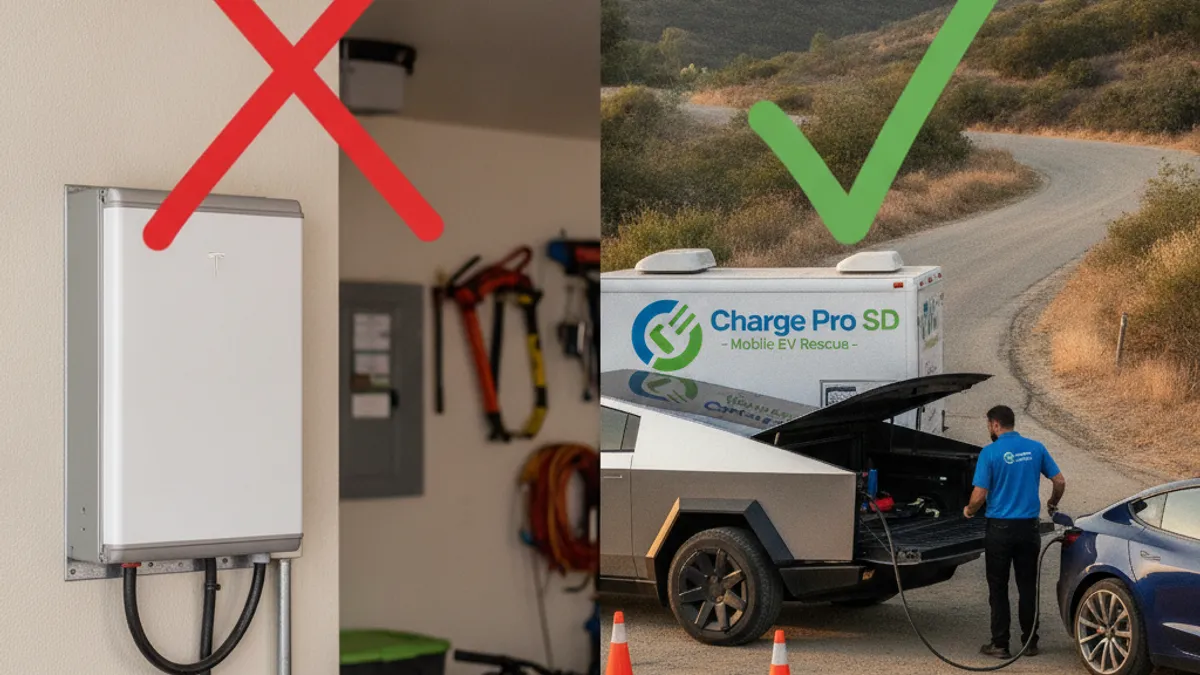
Home storage and a stranded EV are not the same call
A home battery feeds the panel, and a mobile charge feeds the car. Mixing them up wastes time when the 91 commute is already late.
Most of Corona was built after SR-91 opened the westbound commute. About 25 percent of homes here predate 1980, per ACS 2019-2023 figures. Dos Lagos, Eagle Glen, and Sierra Del Oro are newer tracts. That’s the stock people wire for solar and a wall battery. That’s why this search often means a Tesla Powerwall or an Enphase bank.
Charge Pro IE doesn’t install or service those home systems. It’s a referral line that matches stranded EV drivers with independent local operators. Those operators don’t pull permits on Grand Boulevard or own your panel.
What a Corona home battery is actually for
A home battery stores grid or solar power for the house during an outage. Southern California Edison serves Corona, not a municipal utility. Riverside Public Utilities stops at the city line next door.
A licensed electrician or solar contractor handles the install. Check that license at cslb.ca.gov before you sign anything. Charge Pro IE holds no trade license and doesn’t sell home storage.
Ask the contractor how many hours the bank covers in your house. Ask whether it runs everything or just essential circuits. Get the permit path from the contractor in writing. We couldn’t confirm a published backup-hour figure that fits every Corona floor plan.
A battery in Chase Ranch still only powers the house it’s tied to. It doesn’t roll into the Santa Ana River canyon. When the car has to move, home storage is the wrong department. The full comparison is in mobile EV charging vs a home battery.
A dark house on the 91 corridor doesn’t charge the car in traffic
SR-91 through Corona is one of the most congested stretches of freeway in California. The SR-91 and I-15 interchange is one of California’s most congested freeway junctions. Commuters crawl west through the canyon toward Orange County, then east again at night.
Range loss on that stretch is often dwell time, not miles. The air conditioning runs while the car sits still. A driver who budgeted for distance didn’t budget for a long stationary wait. Corona sits at the canyon mouth, so it’s a bit milder than Riverside. Summers are still severe on the south-side grades. The same gap funnels Santa Ana winds the other way.
A Green River wall battery can keep the fridge running in an outage. The EV already on the 91 doesn’t get that power.
Operators we connect you with bring a 240V Level 2 source to the car. They use a native NACS plug, plus CCS or J1772 adapters for other EVs. Typical charging time is 15 to 30 minutes for about 10 to 20 miles. That’s charging time, never an arrival time. The operator quotes you before starting and bills you directly.
For Corona stall patterns, start with EV roadside assistance in Corona. For the freeway itself, see out of charge on the 91.
Express lanes, grades, and a 12V that looks like a dead pack
The 91 Express Lanes and the 15 Express Lanes both run in the median. A car that dies inside them pulls left, not right. That’s the reverse of what most drivers were taught.
The 91 Express Lanes publish their own breakdown guidance and a free tow. We couldn’t confirm a matching published policy for the 15 Express Lanes. Don’t carry one facility’s rules over to the other. In the general-purpose lanes, the right shoulder still applies.
South Corona climbs toward Foothill Parkway and the Cleveland National Forest. Glen Ivy and Temescal Canyon Road run south toward Lake Elsinore. Those grades spend range even when the house charger at El Cerrito is fine. Green River Road on the west edge is another last stretch off the canyon. Downtown and the Circle on Grand Boulevard are flatter than the Skyline side.
A dark dash isn’t always an empty pack. EVs carry a small 12V battery that wakes the car. When that 12V dies, the main pack can still be full. That hits in a garage off Main Street as often as on Ontario Avenue. The Tesla 12V jump path handles that on site. Tesla and every major EV brand are in the mix.
An empty pack needs a mobile EV charging visit. That’s the Level 2 hookup at the bumper.
Which number to call
The house is dark and the car sits in the driveway on a dead panel. That’s a home-power problem. Call an electrician or your solar installer. A mobile operator can’t restore SCE to the block.
The car is already on SR-91, I-15, or SR-71. Home backup won’t reach it. Call for a mobile charge or a 12V jump, depending on what failed.
The panel is fine, but the car still won’t wake. Start with the 12V, then look at the pack.
Charge Pro IE covers Corona as a matchmaker, not a contractor. The operators in the network are licensed. The brand owns no trucks, employs no technicians, and sets no prices.
If you’re stuck now, call (909) 250-2881. An independent operator quotes the job before any cable goes in.
Frequently asked questions
Does Charge Pro IE install home battery backup in Corona?
No. The brand matches you with mobile EV rescue operators only. A home battery needs a licensed electrician or solar contractor.
Why does a battery backup search surface an EV rescue line?
Search engines tie the phrase to any local business that works with batteries. Charge Pro IE works with EV packs and 12V batteries. It doesn’t wire home storage. The two jobs share a keyword, not a crew.
The house is dark and the EV is already on the 91. What now?
Home backup can’t reach a car that’s already in the canyon commute. Call for a mobile Level 2 charge or a 12V jump. Tell the operator whether the dash is dark or the pack is empty.