A roadside jump on an EV almost always means the 12-volt battery. It doesn’t refill the traction pack that turns the wheels. Riverside County Transportation Commission’s Freeway Service Patrol publishes jump-starts. Those materials don’t describe a charge into an EV pack. They also don’t name electric vehicles on those pages. If your last reading was already zero, you need a different call.
RCTC publishes a jump, not a pack charge
RCTC runs Freeway Service Patrol on Riverside County freeways. Its published service list includes jump-starts. That wording matches a boost to a small 12-volt battery. It doesn’t match a 240-volt hookup into a drained EV.
Confirm the current list with RCTC before you count on a patrol truck. Public pages change, and the truck on scene follows that list. A published jump still isn’t a traction-pack fill. Don’t treat FSP as a mobile charger.
Calling it the Inland Empire isn’t a location pin. Riverside County’s ACS 2019-2023 population is 2,478,600. San Bernardino County’s ACS 2019-2023 population is 2,197,104. Name the county, the freeway, the direction, and the exit. A stall on I-10 through Colton is one dispatch. A stall on the 91 in Corona is another. So is a stall on SR-60 in Jurupa Valley. I-215 through Moreno Valley is a fourth. The Cajon climb toward Victorville is a fifth.
If you’re in a Fontana warehouse row, say the complex and the gate. If you’re in an Ontario airport lot, name the lot. A structure, a keypad, or a shoulder changes what equipment fits.
Two batteries sit in the same car
Every major EV still runs a low-voltage battery for computers, locks, and contactors. The big pack under the floor is what moves you. Jump cables talk to the small battery only. They don’t load the traction pack at all.
Tesla, Ford, Hyundai, Kia, Rivian, and Chevy all follow that split. Newer Teslas may use a lithium 12-volt. The rescue is still low-voltage work. It isn’t Supercharger power rolling up on a truck.
If the car showed range, then went mute, start with the 12-volt. If the gauge was already empty, you’re out of charge. Drivers say “dead” for both, so drop that word. Say what the display showed, not your guess. Our notes on a 12-volt that dies cover the dark-dash case.
Don’t copy clamp steps from a different model. Your current owner’s manual is the authority here. A curbside jump guide is background only. It doesn’t replace the book for your year.
Heat and grades wear both systems, in different ways
Inland Empire summers cook a parked EV in a lot. Long inland grades pull hard from the traction pack. The Cajon toward Victorville is one of those grades. The climb toward Yucaipa is another long pull. The mountain run toward Big Bear Lake is a third. The 12-volt still fails on its own path. A car that won’t wake after a hot Fontana shift may be the small battery. A car at 0% on I-10 in Redlands is the pack.
Don’t diagnose the failure from weather alone. Report the heat, the grade, and the last percent. Let the operator sort the two systems apart.
Home power doesn’t settle the battery question either. Riverside Public Utilities serves the City of Riverside. Colton owns the electric system inside its city limits. Fontana, Ontario, and San Bernardino sit on Southern California Edison. A dark home charger in any of those cities doesn’t tell you which battery failed. It only tells you the car didn’t wake.
What to put in the first call
Give make, model, and model year together. “Tesla” isn’t enough on its own. A Model 3 and a Cybertruck don’t share the same 12-volt layout. “Hyundai” alone isn’t enough either.
Read each warning word for word. If several alerts stacked up, read them all. A photo of the screen helps when the operator can take one. If the screen is black, say it’s black.
Then describe the controls as you find them. Say whether the car sees the fob. Say whether the lights answer you. Say whether it will enter Drive. Report those as observations, not as a diagnosis.
Last displayed charge is the fork in the road. A reading like 40% with a silent dash points at the 12-volt. Zero percent with an empty-pack message points at the traction battery. Tesla owners can use this pack versus 12-volt split first.
For a likely Tesla 12-volt, review Tesla 12V jump help. For a CCS or J1772 car, start at non-Tesla EV rescue. The independent operator still confirms the exact vehicle.
When a jump is the wrong request
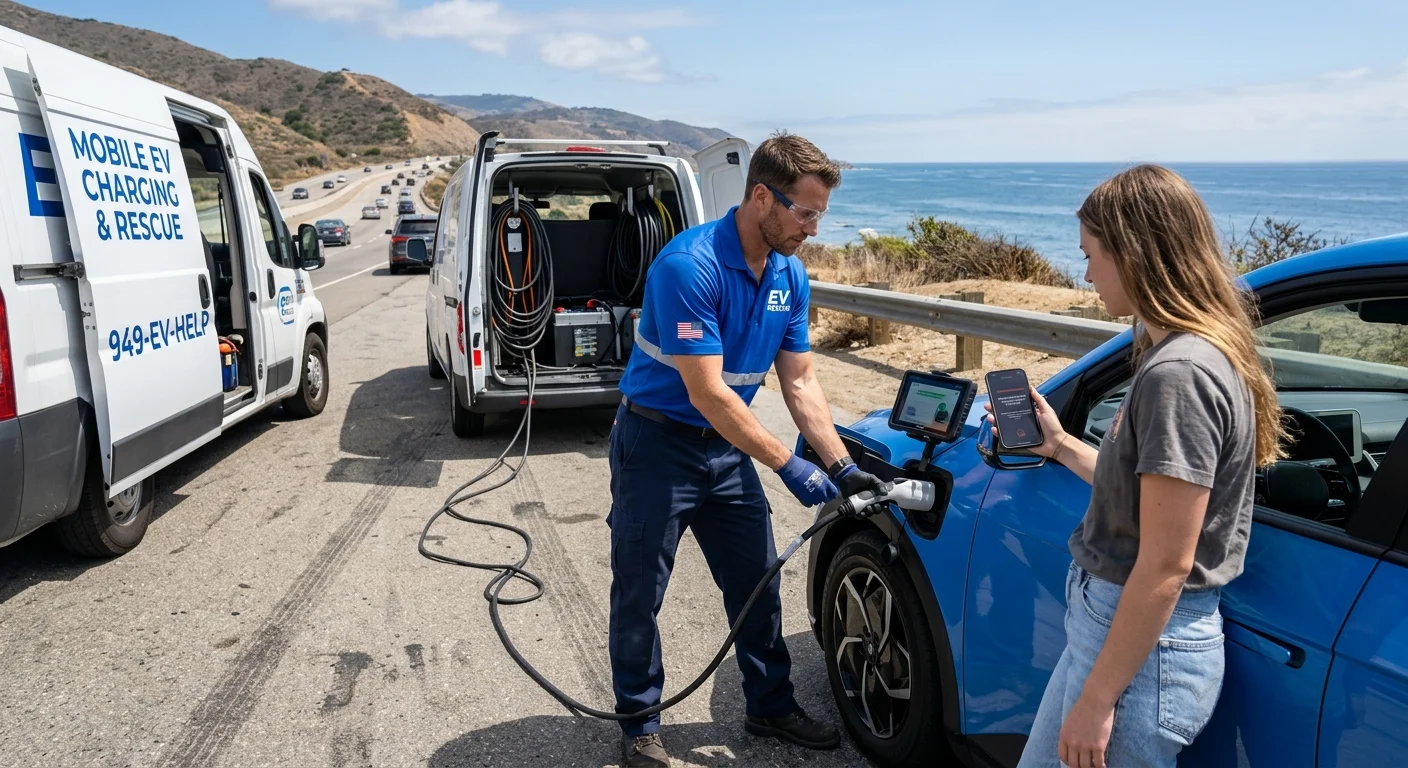
An empty traction pack won’t move because you clamped the 12-volt. Ask for a charge, not a jump. The operators we refer can bring a 240-volt Level 2 source. Teslas take a native NACS plug. Other brands use a CCS or J1772 adapter. That hookup typically adds 10 to 20 miles of range. The charging window is 15 to 30 minutes. That clock is charging time. It isn’t a promise of when someone arrives.
The operator may jump the 12-volt or replace it on site. That’s still not a pack fill. If it dies again after a jump, the small battery may be spent. That’s a replacement talk with the operator, not a pack charge. If the truck can’t reach the car, the operator may discuss a tow. Charge Pro IE doesn’t pick the method. The operator does, after they hear the vehicle and the site.
Skip a jump when you see smoke, smell burning, or feel unusual heat. Skip it after a collision too. Report those facts in plain words. Don’t dress them up as a battery diagnosis.
Tight access can stop a jump request. A low downtown Riverside garage constrains a truck. So does a gated Eastvale driveway. A warehouse dock in Fontana does too. Say the clearance, the gate path, and whether you can roll a few feet.
Charge Pro IE refers. You hire the operator.
Charge Pro IE is a referral line for the Inland Empire. We match stranded EV drivers with independent local mobile rescue operators. We don’t jump batteries. We don’t charge packs. We don’t tow. We own no trucks and no yards. We employ no technicians. We hold no license. We set no prices. We publish no arrival window.
You tell us the car, the warnings, the last percent, and the exact place. We pass that to an operator who can review whether the job fits. They quote you before they start. They bill you directly.
Ask them to name the job in one sentence. Call it a 12-volt jump, a pack charge, a replacement, or a tow. If that sentence is fuzzy, pause. The pros we connect you with are licensed. They still owe you a clear description before they start.
If you’re already sure the pack is empty, use mobile EV charging. If you’re not sure which battery failed, use EV roadside assistance.
Keep the owner’s manual reachable if you can. The operator may need the 12-volt location for your year. The U.S. Department of Energy publishes general EV owner material. It still doesn’t override the manual in your car.
Call when the EV won’t start. You need a local operator to sort jump, charge, or tow. Have the model, warnings, last charge reading, and exact pin ready. Call (909) 250-2881. We’ll connect you with a local EV rescue operator.