Shift change in Fontana. The Model Y sits between trailers off the 10. You tap the pillar and nothing moves. The screen stays black. That Tesla Model Y that will not start is often the small 12V battery, not an empty drive pack.
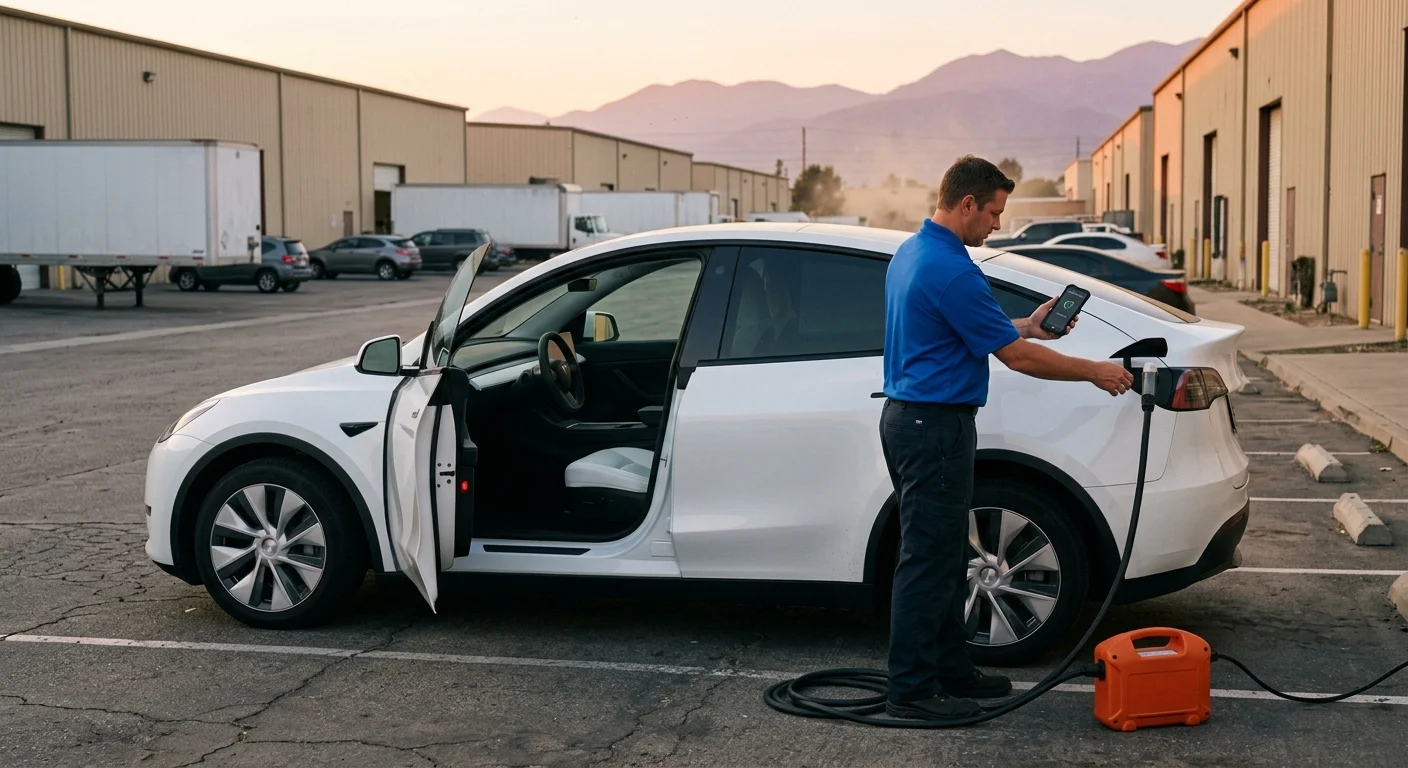
The Model Y that looks fully dead is often the 12V
Every Tesla still has a separate low-voltage battery. It wakes the computers, latches, and contactors that let the big pack work. If that small battery is flat, the car can look like a brick even with miles left in the pack. We covered why that battery exists in Do Teslas have a 12V battery. This page is the Model Y version of that no-start.
The Inland Empire is Tesla country. California Energy Commission figures through 2025 put Tesla at 61.7% of battery-electric cars in Riverside County and 66.4% in San Bernardino County. That is roughly two of every three BEVs. The Model Y is the crossover on warehouse miles through Fontana and Ontario, and on the 10 and 15 at commute time. BLS counted 121,800 warehousing and storage jobs in this metro as of March 2025. A lot of those Ys sit in hot lots all day, then fail to wake at punch-out.
A dark dash does not prove the pack is empty. Open the Tesla app if the phone still talks to the car. Miles on the display mean energy is still in the pack. No app, no lights, no handles: treat it as a 12V no-start until a licensed operator says otherwise.
Heat here is not a coastal story. Riverside Municipal Airport averages 21.7 days at or above 100 F. Victorville averages 42.2. Recurrent’s fleet research puts range loss around 17-18% at 100 F. That number is pack range, not a 12V spec. The small battery still sits in a hot frunk with no shade. Santa Ana winds through the Fontana-Chino area add dry, dusty days. None of that is a diagnosis by itself. It is why a Y that sat through a swing shift can wake up blank.
If the car has power and still will not roll, that is a different symptom. Lights and a live screen with no Drive usually mean the computers woke. A dead 12V usually takes the whole show down. Run the general Tesla order first if you want the full flow: our seven-step Tesla won’t-start checklist. Then come back here for the Y hood, the warehouse lot, and the pack-versus-12V call.
Where the 12V lives on Highland and Juniper cars
Tesla’s Model Y refresh is the Juniper. Highland is Tesla’s name for the refreshed Model 3. Pre-refresh Model Y cars sit in the same low-voltage era as those Highland-era Teslas. Juniper cars are a later book. Do not mix the two, and do not use a Model 3 photo as a Model Y map.
Tesla has used both a lead-acid 12V and a lithium low-voltage battery on the Model Y. We are not printing a changeover year or a part number. Confirm chemistry, battery location, and jump posts in that year’s owner’s manual and in the Tesla app. The year on the car plus Tesla’s PDF for that year is the source. A forum post from a different build is not.
On both generations, the work starts at the frunk, not the rear bumper. If the 12V is dead, the powered hood latch may not pop. Tesla’s book for your year shows the mechanical hood release, including any hook or cable Tesla placed for a no-power open. Follow that page. A clip filmed on a different year can put your hand on the wrong hook.
Jump posts, when Tesla provides them, are labeled under the hood. They give an operator a marked low-voltage connection so the computers can wake. They are not a license to clamp onto the battery case. A lithium low-voltage pack is not jumped the way a Civic is jumped. A lead-acid 12V still wants the posts Tesla marked, not a guess at a nearby bolt.
Service mode is a screen, not a wrench. If the display is already up, Tesla’s Controls menu on some software builds includes service views. Confirm the path in the car. Do not change high-voltage isolation settings from a forum list. If the screen is black, skip Service mode. You cannot tap what you cannot see. That is when a Tesla 12V battery jump from a licensed local operator is the next real step, after the posts in the book are confirmed.
Checks you can run in a Fontana or Ontario lot
Stay out of travel lanes. California Vehicle Code 21718 bans stopping on a controlled-access freeway except in listed cases, including a disabled vehicle that has already summoned help. If you are on the 10 or 15, get to the shoulder if you can. Call 911 if you are still in a lane. CVC 25251 requires four-way flashers on a disabled vehicle that has them. CVC 22651(f) lets officers remove a vehicle left more than four hours on a freeway if it cannot move under its own power.
RCTC Freeway Service Patrol covers SR-91, I-15 from SR-60 south to SR-79 / Temecula Parkway, SR-60 from Milliken Avenue to Theodore Street, and I-215 through Riverside County. SBCTA patrols more than 95 freeway miles along I-10, I-15, I-215, SR-60, and SR-210. Both programs list battery jump-starts. As of September 2026 those agency pages do not mention electric vehicles. Do not assume an FSP truck will treat a Model Y like a gas sedan. Look up CHP, RCTC, or SBCTA for how to request a patrol. We do not print their phone lines here.
If you are already in a warehouse lot, you are the easy case. Fontana’s Tesla Supercharger on Summit Avenue has 24 stalls. Ontario has sites on East C Street (8 stalls) and South Vineyard Avenue (24 stalls). Those help only if the car can wake and roll. A black dash in a lot off Sierra, Cherry, or Milliken is a 12V scene until proven otherwise. Ontario International Airport is in the same city, with free EV charging on the south side of Lots 2 and 4 (parking fees still apply). An airport stall with a dark Y is the same 12V question as a warehouse stall.
Walk this list. Confirm each step in the Tesla app and that year’s manual.
Phone key first. Open the Tesla app and try Unlock. A dead phone can fake a no-key car. A key card still in a bag will not wake a car whose 12V is already gone.
Charge cable next. If you just unplugged, look at the charge port. A stuck latch can keep Drive off even when the pack has energy. The app has a cable-release control on many builds. Confirm it in the car’s book before you yank the handle.
Force restart only if the screen or wheels still have life. Tesla documents a Model Y reboot in that year’s manual. The hold, the buttons, and the difference between a screen reset and a full power cycle live in Tesla’s pages, not here. If the dash is fully black, a reboot you cannot see will not save you.
Then look for leftovers. Hazard switch, a door-handle press, a faint click in the frunk. Any of those means some low voltage is left. App range with a dead dash still points at 12V, not an empty pack.
For the longer diagnostic path, use Tesla 12V dead: diagnose and jump steps. Keep this page for the Y in this lot.
When a jump is safe, and when to stop
A jump on a Model Y is a low-voltage wake, not a gas-car bump start. The operator connects to Tesla’s marked posts, not to random metal in the frunk. Polarity, clamp time, and whether your year is lead-acid or lithium all come from Tesla’s book. If that page is not in your glovebox PDF, stop and wait for a licensed operator.
Stop and do not clamp if you smell a battery, see a swollen case, hear popping, or see corrosion across a terminal. Stop if a warning on a half-alive screen names the high-voltage battery, isolation, or a thermal event. Those are pack or isolation problems. A 12V jump will not fix them.
Do not jump a Model Y from another Tesla’s 12V unless Tesla’s manual for both cars says that pairing is allowed. Two white Ys in a Fontana lot is not a procedure.
A licensed operator who does this work should confirm the year, the chemistry, and the post layout before they connect. Charge Pro IE does not jump the car. We connect you with that operator. You pay them. They set the price and the clock. Ask for a Tesla 12V battery jump if the dash is dark and the app still shows pack miles.
If the car wakes and then dies again, that is a failing 12V, not a one-time drain. Do not keep jumping it through a shift. Drive to service while it is awake, or have the operator stay until the car can hold a boot. Repeated no-starts after a wake are a replacement conversation with a shop, not a roadside hobby.
What a local operator can do that Tesla mobile may not
Request Tesla Roadside in the Tesla app first. That is Tesla’s path. What they send, and whether they cover the visit, is Tesla’s policy for your account. We do not speak for Tesla, and we do not quote their fees.
Tesla mobile is a Tesla channel. Independent operators are a different channel. The licensed local pro we match can bring a 12V jump to a warehouse stall Tesla may treat as a tow. They can also bring a Level 2 rescue charge if the pack is the problem. The approved rescue charge on this site is 10 to 20 miles of range in 15 to 30 minutes of Level 2 charging. That is charging time on the cord, not a promise of when someone arrives.
The U.S. Department of Energy’s Alternative Fuels Data Center describes public Level 2 as about 25 miles of range per hour. A short rescue charge is a smaller slice of that, enough to roll to a Supercharger instead of sitting in the lot.
A local operator can work a stall Tesla’s map does not treat as a pin: a Fontana yard off Cherry, an Ontario warehouse south of ONT, a dark stall at Inland Center. Tesla Roadside may still be the right first call. A Tesla roadside rescue match is the backup when the app is spinning or the car is not on Tesla’s preferred path.
Charge Pro IE is a referral service. We hold no trade license, own no truck, and send no crew. The operator quotes you, bills you, and does the work. The pros we connect you with are licensed. Confirm insurance, timing, and fit with that operator before they start.
When this is a pack problem, not a 12V problem
The pack is the suspect when the app shows 0%, when the car woke, rolled, and then coasted to a stop, or when you already jumped the 12V and Drive still refuses with a traction-battery message. A low-voltage warning and a low-pack warning are not the same sentence. Read the exact text in the car or the app.
If the Y woke and has a few miles, a Supercharger is the clean fix. Fontana Summit, Ontario Vineyard, and the Riverside 9th Street site (24 stalls) sit on the valley floor. The San Bernardino Mountains are a different map: 14 Tesla stalls total, split between Big Bear Lake (6) and Lake Arrowhead (8), with none on the climb. Do not aim a dying Y at SR-18 or SR-330 hoping for a stall on the grade.
If the car cannot roll, a mobile Level 2 charge is the pack-side rescue. That is not a 12V jump. Mixing the two wastes a visit.
Software can fake a no-start with a live pack and a live 12V. A recent update, a frozen Starting tile, or a car that has power but will not shift is a reboot-and-app problem first. Confirm the force-restart steps in the manual. If it still sits after a documented reboot, treat it as a service job, not another clamp.
County ZEV counts live at the California Energy Commission. DOE’s electric vehicle overview is a plain primer on how the high-voltage pack and the 12V system share one car.
When to call us
If the Model Y is dark in a lot, or awake with no Drive after you have run the book, you need a licensed local operator, not another forum thread. Call us at (909) 250-2881 and we’ll connect you with a local EV rescue operator.