When an EV’s 12-volt battery dies, the car looks completely dead. Screens stay black and handles may not present. The drive pack can still hold a charge. Inland Empire owners meet that split in a Fontana warehouse row. They meet it in a Riverside driveway too. It also shows up on the shoulder after the Cajon climb. There’s a second path most drivers miss. Once usable range is gone, treat the 12-volt system as unsupported. It then needs power from outside the car. Check the owner’s manual or in-car documentation for your model.
Two failures that look like one dead car
Every Tesla runs two batteries, and so do other EVs. The high-voltage pack moves the wheels down the road. The small 12-volt battery wakes the computers, the locks, and the lights. It also closes the contactors that connect the pack. If that small battery is flat, the pack stays locked away. You press the brake and wait for the ready chime, then nothing happens.
Empty miles add a check that matters at the car. When the high-voltage pack is depleted, treat the 12-volt battery as unsupported. That 12-volt then runs down on its own. After that, you need an external 12-volt source. Confirm the sequence in the owner’s manual or in-car documentation for your model. The car won’t wake without that outside power. A zero-range stall toward Victorville on I-15 can go fully dark. It isn’t only a zero on the display.
You get two roads to the same brick. One is a worn 12-volt with miles still showing. The other is an empty pack Tesla no longer keeps the 12-volt alive on. From the driver’s seat those two look identical. Both need 12-volt power restored before anything else. A charger or a Supercharger comes after that. If you’re unsure which hardware you have, start with Do Teslas have a 12V battery?.
What the 12-volt actually does
New owners often think the large pack runs every circuit, but it doesn’t. Headlights, wipers, and the screen all run on 12 volts. Airbags, steering assist, and the main computer sip that same feed. The contactors that close the high-voltage circuit need it as well. No 12-volt means no start, even with a full pack.
Treat the 12-volt as the key that unlocks the pack. The pack can be healthy and still sit unused. Without that key, it can’t power the motors or complete a charge handshake. That’s why a dead EV is so often this small battery, not a pack replacement.
Warehouse and airport shifts around Ontario leave cars parked for hours. In the city of San Bernardino, ACS 2019-2023 puts pre-1980 housing at 60.9%. A car that sits can flatten the 12-volt even with a fine pack.
Where Inland Empire miles take a weak 12-volt
Riverside County’s ACS 2019-2023 population is 2,478,600. San Bernardino County’s population is 2,197,104. The 12-volt doesn’t care about the county line. It cares about sit time, heat, and whether the pack was already empty.
A Model Y that climbed toward Lake Arrowhead can still have pack left coming down. If you burned the last bars on the climb, Tesla’s cutoff is already in play. The car may go dark in the lot instead of on the grade. Big Bear Lake and Big Bear City sit on Bear Valley Electric Service, not Southern California Edison. That utility split doesn’t jump a dead 12-volt.
Down in the valley, Fontana and Ontario sit on Southern California Edison. The City of Riverside uses Riverside Public Utilities, which has served that city since 1895. Colton owns its electric system inside city limits. None of those utilities will wake a dark EV. If the dash is black, you’re past a rate plan. You need 12-volt power at the car.
I-10 through Colton and SR-60 in Jurupa Valley see the empty-pack version. The car used the last miles in traffic, then sat. Tesla had already stopped supporting the 12-volt. By the time you try the handle, the cabin is a brick. The same sequence shows up after the Cajon climb into Hesperia and Victorville. Restore 12-volt power first, then worry about energy in the pack.
Glitches that show up before a black screen
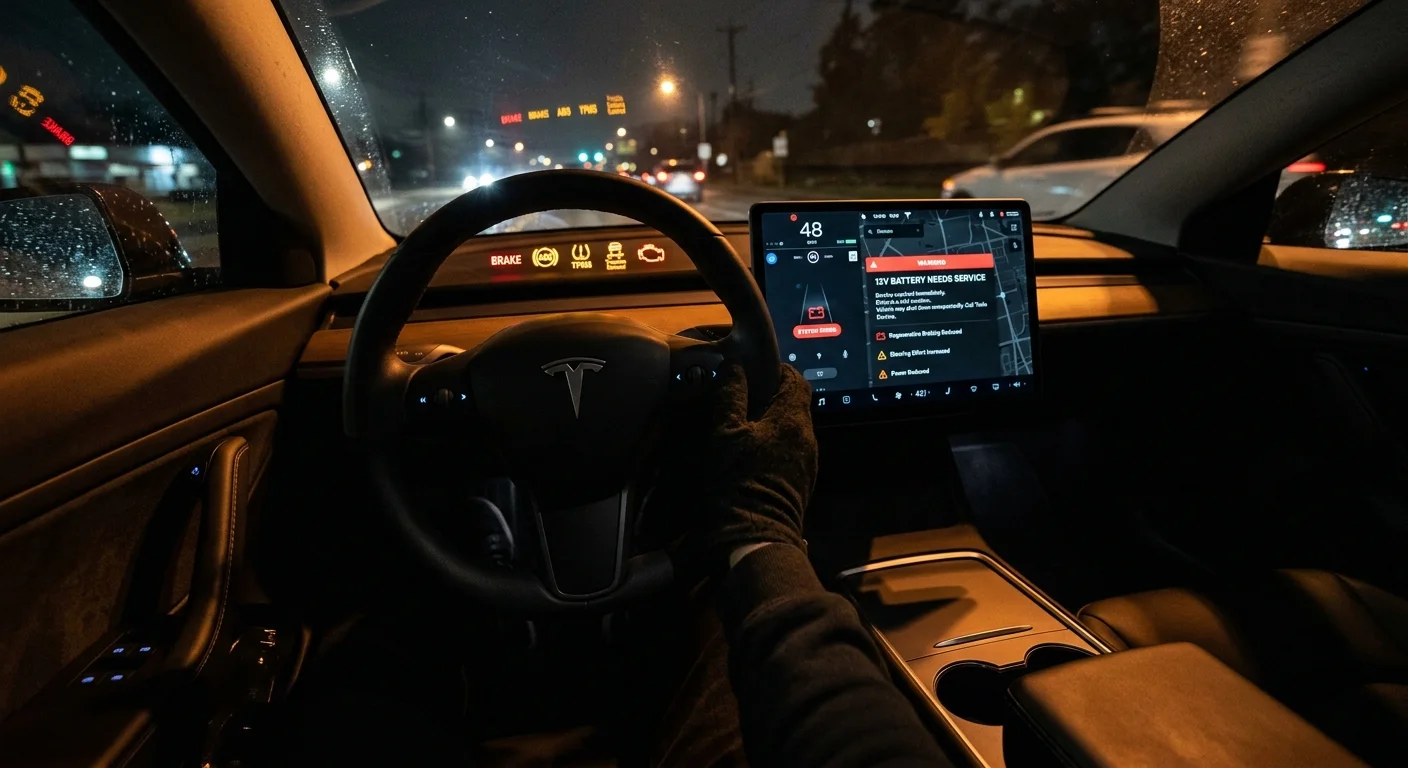
A dying 12-volt rarely starts with silence. The screen may flicker and climate control may cut in and out. Alerts stack up: reduced steering assist, limited regen, or a generic service warning. Those alerts often don’t name the 12-volt and only mean sagging voltage.
Then the car won’t ready when you press the brake. There’s no chime, and the screen is blank or stuck on a dim logo. Door handles may not present and the phone key may do nothing. Tesla owners often see that the vehicle can’t be driven. A 12-volt warning may sit next to that. A BMW i4 may flash a replace battery message. That message points at this same small battery, not the drive pack.
If the pack was already at zero, Tesla’s cutoff can skip the warning stage. You used the last miles and the car sat. The 12-volt then went unsupported on its own. The next try at the door feels like a brick.
Non-Tesla EVs fail in the same pattern. CCS and J1772 cars still need 12 volts to undock a charge port. They need it to talk to a station too. A dead-looking Ioniq 5 or Mach-E with a charged pack is often this battery. The operators we connect you with handle Tesla and every major EV brand.
Locked out with a pack that still has miles
Many EVs open with electronics, not a metal key you use daily. Tesla handles need 12-volt power to present. The app needs the car awake enough to hear it. A flat 12-volt can leave you outside a Model Y in an Ontario airport lot. You’re holding a phone that can’t reach the car.
Some models hide a mechanical key, but getting in still may not wake the car. Power releases for the front trunk can stay dead. That’s a problem, because Tesla’s 12-volt jump posts sit up front. If the hood won’t open, you can’t reach them. Tesla documents a manual front-trunk method for no-power cases. Use your model’s owner manual and don’t pry panels on a guess.
The drive pack is usually still fine
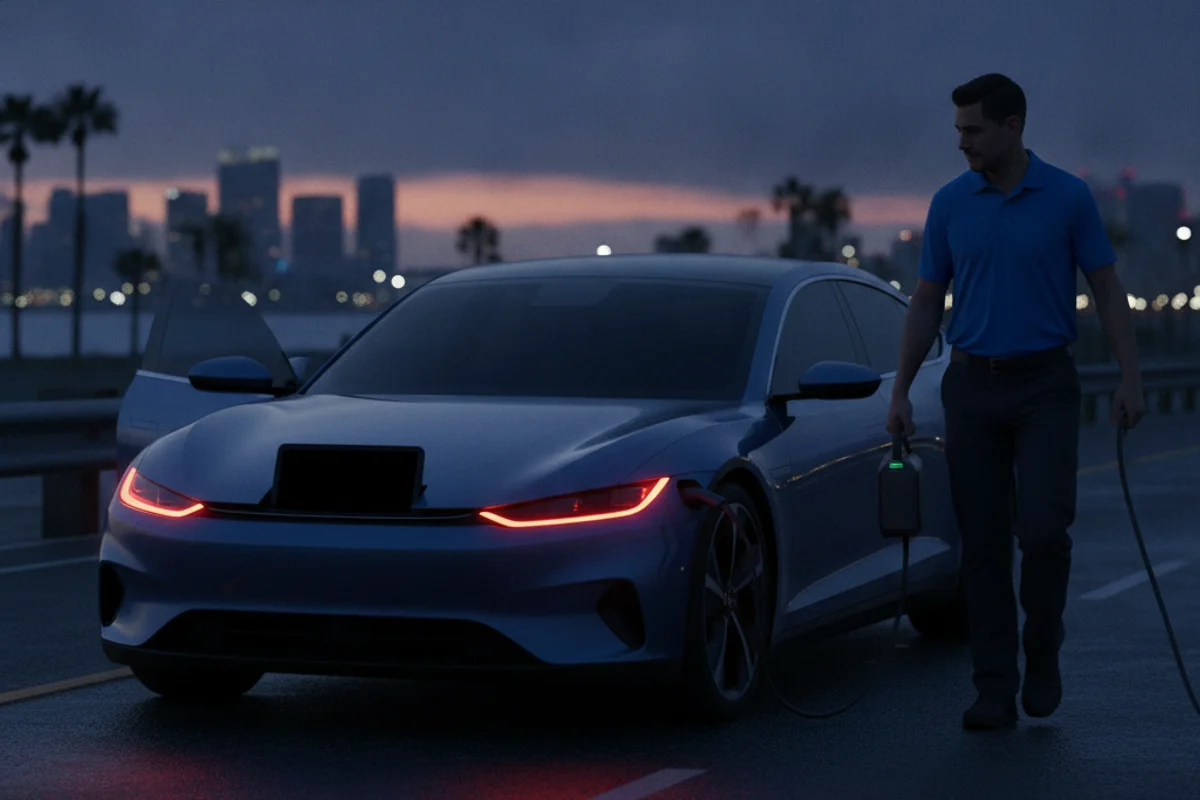
A dead 12-volt doesn’t mean the expensive pack failed. The pack and the 12-volt are separate systems with different jobs. The pack stores propulsion energy at hundreds of volts. The 12-volt runs accessories and closes the contactors. When the 12-volt is out, the pack sits unused. Its own management system is still there once low-voltage power returns.
If the display still showed range, start with the 12-volt. If you were already at zero miles, Tesla’s published rule still applies. Restore 12-volt power, then put energy in the pack. Dead Tesla: pack or 12V covers the checks that keep those two mixed up.
The pack may have spent a little energy trying to keep the 12-volt alive. That’s usually small, and it isn’t pack damage. Once the car wakes, the DC-DC converter charges the 12-volt from the pack. That only works if the pack still has energy. If the pack is empty, waking the 12-volt is only step one. You still need a charge before you roll.
How 12-volt power gets restored
The job is to feed the 12-volt circuit until the computers can boot. Tesla and other makers mark jump points in the frunk or under the hood. A portable 12-volt jump pack is the usual tool. Give the car a short rest on that feed before you try to ready it.
If the 12-volt is only tired, the DC-DC converter may recharge it from the pack. If the 12-volt is worn out, that wake-up won’t hold. You’ll need a replacement instead of another jump. Tesla 12V battery failure: when it hits is the pattern owners here actually see. For hookup order, use how to jump start an EV at the curb or your owner’s manual. Newer Model 3 and Y cars use a lithium 12-volt. That unit doesn’t always behave like the older lead-acid battery. Don’t copy a gas-car video and hope.
The operators we connect you with can jump or replace a dead 12-volt on site. If the pack is empty after wake-up, they can bring a 240-volt Level 2 source. Teslas take a native NACS plug on the charge side. Other EVs use a CCS or J1772 adapter. That typically adds 10 to 20 miles of range in 15 to 30 minutes of charging. That window is charge time on the car. It isn’t a promise of when someone arrives. The operator quotes you before starting and bills you directly.
Why a running gas car is a bad donor
Jumping an EV from a gasoline car is a poor match. A running alternator can spike voltage when cables go on or come off. EV modules expect a steady 12-volt feed. A spike can damage more than the small battery. A dedicated jump pack keeps that feed controlled. So does a tech who works on EVs.
When you want an operator, not another guess
Once the screens are up, look at range. If miles remain, get the 12-volt tested and plan a replacement if it’s old. If miles are at zero, you still can’t charge until the car is awake. The charge port has to open before a plug will work. That’s Tesla’s sequence: external 12-volt first, then energy into the pack. A jump that dies again within hours is a worn battery, so replace it.
Your local electric utility won’t jump a dark EV. SCE, Riverside Public Utilities, and Colton Electric set home rates. They don’t carry 12-volt packs to the curb.
If the hood won’t open or a jump didn’t hold, stop forcing panels. Charge Pro IE is a referral line for the Inland Empire. We don’t own trucks and we don’t do the work. We connect you with an independent local operator. Call (909) 250-2881 and we’ll match you with someone who quotes before they start. For a Tesla that needs that 12-volt wake-up, start with Tesla 12V battery jump.
Frequently asked questions
What happens when an electric car battery dies?
The car looks completely dead. Screens stay dark, door handles may not present, and the ready chime never comes when you press the brake. That is often the small 12-volt battery, even when the drive pack still holds a charge. On a Tesla, an empty pack can look the same. Treat the 12-volt as unsupported and plan on needing power from outside.
Does a dead-looking electric car mean the drive pack failed?
No. The expensive drive pack is a separate system from the 12-volt battery. The pack stores propulsion energy, while the 12-volt runs accessories and closes the contactors. When the 12-volt is out, the pack sits unused until low-voltage power returns.
Can an electric car still have range if it looks completely dead?
Yes. The drive pack can still hold a charge while screens stay dark. A worn 12-volt with miles still showing looks the same from behind the wheel as an empty pack after Tesla has stopped supporting the 12-volt. Restore 12-volt power first, then look at range.
What should I do first when the EV will not wake?
Restore 12-volt power before you try to charge. The computers have to boot and the charge port has to open, and both need that 12-volt feed. If the 12-volt is only tired, the wake-up may hold. If it is worn out, the jump won’t last and you need a replacement.
Why does a Tesla go fully dark when the pack is empty?
Once usable range is gone, treat the 12-volt battery as unsupported. That 12-volt then loses charge by itself, and the car won’t wake without power from outside. Getting the 12-volt up is only the first step. The pack still needs a charge before the car can move.