Your EV is dark in a Perris parking lot, but the main battery may not be empty. A failed low-voltage system needs different help from a depleted traction pack.
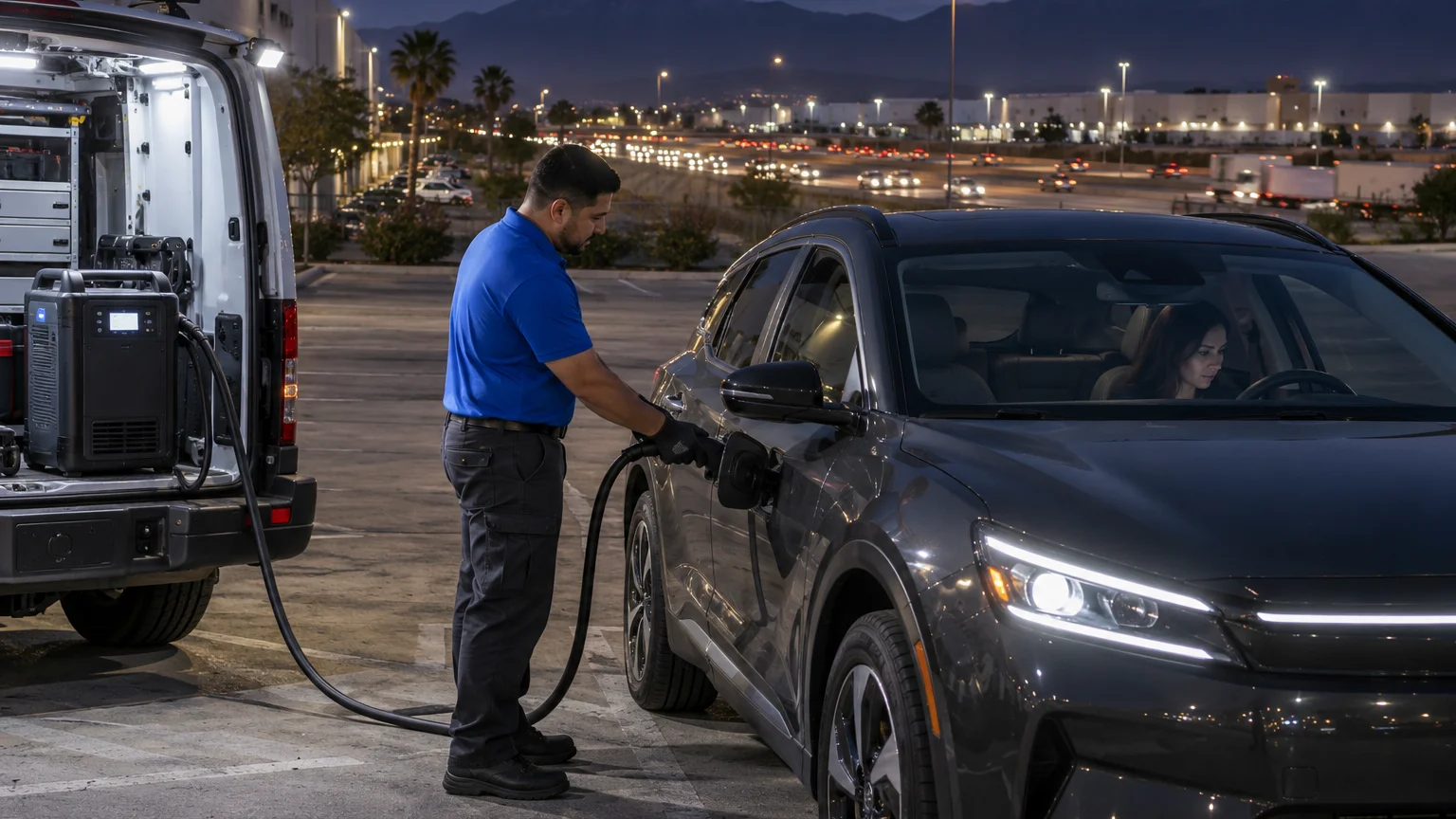
A dead 12V and an empty pack need different help
An EV has a low-voltage electrical system and a high-voltage traction pack. They serve different jobs. That difference determines whether you need a jump, mobile charging, or a tow.
The low-voltage system supports the car’s electronics, locks, displays, and startup process. A jump pack addresses that system. It doesn’t add driving range to the traction battery.
Mobile EV charging serves a different purpose. It adds energy to a depleted traction pack. The approved rescue figure for Level 2 charging is 10 to 20 miles of range during 15 to 30 minutes of charging. That describes charging time, not operator arrival.
Start with what happened before the vehicle stopped. A car that showed falling range before losing propulsion points toward a depleted traction pack. A parked EV that suddenly won’t unlock or show a dashboard may have a low-voltage problem. Neither symptom proves the diagnosis by itself.
Don’t connect a jump pack based only on a dark screen. Connection points, battery types, and access procedures vary between models and production years. Check the owner’s manual for your exact vehicle.
Our non-Tesla EV rescue service connects Perris drivers with licensed, independent operators. Charge Pro IE doesn’t jump batteries, charge vehicles, or provide towing. The matched operator evaluates the symptoms and performs the physical work.
What a dark dashboard tells you
A black dashboard is useful information, but it isn’t a complete diagnosis. Look at the whole pattern before requesting help.
Check whether the doors respond to the key or app. Note whether interior lights appear. Watch for warning messages, clicking, partial screen activity, or a charge-port response. Write down the last range shown before the car went dark.
A vehicle that still displays a very low range reading may need traction-pack charging. A completely unresponsive vehicle can point toward the low-voltage system. It can also involve another electrical fault that roadside charging won’t fix.
If the EV is plugged in but remains dark, don’t assume the charging station is working. A connected cable doesn’t prove that energy is reaching the vehicle.
The owner’s manual remains the authority for your model. Use its roadside, low-voltage, and towing sections. Don’t follow connection instructions written for another vehicle. Even two models from the same manufacturer may use different access points.
Our guide to whether roadside help can jump-start an EV explains the basic service distinction. When calling an operator, describe the dashboard, locks, last displayed range, warning messages, and parking position. Those details help the operator decide what equipment may fit the situation.
Checks to make before connecting a jump pack
First, confirm that you’re following the manual for the exact model and year. Don’t rely on a generic diagram from an unrelated EV. A visible terminal, cable, or connector may not be an approved jump point.
Inspect the area without removing covers that the manual doesn’t direct you to open. Follow the manual’s instructions for deciding whether to proceed.
Keep the traction pack separate from the low-voltage procedure. Use only the low-voltage jump points identified in the owner’s manual.
Before an operator connects equipment, share what happened. Mention whether the EV lost range while moving, went dark after parking, or failed during a charging session. Also report previous low-voltage warnings and any recent repair work.
A successful low-voltage wake-up doesn’t prove the car is ready to drive. The vehicle may show warnings or remain unable to shift. Follow the dashboard and owner’s manual. If the problem returns, the car may need repair or transport rather than another jump.
If you aren’t sure which service fits, request emergency EV roadside assistance. Charge Pro IE will connect you with a licensed local operator. The operator can discuss the vehicle, location, and requested work before you accept service.
Why I-215 and warehouse lots change the safety plan
Location matters as much as the battery symptom. A disabled EV in a Perris warehouse lot presents a different problem from one stopped beside I-215.
In a private lot, tell the operator which driveway provides access. Share the business name or a visible building marker. If security controls the gate, confirm how the operator can enter. Don’t claim a loading zone or restricted space is available without the property’s approval.
On I-215, traffic exposure comes first. Riverside County’s Freeway Service Patrol lists I-215 throughout the county as a covered corridor. Its published services include battery jump-starts. The agency pages don’t mention electric vehicles, so EV-specific help isn’t confirmed. Drivers can dial 5-1-1 from a mobile phone or use a freeway call box.
Published patrol hours conflict between Riverside County agency pages and can vary by beat. Confirm current availability rather than assuming a patrol is operating.
California law requires flashing hazard lights when an equipped vehicle is disabled on the roadway. If the EV remains in a traffic lane, call 911.
A safe shoulder position still needs accurate location details. Give the highway, direction of travel, nearest exit, and whether you’re before or after it. Our Perris overview covers more EV roadside assistance in Perris. Drivers heading north can also review guidance for being out of charge on I-215 near Moreno Valley.
When a mobile charge will not wake the vehicle
Mobile charging can add traction-pack energy, but it won’t solve every no-start condition. It won’t replace a failed low-voltage battery, repair collision damage, or correct an unrelated electrical fault.
The clearest mobile-charging case is a vehicle that depleted its driving range and can still accept a charge. The operator must still confirm that the vehicle and available equipment are compatible.
A dark EV may not begin charging if its low-voltage system can’t support the startup process. In that situation, connecting a charging cable alone may not wake the vehicle. The operator may need to assess the low-voltage system first.
Charging also isn’t the right answer when the car reports a fault, won’t release the parking mechanism, or can’t accept power. Check the manual for the correct release and recovery procedure.
If the vehicle wakes after low-voltage support but shows no usable traction-pack energy, it may need both services. The jump and charge remain separate tasks. Ask the operator to explain the proposed work before it begins.
When roadside work can’t make the EV movable, towing may be the next step. The required towing method depends on the vehicle. Follow the manufacturer’s instructions rather than allowing an improvised pull. The U.S. Department of Energy offers broader background on electric vehicle systems, but your own manual controls the vehicle-specific procedure.
How to match the right Perris operator
Give the referral service enough detail to distinguish a low-voltage problem from an empty traction pack. Start with the vehicle’s make, model, model year, and exact location.
Then describe the symptoms in plain words:
- The dashboard is completely dark.
- The doors do or don’t respond.
- The car showed a remaining-range figure before stopping.
- A low-voltage or charging warning appeared.
- The charge port opens or remains unresponsive.
- The vehicle is in a lot, on a shoulder, or in a traffic lane.
Mention whether the vehicle has collision damage or visible electrical damage. Also state whether a charging cable is attached. Tell the operator if equipment is stuck.
For a Perris lot, provide the correct entrance and any gate instructions. For I-215, give the direction and nearest exit. Perris covers 31.563 square miles, so a precise pin is more useful than the city name alone. The city overlaps several ZIP Code areas, including 92570, 92571, 92585, 92586, and 92587.
Ask the operator what service is being proposed. Confirm whether it’s a low-voltage jump, mobile traction-pack charging, or towing. Charge Pro IE doesn’t set the operator’s price, so request the operator’s quote before authorizing work.
The goal isn’t to request every possible service. It’s to match the symptom, vehicle, and location with the right equipment. Clear details reduce the chance of an operator arriving prepared for charging when the EV actually needs low-voltage support.
When to call us
Call when your Perris EV is dark, out of range, or needs an operator to distinguish a 12V problem from a depleted traction pack. Call us at (909) 250-2881 and we’ll connect you with a local EV rescue operator.