An EV losing power on SR-18 creates two separate problems. You need a safe stopping place, then you must decide between a mobile charge and a tow.
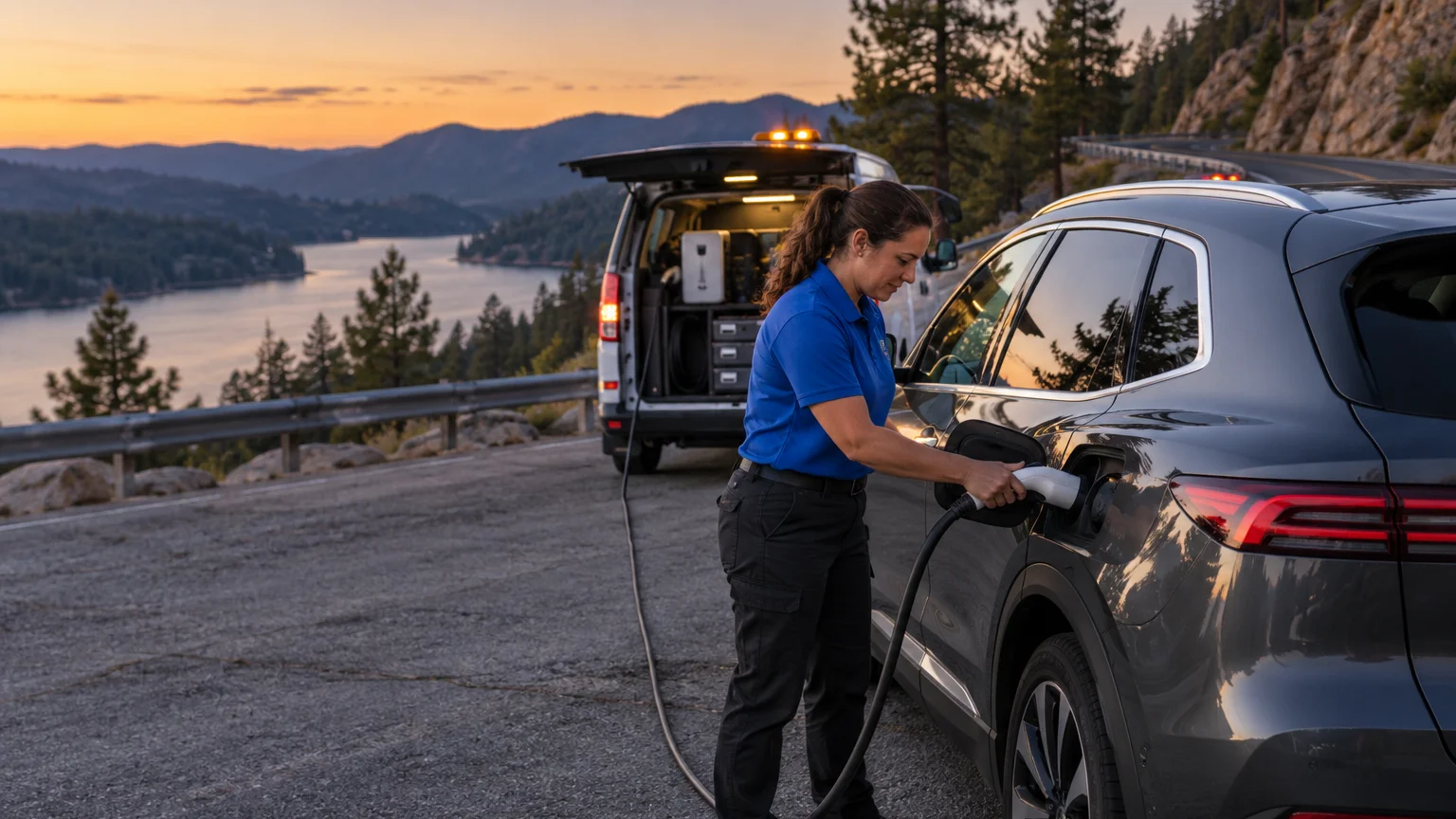
SR-18 creates a mountain recovery decision
Mobile EV charging on SR-18 near Lake Arrowhead isn’t the same as charging in a flat parking lot. Your location, remaining power, direction of travel, and stopping position all affect the recovery choice.
Caltrans tracks 26 chain-control segments on SR-18. Those segments run from Lower Waterman Canyon to Johnson Summit. Their published elevations span 1,768 to 6,837 feet. Lake Arrowhead’s Census-designated place has a centroid elevation of 5,196 feet.
Those figures explain why “almost there” isn’t enough information. A driver approaching Lake Arrowhead may still face climbing before reaching a charger. Another driver may be pointed downhill but unable to restart the vehicle.
Charging options are also limited across the mountain resort area. The federal station inventory verified in September 2026 listed 14 Tesla Supercharger stalls across that area. Six were in Big Bear Lake, and eight were in Lake Arrowhead. None were listed on the climb.
The Lake Arrowhead site was listed at 28200 CA-189. That historical listing doesn’t confirm current access or working equipment. Check your charging network’s app before treating any station as reachable.
For broader local planning, see our guide to EV roadside assistance in Lake Arrowhead. If you’re already stopped, focus on the immediate decision. A mobile charge may help a responsive car with an empty traction battery. A tow may fit a vehicle that can’t accept power, can’t restart, or isn’t safely positioned for roadside charging.
Find a safe turnout before checking the car
Your first decision isn’t charge or tow. It’s whether the vehicle is safely out of moving traffic.
If the EV still moves, don’t gamble on reaching Lake Arrowhead. Use the nearest safe place where you can fully clear the travel lane. Don’t stop on a blind curve or where the vehicle blocks traffic. If you’re already stuck in a traffic lane, call 911.
California Vehicle Code 25251 requires flashing warning lights when an equipped vehicle is disabled on the roadway. Turn on the hazards if the car still has enough low-voltage power. Don’t stand beside moving traffic to inspect a charge port or tire.
A turnout also needs enough space for the requested recovery. A charging operator must decide whether the site permits safe access and equipment placement. A tow operator needs room to approach and load the vehicle. The operator, not Charge Pro IE, makes that on-scene decision.
Once stopped, save a map pin or screenshot. Mountain addresses can be less useful than your exact map location. Note your direction of travel and the last landmark you passed. Tell the operator whether you’re fully inside a turnout, partly on the shoulder, or blocking a lane.
Check Caltrans QuickMap for current road conditions. Caltrans also provides route reports and District 8 chain-control information. Conditions can change after an article is published, so use live sources before moving the car.
Drivers planning a Lake Arrowhead visit can also read our day-trip roadside guide. It covers preparation before the climb. This page focuses on the decision after the vehicle has stopped.
Separate lost range from low-voltage failure
A displayed zero range doesn’t explain every dead EV. The traction battery moves the car, while a separate low-voltage system supports controls, locks, screens, and other functions.
Start with what the vehicle still does. Record the displayed range and any warning message. Check whether the screen, locks, hazards, and charge-port controls respond. Don’t take those observations as a complete diagnosis. They simply help the matched operator bring the right equipment.
A responsive screen with an empty-range warning may point toward a depleted traction battery. That’s the situation where out-of-charge EV recovery may be considered. The operator must still confirm that the vehicle can accept a charge.
A dark screen, unresponsive locks, or a charge door that won’t open may indicate a low-voltage problem. It could also have another cause. Don’t force the charge-port door or start removing vehicle panels beside SR-18. Use the model-specific owner’s manual for approved access and recovery instructions.
A mobile traction-battery charge won’t automatically solve a low-voltage failure. Likewise, a low-voltage jump doesn’t add driving range to an empty traction battery. If the symptoms don’t clearly fit either problem, a tow may be the safer recovery choice.
Tell the operator the year, make, and model. Include any exact dashboard message. Also mention whether the vehicle is in Park, whether the steering unlocks, and whether the charge port opens normally. These details are more useful than saying only that the battery died.
Why a downhill destination may still be unreachable
A downhill route can sound like an easy answer. It isn’t a recovery plan by itself.
An EV must be operating before it can travel downhill. A vehicle that has shut down may not shift, release its parking brake, power its controls, or enter a drivable state. Don’t try to roll a disabled EV toward Lake Arrowhead or down SR-18.
The remaining route also matters. SR-18 doesn’t become a continuous descent simply because your final destination is lower. Caltrans divides it into many mountain segments. Your next mile may differ from the overall direction shown on a map.
Cold conditions can also change available range. AAA reported a 39 percent decrease in calculated EV driving range at 20°F during its 2026 testing, with the cabin set to 72°F. That result isn’t a prediction for your car. Vehicle, battery, weather, and climate-control use all matter.
Don’t use a generic range estimate as permission to leave a safe turnout. Compare the vehicle’s displayed range with the route shown by its own navigation system. Then check live road conditions and charger status. If the margin is uncertain, explain that uncertainty to the operator.
Lake Arrowhead’s Tesla location was historically listed with eight stalls at 28200 CA-189. That doesn’t mean every EV can use it, every stall works, or the site is reachable from your position. Confirm connector compatibility, access, and live status in the relevant network app.
If you’re approaching from the west, our guide to EV roadside assistance in Crestline adds nearby local context without assuming that Crestline is your destination.
Compare a mobile charge with a tow
The right choice depends on what the vehicle needs after recovery.
A mobile charge fits a narrow goal. The car must accept power, the operator must reach a workable stopping position, and the added range must support a realistic destination. A typical rescue charge can add 10 to 20 miles of range during 15 to 30 minutes of Level 2 charging. That time describes charging, not operator arrival.
The US Department of Energy provides general EV information, but your vehicle controls how much usable range it gains. Temperature, terrain, battery condition, and energy use can change the result.
A tow may fit better when the EV won’t power on, won’t shift, won’t accept a charge, or shows a fault beyond simple depletion. Towing can also make sense when the nearest compatible charger lies beyond the practical range a roadside charge would add.
Don’t choose only by assumed price. Charge Pro IE doesn’t set rates. The independent operator quotes and bills you directly. Ask what service is being quoted, where a tow would end, and whether the mobile charging connection matches your vehicle.
Our emergency EV roadside assistance service connects drivers with licensed local operators. Charge Pro IE doesn’t own charging trucks or tow vehicles. The matched operator decides what work can be done safely at your location.
If you’re comparing the choices before calling, estimate the minimum useful outcome. Ten added miles won’t help if the confirmed compatible destination is farther away. A tow to the wrong connector won’t solve the problem either.
Share the route, direction, and nearest landmark
“SR-18 near Lake Arrowhead” covers too much road for a useful recovery request. Give the operator a map pin first.
Then state your direction of travel. Include the nearest visible landmark, road junction, turnout, or readable marker. Don’t guess a mile marker or street name. If you can’t confirm it, say that plainly.
Describe the stopping position in simple terms. Say whether all four wheels are outside the travel lane. Mention a narrow shoulder, slope, locked gate, snow, chain-control checkpoint, or blocked approach if you can see one. Don’t report road conditions beyond your own location as if they apply across the route.
Next, share the vehicle details:
- Year, make, and model
- Displayed range or battery percentage
- Exact warning message
- Whether the screen and locks respond
- Whether the charge port opens
- Whether the car shifts into Neutral
- Connector or adapter available in the car
- Your intended destination after recovery
Check the network app for your intended charging station. Give the operator the station name and status shown on your screen. Don’t rely on an old screenshot or an article’s station inventory.
Charge Pro IE serves the Inland Empire and connects drivers with licensed, independent operators. It doesn’t perform the charge or tow, set the operator’s price, or promise an arrival time.
The right location details prevent a mobile-charge request from becoming guesswork. They also help identify when a tow is the clearer option. If you need more context before calling, review the Lake Arrowhead roadside assistance guide and keep your exact map pin ready.
When to call us
Call when your EV is safely stopped and you need an operator to assess a mobile charge or tow. [Call us at (909) 250-2881 and we’ll connect you with a local EV rescue operator.