EV charger installation in San Bernardino starts with the panel, not the wall box. This valley is the last flat charge before the mountain and the Cajon Pass. Charge Pro IE doesn’t install home chargers. We match stranded drivers with independent local operators if the pack is already empty.
This valley is a launch pad
San Bernardino sits at the base of a wall. The San Bernardino Mountains rise thousands of feet directly north of the city. Every mountain trip and every High Desert trip starts here. You leave the valley floor at about 1,000 feet and you go up from there.
SR-18 and SR-330 climb out toward Crestline, Lake Arrowhead, Running Springs, and Big Bear. I-215 merges into I-15 just north of the city. That merge is the start of the Cajon Pass toward Hesperia. A home Level 2 circuit in this valley is how you top up before those grades. Going up costs range. Coming down gives some of it back through regen. It doesn’t give all of it back.
The mountain question isn’t whether you can get up. It’s whether you can get back down. That’s why a working garage charger in San Bernardino isn’t a nicety. It’s the last easy 240-volt stop before two different climbs.
Weekend traffic still funnels through Base Line Street, Waterman Avenue, and Mount Vernon Avenue. I-10, I-215, and SR-210 meet in this city. A house charger doesn’t fix a freeway stall. It does cut how often you start a climb on a thin pack.
What a home Level 2 job actually is
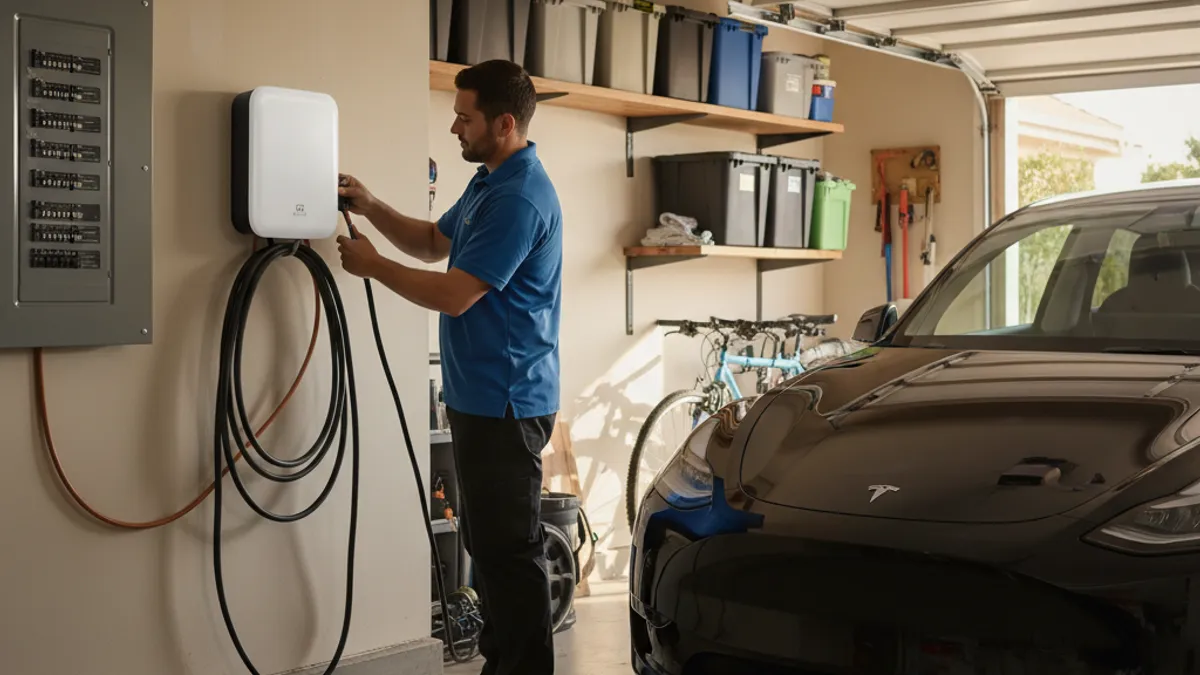
People picture an electrician bolting a unit to drywall. The hardware is the small part. The work is the dedicated 240-volt circuit behind it.
The installer adds a breaker, runs new wire to where you park, and lands a Level 2 connector. Difficulty tracks spare panel capacity, the wire run, and whether your city wants a permit.
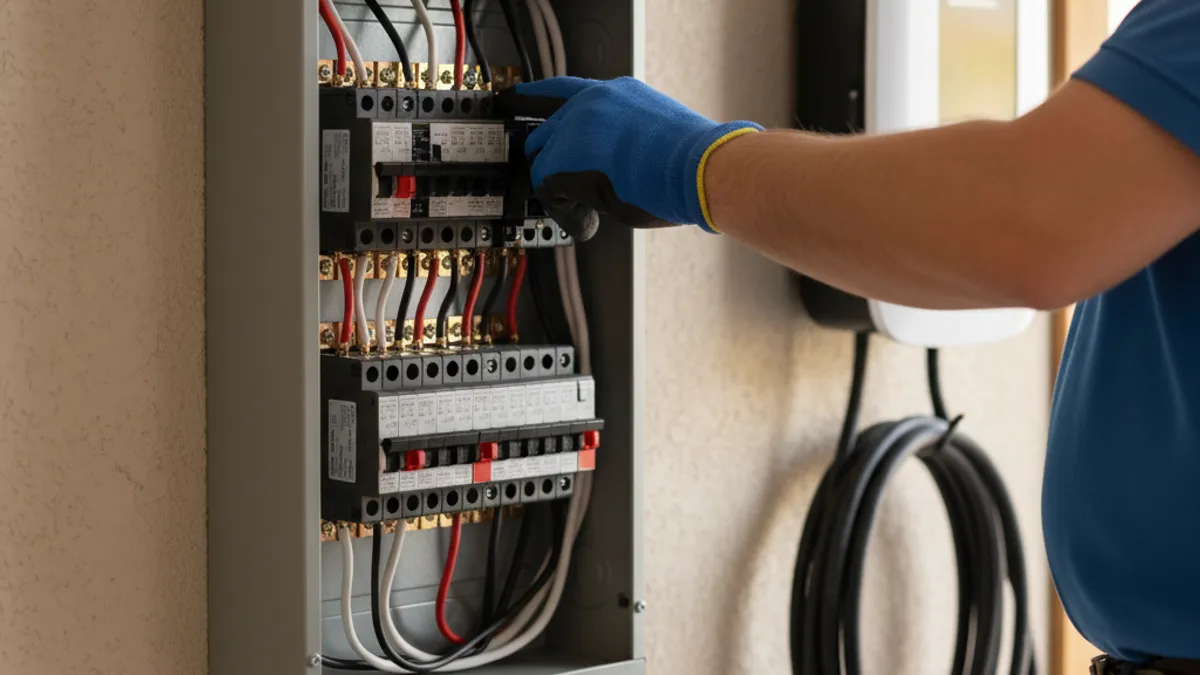
A load calculation is the honest first step. The electrician adds up what the house already draws. Then they check whether a 240-volt charger still fits. If the math is tight, the options usually look like this.
A load-management device can throttle the charger when the house is already pulling hard. A panel upgrade is the heavier path, and it’s its own project. If a quote never asks the age of the panel, treat it as incomplete.
We don’t pull permits or run circuits. Hire a local electrician for that work. Ask them to put the load calculation in writing before you lock a price.
Old houses, thin panels, nine different cities
The San Bernardino Valley is the oldest dense core of this market. San Bernardino’s housing stock is 60.9 percent built before 1980, ACS 2019-2023. That’s the oldest large-city share in the Inland Empire figures we have. Redlands sits at 60.4 percent. Grand Terrace is 60.6 percent. Bloomington, which is unincorporated, is 62.5 percent.
Panel capacity is the constraint, not the driveway. Downtown San Bernardino, Perris Hill, and the Base Line corridor tend to be older. Arrowhead Springs and the University District around Cal State San Bernardino mix vintage stock with later infill. A bungalow in Del Rosa and a newer house in Verdemont aren’t the same job.
Redlands at the east end is greener and considerably better off. San Bernardino has the lowest median household income of any large city in this market. Victorian and early twentieth-century homes on large lots are common in Redlands.
A failed climb is a hard hit in a lower-income city. That’s not a reason to skip the electrician. It’s a reason to get the panel question right the first time. For the failure modes we see on older inland panels, read older Inland Empire panels and EV chargers.
Loma Linda University Medical Center, Cal State San Bernardino, and the county government center hold cars all day. Long dwell plus valley heat is how a weak 12-volt battery dies, even when the pack still has miles. A home charger doesn’t fix a 12-volt.
Who serves the meter: Edison isn’t the whole valley
Most people assume the whole Inland Empire is Southern California Edison. Colton isn’t.
The City of Colton Electric Utility owns the electrical infrastructure within city boundaries. A Colton resident who calls SCE about an EV rate is asking the wrong utility. Confirm current program names with Colton Electric before you count on any of them.
San Bernardino, Rialto, Highland, Loma Linda, Grand Terrace, Redlands, and Yucaipa are on SCE’s served-cities list. If you’re on SCE, the residential EV rate to ask about is TOU-D-PRIME. Off-peak home charging is the point of that plan. Confirm today’s windows and prices on SCE’s own EV rate page. They change.
SCE also publishes Charge Ready Home for residential hardware help, and a pre-owned EV rebate program. Income rules and funding windows move. Read the live pages at evhome.sce.com and evrebates.sce.com before you budget around them. Charge Ready for businesses is a different program. SCE says new applications are no longer being accepted there.
Bloomington is unincorporated. Don’t guess the utility from a neighbor in Rialto or Colton. Look at the bill, then call that utility.
A mountain cabin is another split. Big Bear Lake and Big Bear City sit on Bear Valley Electric Service, not Edison. Lake Arrowhead and Crestline are listed on SCE’s community index. Big Bear Lake is an incorporated city. Big Bear City is an unincorporated community. Mixing those two up is how locals stop trusting a page.
City by city across the valley floor
San Bernardino
This is the county seat. ACS 2019-2023 puts the city at 222,724 people. I-215, I-10, SR-210, SR-18, and SR-330 all touch town. The arrowhead landmark sits on the mountain face above the city.
Ask the electrician about panel age first. More than six in ten homes predate 1980. Then ask how you drive. Mountain via SR-18 or SR-330, or north toward Cajon. A garage circuit here is how you leave flat ground with a full pack.
Neighborhoods aren’t interchangeable. Muscoy sits on the northwest edge. Downtown, Waterman Gardens, and Perris Hill are older cores. Verdemont and the University District behave differently on a quote.
Highland
Highland is the foot of the SR-330 climb. Weekend trips to Crestline, Running Springs, or the Rim of the World start the grade here. Housing is younger than San Bernardino’s core, at 44.7 percent pre-1980, ACS 2019-2023. Still get a load calculation. The climb doesn’t care that your panel looked fine on paper.
Redlands
Redlands is the east-end launch for SR-38, the long way to Big Bear via Angelus Oaks. Historic downtown along State Street and Orange Street is packed with old service. The University of Redlands and the citrus-era lots add long wire runs from panel to a detached garage.
I-10 cuts the city. Alabama Street, Lugonia Avenue, and Barton Road are the local grid. Higher incomes here don’t make a 1920s panel larger. Insist on the load calc in writing. For local context after a stall on that freeway, keep EV charging in Redlands handy.
Yucaipa
Yucaipa sits higher on the east edge. ACS 2019-2023 puts pre-1980 housing at 52.5 percent. The drive into town is already a climb from the valley floor. A home charger here is how you recover after that grade, and how you leave for the mountain again. Confirm SCE programs against your actual meter.
Loma Linda
Loma Linda is small and medical. Loma Linda University Medical Center holds staff and visitor cars for long shifts. A home Level 2 circuit still matters for the commute home. Nearly 45 percent of housing predates 1980. Barton Road and the I-10 edge are the usual corridors. Don’t skip the permit question with the city’s building department.
Grand Terrace
Grand Terrace is a small incorporated city between Colton and the Riverside line. Pre-1980 housing is 60.6 percent, ACS 2019-2023. Short blocks and older panels are the story. Confirm you’re in city limits before anyone files paperwork. Check the bill so you don’t call Colton Electric by mistake.
Colton
Two interstates cross here: I-10 and I-215. Shoulder calls are common. Reche Canyon Road climbs south toward Moreno Valley on a narrow two-lane with limited shoulder. That grade is short, and it’s real.
Call Colton Electric, not SCE, for rates and any published EV programs. We couldn’t confirm a Colton-specific charger rebate name worth publishing here. Ask the utility directly. City-level install rules also live with Colton’s building department. More on the local grid is at EV charging in Colton.
Rialto
Rialto is warehouse country with a dense residential base. The logistics belt along Riverside Avenue and I-10 runs delivery fleets. The Rialto Metrolink station is a long-dwell lot. Cars sit from before dawn until after dark. A home charger is what those commuters are missing. That’s why rental housing and older panels show up in quotes.
I-210 runs the foothills on the north side. Foothill Boulevard, Baseline Road, and Alder Avenue are the local spines. About 45 percent of housing predates 1980. SCE serves the city.
Bloomington
Bloomington is unincorporated, not a city. Housing is old: 62.5 percent pre-1980, ACS 2019-2023. It sits on Rialto’s southern boundary in the same warehouse weather. Permit routing goes through San Bernardino County. Still confirm the office and the current checklist before work starts. Look at the electric bill for the utility name.
Permits: confirm the city, then the county
We didn’t find a verified city-by-city EV charger permit table for this valley. Don’t let anyone treat a blog as the building code.
Incorporated cities run their own building departments. That’s San Bernardino, Highland, Redlands, Yucaipa, Loma Linda, Grand Terrace, Colton, and Rialto. Bloomington and other unincorporated pockets go through the county. A panel upgrade is usually a bigger submittal than a clean 240-volt branch circuit. Ask the electrician who pulls the permit and who calls for inspection.
If someone offers to skip the paperwork, walk away. Confirm with your city and your insurer what an unpermitted circuit means for you. We’re not the authority on that. They are.
Questions that separate a real quote from a cheap box
Use these when you call electricians.
- Will you run a load calculation, and can I have it on paper?
- Is the panel large enough, or are we talking a panel upgrade?
- Is the electrical permit in the price, and who schedules inspection?
- What amperage are you building the circuit for?
- How long is the wire run from panel to parking, and is that in the quote?
- Which utility is on this meter, and can you set charging on that utility’s EV rate?
An installer who answers all six is easier to trust than one who only prices the wall unit. Charge Pro IE isn’t an electrician. We won’t bid the panel.
Driving while the panel work is in queue
You still have to get to work. You still have weekend miles into the mountains. A 120-volt outlet is slow. It won’t rebuild a pack before a Cajon run.
Public charging is one option. We’re not going to guess how far the nearest stall is from your driveway. Named Tesla Supercharger counts we can stand behind up the hill are these. Six stalls at Big Bear Lake. Eight at Lake Arrowhead. Fourteen in that mountain resort area.
If the car is already low, a mobile Level 2 visit is the bridge. The operators we connect you with bring a 240-volt source to the vehicle. They use a native NACS plug, plus CCS or J1772 adapters for non-Tesla EVs. Charging time is typically enough to add 10 to 20 miles of range in 15 to 30 minutes. That’s time on the plug, not a promise of when someone arrives. The operator quotes you before starting and bills you directly.
That bridge is what mobile EV charging is for. It’s also the core of home charger install versus a mobile charge when yours is down. If you already misjudged the Cajon climb, read out of charge on I-15 at the Cajon Pass.
When the new charger quits anyway
Breakers trip. GFCI devices open. Wall units throw errors a week after inspection. You wake up to a car that didn’t take overnight power. That’s now a stranded-car problem, not only an electrical warranty problem.
Call the electrician back on the charger. If you need the vehicle to move, a mobile Level 2 visit can put enough range in to roll. Then you sort the warranty on your own clock. We don’t repair wall connectors. The operators we refer don’t either.
Summer afternoons in this valley are among the hottest in the non-desert part of the Inland Empire. Daytime charging on a peak time-of-use window is still a poor way to fuel. Overnight on the EV rate is the sane default. Confirm the current peak hours with SCE or Colton Electric, whichever is on your bill.
Frequently asked questions
How much does EV charger installation cost in San Bernardino?
We couldn’t confirm a published typical price for this valley, so we’re not going to invent one. Labor, wire run, and a possible panel upgrade dominate the quote. Get a written load calculation from at least two electricians. Confirm any rebate with SCE or Colton Electric before you subtract it from the bid.
Do I need a permit for a Level 2 charger in San Bernardino?
We couldn’t verify a single current permit rule that covers every city in this valley. Ask the building department for your address. Incorporated cities run their own counters. Unincorporated Bloomington goes through the county. A reputable electrician pulls the permit and meets the inspector.
Can I charge before the home installer is finished?
Yes. A wall outlet is slow. Public stalls work when they work. You can still get a 240-volt top-up at the curb. The operators we connect you with bring Level 2 to the car. They quote before they start and bill you directly.
What to do next
Get two electrician quotes. Insist on a load calculation. Confirm the utility on the meter, especially in Colton. Ask the city about the permit. Schedule charging on the EV time-of-use plan once the circuit is live.
This valley is still the last flat charge before the mountain and the Cajon Pass. Finish the garage circuit before you trust a weekend pack to SR-18 or I-15. If the car is empty before that work is done, we can connect you with a local operator. Call (909) 250-2881. That number is a referral line, not a promise of when a truck rolls.