A home EV charger in the Inland Empire is an electrician’s project. It isn’t a utility truck, and it isn’t a rescue call. Southern California Edison covers most inland cities on its served cities list. Riverside, Colton, and Banning each run their own electric utility. Moreno Valley splits SCE with Moreno Valley Utility. Each one treats home charging on its own paper. None of them bring a plug when your wall unit fails.
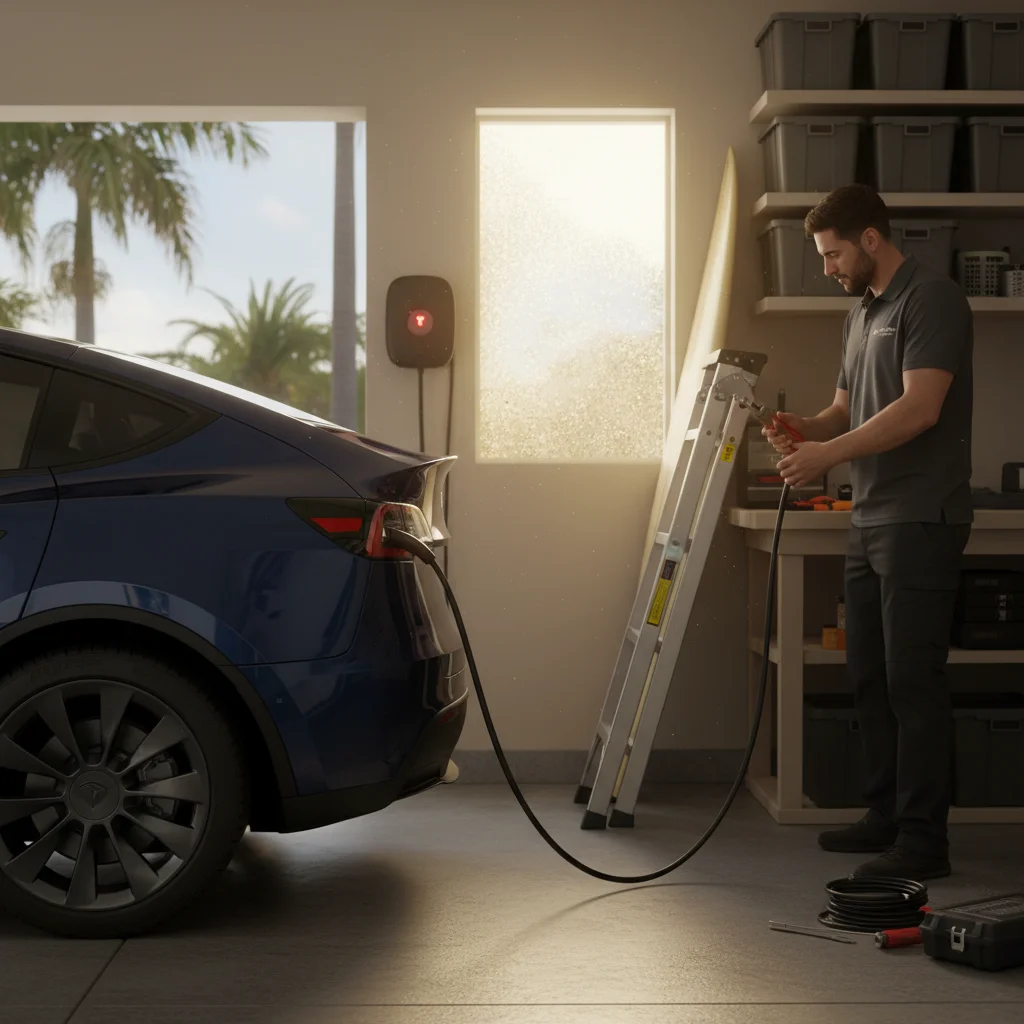
If you typed “ev charger installation inland empire,” you’re looking at two jobs. One job is a 240-volt circuit on a garage wall. The other is a mobile Level 2 visit after that circuit fails. Charge Pro IE is a referral line for the second job. Independent local operators do the work on that visit. The brand doesn’t install chargers, own trucks, or hold a contractor license.
Five utilities, and none of them roll to you
Most inland cities sit on Southern California Edison. Chino, Ontario, Fontana, San Bernardino, Corona, and Temecula are on SCE’s served cities list. Upland, Highland, Redlands, Eastvale, Norco, and Rialto are too. Menifee, Perris, Hemet, Hesperia, and Adelanto follow the same map.
Riverside, Colton, and Banning aren’t on that Edison list. Those three cities run municipal electric utilities, and the paperwork starts there.
Riverside Public Utilities has served the city since 1895. A Riverside garage charger is an RPU problem, not an Edison problem. RPU publishes an Electric Vehicle Rate for residents. It also publishes a Time-of-Use EV Rate Meter Rebate path. Electrify Riverside is the residential rebate page. Confirm current terms on the city’s utility site before you buy hardware. Programs change, and funding runs out. This page won’t quote rebate amounts, because those figures move.
Colton is a full municipal system. The city says it owns the entire electrical infrastructure within its boundaries. A Colton wall charger talks to the City of Colton Electric Utility. Permit rules belong to that utility and the city’s building desk. Those numbers weren’t independently confirmed here. Ask Colton Electric, and ask the city, before you pay a deposit.
Banning follows the municipal pattern on its own grid. The City of Banning Electric Utility serves the town. Banning is absent from SCE’s incorporated-cities list. If a contractor quotes an SCE home-charging rebate in Banning, pause. Check the utility printed on the bill. The wrong paperwork delays a plug you needed this week.
Moreno Valley is a split-utility city. SCE still covers much of the city. Moreno Valley Utility covers newer development built since 2004. MVU states it has over 6,500 customers. It publishes an address lookup for that split. Your neighbor can sit on a different utility. The charger quote has to name the right one. A rate plan that doesn’t match the meter won’t help you.
Rancho Cucamonga splits too, and SCE covers most of the city. Rancho Cucamonga Municipal Utility serves a southeast pocket. That pocket has over 3,900 metered businesses and residents. It includes The Enclave, Day Creek Square, The Resort, and the Victoria Gardens area. A house by Victoria Gardens isn’t automatically on Edison. Confirm the bill before the electrician orders parts.
Victorville homes are on SCE. Victorville Municipal Utility Services serves only the Southern California Logistics Airport and Foxborough Industrial Park. It states it doesn’t provide utility services in residential areas at this time. Don’t plan a house charger around VMUS.
Big Bear Lake and Big Bear City sit on Bear Valley Electric Service. That service area also names Lake Williams, Erwin Lake, Sugarloaf, Moonridge, Fawnskin, and Boulder Bay. Lake Arrowhead and Crestline appear on SCE’s tariff index. Bear Valley’s own service-area page doesn’t list those two. Mountain paperwork and valley paperwork aren’t the same stack.
San Jacinto has another split, because SCE delivers the power. San Jacinto Power, a community choice aggregator, supplies the generation. Apple Valley works in a similar way. SCE delivers, and Apple Valley Choice Energy procures. You still have one meter. The bill text won’t look like a simple Edison page.
See home EV charger install across the San Bernardino Valley. Start at EV charging in the Inland Empire.
What SCE publishes, and what it doesn’t send
SCE’s residential EV rate is TOU-D-PRIME. The utility also names Charge Ready Home. It names a Pre-Owned EV Rebate Program. Dollar amounts on those pages change. Read SCE’s site before you sign. Don’t copy a rebate figure from a blog.
SCE’s business Charge Ready Program isn’t an open door. The utility states applications are no longer being accepted. Agreements must be fully signed by December 31, 2026. Don’t build a new commercial install around that program.
A rate plan is a bill, and a rebate is paperwork. Neither one dispatches a truck to a dark wall connector. That holds in Eastvale and in a quiet Hemet garage.
Who actually hangs a Level 2 charger
Charge Pro IE doesn’t pull permits, and it doesn’t run conduit. The pros we connect you with handle roadside rescue. They’re licensed as operators in this network. They don’t hang home chargers. If you need a wall unit, you hire a licensed electrical contractor. Ask for the license number. Check it on the California Contractors State License Board site. This page can’t confirm which local firms currently hold active licenses. It can’t confirm insurance, bonding, or EV charger experience. That proof has to come from the board and from the contractor.
Ask who pulls the permit with your city. Riverside, Colton, Banning, and Moreno Valley each run their own building counter. An SCE city has its own counter too. A new Eastvale tract and a pre-1980 Norco panel aren’t the same job. This research didn’t verify each city’s permit fee or wait. The contractor should name the city. You should confirm it with that city.
Ask whether the quote is fixed or open. Ask what happens if the panel can’t carry a new 240-volt circuit. Ask whether the installer has worked your charger brand. A Tesla Wall Connector and a ChargePoint Home Flex aren’t identical. Ask what labor coverage they put in writing. Hardware warranties sit with the manufacturer. Labor terms sit with the contractor. Don’t treat a verbal promise as the record.
Don’t treat this brand as a referring electrician. If a name isn’t on your CSLB lookup, don’t hire off a blog mention. We aren’t publishing an installer roster. We can’t verify one here.
New tracts and old panels aren’t the same job
The Inland Empire isn’t one housing stock. ACS 2019-2023 figures show that clearly. Eastvale has 2.2% of housing built before 1980. French Valley sits at 2.3%, and Temecula is 6.5%. Murrieta is 6.2%, and those garages often started with newer panels.
San Bernardino is 60.9% pre-1980, and Riverside is 56.4%. Ontario is 50.7%, and Colton is 51.8%. Montclair is 68.5%, and Norco is 68.8%. Bloomington, unincorporated, is 62.5%, and Crestline is 77.7%. An older panel can still take a charger. It can also stop a job until an electrician checks the bus.
San Bernardino County overall is 43.8% pre-1980. Riverside County is 30.2%. That’s the same ACS 2019-2023 vintage. A Rancho Cucamonga quote isn’t a central Riverside quote. See older Inland Empire panels and EV chargers.
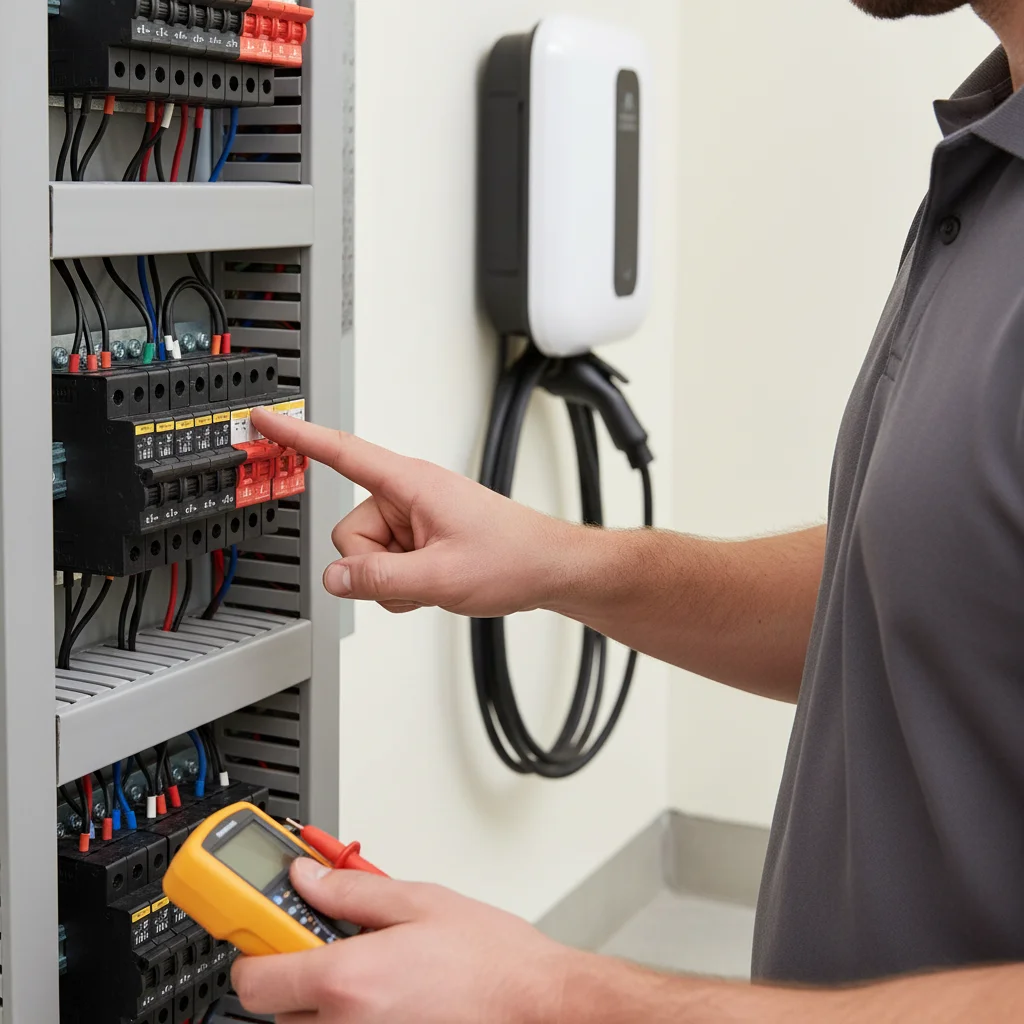
A breaker that opens overnight is a common first clue. A reset that holds may get you through the morning. A breaker that opens again is an electrician’s problem, not a mobile rescue. GFCI devices in a garage can also open on a long charge session. The charger’s own lights tell a different story. A solid green usually means the session is fine. A blinking red or amber means you need the manual. Sometimes the car stops the session to protect the pack.
When the wall unit is dark and you still have to leave
You plugged in after a long inland day, then woke up to a low pack. The charger light isn’t green, and school still starts. A shift still starts, and a desk in Riverside still expects you.
A public fast charger can finish the day if the car can reach one. This page won’t guess how far that is from your driveway. If the car won’t roll, a tow to a station is one path. A mobile visit is another.
The operators we refer bring a 240-volt Level 2 source to the car. Tesla vehicles take a native NACS plug. Other EVs use a CCS or J1772 adapter. A typical session adds 10 to 20 miles of range. That takes 15 to 30 minutes of charging. That’s charging time, not an arrival time. The operator quotes you before any cable goes in, then bills you directly.
That’s mobile EV charging, not a panel repair. It won’t replace a failed wall connector. It won’t pull a permit. It can put enough range on the car to reach work. It can also reach a public charger that can fill the pack. What a mobile EV charging visit actually is spells out the limits.
If the dash is dark, you may not have an empty pack. You may have a dead 12-volt battery. Operators in this network can jump or replace a 12V on site. They handle Tesla and every major EV brand. A wall-charger error and a 12V failure can look the same before sunrise. Tell the operator what the dash shows.
Getting through the days until the electrician finishes
A failed home charger is often a multi-day problem. This page can’t confirm how long a local electrician takes. That wait is set by the contractor. It isn’t set by SCE, RPU, Colton, Banning, or MVU. It isn’t set by this referral line. Public charging can cover some days, but not a car that won’t leave the garage.
Some drivers ask an operator to return for another Level 2 top-up. That can cover days while the wall job is open. That’s a new quote each time. Nobody here sets a standing rate. Price setting is in who sets the price when you need a mobile EV charge.
Those five utilities still won’t meet you at the bumper. Their job is the meter and the bill. EV roadside assistance is the job that meets the car.
If you’re shopping for a first install, hire the electrician. Verify the license, and match the utility on the bill. If the pack is too low to move, call (909) 250-2881. An independent operator quotes the visit, then bills you. No one here promises a clock.