The last bars often die on SR-2 above town, on a cabin street, or in a driveway after a parked night. Wrightwood sits at about 6,700 feet in unincorporated San Bernardino County, with about 5,000 year-round residents and a lot of older mountain housing. There is no Tesla Supercharger listed in town, so an empty pack or a dead 12-volt is a mountain stall, and you want a matched local operator, not a guess at the next plug.
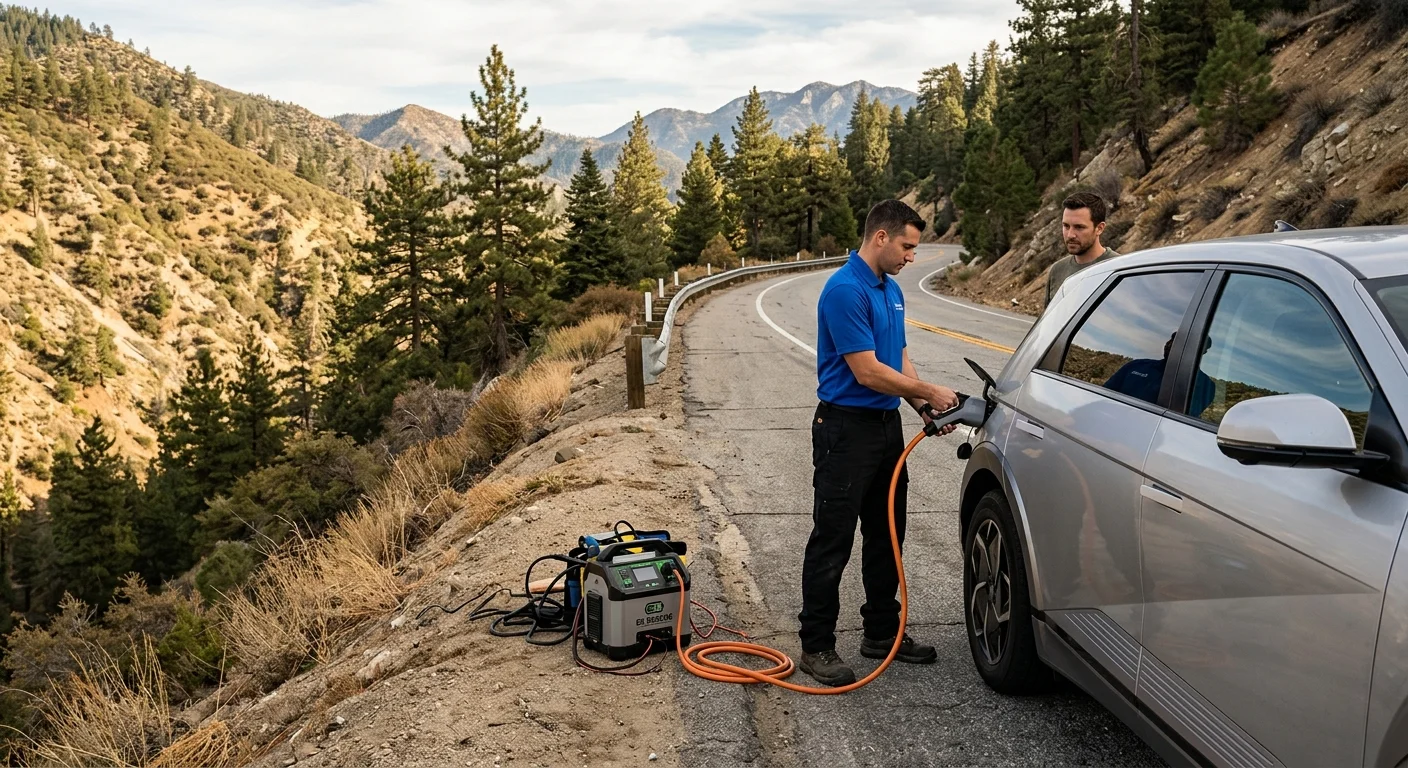
Empty in Wrightwood is a mountain problem, not a city one
Wrightwood is a Census designated place, not an incorporated city. The Census counts about 5,067 people across about 6 square miles. The ground at the place centroid is 6,736 feet. That is the reference point, not the highest ridge or the lowest driveway. Mail and mapping often split across ZIP 92397 and a 92371 overlap toward Phelan. About 62 percent of the housing was built before 1980, which is cabin and older-home stock, not a valley subdivision with a charger on every garage wall.
This is a different mountain from Lake Arrowhead and Big Bear. Wrightwood sits on the San Gabriel side, on SR-2, west of the Cajon. Arrowhead and Big Bear sit on the San Bernardino Mountains loop, with their own thin Supercharger map. A stall here does not put you next to Village Drive in Big Bear Lake or CA-189 in Lake Arrowhead. It puts you on a two-lane mountain road, a steep street, or a driveway that may not even have a working 240-volt outlet.
Phelan, down the grade, sits at about 3,800 feet. Cajon Pass, at the named point, is about 3,779 feet. Cajon Summit is about 4,261 feet. You can lose thousands of feet of elevation in a short drive, or burn the last bars trying to climb back. San Bernardino County Transportation Authority Freeway Service Patrol covers named freeways: I-10, I-15, I-215, SR-60, and SR-210. SR-2 and SR-138 are not on that list. The yellow trucks that jump a battery or drop a gallon of gas on the freeway do not patrol Park Drive. If you are empty in Wrightwood, treat it as a mountain rescue, and use emergency EV roadside assistance to get matched with a licensed local operator who can work at the curb.
Why the climb on SR-2 burns the last bars
SR-2 is the spine into town. Drivers come up from the Los Angeles foothills, or they climb from the desert side after a stop in Phelan or along I-15. Either way, the car is working against grade, thinner air, and often a cold pack. A range number that looked fine in Rancho Cucamonga or Fontana does not survive that climb if you left with a thin buffer.
Heat is not the Wrightwood problem the way it is on the valley floor. Riverside Municipal Airport averages about 22 days at or above 100 F. Victorville averages about 42. Wrightwood is a high, cold-night town. AAA’s 2026 testing found that at 20 F, with the cabin at 72 F, EVs lost 39 percent of calculated driving range. Recurrent’s winter set puts cars at about 78 percent of max range at 32 F, and about 70 percent at 20 F. Cabin heat is the quiet drain after you park. The climb is the loud one while you are still moving.
Caltrans District 8 covers San Bernardino County. Chain control on nearby mountain and pass routes uses R-1, R-2, and R-3. You must carry chains to enter a chain control area. A highway will often close before R-3 is posted. Check live status on Caltrans QuickMap before you commit to the grade. Do not spend your last miles hunting a turnout in a storm. If the pack is already low, turn around toward a verified plug while you still can, or stop in a safe pullout and call for help.
A typical mobile rescue charge, once the operator is on site and plugged in, adds 10 to 20 miles of range in 15 to 30 minutes of Level 2 charging. That is charging time, not travel time. The U.S. Department of Energy’s Alternative Fuels Data Center puts public Level 2 in a band that works out to roughly 25 miles of range per hour. That is enough to drop toward Phelan or a listed Supercharger, if that is the plan you and the operator agree on. It is not a full pack.
Cold 12V failures after a parked ski or cabin day
A lot of Wrightwood stalls are not empty packs. The car sat in the pines after a cabin night or a day on the hill. In the morning the screens are dark, the doors are fussy, and the high-voltage pack may still hold plenty of miles. EVs use a 12-volt battery to wake the computers. When that battery is tired, the car looks dead even if the traction pack is not.
Cold makes that more likely. Older mountain housing, much of it pre-1980, often means the car sat unplugged. Sentry mode, cabin preconditioning, and a weak 12-volt add up. Tesla owners in San Bernardino County are a large share of local battery-electric cars, about two out of three BEVs countywide, but the 12-volt problem is not Tesla-only. Rivian, Ford, Hyundai, Kia, and the rest can strand the same way.
Do not treat a dark car as an empty pack by default. Check the owner’s manual or in-car docs for your model before you try a jump. The steps and the 12-volt location differ by make. A licensed operator can sort a 12-volt wake from a true out-of-charge. Those are different jobs. A jump that wakes the car still leaves you on a mountain with whatever range you had. A mobile EV charging visit is the job when the traction pack is actually empty.
If the car will not shift or the contactors will not close, say that when you call. If you can still roll to a driveway or a wide shoulder, do that first. A 12-volt failure in a travel lane on SR-2 is a safety problem before it is a charging problem. Hazards on, people out of the roadway if it is safe, then the phone.
A Supercharger down the hill is not a plan from town
DOE Alternative Fuels Data Center data, checked as Tesla Supercharger inventory in September 2026, lists no Wrightwood site. That inventory can lag Tesla’s own map, so open the Tesla app, PlugShare, or the network app for the stall you think you can reach. Do not trust a screenshot from last winter.
The nearest listed Tesla stalls sit on other grades. Hesperia has 20 stalls at 12795 Main Street. Victorville has sites on 7th Street and Amargosa Road. Fontana has 24 stalls on Summit Avenue. Rancho Cucamonga has stalls on Cultural Center Drive and Foothill Boulevard. Lake Arrowhead has 8 stalls on CA-189. Big Bear Lake has 6 on Village Drive. The entire San Bernardino Mountains resort area in that inventory is 14 Tesla stalls, with none on the climb. Wrightwood is not on that loop.
So “I’ll just make the Supercharger” from a Wrightwood street is often a second stall waiting to happen. You still have to drop toward Phelan and the High Desert, or commit to a long mountain transfer toward Arrowhead. If you already ran empty on I-15 in Cajon Pass, you know that grade does not give range back. The same is true in reverse if you try to climb home on fumes.
Public Level 2 in a small mountain town is sparse and status changes. If a pin looks open, confirm it in the live app before you spend the last miles. The U.S. Department of Energy explains charging levels. It does not put a guaranteed plug on Park Drive. If you cannot confirm a working stall, stay put in a safe spot and ask for a mobile charge rather than rolling the dice on a downhill run.
Who to call: Tesla, a club, or a local operator
Roadside help can charge an EV, if the party you call actually sends a charging operator. A lot of classic roadside is still a tow, a 12-volt jump, or a tire change. That is useful. It is not the same as adding range at the curb. Ask the question out loud: can you add miles here, or are you towing me to a charger.
Tesla owners should open the Tesla app and use whatever roadside path their account shows for this VIN. Coverage and what shows up vary by policy and date. This page will not invent Tesla’s terms. Read the app and the warranty line against your own car. A club membership (AAA or another) can be part of the answer. What is “free” is whatever your card and your declarations page say, plus California Freeway Service Patrol on the named freeway beats. FSP is free on those corridors, with no gratuities. Agency pages do not mention EVs. They also do not list SR-2. Wrightwood is outside that free freeway net.
OEM roadside and club roadside often default to a tow toward a charger. On this mountain, the nearest listed DC fast site may be a long, steep tow. A privately arranged tow is a private transaction. CHP rotation rates are not a statewide price list. Charge Pro IE does not set a fee and does not quote one. The licensed operator you are matched with quotes and bills you directly.
Call the referral line when you want a local operator who can do mobile EV charging or a 12-volt wake in Wrightwood, not a generic statewide dispatch page. Tell them you are in Wrightwood, on SR-2 or a named street, whether the car is dark or showing zero miles, and whether you can stay out of the lane. The same mountain logic applies to a Lake Arrowhead day-trip stall and to an empty car once you drop into Phelan. Different ridge, same rule: match the help to the actual failure.
How to stay safe on the shoulder until help is matched
Get out of the travel lane if the car will still roll. A wide turnout, a driveway, a lot, or a true shoulder beats a two-lane blind curve. Turn on the four-way flashers. California Vehicle Code 25251 requires flashing the turn-signal lamps as warning lights when a vehicle is disabled on the roadway, if it has four-way flashers. You may use a short-and-long flash pattern when you need help.
CVC 21809, the Move Over law, covers a stationary vehicle showing hazards or a warning device. Other drivers must approach with caution and change lanes away, or slow to a speed that is safe for the road and weather. The infraction fine is not more than $50. That rule is for the people passing you. It does not make the shoulder safe. Keep people on the uphill or guardrail side, away from traffic.
CVC 21718’s freeway stop rules apply on controlled-access freeways. SR-2 through Wrightwood is mostly a two-lane mountain highway, not that class of freeway. Do not sit in a live lane hoping the code covers you. If you are still in the roadway, call 911. CHP and Caltrans jointly run Freeway Service Patrol on listed freeways only. For a Wrightwood street, 911 is the emergency path. The referral line is the path for a matched charging or 12-volt operator once you are stable.
Do not stand behind the car. Do not walk in the lane to “see if a charger is close.” Check Caltrans QuickMap if weather or chains are in play. Night comes fast in the pines, and a dark EV is easy to miss. Stay with the car if it is the safest shelter, engine or climate off if you are preserving a thin pack, and keep the phone on. Charge Pro IE does not promise an arrival window. The operator who takes the job sets the timing. Your job until then is to stay visible, stay off the asphalt, and stay warm without draining the last of the 12-volt.
When to call us
Call when the pack is empty on SR-2, on a Wrightwood street, or in a cabin driveway, or when the car is dark after a cold parked day and you need a licensed operator at the curb. Charge Pro IE matches you with that operator. It does not send its own truck. Call us at (909) 250-2881 and we’ll connect you with a local EV rescue operator.