Hillside homes in Chino Hills do most of their EV charging in the garage. When a 12-volt battery dies or the pack hits empty, you’re usually stuck in the driveway. The city covers 44.65 square miles of real hills in San Bernardino County. ZIP 91709 covers the place, even if the 917 prefix feels like Orange County. Neighborhoods climb from the valley floor. The trip computer doesn’t always treat that grade as real. This page covers home Level 2 charging under Southern California Edison. It also covers range on Carbon Canyon Road and SR-71. It covers what a mobile rescue operator can add when the car won’t roll.
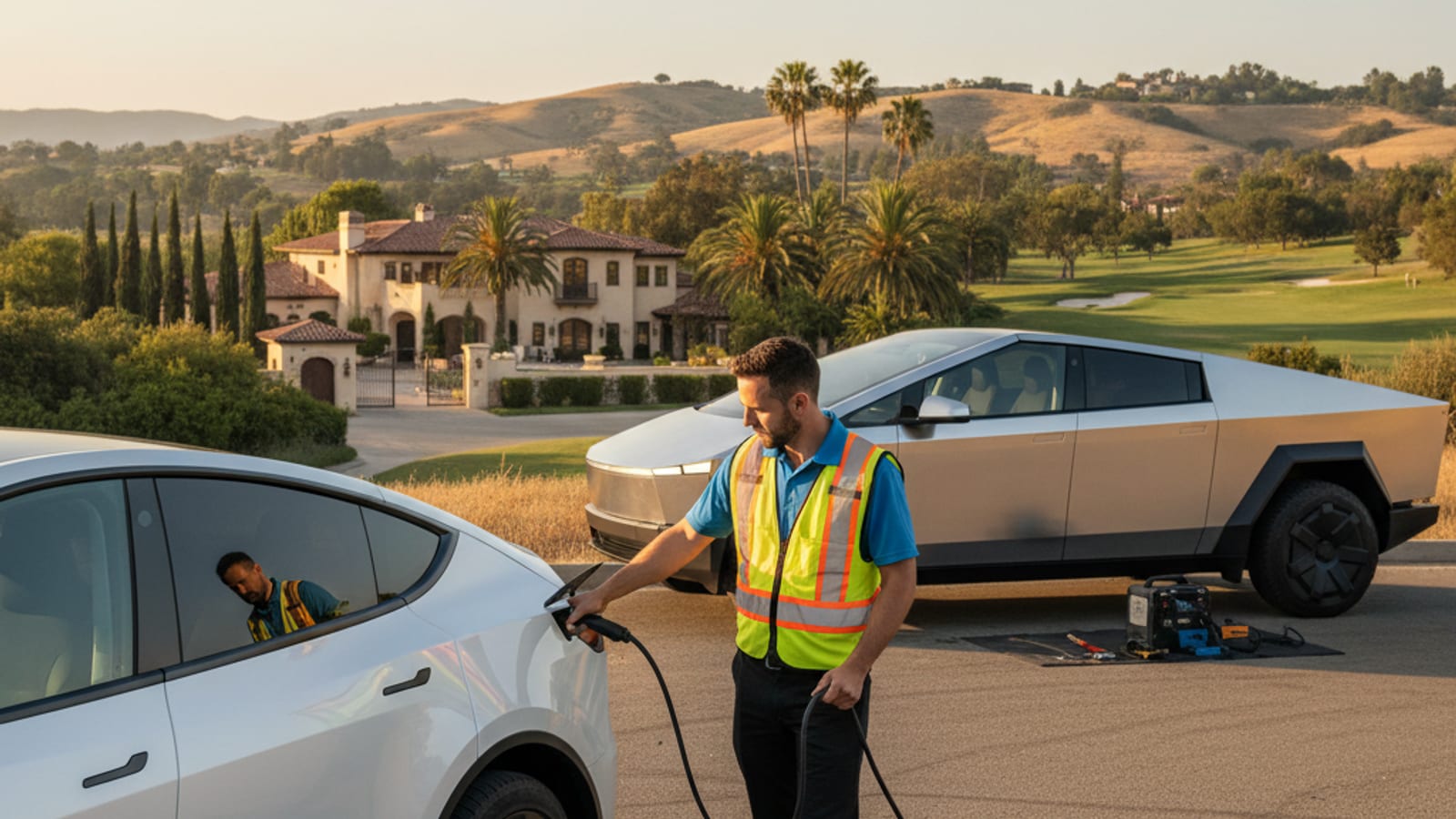
Chino Hills is a home-charging city on a genuine hillside
Census ACS 2019-2023 puts the population at 77,927. The 2024 estimate is 77,418. Only 17.4% of housing was built before 1980 in that ACS vintage. Most lots are newer. Home charging is the norm. Out-of-charge calls here tend to be road-specific.
The name is literal. Vellano, Rolling Ridge, Butterfield Ranch, Los Ranchos, Woodview, and Payne Ranch sit on slopes. Sleepy Hollow and Carbon Canyon follow the canyon instead of a grid. The Shoppes district sits lower, along Chino Hills Parkway and Grand Avenue. Peyton Drive and Pipeline Avenue connect those elevations. You feel the climb in the right pedal on the way back.
People often assume this is Orange County. It isn’t. Chino Hills borders Diamond Bar, Brea, Yorba Linda, Chino, Corona, and Ontario. The suburban look can fool a visitor. The city is in San Bernardino County. Permits and utility maps follow that county line. If you’re filling out a charger permit or a roadside form, use the county that’s actually on the map.
For a city-level snapshot, see our Chino Hills EV charging page.
Why the trip computer lies on these grades
Advertised range assumes a fairly level loop. Chino Hills isn’t that loop. The neighborhoods climb hard from the valley floor. Regenerative braking gives some energy back on the way down. It doesn’t give you a free ride back up. A grocery run that looked short on the map can use more than the display predicted.
Heat is the other quiet drain. Cars parked at Chino Hills State Park trailheads sit for hours on a fire road in the sun. Cabin cooling on the drive home pulls from the same pack that just sat hot. The computer may still show a comfortable number when you leave the lot. The climb back toward Rolling Ridge or Vellano spends that cushion.
You don’t need a mountain pass for this to matter. Grand Avenue, Peyton Drive, and the ridgeline streets are enough. Drive them the way you always do. Leave a larger buffer than a flat city would need. Short hops between The Shoppes and a ridgeline garage add up. So do stacked climbs in both directions.
The outbound drop spends less energy. The inbound climb is where the number moves. If you treat range like a flat-grid city would, you’ll arrive home closer to empty than you meant to. Plug in that night. Don’t save the last bar for morning.
Carbon Canyon Road is the one route that gets unkind
SR-142, Carbon Canyon Road, is a narrow, winding, climbing two-lane toward Brea. It has almost no shoulder and nowhere to stop. Being low on charge there is a real problem, not a mild inconvenience. Traffic stacks in the canyon. You can’t pull over and think.
If you use Carbon Canyon as a cut-through, treat a low battery warning as a reason to turn around before the winding stretch. Charge at home first. Don’t count on finding a quiet pad once you’re in the canyon. That’s about the geometry of the road.
The SR-71 commute is the second place a thin pack gets stressful. That corridor carries drivers toward Orange County and Los Angeles County jobs. Stop-and-go on a grade eats range faster than a steady cruise. If the car’s already low when you leave Butterfield Ranch or Los Ranchos, the 71 is a poor place to learn it.
A third scene is Chino Hills State Park. Trailhead parking is a long sit in heat. You come back to a hot cabin and a pack that’s been managing thermal load while you hiked. Check the number before you start the climb home. If the figure’s already thin, stay on lower streets until you can plug in. Don’t thread SR-142 as a shortcut home.
Home charging is the daily plan, and the panel still matters
Most Chino Hills EV owners plug in at home. That matches the housing stock. Newer houses often have a path to a 240-volt circuit. That doesn’t mean every panel is ready. A Level 2 wall unit needs a dedicated circuit, like a dryer. Hire a licensed electrician to check capacity. They should run the permit. They should place the unit where the car actually parks.
Some lots still date to before 1980. That 17.4% share is small next to older valley cities. Those panels can still be the ones that trip. Even new construction can undershoot if the house already has a spa, a second oven, or a workshop. Panel capacity is a growth topic in a city with newer housing. It isn’t a rescue promise. It’s the reason a driveway stall still happens when the charger is right there.
If you want the home-versus-roadside difference in plain terms, read home 240-volt charging vs a roadside Level 2 hookup. For what fails first on older gear, see older Inland Empire panels and EV chargers.
Level 1 is a trickle, not a plan for these hills
Every EV ships with a cord that fits a standard 120-volt outlet. That trickle can maintain a car that barely moves. It’s a slow way to recover a large pack after a real drive. On a Chino Hills grade day, overnight on Level 1 often isn’t enough to restore a comfortable buffer. Use it as a backup, not as the household routine.
Level 2 is the everyday Chino Hills setup
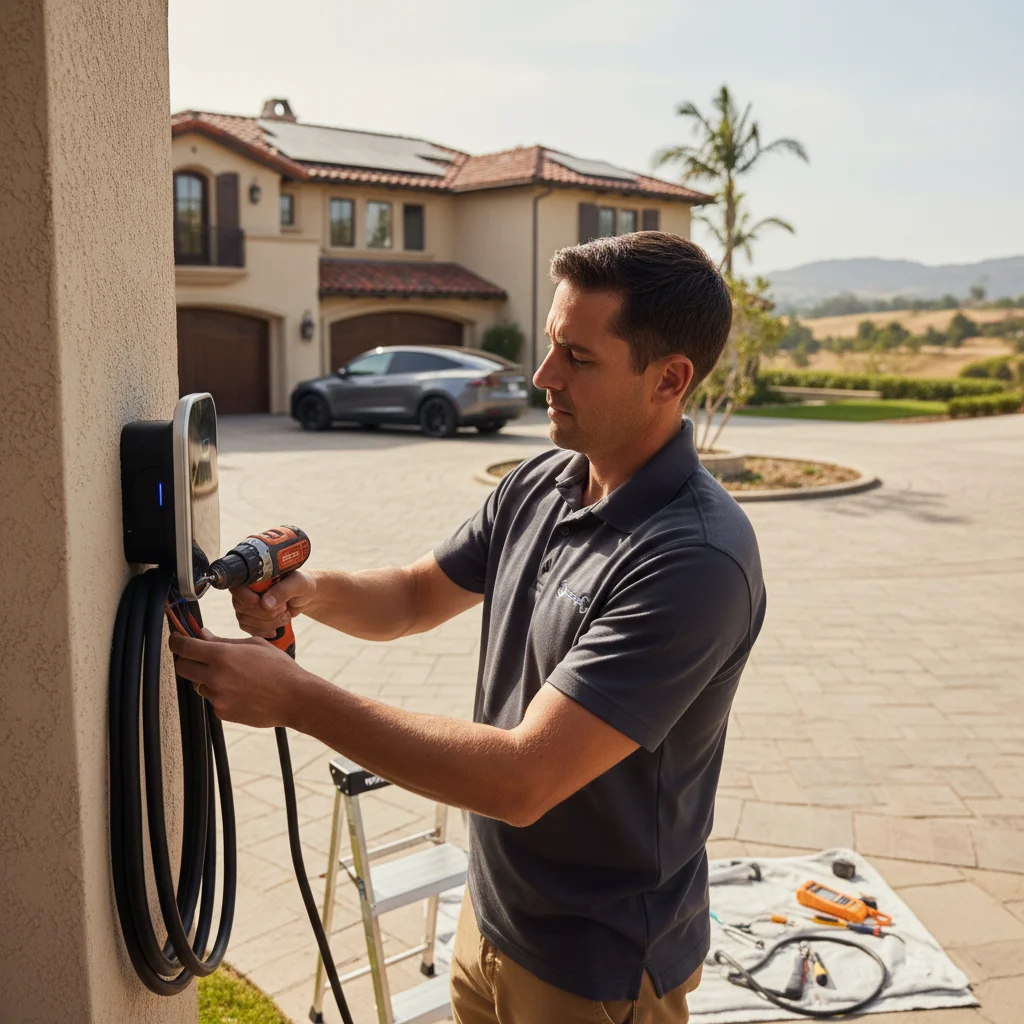
A Level 2 unit on a 240-volt circuit is what most hillside garages are built around. You plug in after the last trip. You wake up with enough range for the next one. Place it where the car lives: garage, carport, or a covered pad. Long, steep driveways in Vellano or Rolling Ridge can make cord reach a design problem. Measure before you mount.
Southern California Edison serves Chino Hills. SCE publishes a residential EV rate called TOU-D-PRIME. Off-peak windows cost less than on-peak weekday afternoons. Exact figures change. Confirm the current tariff on SCE’s EV plan page before you schedule charging. Don’t copy a number from memory. SCE also publishes Charge Ready Home for qualifying customers. Eligibility and funding shift. Check the Charge Ready Home site for what’s open now.
Charge Pro IE doesn’t install chargers, own panels, or sell electricity. The brand is a referral line. It matches stranded drivers with independent mobile operators. Home setup is your electrician and your utility.
The wall unit only helps if the circuit is live. A tripped breaker looks like an empty car in the morning. Check the panel before you assume the pack is dead. If the breaker trips again, stop resetting it. That’s an electrical problem for the electrician you hire. A mobile operator can still add range so you can leave the lot.
Public charging is a planning tool, not the nightly routine
This page won’t guess how far you are from a stall. That distance wasn’t verified here. Use the map in the car, then confirm the stall is actually working before you need it. Apps help. They also lag. A pin marked available can still be occupied or offline when you arrive.
Tesla Superchargers are Tesla’s DC fast network. Many non-Tesla EVs can use that network with a NACS adapter, where Tesla allows it. Other brands still look for CCS. Confirm connector and access in the car, not from memory. None of that replaces a working home Level 2 for a Chino Hills week.
If a public stall fails while you’re already low, sitting and hoping is a poor plan. Get to a safe spot. Then decide whether you can reach another stall, get home, or need a mobile Level 2 visit.
Two failures that look the same in the driveway
An EV that won’t wake isn’t always empty. A dead 12-volt battery can freeze the car while the traction pack still holds plenty of energy. Lights stay dark. Doors may not latch the way you expect. The big battery never gets a chance to drive.
That 12V failure shows up on Tesla and on other brands. Heat, age, and short neighborhood trips all wear it. On a hillside lot, the car may sit locked in the garage while you’re already late for the 71. A jump or a 12V replacement on site is a different job from adding range to an empty pack.
If the dash shows a real empty traction pack, charging is the job. Towing a modern EV needs the right equipment and the right mode. A mobile Level 2 visit can add a modest amount of range in the driveway. That can be enough to reach a faster stall, or to finish the day. Operators the network connects you with typically add 10 to 20 miles of range. That takes 15 to 30 minutes of charging. That’s charging time. It isn’t an arrival time, and the brand doesn’t promise one.
Tell the operator which problem you have. A dark car that clicked once may be 12V. A car that wakes and complains about miles may be empty. If you’re unsure, say so. The person who shows up can sort it on site.
Tesla owners can start with Tesla 12V battery jump. The same operators handle CCS and J1772 cars with adapters. See EV roadside assistance in Chino Hills for how those calls usually play out on local streets.
What a mobile Level 2 visit actually is
Charge Pro IE matches you with an independent local operator. The brand holds no license, owns no trucks, and employs no technicians. The operator quotes you before work starts and bills you directly. Prices aren’t set on this site.
The operator brings a 240-volt Level 2 source to the car. Teslas take a native NACS plug. Other EVs use a CCS or J1772 adapter. That’s enough to add a useful cushion. It isn’t a Supercharger in your driveway. It won’t fill a large pack in a few minutes. It’s meant to get you off a dead stop.
For a plain walkthrough of the visit, read what a mobile EV charging visit actually is. The mobile EV charging page is the service path if the pack is empty.
If the car is on Carbon Canyon Road, stay in the vehicle if it’s safer than standing in the lane. There’s almost no shoulder. Call from a spot where another driver can actually reach you. If you can still creep to a driveway or a lot off the winding stretch, do that first.
A Chino Hills call is often a steep driveway or a canyon road with no place to pause. Give the operator the slope, the nearest cross street, and whether the car is Tesla, CCS, or J1772. Those details matter more than a street name alone.
The pros we connect you with are licensed. Charge Pro IE still isn’t the party that hooks up the cable. The operator on scene does the work and takes payment.
Range habits that actually help on these streets
Keep daily charge in the mid band your maker recommends, unless you have a long day planned. That’s a battery-care habit, not a local rule. Heat and repeated climbs are the local part. Cabin preconditioning while you’re still plugged in uses house power instead of pack power. That helps on a Rolling Ridge morning.
Tire pressure matters on a grade. Soft tires waste energy you’ll want on Peyton Drive. Software updates can change how the car budgets energy. Install them when you’re home, not when you’re already late.
None of this replaces a working 12V. If the small battery is tired, the car can look dead after a quiet night in the garage. That’s a driveway problem in a city where people charge at home and still get stranded two steps from the wall unit.
Watch the return trip more than the outbound one. The outbound run toward The Shoppes or toward Chino is often downhill or flatter. The return is the climb. Drivers who glance at range at the store can still arrive home thinner than they expected. Plug in that night. Don’t leave a 12V mystery for the morning of a 71 commute.
Sleepy Hollow and Carbon Canyon add twisty miles to that pattern. You aren’t on a grid. Speed changes and elevation changes stack. Give yourself more buffer than the car’s number. The display is a guide. The hill is the fact.
Neighbor cities and why the county line matters
Chino is next door and flatter. Ontario sits toward the airport and warehouse grid. Corona is over the 71 mix. Diamond Bar, Brea, and Yorba Linda sit across county lines. A driver who treats Chino Hills like an Orange County suburb will mis-file the utility and the county on paperwork. SCE still serves this city. Confirm your rate on SCE’s site, not on a neighbor’s municipal utility page.
The Shoppes at Chino Hills and Carbon Canyon Regional Park are local landmarks, not charging claims. You can run errands there. You still plan the return climb. Chino Hills State Park is the heat-soak lot. Vellano is a ridgeline neighborhood. Each one is a different driveway angle when the car refuses to wake.
When you should call, and what you shouldn’t expect
Call when the car won’t roll and you can’t use the home charger. Call when the 12V has killed access. Call when you’re low on Carbon Canyon and you still have a safe place to stop. Don’t wait in a no-shoulder curve.
Charge Pro IE won’t quote a price on this page. The operator will. The brand won’t give an arrival time. It doesn’t publish hours. It doesn’t claim a fleet. Independent operators do the work. They handle Tesla and every major EV brand the network covers.
If the home Level 2 is dark because the breaker tripped, that’s still a driveway problem. Reset only if you know the panel and it’s safe. A repeated trip means the circuit or the charger needs an electrician, not another roadside visit. The mobile operator can add range so you can leave. The electrician fixes the wall.
Frequently asked questions
Why does a Chino Hills EV stall in the driveway if I charge at home?
Home charging is the norm here, and most housing is newer. A stall still happens when the 12V dies overnight, the wall unit is dark, or the pack was already thin after a climb. The car can sit two steps from a plug and still not wake. That’s a 12V or a circuit problem, not proof you skipped charging.
What makes Carbon Canyon Road a bad place to run low?
SR-142 is two lanes, winding, and climbing toward Brea. It has almost no shoulder and nowhere to stop. Traffic stacks in the canyon. A low pack there is a road problem. Charge at home before you use it as a cut-through.
Can a mobile visit help both a Tesla and another EV on a hillside lot?
Yes. Operators in the network bring a 240-volt Level 2 source. Teslas use a native NACS plug. Other EVs use a CCS or J1772 adapter. They can also jump or replace a dead 12V on site. The operator quotes before starting and bills you directly. Charge Pro IE only makes the match.
A hillside city still needs a backup plan
Chino Hills EV charging is a home story on steep streets. Keep the Level 2 healthy. Leave extra range for the climb. Treat Carbon Canyon and a hot state-park lot as the days that spend the buffer. If the car won’t roll, you’re usually in a driveway. A mobile Level 2 visit or a 12V jump is the practical next step.
Charge Pro IE is the Inland Empire referral line for that match. Call (909) 250-2881 when you need an operator. Confirm the quote with the person who shows up before any work starts.