An EV charging truck visit is a 240-volt Level 2 hookup at your bumper. An independent operator brings that source to the car. Charge Pro IE only matches you with that operator. We don’t run the truck, and we don’t bill the session. Typical charging time is 15 to 30 minutes. That session usually adds about 10 to 20 miles. Those minutes are charging time, not a clock for when someone arrives.
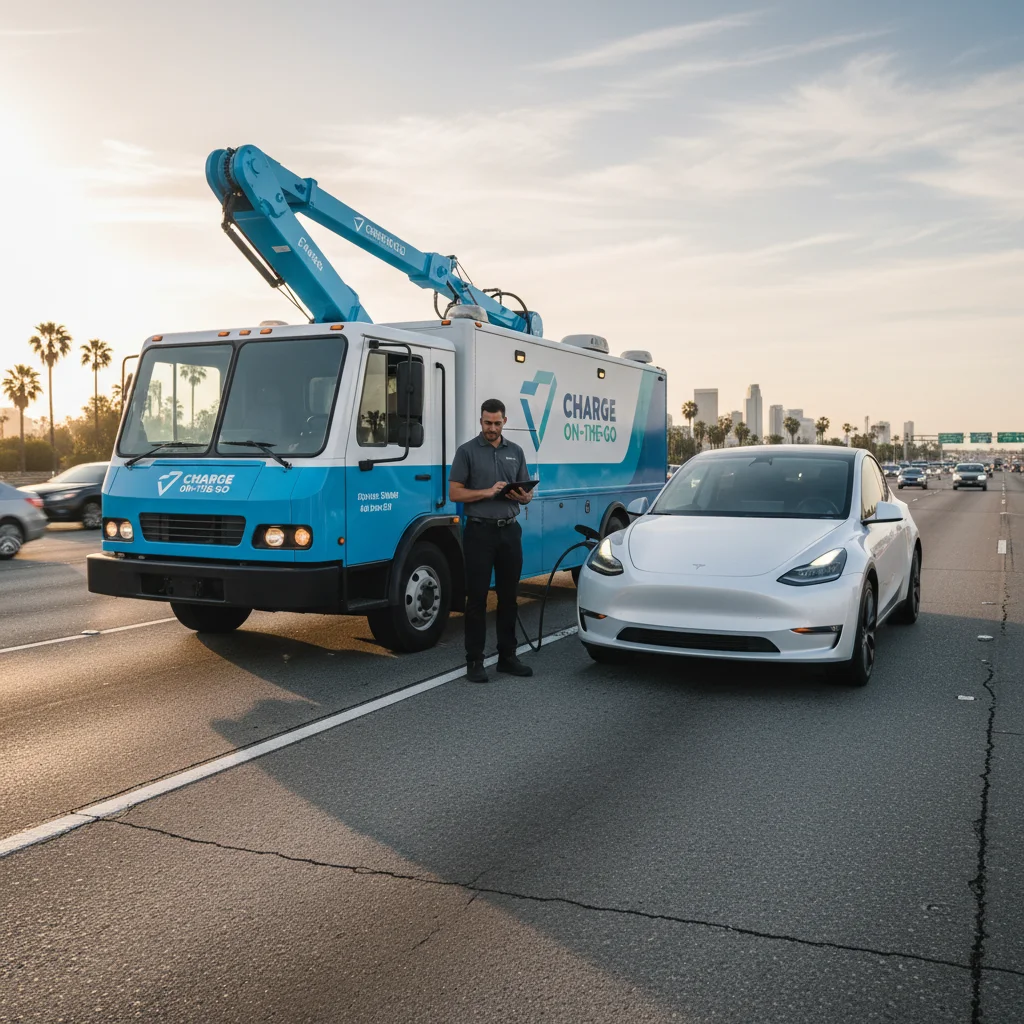
What people mean by ev charging truck, and what arrives
The search sounds like a Supercharger bolted to a van. Older explainers still sell that picture. They describe a rolling DC pack and a full shoulder refill. That’s not the visit operators in this network run. They deliver mobile EV charging as Level 2 at 240 volts. The lead is native NACS for Tesla and other NACS ports. Non-Tesla cars get a CCS or J1772 adapter. The job is a short, usable bump. You drive to a public DC stall, or you drive home. You don’t sit on the shoulder for a full refill.
Charge Pro IE is a referral line for the Inland Empire. We don’t hold a license and we own no trucks. We employ no technicians, and we set no prices. The operator quotes you before starting, then bills you directly. What’s actually on a mobile EV charger truck covers gear that often rides in the bed.
Some listings treat every operator as the same generator truck. Others picture a giant battery bank and stop there. This site doesn’t publish an onboard kWh figure. We don’t own the gear, so we don’t guess its size. What we can say is the output class: 240V Level 2. If a unit also carries 12V jump tools, that’s the other common on-site job.
Level 2 at the car is not your house circuit
A home wall unit and a roadside Level 2 lead share a voltage family. They don’t share a meter, a garage, or a utility. Home 240-volt charging vs a roadside Level 2 hookup is the longer comparison. At a house, the name on the bill depends on the city. Southern California Edison is the usual utility in Fontana, Ontario, Chino, and most valley cities. Riverside Public Utilities has served the city of Riverside since 1895. The City of Colton Electric Utility owns the electrical infrastructure inside Colton. The City of Banning Electric Utility covers Banning. Bear Valley Electric Service names Big Bear Lake and Big Bear City.
Rancho Cucamonga is split between SCE and a city utility. SCE covers most of the city. Rancho Cucamonga Municipal Utility serves a southeast pocket with over 3,900 metered businesses and residents. That pocket includes Victoria Gardens, The Enclave, Day Creek Square, and The Resort. Moreno Valley is split too. SCE plus Moreno Valley Utility cover different parts of town. MVU publishes over 6,500 customers in newer development since 2004. San Jacinto gets delivery from SCE and generation through San Jacinto Power. Apple Valley gets delivery from SCE and procurement through Apple Valley Choice Energy. Victorville homes are on SCE. Victorville Municipal Utility Services serves only the Southern California Logistics Airport and Foxborough Industrial Park. It doesn’t provide utility service in residential areas at this time.
None of those utilities power the operator’s cable. The roadside visit doesn’t use your driveway breaker. A dark home panel differs from an empty pack on I-10. Don’t mix the two when you call.
The 12V path sits beside the pack path
Plenty of dead-EV calls aren’t an empty traction pack. The 12-volt battery runs computers, contactors, and door latches. When it drops, the car can look fully dead. Miles can still sit in the big pack. Operators we connect you with jump or replace that 12V on site. Tesla is in that mix, and so is every major EV brand. If you drive CCS or J1772, start with non-Tesla EV rescue. Say whether the dash lights, whether the charge port opens, and whether the pack was already low. That split saves a Level 2 cable on a car that needed a jump.
What an EV charging truck visit is not
It’s not a Supercharger. Tesla’s DC sites are fixed cabinets in a lot. An operator vehicle isn’t one of those cabinets. It’s not a published arrival time, and this site doesn’t promise one. It’s not a fee we set. Ask the operator for the quote before anything starts. It’s not a full refill. Ten to twenty miles is the typical add from 15 to 30 minutes of Level 2. It’s not proof that a lot, a freeway, or a town lacks public charging. This page doesn’t estimate distance to the next stall. If you already know a named site is packed or offline, say that on the call.
It’s also not a repair order. A failed charge port needs a shop or a tow. So does a tripped isolation fault, or a pack that refuses current. Don’t assume the operator is there to diagnose inverters. This visit is a Level 2 lead to your inlet. A flatbed still wins after a collision. It also wins when a parking pawl is locked. It also wins when the car won’t accept energy. The visit is for a car that can take Level 2 or a 12V jump.
Inland roads, heat, and grades change the same stop
Swap the city name and this advice would fail. A Temecula surface street isn’t the Cajon climb. Inland north county and the valley cities don’t share one driving day. East County grades, the High Desert, and south-county wine-country miles don’t either.
The I-15 rise toward Cajon Pass and Victorville eats reserve you still had in Rancho Cucamonga. Out of charge on I-15 at the Cajon climb walks that specific stall. I-215 through Moreno Valley and Perris is a different shoulder. I-10 through Colton, Redlands, Beaumont, and Banning stacks valley heat with elevation toward the pass. SR-60 through Jurupa Valley is stop-and-go, not a mountain grade. The Ortega near Wildomar is a two-lane canyon road. Mountain days through Lake Arrowhead, Crestline, Running Springs, and Big Bear spend energy on the climb. The return descent is when a thin reserve can strand you before the valley floor.
Housing age from ACS 2019-2023 changes the stall setting, not the physics. San Bernardino County has 43.8% of units built before 1980, versus 30.2% in Riverside County. San Bernardino city is 60.9% pre-1980, and Riverside city is 56.4%. Eastvale is 2.2%, Temecula is 6.5%, and French Valley is 2.3%. Older blocks mean curb parking, alleys, and tight driveways. Newer Menifee, Eastvale, and Temecula Valley streets mean garage aprons and cul-de-sacs. The operator still needs room to sit safely and run a cable.
Warehouse rows in Fontana and Ontario add another pattern. So do airport lots around Ontario: long rows, limited shade, and a car that sat through a shift. High Desert stretches around Adelanto, Hesperia, Apple Valley, and Phelan are longer town-to-town miles. Cabazon destination lots and Glen Helen event parking are stall settings people name. None of that is a charger inventory. It’s where the bumper actually is when you call.
Summer valley heat is part of the same story. Packs and 12V batteries both feel those swings. The visit doesn’t change the weather. It only adds enough range, or enough 12V life, to move the car.
NACS, CCS, and J1772: the handle question
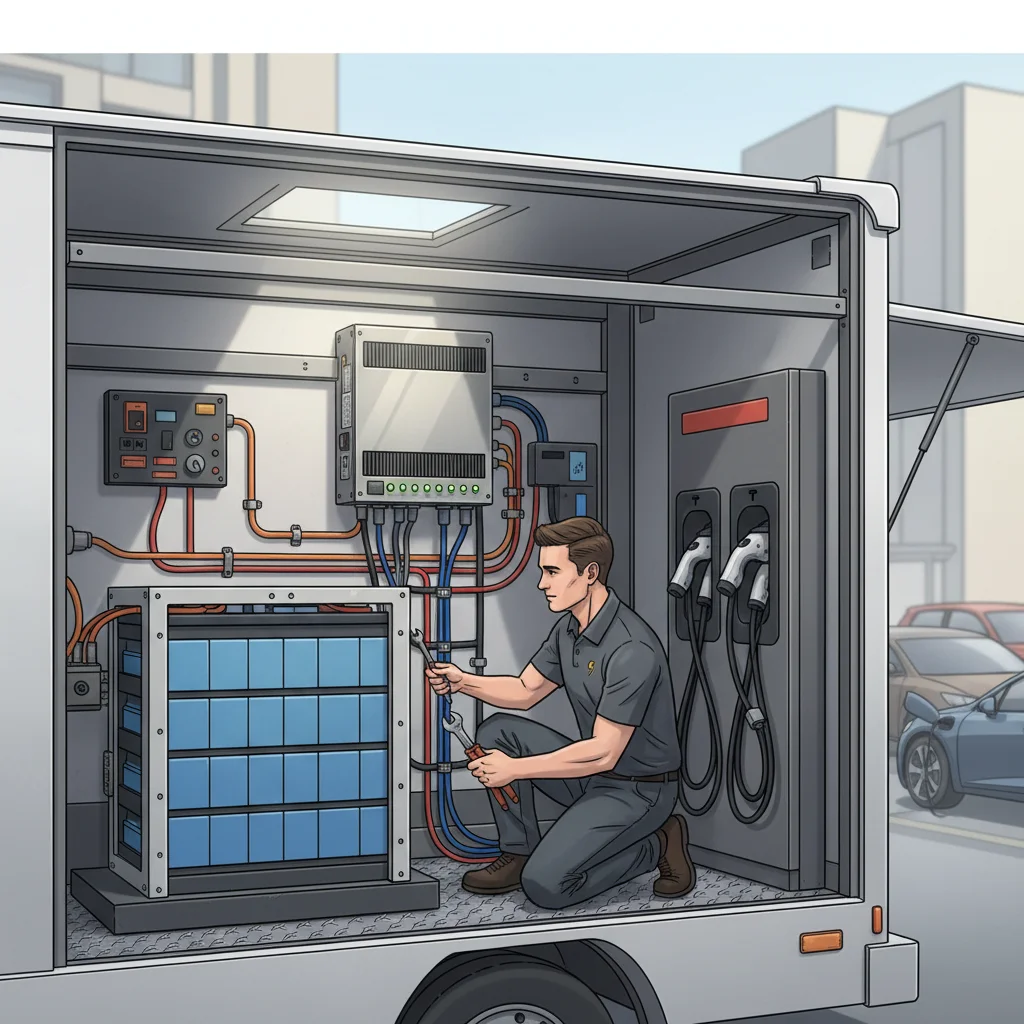
Tesla’s NACS plug is compact. Newer models from Ford, GM, Rivian, and others have been moving onto it. Operators carry a native NACS cable. Many non-Tesla EVs still use J1772 for AC. CCS1 is that J1772 inlet plus two DC pins for fast stalls. This stop is still Level 2 AC. The adapter is so the handle fits. It doesn’t turn the visit into a Supercharger. A Bolt, an Ioniq 5, an EV6, or an ID.4 needs that adapter path. A newer NACS Ford or Rivian may not. Give the year and trim on the call. The operator shouldn’t discover the port with the wrong lead in hand.
How the referral call works
Leave a message with where you are, what you drive, and a callback number. A cross-street in Hemet works, and so does an I-10 off-ramp in Calimesa. A pin in a Cabazon lot or a warehouse row in Bloomington works too. We match you with an independent local operator. That person quotes before starting, and they bill you. Charge Pro IE doesn’t collect the charge. We don’t dispatch a company-owned unit.
This site doesn’t publish an ETA. Don’t read 15 to 30 minutes as a travel time. That’s how long the cable is usually on the car. Shoulder work still means hazards on, and you stay out of the lane. Stay behind a barrier when there is one, and don’t stand between the vehicles. If current won’t flow, the operator should say so. Then you’re choosing a tow, not another session on a dead handshake.
Use mobile EV charging near me in the Inland Empire for the near-me version. City-level pages live under EV charging in the Inland Empire.
When to request the visit
Request a mobile charge when the pack won’t reach your planned stall. Request it when the car will still accept a plug. Request a 12V jump when the dash is dark and the pack wasn’t empty. Skip it when the car is crash-damaged. Skip it when a parking pawl is locked. Skip it when a charge-system fault already refused a public stall.
Don’t wait for a brand-owned truck, because we don’t have one. This page doesn’t publish a dollar figure. The operator quotes the job before starting. The pros we connect you with are licensed. Charge Pro IE is the referral line, not the crew.
If you’re on the 91 in Corona, the script doesn’t change. If you’re on I-215 in Perris, it doesn’t change. If you’re parked after wine-country miles in Murrieta or Temecula, it doesn’t change. Name the road, name the car, and stay visible.
When you want that match, call (909) 250-2881. Say the location, the vehicle, and how to reach you. The operator quotes before any work starts.