If your Inland Empire EV won’t roll, you need rescue, not a shop. A quoted Level 2 visit or a 12V jump is roadside help. It isn’t a repair. The operators Charge Pro IE connects you with only do the rescue. They quote you before they start, and they bill you directly. They don’t put the car on a lift. They don’t replace a high-voltage pack.
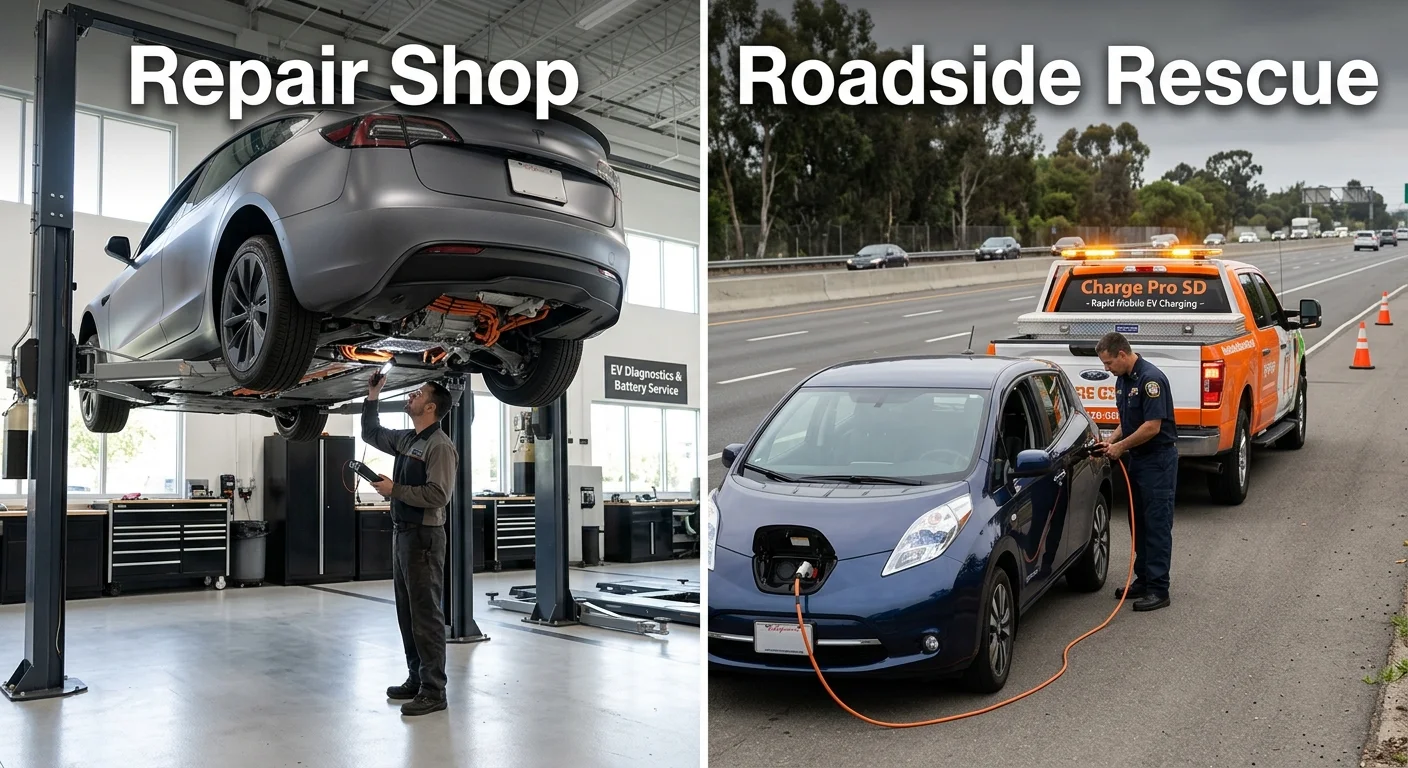
Empty on the shoulder isn’t a bay appointment
EV rescue vs repair gets mixed up because both get sold as “EV service.” One is a dealer or independent shop. The other is a mobile operator who comes to you. The search box doesn’t tell them apart. You have to.
Rescue is for a car that can’t leave under its own power. The main pack is empty, or the 12V is dead. The car won’t wake. You’re on the I-10 shoulder through Colton or Redlands. You’re on I-215 through Moreno Valley or Perris. You’re in a Fontana warehouse row after a night shift. The useful call is the one that comes to the car.
Repair is for a car that can still drive. A warning sits on the dash. Range fell with no heat or grade to explain it. You hear a new noise. Climate control acts strange. That work needs a scan tool, a lift, and a booked stall. A Level 2 cable on the curb won’t find that fault.
What a rescue visit is, and what it isn’t
Inland Empire operators on this line bring a 240-volt Level 2 source to the car. Tesla vehicles take a native NACS plug. Other EVs use a CCS or J1772 adapter. A typical session adds 10 to 20 miles of range. That takes 15 to 30 minutes of charging time. Those minutes are time on the cable. They aren’t a clock for when someone arrives.
If the 12V failed, they can jump it where you sit. They can replace a dead 12V on site when that’s the job. They handle Tesla and every major EV brand. Then the visit ends. You drive to a public stall, a dealer, or home.
That’s mobile EV charging, not shop labor. It’s also a 12V jump when the pack still holds energy. For a stall in general, start with EV roadside assistance.
A boost is a bridge. It doesn’t rebuild an onboard charger. It doesn’t quiet a noisy drive unit. It doesn’t apply a maker software update. If you want the visit without the fog, read what a mobile EV charging visit actually is.
What belongs in a shop
A service center owns the long jobs. High-voltage pack diagnosis. Drive-unit work. Suspension. An onboard charger that won’t accept a plug. Warranty claims, recalls, cabin filters, brake fluid, and tires on a rack. Software the maker wants done in a bay.
EVs skip oil changes. They still need scheduled care. Your owner’s manual still sets that calendar. If the car rolled in under its own power, book a dealer or an EV shop. Don’t call a rescue operator for a rattle that started last Tuesday.
A shop can also be the right next stop after rescue. A Level 2 boost gets you off I-15 on the Cajon climb toward Victorville. It doesn’t fix a charger that failed inside the car. A 12V jump in a Riverside driveway lets the car wake so you can move. If that 12V dies again the next morning, you now have a parts problem. Rescue already did its part.
Why the Inland Empire makes this mix-up easy
This market is two counties, not one city with a new name. Riverside County has 2,478,600 people. San Bernardino County has 2,197,104. ACS 2019-2023 is the vintage for both figures. Driving here isn’t one pattern.
Valley miles in Ontario and Fontana sit in warehouse traffic. The High Desert after Cajon is a long pull toward Victorville, Hesperia, and Adelanto. Mountain trips to Lake Arrowhead, Crestline, and Big Bear Lake add grade both ways. South county miles out of Temecula and Murrieta don’t feel like a Montclair arterial. Heat and grade can empty a healthy pack. That can look like a broken car. Often the car is fine. It’s empty. Empty is rescue. A range complaint that keeps repeating after a full charge is a shop diagnosis.
Home power is split too. That confuses people who want one electric company for the whole map. Most cities sit on Southern California Edison. Riverside Public Utilities serves the city of Riverside, and has done so since 1895. Colton owns the electrical infrastructure inside city limits. The City of Banning Electric Utility serves Banning. Bear Valley Electric Service covers Big Bear Lake and Big Bear City. Its area also names Sugarloaf, Moonridge, Fawnskin, and Boulder Bay. Rancho Cucamonga is mostly SCE. Rancho Cucamonga Municipal Utility covers a southeast pocket. That pocket includes the Victoria Gardens area. Moreno Valley is mostly SCE. Moreno Valley Utility serves newer development since 2004. San Jacinto gets SCE delivery, with San Jacinto Power supplying generation. Apple Valley gets SCE delivery, with Apple Valley Choice Energy procuring power. Victorville homes are on SCE. Victorville Municipal Utility Services doesn’t serve residential streets. It only serves the Southern California Logistics Airport and Foxborough Industrial Park.
None of that is a repair bay. A dark wall charger in Riverside is an RPU question. The same dark charger in Redlands or Yucaipa is an SCE question. In Big Bear Lake it’s a Bear Valley question. If the car is already empty in the driveway, that’s still rescue. The operator only offers a Level 2 visit or a 12V jump. They don’t rewire the panel. They don’t speak for your utility.
Housing stock differs in a way that also sends people to the wrong number. ACS 2019-2023 puts pre-1980 housing at 60.9% in San Bernardino. Redlands is 60.4%. Upland is 55.9%. The city of Riverside is 56.4%. Eastvale is 2.2%. Temecula is 6.5%. Murrieta is 6.2%. Older panels show up more in the older cities. That can mean an electrician, or a home-charger conversation. It still isn’t a stall on SR-60 in Jurupa Valley. It isn’t a stall on the 91 through Corona either.
The 12V failure that looks like a dead EV
Many drivers describe a car that looks totally dead. The high-voltage pack can still hold plenty of energy. The small 12V battery runs computers, locks, and the wake-up circuit. When it dies, screens stay dark. Doors may not act right. A shop appointment next week doesn’t move you off a Corona shoulder. A jump might.
If the 12V is the only failure, rescue is the right first call. Then book a shop if you need a lasting replacement. That’s if the operator didn’t swap it on site. If the pack is actually at zero, a jump won’t create miles. You need the Level 2 cable. When you can’t tell which failure you have, start with charge, jump, or tow.
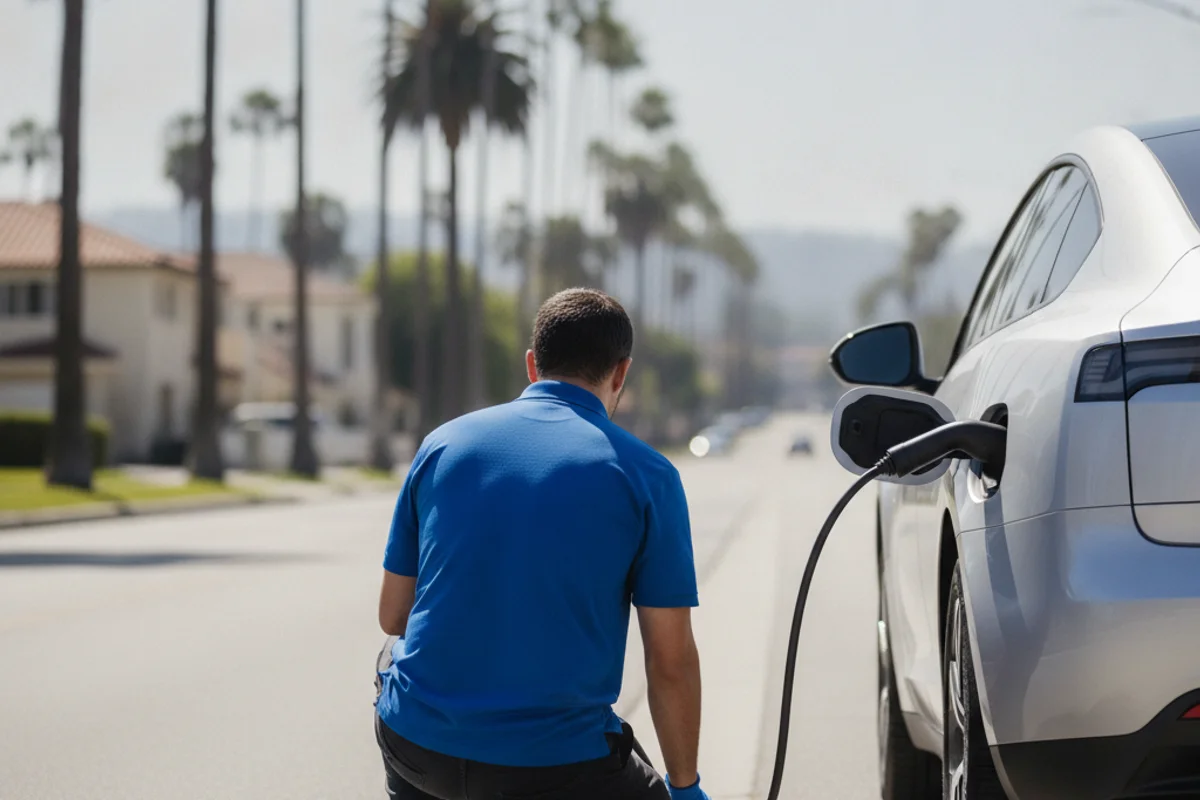
How to pick the call without a speech
Walk this once. Then dial.
The car won’t power on, or it won’t move. That’s rescue.
The range display shows empty, or you already hit the last warning on the shoulder. That’s rescue.
You’re in an Ontario airport lot and the car won’t wake. Same story in a Fontana warehouse row or a Cabazon destination lot. That’s rescue.
The car drives, but a light stays on. That’s a shop.
The car drives, but you heard a new noise. That’s a shop.
The wall charger at home failed. The car still has enough miles to reach a public stall. That can wait for an electrician. If the car is already stuck in the driveway, that’s rescue again.
If you’re choosing between a hook and a cable, mobile charge versus a tow is the next read. For the two-county map of this market, start at EV charging in the Inland Empire.
The pros we send aren’t a shop
Charge Pro IE is a referral line. It matches stranded EV drivers with independent local mobile rescue operators. It performs no work and owns no trucks. It employs no technicians, sets no prices, and publishes no hours. It holds no license.
The operator quotes before starting. You pay the operator. What you buy is a rescue. You don’t buy a diagnosis of a noisy motor. You don’t buy a software update. You don’t buy a pack replacement. The pros we send don’t run a repair bay.
If you call about a warning light, and the car still drives, you’ll get pointed to a service center. That’s the honest split. It saves you a wait that can’t help.
When this line is the right one
Call when the Inland Empire EV is stranded. Empty pack. Dead 12V. Car won’t roll. Charge Pro IE will connect you with a local operator. The operator quotes before any cable goes on. Call (909) 250-2881 when that’s the situation you’re in.