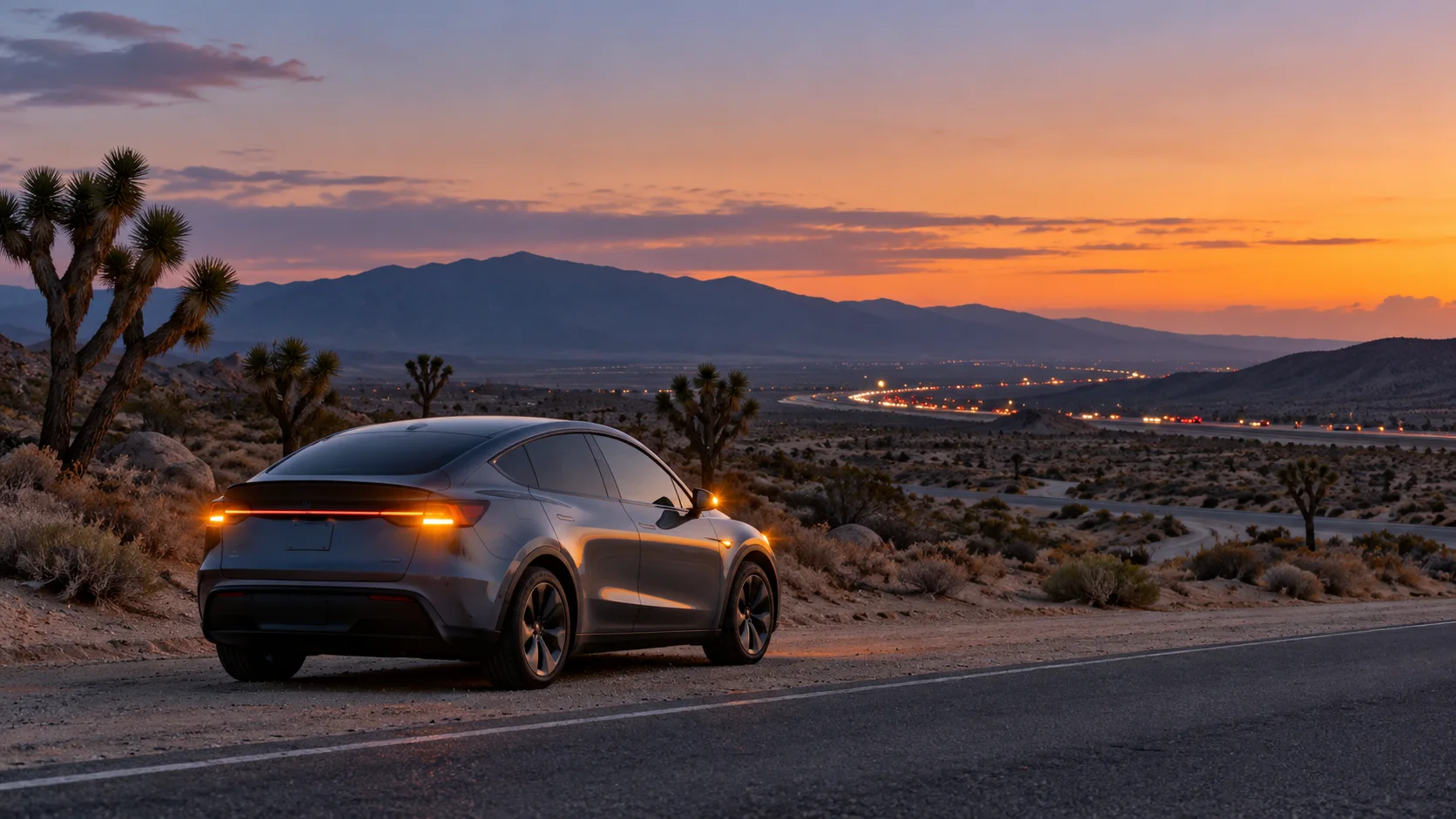
EV roadside assistance in Oak Hills begins with location. A pin near I-15, a rural parcel, and a surface-road stop are not the same call. Share the exact pin, the nearest cross street, and whether the car is safely accessible. Then separate an empty traction pack from a low-voltage failure or a fault that needs a tow.
Oak Hills is not downtown Hesperia
Oak Hills is a census-designated community in San Bernardino County, not a neighborhood label for every stop south of Hesperia. The 2019–2023 American Community Survey counted 9,013 residents. The Census Bureau’s 2023 gazetteer lists 24.516 square miles of land. That broad footprint is why the community name by itself is not enough for a roadside request.
A driver may be close to I-15 after the Cajon climb, on a paved local road, or at an address reached by a quieter last mile. Give the professional the actual access conditions. Mention gates, steep driveways, unpaved approaches, or a shoulder that does not leave working room. Do not substitute “Hesperia” simply because it is the nearest familiar city.
If your pin is north in Hesperia, use the Hesperia EV roadside guide. If the vehicle stopped on the Cajon grade itself, treat it as an I-15 freeway call rather than an Oak Hills surface-road stop.
The climb can use the buffer before Oak Hills
Caltrans identifies the I-15 chain-control segment from the Devore junction through Main Street in Hesperia. The named Cajon Summit high point is north of Cajon Pass, and the climb from Devore to the high point is roughly 2,080 feet based on the ledgered USGS elevation points.
That does not prove why a particular battery reached zero. It does explain why a driver should treat the climb and the remaining local miles as separate parts of the trip. Reaching the top of the corridor with a thin buffer does not mean the destination is within that buffer.
Wind is another planning factor. NOAA’s published Southern California Santa Ana research identifies Cajon Pass as one of the places where the strongest winds usually occur. Current conditions still need a live source. Check the National Weather Service and Caltrans before travel instead of relying on a seasonal assumption.
Empty pack or low-voltage failure
Before requesting a mobile charge, report what the car is doing.
- If the vehicle is awake and the displayed driving range reached zero, the traction pack likely needs energy.
- If the car went dark while it still showed range, report a possible low-voltage problem.
- If there is collision damage, smoke, unusual heat, or a high-voltage warning, keep away from the vehicle and use emergency or towing guidance.
- If the car powers on but refuses to charge, a roadside energy source may not solve the fault.
Do not try unfamiliar jump points or disassemble trim at the roadside. Vehicle procedures vary. The professional needs the year, make, model, last battery reading, warning message, and whether the doors and screens still work.
The EV roadside assistance service is the broader path for diagnosis and referral. It is not a promise that every stopped EV should be charged in place.
Public charging is a plan only while the car can move
No verified public fast-charger count for Oak Hills is in this site’s claims ledger. Use current vehicle navigation, the relevant charging-network app, and a map such as PlugShare to check compatible stations. Confirm that a site is reachable, available, and working before spending the last range to chase it.
If the vehicle has already stopped, a map pin elsewhere does not move it. The immediate choices become a limited mobile charge or a tow. A mobile charge can fit when the car is healthy, safely positioned, accessible, and able to accept energy. A tow fits when the car is damaged, faulted, unable to charge, or in a position where connecting roadside equipment would be unsafe.
A typical mobile Level 2 rescue charge adds about 10 to 20 miles during 15 to 30 minutes of charging. That interval is charging time only. It is not an arrival estimate. Use those miles to reach a confirmed charger or safer destination, not to begin a long High Desert trip without a new plan.
For the regional version of this issue, see mobile EV charging across the High Desert. The High Desert miles near Adelanto guide covers a different corridor problem and should not be treated as an Oak Hills location guide.
What Charge Pro IE does and does not do
Charge Pro IE is a referral service. It matches customers with licensed independent local EV charging professionals. It does not perform roadside work, employ technicians, own equipment, set prices, give warranties, or promise an arrival time. The independent professional decides whether to accept the request, quotes the work, and bills the customer directly.
That distinction matters in Oak Hills because access can change the feasibility of a visit. A professional may need to evaluate shoulder width, the surface under the vehicle, gates, and whether the car can safely accept a charge. Charge Pro IE cannot make that on-scene decision from a web page.
Use the mobile EV charging service when the traction pack is empty and the car otherwise appears able to charge. Describe a low-voltage issue clearly if the car still had range but will not wake.
Details to have ready
Before requesting a referral, collect:
- A precise map pin and nearest cross street.
- Whether the stop is on I-15, a ramp, a paved local road, or private property.
- Gate, grade, shoulder, and surface details.
- Vehicle year, make, model, and color.
- Last displayed range or battery percentage.
- Any warning text and whether the screens, locks, and charge port respond.
- Whether there is damage, smoke, heat, or another safety concern.
Oak Hills roadside help works best when the location is treated as its own High Desert call. An exact pin and an honest description of the vehicle are more useful than guessing which nearby city should answer.