The cluster stays black. Your EV6 sat through a Rancho Cucamonga night and now it will not wake. That pattern is usually the 12-volt battery, not an empty traction pack.
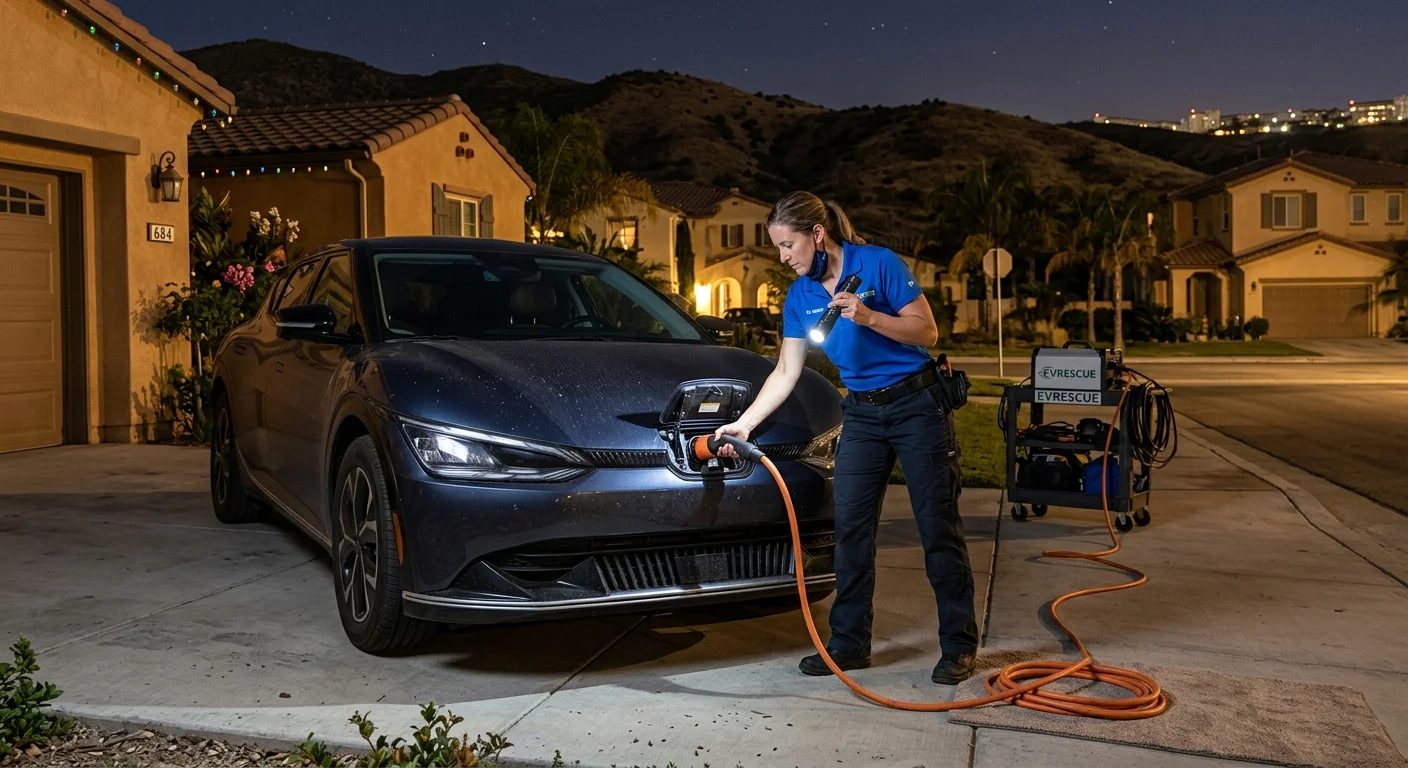
An EV6 that will not wake is usually the 12V, not the pack
An EV6 has two electrical jobs. The traction pack moves the wheels. A small 12-volt battery wakes the computers, the screens, the latches, and the charge-port door. When that 12-volt is down, the car looks fully dead even if the pack still holds range.
You will see a dark cluster, no READY light, and a fob that does nothing in your pocket. The charge door may stay shut. That is not a starter, an alternator, or a fuel pump. Those are gas-car parts. They do not belong on this diagnosis.
The same 12-volt sleep shows up on our Hyundai Ioniq 5 12-volt checks and the Kia EV9 won’t-start guide. If the screens light and the car reports low range, you are in a different problem. That is a charge failure. Use the EV6 won’t-charge checklist.
We could not confirm the EV6 12-volt chemistry, size, or under-hood layout from a Kia source we can cite. Open the owner’s manual for your VIN and year. Check Kia Connect if the app still reaches the car. An app that also went dark is a 12-volt clue, not a pack clue.
Inland Empire heat adds load. Riverside Municipal Airport averages 21.7 days at or above 100 F each year. Victorville averages 42.2. Recurrent’s research puts EV range loss around 17-18% at 100 F. The 12-volt lives in that heat, then sits all night after a warehouse shift or a stop at Victoria Gardens. The U.S. Department of Energy explains the split between a traction pack and a 12-volt system. It will not replace the Kia manual.
What you can check in a Rancho or Chino driveway
A driveway in Rancho Cucamonga or Chino is the right place to look. The shoulder of I-15 is not. If you are already on a freeway, turn on the hazards. California Vehicle Code 25251 requires four-way flashers on a disabled vehicle that has them. CVC 21718 also requires you to have summoned help if you are stopped on a controlled-access freeway.
In the driveway, run the boring checks first. Confirm Park. Press the brake. Keep the fob in the cabin, not in a metal bowl or a Faraday pouch. A dead coin cell in the fob can look like a dead EV6. The backup start, with the fob held to the EV button, is a model-year procedure. We could not confirm the contact angle or the hold time from a citable Kia page. The owner’s manual has that step. Kia Connect may show a fob warning if the car still phones home.
Walk around and look at the charge port. A cable left in a Chino workplace overnight, or a port door that will not pop, points at the 12-volt. Do not force the door.
Do not pull covers to hunt jump posts from a forum photo. Rancho Cucamonga’s centroid sits about 1,400 feet. Chino sits much lower, around 600 feet, in a hotter basin. Neither number tells you where Kia hid the 12-volt. The glove-box book does.
If you have a home charger and you thought last night’s session killed the car, split the issues. Chino, Chino Hills, and most of Rancho sit on Southern California Edison. A southeast pocket of Rancho, including the Victoria Gardens area, is Rancho Cucamonga Municipal Utility. Wake the car before you blame either utility. A silent EV6 cannot report whether a charge finished.
Jump points and why a gas-car jump is the wrong move
The EV6 still has a 12-volt jump path. We could not confirm post locations, polarity, or the metal grounding point from a public Kia source. Do not copy a gas-car cable diagram onto this car.
A neighbor with jumper cables is usually the wrong first move. A 12-volt pack from a gas Civic can still damage an EV if the negative clamp lands on the battery negative, or if someone brings a 24-volt jumper. Orange high-voltage cables are not jump points. Do not touch high-voltage parts when you cannot tell whether READY is on.
For general curb caution, read how to jump-start an EV at the curb. Then open the EV6 manual anyway. The authority for your car is the book that shipped with that VIN.
Hydrogen gas and battery acid are real hazards on a conventional 12-volt. We will not walk a clamp-by-clamp sequence we cannot source. Inland Empire driveways are tight, and a flashlight in a Chino garage is a poor place to guess. If the jump-start chapter is unclear, or the posts are not obvious, leave the hood closed. That is the moment to match a licensed local operator.
Charge Pro IE does not jump the car. We match you with independent local EV rescue operators. They quote you and bill you. We set no price and we promise no arrival window.
If it started yesterday and died in the lot overnight
This is the warehouse-shift version. Warehousing and storage in the Riverside-San Bernardino-Ontario metro held 121,800 private-sector jobs as of March 2025. Ontario, Fontana, and Jurupa Valley lots fill with EVs that ran fine at 5 p.m. and sit silent at 5 a.m.
Overnight heat is the local texture. A pack that still had range at clock-out can leave the 12-volt supporting cabin electronics and scheduled climate. We could not confirm Kia’s drain figures. You can see the result: black screens in a Fontana lot at dawn.
Tell the two failures apart. Screens dead, locks odd, charge door stuck: 12-volt. Screens alive, READY refused, percent near zero: empty pack. A car that will not start after a full work night is often the first. A car that rolled in on fumes may be the second.
If you made it to Ontario International Airport, the airport publishes free EV charging on the south side of Lots 2 and 4. Parking fees still apply. That plug does not wake a dead 12-volt. It only helps a car that will still accept a charge.
High Desert nights swing harder. Victorville sees roughly twice as many 100-degree days as Riverside. An EV6 that lives in Hesperia or Apple Valley and works a valley warehouse is doing both climates in one commute. The 12-volt does that commute too. Shift parking along I-10 and I-15 is overnight, hot, and far from a dealer. That is why this failure shows up at dawn.
Kia roadside versus a local CCS operator
Kia roadside, if your plan includes it, runs through Kia Connect or the number in your glove box and on your insurance card. We could not confirm a public Kia roadside number we can publish. Use the documents tied to your VIN.
A yellow Freeway Service Patrol truck is a different system. RCTC and SBCTA both list battery jump-starts. Their pages, as of September 2026, do not mention electric vehicles. FSP is free. Coverage is named corridors: I-10, I-15, I-215, SR-60, SR-91, and SR-210 on the published maps. A Fontana warehouse driveway is not an FSP corridor. A patrol that can jump a gas battery may still not know the EV6.
A random tow has a plug problem. Many newer EVs moved toward NACS. Plenty of EV6s still show a CCS inlet. Look at your port. A truck with only a Tesla-style plug, or with no DC gear, cannot add range to a CCS car without the right adapter.
Non-Tesla EV rescue is the local match for this car. Emergency EV roadside assistance covers the broader Inland Empire case, driveway to shoulder. A typical rescue charge, when the car will accept Level 2, is 10 to 20 miles of range in 15 to 30 minutes of charging. That is charging time, not an arrival promise. The operator sets the price.
The California Energy Commission counts 149,065 battery-electric light-duty vehicles across the two counties for 2025. Most are Teslas. Hyundai already sits in the next-largest group. An EV6 here is common enough to need CCS-capable help, and uncommon enough that a Tesla-only truck is the wrong truck.
When to stop and match a rescue instead of DIY
Stop when the cluster stays dark after the manual’s documented checks. Stop when you cannot find the jump posts without prying. Stop when the car is on I-15 through Cajon Pass, I-10 through Colton, or SR-60 in Jurupa Valley. CVC 22651(f) lets an officer remove a vehicle left more than four hours on a controlled-access freeway if it cannot move under its own power. Summon help. Do not keep tapping the EV button until those hours are gone.
Stop if kids are in the car and the cabin is hot. Riverside Fire Station 3 averages 28.0 days at or above 100 F. A dark EV6 in that heat is not a driveway project.
Stop if you cannot tell a 12-volt failure from an empty pack. A licensed local operator can treat the 12-volt, add Level 2 range when the car will take it, or arrange a flatbed when it will not. Charge Pro IE owns no trucks and performs none of that work. We connect you. You contract with the operator.
If the car wakes and then dies again, that is a Kia dealer conversation, not another curb jump. We do not publish Kia battery prices or warranty terms. Those live on the warranty line for your VIN.
When to call us
When the EV6 will not wake in a Rancho driveway, a Chino garage, or a warehouse lot, and the manual’s 12-volt checks are done, match a mobile EV rescue instead of another cable experiment. Tell the operator it is an EV6, whether the screens are dark, and what the charge port looks like. Call us at (909) 250-2881 and we’ll connect you with a local EV rescue operator.