Redlands is the last easy valley stop before the SR-38 climb toward the mountains. If your EV pack is empty here, call for EV roadside assistance in Redlands rather than guessing. Charge Pro IE matches stranded drivers with independent local operators. Those operators bring a 240-volt Level 2 source to the car. They quote you before they start, and they bill you directly.
Get to a safer spot on I-10, SR-210, or SR-38
Redlands sits in San Bernardino County, a little higher than the valley floor. I-10 cuts east and west through town. SR-210 drops in from the north toward Highland. SR-38 leaves town and climbs toward Angelus Oaks and Big Bear. That mountain road is the long scenic route, and it doesn’t ease up. Onyx Summit sits over eight thousand feet. Summer heat already taxes range before you turn uphill.
A car that dies on a grade often can’t coast far. Get as far right as the pavement allows. Turn the hazards on and stay belted if you’re next to moving traffic. Don’t step out to inspect the charge port on a live shoulder.
If the car can still creep, use those last yards. Aim for a wide shoulder or the next off-ramp. A gore past the merge is better than the merge itself. On I-10, say whether you’re eastbound toward Yucaipa or westbound toward Loma Linda. Alabama Street, Orange Street, and Redlands Boulevard are the exits people actually name. On SR-210, name Highland if you’re still north of town. On SR-38, say how far you got. Name Mentone, Crafton, or the Arrow Route if you can.
A stall inside a merge is harder for other drivers to see. If you can clear the interchange before you stop, do that. If you can’t move at all, stay put and stay visible.
Call 911 first if the vehicle blocks a lane. Do the same if it’s smoking or was in a collision. Officers’ instructions beat anything in this post.
Downtown, campus lots, and old-house driveways
Not every Redlands stall is on a freeway. Historic downtown runs along State Street and Orange Street. Those blocks hold long-dwell parking for the Redlands Bowl and the shops. The Lincoln Memorial Shrine sits in the same district. The University of Redlands district fills lots for classes and events. Kimberly Crest House sits up in the older south-side hills. Citrus groves and old packing-house blocks still shape the east side of town.
Those pins are a different problem than I-10. A gated campus lot changes what a service vehicle can reach. So does a downtown structure with a height limit. South Redlands and the Terrace climb more than they look from the valley. The southern neighborhoods rise into the Smiley Heights hills. A driveway that felt flat on the way in is a grade on the way out.
Housing is the other local trap. About 60.4 percent of Redlands homes were built before 1980, per ACS 2019-2023. This is an old, affluent city with Victorian and early twentieth-century houses on large lots. The architecture is beautiful, and the electrical service is often a hundred years old. Plenty of owners buy an EV, then find the panel can’t host a home charger. A car that sat in the driveway all night can still wake empty. That’s a roadside job at a residential address, not a freeway one.
The Lugonia corridor, Barton Road, and Mentone on the eastern edge add more of the same mix. Neighbors in Highland and Yucaipa share that mountain-facing edge of the valley. If you were already heading that way, say so when you call.
Southern California Edison serves Redlands, so an SCE outage at the house isn’t the same as a dead pack on I-10. Tell the operator which one you’re dealing with.
Tell a dead pack from a dead 12-volt
“My EV died” covers two failures that look similar from the curb. They’re not the same job.
A depleted traction battery usually warns you first. You’ll see a low-charge or zero-range message before the car stops pulling. A 12-volt failure often goes dark instead. Locks, handles, infotainment, or the shifter may freeze. That can happen even if the last range reading looked fine.
Write down the exact warning text instead of paraphrasing it later. Check whether the app still wakes the car. Check interior lights and door locks. A cabin that still lights up, but won’t drive, points one way. A fully dark cabin points another. Neither check is a diagnosis, but both help the person you reach next.
Don’t open high-voltage covers. Don’t invent a jump procedure from a video. A step that’s correct on one car can damage another. If you have the owner’s manual for your model year, use its 12-volt pages. If you don’t have it, say that. Guessing is worse than calling the problem unknown.
Our post on how to tell a dead Tesla pack from a 12-volt failure walks through those clues. The same split applies to other brands.
What a matched operator can do on site
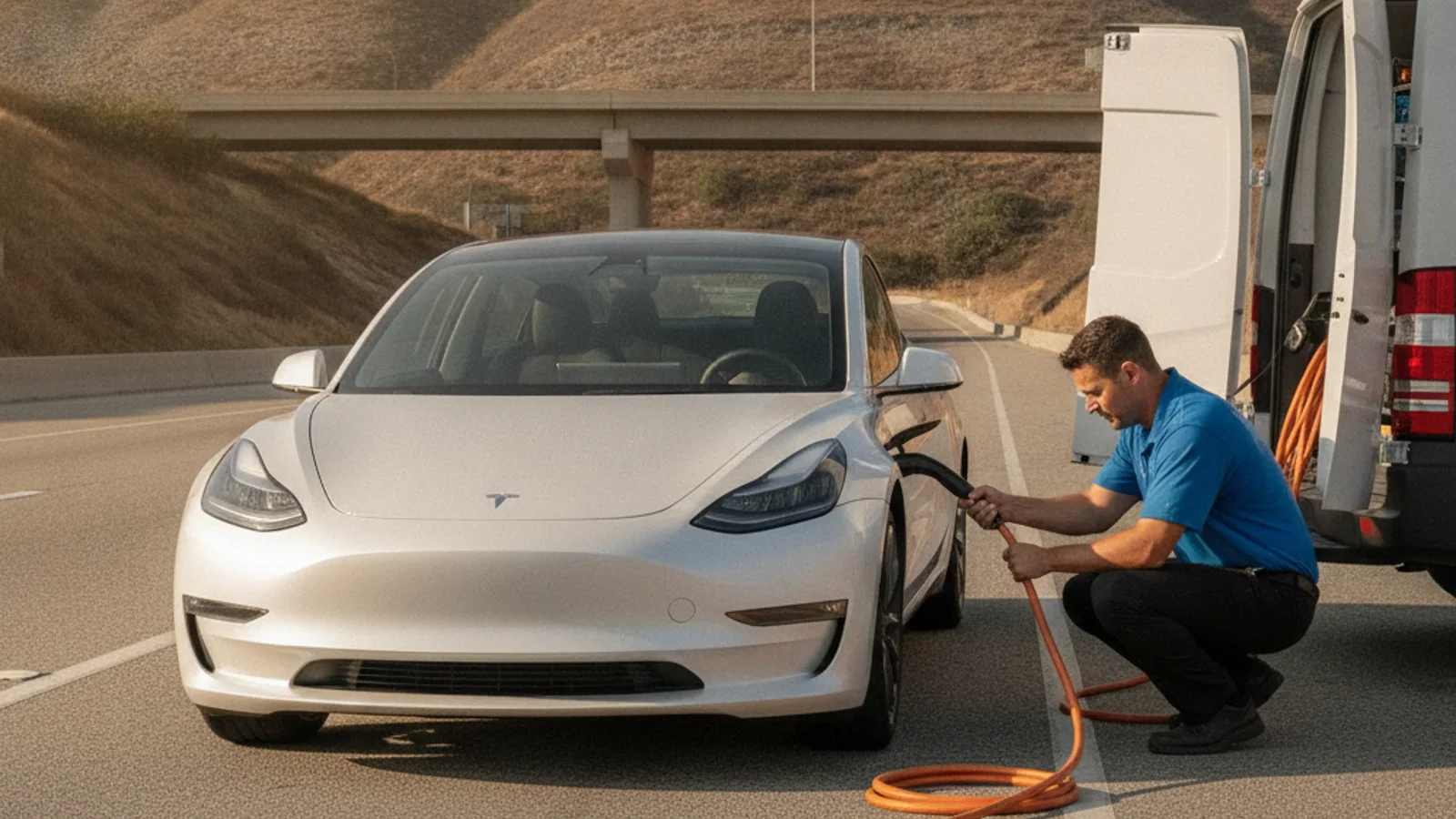
Ask about mobile EV charging when the signs point to an empty pack. The pin also has to be somewhere a service vehicle can work safely. A paved shoulder past the merge can work. A campus lot or a driveway off Redlands Boulevard can work too. A live lane on I-10 can’t.
The independent operator you get connected with decides if a charge fits. They review make, model, symptoms, and the exact pin. Operators typically bring a 240-volt Level 2 source with a native NACS plug. They carry CCS or J1772 adapters for non-Tesla EVs. According to the DOE Alternative Fuels Data Center, Level 2 in the field uses J1772 or J3400. DC fast charging uses CCS, CHAdeMO, or J3400. Your car, not the truck, sets which of those applies.
A roadside session isn’t a full fill. The usual goal is enough range to reach a fixed charger you choose. Operators typically add about 10 to 20 miles of range in 15 to 30 minutes of charging. That’s charging time on the cable. It’s not a promise of when anyone arrives.
They can also jump or replace a dead 12-volt battery on site for Tesla and every major EV brand. That path only fits if the traction pack still has energy. The 12-volt has to be the thing that failed.
For charging context in town, see EV charging in Redlands.
When moving the car is the better path
Transport is more likely when the 12-volt is the failure. It also fits when the charge port won’t latch, or the pin is unsafe for equipment. A live I-10 lane is one of those pins. In those cases an operator may want the car moved instead of charged in place.
Out-of-charge recovery is how we connect you with operators who make that call. They work from the actual vehicle and setting, not a guess over the phone. If you don’t know why it stopped, say unknown. That’s clearer than a cause you invented.
Don’t coach the loading, tow mode, or parking-brake release. Instructions written for a Tesla on a Hyundai, or the reverse, can wreck a drive unit. Hand over the manual’s towing section if you have it. If you don’t, say so.
If you already sat down on the interstate, read stranded EV on I-10 through Redlands. Heading toward Yucaipa on a dying pack is a different grade problem just east of town.
Details that actually help the operator
“Somewhere in Redlands” covers about 36 square miles. “Eastbound I-10, just west of Alabama Street, before the Orange Street exit” is a place someone can find.
Lead with direction and the nearest named road. Then add a mile marker, overpass, packing house, the university, or downtown State Street. ZIP codes 92373 and 92374 cover much of the city core. 92346 and 92359 overlap the edges toward Highland and Mentone. Say whether you’re on a freeway shoulder, a campus lot, or a Smiley Heights driveway. Mention locked gates, keypads, and tight turnarounds. If you’re not the owner, say whether someone who can approve service is with the car.
Make, model, year, and the last dash message matter as much as the pin. The operator needs the badge, not “an electric car.”
Call when the car won’t roll
Call when the EV has stopped in Redlands and you can’t tell charge from tow. That includes I-10, SR-210, SR-38, Barton Road, Lugonia, and a dark driveway. Share the symptoms and the pin described above. We’ll connect you with a local EV rescue operator at (909) 250-2881.