The GMC Sierra EV that dies on a warehouse row still takes a quoted Level 2 visit. The same is true on High Desert miles after the Cajon climb. GMC Sierra EV emergency charging isn’t a Supercharger stall. It’s a mobile operator bringing a 240-volt source to the truck. Charge Pro IE matches you with that independent operator. The operator quotes you before the cable goes in, then bills you directly.
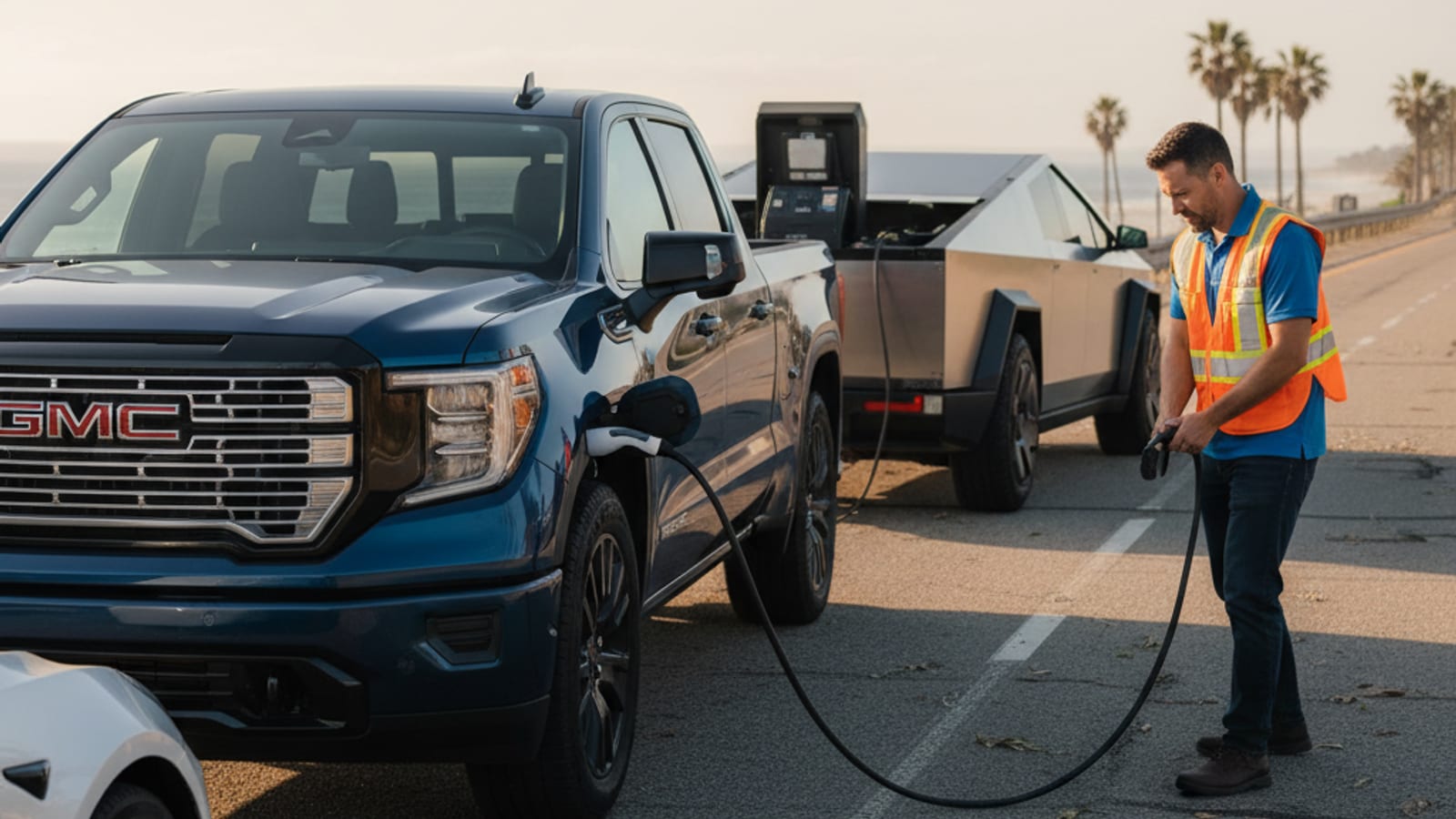
This truck is built for payload, not for a thin commute buffer. It sits through Fontana and Ontario shifts. It also runs long inland grades toward Victorville, Hesperia, Adelanto, Apple Valley, and Phelan. When the traction pack hits the floor, you need enough range to roll. Aim for a stall you can use, or a home plug. The visit is Level 2. It typically adds 10 to 20 miles of range in 15 to 30 minutes of charging. That window is charging time. It’s never an arrival time.
Warehouse rows and desert miles fail in different ways
A Sierra EV in the Inland Empire doesn’t strand in one pattern. The recovery is still the same product: a quoted Level 2 hookup at the truck.
Shift-end lots in the freight belt
Fontana’s ACS 2019-2023 population is 214,169. Ontario’s is 180,547. Those two cities sit in the freight belt with Rialto, Bloomington, and Jurupa Valley. The San Bernardino Valley floor carries a huge share of warehouse and airport-adjacent work. A Sierra EV that sat in accessory mode can wake with less pack than the driver budgeted. Cabin climate and bed-powered tools do the same. The stall can be legal parking. The truck still won’t roll.
You don’t need to guess the lot’s public charging layout. If the truck won’t move, the practical path is mobile EV charging at the stall. The operator comes to the row. You stay with the truck. You hear the quote first.
Fontana shift-end stalls are a common version of this call. A dead EV by a Fontana warehouse walks through that scene. Ontario airport cargo lots rhyme with it. Name the aisle, the cross-street, and the city. Warehouse parks look identical after dark.
A work truck also idles in ways a sedan doesn’t. Lights stay on. The cabin stays cool. Someone runs a saw or a compressor off the bed. None of that is a defect. It’s the job. It still spends energy you thought you still had for the drive home. If the percent was already thin at punch-out, the lot is where the warning finally wins.
High Desert miles past Cajon
Victorville, Hesperia, Adelanto, Apple Valley, and Phelan sit on the far side of I-15’s Cajon climb. Grades, heat, and payload all pull range. A Sierra EV that left the valley with a thin buffer can finish that climb short. The High Desert is long, hot, and work-oriented. That’s the whole story.
If you’re already stopped on those miles, start with out of charge on empty High Desert miles near Adelanto. The product doesn’t change. It’s still Level 2 at the truck, quoted on site, billed by the operator.
Victorville’s ACS 2019-2023 population is 137,627. Hesperia is 100,775. Adelanto is 37,964. Apple Valley is 75,473. Phelan is 18,496. Those places aren’t a single town with one lot pattern. They’re spread across open miles, industrial parks, and residential grids. A pin that says “near Victorville” isn’t enough. Give the road, the direction, and a mile marker or cross-street.
What GMC Sierra EV emergency charging actually is
GMC’s electric Sierra is a non-Tesla. Operators we connect you with bring a native NACS plug, plus a CCS or J1772 adapter for non-Tesla EVs. Your Sierra EV takes the adapter path. You don’t need the adapter’s name to call. You do need to say it’s a GMC Sierra EV. Say whether the dash is dark, or the pack is simply empty.
Emergency charging here means enough energy to drive. It isn’t a full pack. The operator isn’t filling the truck overnight. Typical on-site charging adds 10 to 20 miles in 15 to 30 minutes. That’s often enough to reach a public stall you already had in mind, or to limp home to a wall box. It isn’t a promise that a particular station is open. Confirm the stall in your app before you spend those miles.
Charge Pro IE doesn’t own trucks, yards, or chargers. It doesn’t employ technicians. Independent local mobile rescue operators do the work. They quote before they start. They bill you. That split matters when you’re comparing this call to a dealer tow or an insurer’s roadside program.
For an empty pack, out of charge recovery is the service page. For CCS and J1772 trucks as a class, use non-Tesla EV rescue. The Sierra EV belongs on that path.
Don’t treat this visit like a gas can. Ten to twenty miles is a buffer, not a full day of warehouse loops. If you still have a loaded bed, those miles shrink. If the next move is the Cajon climb, they shrink more. Name a reachable stall or driveway in the quote conversation. Then drive there and plug in for the real fill.
First minutes on the lot or the shoulder
The Sierra EV will usually warn you. Power drops. Climate may cut. The truck may crawl. When it stops, treat the scene first.
Turn on the hazards. Get fully off the travel lane if you can still roll. On I-10 through Colton or Redlands, I-215 through Moreno Valley and Perris, I-15 on the Cajon, or SR-60 in Jurupa Valley, the shoulder is the whole job. Stay in the cabin unless the truck is in a live lane or you’re not safe inside. If you must exit, keep the truck between you and traffic.
Then pin the location. Warehouse row and cross-street. Mile marker. Exit name. City. Fontana, Ontario, and San Bernardino lots look alike at night. The operator can’t guess the aisle.
Say what the truck is doing. Pack at zero, accessories still alive. Dash dark, locks dead, no 12-volt life. Reduced power, then a stop, after a climb or a loaded run. Those three stories aren’t the same call.
If you’re on a named freeway, say the direction. Eastbound I-10 toward Beaumont and Banning is a different pin from westbound into downtown Riverside. Northbound I-15 toward Hesperia isn’t southbound toward Temecula and Murrieta. Small details save a wrong dispatch.
On a warehouse row, add the gate, the dock number if you have one, and whether the operator can enter without a code. A truck that’s inside a fenced park is a different meet than a truck on a public street outside the fence. Don’t wait until the operator is circling the block to mention the gate.
Dead pack versus dead 12-volt
An empty traction pack and a dead 12-volt battery can look similar from the seat. They aren’t.
A depleted traction pack is an energy problem. The truck used its range. Mobile Level 2 charging is the match. A dead 12-volt is a control-power problem. Computers, contactors, and locks run on that small battery. Jumping or replacing the 12-volt on site can wake a truck that still has pack energy. Charging the traction pack won’t fix a 12-volt that won’t hold.
On a work truck, overnight accessory loads and bed outlets can drain the 12-volt even when the main pack isn’t empty. If the dash is black and the charge port won’t wake, tell the operator. The pros we connect you with can jump or replace a dead 12-volt on site. They can also bring Level 2 for an empty pack. Lead with the symptoms. Don’t assume which battery failed.
A Sierra EV that “won’t start” after a long wait in a lot is often the small battery. A Sierra EV that slowed, warned, and then coasted on the Cajon is usually the pack. You can still be wrong. Describe both the last percent you saw and whether the screens still boot.
If hazards still work and the infotainment still wakes, you likely have 12-volt life. If nothing electrical answers, start the call with that. The operator will still quote before they work. You just steer them toward the right tool on the truck.
Inland routes that spend a work truck’s range
You don’t need a lab number to know a loaded Sierra EV uses more energy on a climb. I-15 through Cajon toward Victorville is a long grade. I-10 east through Colton, Redlands, Beaumont, and Banning climbs toward the pass. I-215 through Moreno Valley and Perris is hot valley running. SR-60 through Jurupa Valley mixes freight and grade. Ortega Highway near Wildomar is winding. It’s a poor place to learn you’re already at a warning.
Inland summer heat is real in Riverside County and San Bernardino County. Cabin cooling and battery thermal management both draw energy. This page doesn’t publish a percent loss. GMC hasn’t given this site a verified Sierra EV heat figure. Watch your own energy screen on the first hot week. Leave more buffer than a mild evening commute taught you.
Towing and payload are why this truck exists. They’re also why a “should’ve been enough” estimate fails. If the bed is loaded or a trailer is on the hitch, plan the next plug earlier. The emergency visit can still reach the pin you give. It can’t put back a full workday of range in one stop.
Mountain trips have their own shape. Lake Arrowhead and Crestline sit on SCE’s tariff index. Big Bear Lake and Big Bear City sit on Bear Valley Electric Service, which also names Lake Williams, Erwin Lake, Sugarloaf, Moonridge, Fawnskin, and Boulder Bay. The climb costs energy. The descent can return some through regen. Neither fact replaces a buffer. If you’re day-tripping up and the return is a long downhill, the risk is often the last climb or the lot wait, not the postcard view.
Temecula, Murrieta, Menifee, and French Valley add wine-country and new-home miles south of the 60. Corona stacks on SR-91 congestion. Hemet and San Jacinto sit on hotter, flatter valley miles. None of that requires a special charger type for a Sierra EV. It does require you to stop treating this truck like a gas crew cab with a quarter tank left.
Colton’s ACS 2019-2023 population is 53,772. Redlands is 73,375. Beaumont is 56,266. Banning is 31,093. Those I-10 cities are where a lot of eastbound work traffic thins out and the grade begins to matter. If you passed Colton already thin, don’t wait for Banning to become a surprise.
What the operator brings to a Sierra EV
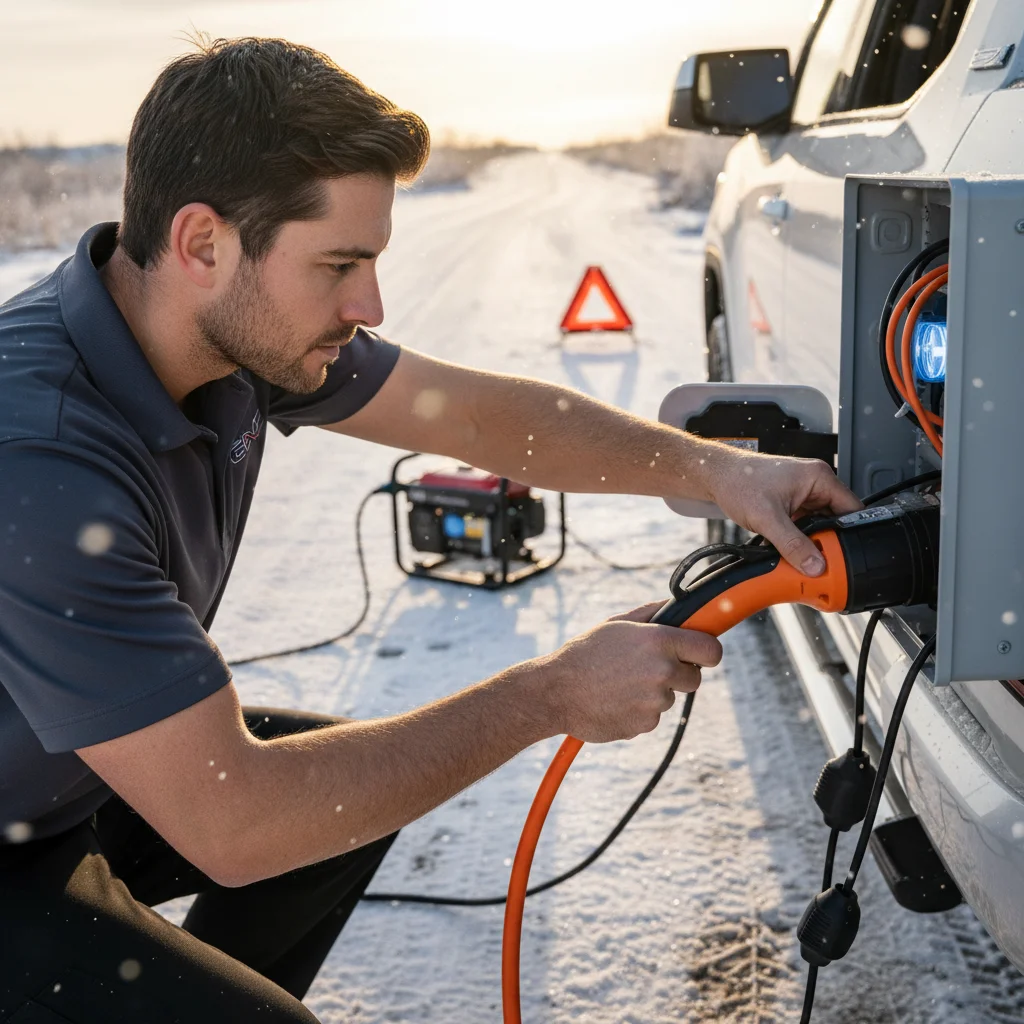
The operator brings a 240-volt Level 2 source. For a Sierra EV, that usually means the CCS or J1772 adapter, not the native NACS plug. Confirm the port when they arrive. Stay out of the charge path. Let them handle the cable.
They typically add 10 to 20 miles in 15 to 30 minutes of charging. Payload, heat, and grade will shape how far those miles actually go. A loaded bed on the Cajon climb isn’t an empty-cab city hop. Ask for enough buffer to reach the stall or driveway you named. Don’t ask for a full pack the visit can’t deliver.
The operator quotes before starting. If the quote doesn’t work, say no. Charge Pro IE doesn’t set the price. The operator bills you. There’s no published fee on this site because the operator sets it, and it changes. Confirm the figure they give you before they plug in.
We serve cities across Riverside County and San Bernardino County. That’s the service area. It isn’t a promise of when someone arrives. Give a pin that a driver can find. Stay with the truck.
After the cable comes off, don’t sit in climate and idle away the new buffer. Drive to the stall or the driveway you named. Plug in there for the rest. The roadside visit is a bridge. The wall box or the public stall is the fill.
Towing a Sierra EV versus charging it in place
A mobile charge is for an energy problem. It isn’t a repair. If a tire is off, a control arm is bent, or the truck won’t accept a charge after the 12-volt is awake, you need a different kind of help.
A Sierra EV is a heavy electric pickup. Flat-towing with drive wheels on the ground is often the wrong move for an EV. A flatbed is the usual safe method. Confirm that with the tow company. Charge Pro IE doesn’t tow. If you’re choosing between a charge and a hook, towing a dead EV versus a mobile charge lays out the split.
Don’t invent wait times for either option. A tow still leaves you needing a charger at the other end. A Level 2 visit tries to skip that second wait when the only problem is an empty pack. If the truck must leave the shoulder for safety, a tow can still be the right first move. Then you charge wherever the truck is allowed to sit.
A Sierra EV also takes more bed length than a compact crossover. Tell the tow company the model. Ask whether they have a bed that fits. This site doesn’t publish a tow rate or a truck count. Those figures weren’t verified here, and the operator on that call is a different business anyway.
Public stalls, travel cords, and other EVs
If the truck can still roll a short distance, a public CCS stall may be the cleaner fix. Use the truck’s nav, PlugShare, ChargePoint, or another app you already trust. Filter for a connector your Sierra EV will take. Confirm the stall is online before you spend the last miles.
This site doesn’t publish a count of Inland Empire public ports. It also doesn’t estimate how far you are from the next one. Those figures weren’t verified for this page. If a stall is listed, treat the listing as a lead. Then verify.
Waiting at a failed public charger while the pack is already critical is how people strand in place. If the truck can’t reach a working stall, call for the mobile visit. Don’t spend the last percent hunting a pin that isn’t live.
A 120-volt travel cord on a warehouse outlet, if you can even get permission to use it, is a trickle. For a full-size electric pickup it’s a last resort, not a freeway plan. A portable 240-volt unit only helps if a matching outlet exists and you have the right connector. Most shoulders and most warehouse rows won’t offer that outlet.
GMC’s ProPower Onboard system feeds external AC loads from the truck. It’s for tools, lights, and jobsite gear. It isn’t a designed way to charge another EV’s traction pack on the shoulder. Don’t plan a rescue around a second electric vehicle. Can one EV charge another covers what actually works, and what usually doesn’t.
Which utility feeds the plug you meant to use
The Inland Empire isn’t one electric company. That matters for overnight charging, not for the roadside visit. The operator doesn’t bill your utility. Your home rate still decides whether the truck starts the next shift full.
Southern California Edison serves most of the mapped cities. That list includes Fontana, Ontario, Chino, Upland, San Bernardino, Rialto, Highland, Loma Linda, Grand Terrace, Redlands, Yucaipa, Corona, Norco, Eastvale, Jurupa Valley, Perris, Menifee, Lake Elsinore, Wildomar, Canyon Lake, Hemet, Temecula, Murrieta, Beaumont, Calimesa, Hesperia, and Adelanto. SCE publishes a residential EV plan named TOU-D-PRIME. Confirm the current rate on SCE’s site before you assume overnight charging is cheap.
Several cities aren’t SCE, or aren’t only SCE.
Riverside is Riverside Public Utilities, serving throughout the city since 1895. RPU publishes an Electric Vehicle Rate. Confirm it with RPU. Don’t mix it with SCE’s plan. Riverside’s ACS 2019-2023 population is 319,069. That’s a lot of driveways on a utility people still call “Edison” by habit.
Colton owns its electric infrastructure inside city boundaries. City of Colton Electric Utility is the name. A Colton driveway isn’t an SCE driveway.
Moreno Valley is split. SCE serves part of the city. Moreno Valley Utility serves newer development since 2004 and publishes an address lookup. Check the lookup before you talk about rates. Moreno Valley’s ACS 2019-2023 population is 211,666. The wrong utility name on a rebate form is a real delay.
Rancho Cucamonga is split too. SCE covers most of the city. Rancho Cucamonga Municipal Utility covers a southeast pocket, including The Enclave, Day Creek Square, The Resort, and the Victoria Gardens area. RCMU says that pocket covers over 3,900 metered businesses and residents. If you live there, RCMU is your utility.
Banning has City of Banning Electric Utility. Big Bear Lake and Big Bear City sit on Bear Valley Electric Service. Lake Arrowhead and Crestline are on SCE’s tariff index, not on Bear Valley’s service-area page.
Victorville residential service is SCE. Victorville Municipal Utility Services serves only the Southern California Logistics Airport and Foxborough Industrial Park. It states it doesn’t provide utility services in residential areas at this time. Don’t treat VMUS as house power.
San Jacinto has SCE delivering, and San Jacinto Power supplying generation as a community choice aggregator. Apple Valley has SCE delivering, and Apple Valley Choice Energy procuring. Those splits change the generation charge. They don’t change the truck.
A home Level 2 plug is still the ordinary way to start a workday. The roadside visit is the backup when that plan fails. Rebates and EV rates change, and funding runs out. This page won’t quote a rebate or a per-kWh price. Confirm both with the utility that actually serves your meter.
If the house power is out, a home backup system still may not reach a truck parked on the street. That’s a different problem from an empty pack on I-15. Call for the mobile visit when the truck is the thing that has to move.
Manufacturer roadside, insurers, and this referral line
Many new GMC trucks ship with some form of roadside plan. The terms weren’t verified for this page. Open the GMC app, the glove-box packet, or the coverage sheet that came with the truck. Read what it actually sends. A lot of conventional roadside programs still think in tows. A tow may not be what you want for an empty pack.
Insurer roadside is the same homework. Ask whether they send a mobile Level 2 source for a depleted EV, or a hook. Don’t assume.
Charge Pro IE is the local backup when you want an independent operator who already does this work. The pros we connect you with are licensed. Charge Pro IE itself holds no licence, owns no fleet, and publishes no hours.
If GMC or your insurer will send a flatbed, you can still choose a Level 2 visit instead. That’s your call after you hear both quotes. This page can’t tell you what your policy year covers. Only the packet in your truck can.
Keep the next shift from starting empty
Home Level 2 is the ordinary fix. Set a habit. Plug in at the end of the shift, not when the percent looks scary. If you’re on SCE, look at TOU-D-PRIME and confirm off-peak windows on SCE’s current page. If you’re on RPU, Colton Electric, MVU, RCMU, Banning Electric, or Bear Valley Electric Service, use that utility’s EV page.
Watch payload. Watch the Cajon and I-10 climbs. Leave a buffer. Ten to twenty percent remaining is a common driver habit. It isn’t a GMC rule this site can certify. Use whatever buffer your own energy graph supports.
Keep the 12-volt in the story. A work truck that sits with loads on can kill the small battery while the pack still has energy. If the truck shows a 12-volt warning, deal with it before the next desert run.
Software updates and GMC’s service schedule live on GMC’s side. Follow them. This site doesn’t publish a Sierra EV maintenance interval.
Use the truck’s nav plus an app you trust before a loaded run to Adelanto or a pre-dawn Fontana shift. Confirm the stall you might need. Then still leave a buffer. Apps help. They don’t replace the last 15 percent.
If two drivers share the truck, say the handoff percent out loud. A crew cab that left Ontario at 40 percent with a loaded bed isn’t the same truck that left at 40 percent empty. The second driver shouldn’t have to discover that on the Cajon.
Frequently asked questions
Who sets the price for GMC Sierra EV emergency charging
Charge Pro IE doesn’t. The independent operator quotes you before charging starts, then bills you directly. No fee appears here because none was verified as a published rate. Inventing one would be wrong. Ask for the quote. Compare it with a tow if you want. Then decide.
How long does a mobile charge take on a Sierra EV
Charging time is typically 15 to 30 minutes, adding about 10 to 20 miles of range. That’s charging time only. Arrival isn’t promised. Heat, payload, and the next grade will change how far those miles last. The goal is enough range to reach a stall or a driveway you name, not a full pack.
Can another EV charge a stranded Sierra EV
Don’t count on it. Bidirectional charging isn’t a standard roadside method. ProPower Onboard is for AC tools, not for filling another vehicle’s traction battery. Call for a Level 2 operator instead.
When the Sierra EV is already stopped, the useful call is the one that sends a quoted Level 2 source to the truck. Charge Pro IE matches Inland Empire drivers with those operators. For GMC Sierra EV emergency charging, call (909) 250-2881. Say you’re in a warehouse lot, on a High Desert shoulder, or on a named freeway. Stay with the truck until the operator finishes the quote.