The cost to tow an EV inland is more than the hook. RCTC freeway patrol will tow a stalled car. The Riverside County Transportation Commission’s pages never mention electric vehicles. A tow can clear a shoulder on the 15, the 10, or the 91. It doesn’t add range, and it doesn’t jump a dead 12-volt. It also doesn’t confirm a working plug at the drop.
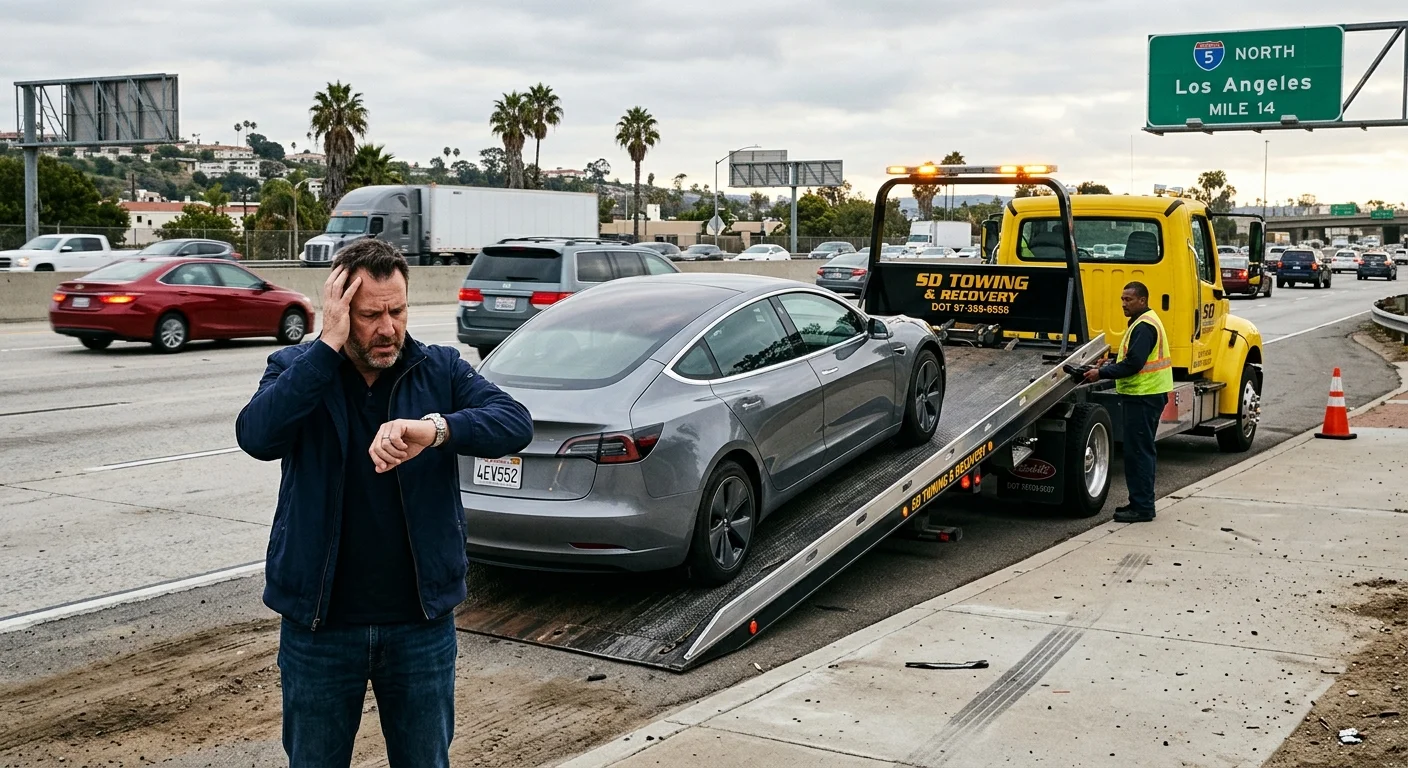
RCTC will tow. It doesn’t treat an EV as an EV
RCTC freeway patrol is a Riverside County program. You stall, a truck comes, and the car leaves the lane. That sequence fits a gas car that overheated. An empty Tesla, Rivian, or Bolt is a different problem.
The patrol’s public pages don’t mention electric vehicles. They don’t mention NACS, CCS, or J1772. They don’t mention Transport mode or a 12-volt that killed the contactors. This page couldn’t verify an EV procedure on those pages. Confirm the patrol rules with RCTC before you accept a hook.
A tow still has a use on the Cajon climb toward Victorville. It can clear I-10 through Colton, Redlands, or Banning. It can move a dead car on SR-91 in Corona. It can pick up a stall on I-215 through Moreno Valley and Perris. Moving the car isn’t the same as recovering it.
Read Tesla flat tire coverage, and the Inland Empire’s free freeway option.
This page couldn’t confirm an EV patrol policy for San Bernardino County. Ask the agency running that freeway. Don’t assume Riverside County rules follow you over the county line.
Nobody here can quote the cost to tow an EV
No verified inland tow rate turned up for this page. Not a hook charge, a per-mile add-on, or a flatbed premium. A number on this page would be a guess, and we don’t guess.
The operator who shows up sets the price. That’s true for a tow company and for a mobile charge. Charge Pro IE doesn’t set prices, and we don’t bill you. The independent operator quotes you before starting, then bills you directly. Ask what the quote includes and where the car is going. Ask whether that place can charge your connector. Ask whether the truck is a flatbed.
For the mobile-charge side of that talk, see who sets the price when you need a mobile EV charge.
A dead dash isn’t always an empty pack
A lot of dead-EV calls are 12-volt failures. The small battery runs the computers, the latches, and the high-voltage contactors. When it dies, the car looks bricked. Towing that car to a Supercharger does nothing if the contactors can’t close.
The operators we send can jump or replace a dead 12-volt on site. They handle Tesla and every major EV brand. If the car wakes, you may not need a hook.
An empty pack is the other case. The display is honest, and the miles hit zero. A tow can take you toward a plug. A mobile EV charging visit brings a 240-volt Level 2 source to the bumper. Native NACS for Tesla, and a CCS or J1772 adapter for everyone else. Operators typically add 10 to 20 miles in 15 to 30 minutes of charging. That window is charging time, and it’s never an arrival time.
The wrong tool is how you buy a second trip.
Inland roads change what a tow is worth
The Inland Empire isn’t one commute. The Cajon grade on I-15 toward Victorville is a truck climb with a hot shoulder. I-215 through Moreno Valley and Perris is valley heat and fast lanes. SR-60 through Jurupa Valley is warehouse traffic. The 91 through Corona stacks even when the pack is fine. Ortega Highway near Wildomar is a canyon alignment with little room to wait.
High Desert towns sit after that climb. Adelanto, Hesperia, and Apple Valley add long, hot miles once you clear Cajon. Lake Arrowhead, Crestline, Running Springs, and Big Bear Lake add elevation. A drop in the wrong basin can leave a car that still can’t get home.
Fontana warehouse rows and Ontario airport lots are shift vehicles that need to move. Cabazon and Glen Helen are the event version of the same stall. You parked, and the car won’t wake. A yard across town doesn’t finish that day.
This page doesn’t claim any of those roads lack public charging. Named sites exist across the basin, including Tesla stalls in Calimesa. The tow still has to hit a stall that’s open, working, and the right plug. That last check is where the extra trip starts.
For the Cajon climb, see out of charge on I-15 at the Cajon climb toward Victorville.
A tow home isn’t one charging plan
The Inland Empire isn’t one electric company. Southern California Edison covers many cities, but not all of them. Riverside Public Utilities serves the city of Riverside. Colton and Banning run their own electric utilities. Big Bear Lake and Big Bear City sit on Bear Valley Electric Service. Rancho Cucamonga and Moreno Valley each have an SCE area and a municipal pocket.
A tow home still depends on a working charger at that address. Charge Pro IE doesn’t run those utilities. If the home charger is dark, the car is still dead in the driveway. You need a mobile charge at the curb, not a second tow. See home charger install versus a mobile charge when yours is down.
Flatbeds matter when the pack has no power
Most EVs shouldn’t be wheel-lifted. Two wheels on the pavement can spin a motor that isn’t in Neutral. Regenerative hardware and the drive unit aren’t built for that drag. Tesla publishes its own no-power tow steps. For a Model 3, Y, S, or X with a dead pack, use a flatbed. Keep all four wheels up. A dolly that leaves a drive axle down can ruin a drive unit.
See how to tow a Tesla with no power without damaging the drive unit.
RCTC pages don’t walk you through that. A truck sent for a gas-car spinout may not have a flatbed. The driver may not know Transport mode. If the 12-volt is dead, Transport mode may not wake.
A mobile charge skips the drivetrain question. The car stays put, so nobody winches it or guesses Neutral.
The extra trip is the cost people miss
The first truck takes you to a public stall. That stall can be occupied, offline, or the wrong connector. You’re still dead, and now you need another hook.
This page doesn’t guess how often that happens inland. A tow is transport, not a charge confirmation. If you can’t verify the plug before the truck rolls, you’re gambling the next hour.
Operators we send check the port and bring the matching adapter. They add enough range to reach a charger you choose. 10 to 20 miles is sometimes enough to get home. You aren’t hoping a lot you’ve never seen has an open stall.
See mobile EV charging vs a tow: which one do you actually need.
What a roadside Level 2 visit is, and isn’t
Charge Pro IE is a referral line. We match stranded EV drivers with independent local mobile rescue operators. We don’t own trucks, employ technicians, or hold a license. We publish no hours and promise no arrival time. The operator who takes the job quotes you first.
They bring 240-volt Level 2 to the car. They jump or replace a dead 12-volt on site. They don’t rebuild a pack. They don’t replace a freeway patrol when the lane must be cleared now.
If the shoulder is unsafe and a patrol is arranging a tow, take it. A charging plan doesn’t beat a live lane. Call for a mobile charge once the car is in a legal, stable spot. Or call us first if you’re already clear of traffic.
When the tow is still the right call
A mobile charge can’t fix a bent control arm. It can’t roll on a destroyed tire. If the car is in a live lane, get it out. If you need a dealer, you need a flatbed to that dealer.
Use a tow for a live lane or a mechanical failure. Use it when you already know the destination can charge this connector. Use it when a patrol on scene is already arranging the hook.
Use a mobile charge when the pack is empty and the car can stay put. Use it for a 12-volt failure on an otherwise intact car. Use it when you don’t have a verified plug at the far end.
Ontario airport lots and Fontana warehouse rows are usual stay-put cases. Cajon and I-10 through Banning can put you in a live lane.
Ask three things before the strap goes on
Ask whether they have a flatbed and where the car is going. Ask whether that place can charge your connector. If any answer is vague, pause. The cost to tow an EV is the first ticket. It’s the next one too if the drop fails.
Charge Pro IE can connect you with a local operator. Call (909) 250-2881. The operator quotes before any cable goes in. You pay that operator directly.