How long a Ford Lightning charge takes depends on the pack. It also depends on which plug you land on. On DC fast, Ford lists about 41 minutes from 15 to 80 percent. That’s the Extended Range pack under ideal conditions. A home Level 2 fill commonly runs 8 to 10 hours. If you’re stuck on an Inland Empire shoulder, the clock is different. A roadside Level 2 visit typically adds 10 to 20 miles. That bump lands in 15 to 30 minutes of charging. That’s charging time, never an arrival time.
Three clocks, not one charging time
Drivers asking how long it takes to charge a Ford Lightning want one number. There isn’t one. Overnight at home is one clock. A DC fast stop on I-10 or I-15 is another. A mobile Level 2 hookup on the shoulder is a third. Mix those up and you’ll plan the wrong stop.
This truck makes the split sharper than a small EV. It’s a full-size pickup with a work-truck battery. Empty-to-full at home is a long sit. A road-trip top-up can be a short stall stop if the station delivers. A rescue charge only buys enough miles to reach a working plug. Those plugs don’t behave the same. See home 240-volt charging versus a roadside Level 2 hookup.
The two packs don’t share one timeline
Ford sells the Lightning with two battery options, and they don’t fill alike. The Standard Range pack is about 98 kWh total. Usable energy sits around 89.5 kWh. The Extended Range pack is larger at about 131 kWh total. Usable energy sits around 120 kWh.
A bigger pack takes more hours to fill from empty at home. At a DC fast charger it also tends to take a higher peak rate. That’s why the two packs don’t scale with the kWh gap. Fast-charge windows end up close. Overnight hours still run longer on Extended Range.
The honest answer is which battery, which charger, and what state of charge. Plan around your actual truck, not a generic Lightning number.
Heat, grades, and inland miles
Charging time is the plug, and remaining range is the road. In this market those two fight each other. Valley heat in Riverside and San Bernardino pulls extra miles from the pack. The Cajon climb on I-15 toward Victorville eats miles on the way up. That route is covered in out of charge on I-15 at the Cajon climb. I-10 through Redlands, Beaumont, and Banning does the same with a load.
That’s not a change to Ford’s spec-sheet minutes. It changes when you need the next session. A Lightning leaving Fontana at 30 percent can go empty sooner on a grade. Ontario airport cargo rows do the same after a long idle with climate on.
Mountain nights are a different story. Big Bear Lake and Big Bear City sit on Bear Valley Electric Service, not SCE. Lake Arrowhead and Crestline stay on Southern California Edison. A colder pack at a DC stall generally accepts power more slowly. Valley heat is the everyday range tax. A cool battery shows up on the mountain trips.
Home charging: the overnight clock
A regular 120-volt outlet is Level 1. It can add energy, but it’s not a daily plan for a battery this size. Meaningful range overnight takes many hours. A full charge from empty can take several days. Most owners treat Level 1 as a backup, not a routine.
Level 2 at 240 volts is the overnight clock that actually fits a Lightning. Ford’s Charge Station Pro delivers up to 80 amps on a dedicated circuit. Ford’s published times put Extended Range empty to full around 8 to 10 hours. The Standard Range pack lands around 6 to 8 hours. A 48-amp home charger stretches a full fill to around 12 to 14 hours. Plug in after work and you’re usually whole by morning.
That assumes you already have a 240-volt circuit. A lot of Inland Empire housing doesn’t. ACS 2019-2023 puts 60.9 percent of San Bernardino housing built before 1980. Riverside sits at 56.4 percent, and Redlands at 60.4 percent. Eastvale is 2.2 percent. Older panels in the San Bernardino Valley often leave a truck on a slow outlet. Newer Eastvale streets are a different stock. If the panel is the bottleneck, start with older Inland Empire panels and EV chargers. A licensed electrician confirms capacity. Charge Pro IE doesn’t install circuits or sell hardware.
Your house meter may not even be Southern California Edison. Riverside Public Utilities serves the city of Riverside. Colton owns its electric infrastructure inside city limits. Banning has a city electric utility. Rancho Cucamonga has an RCMU pocket around Victoria Gardens and nearby tracts. Moreno Valley Utility covers part of newer Moreno Valley development. Those names change who you call about a home charger, not Ford’s charge curve.
DC fast charging: Ford’s minutes, and what inland stalls do
This is where Ford Lightning charging time gets short enough for a highway stop. Ford publishes a 15 to 80 percent DC window around 41 minutes. That’s Extended Range, on a stall that can feed the truck. Standard Range sits around 44 minutes under the same conditions. Both assume a mild pack temperature. They also assume the station actually delivers its rating.
Real stalls often don’t. An older or crowded public charger can run below the number on the cabinet. Speed also isn’t flat from 15 to 80 percent. Like most EVs, the Lightning accepts power fastest in the middle of the session. It tapers as the pack fills. That’s why most fast stops target 80 percent, not 100. The last 20 percent can take nearly as long as everything before it. A Chino jobsite or a Temecula lot usually doesn’t need a full pack.
A loaded work day changes the curve a little. Towing or hauling before you plug in can leave the pack off the lab curve. None of that is unique to Ford. A truck this heavy just makes the swing easier to notice. Start a DC session already high in the pack and the useful window shrinks. The percentage may climb quickly, but the miles you add may not.
What a roadside Level 2 visit actually adds
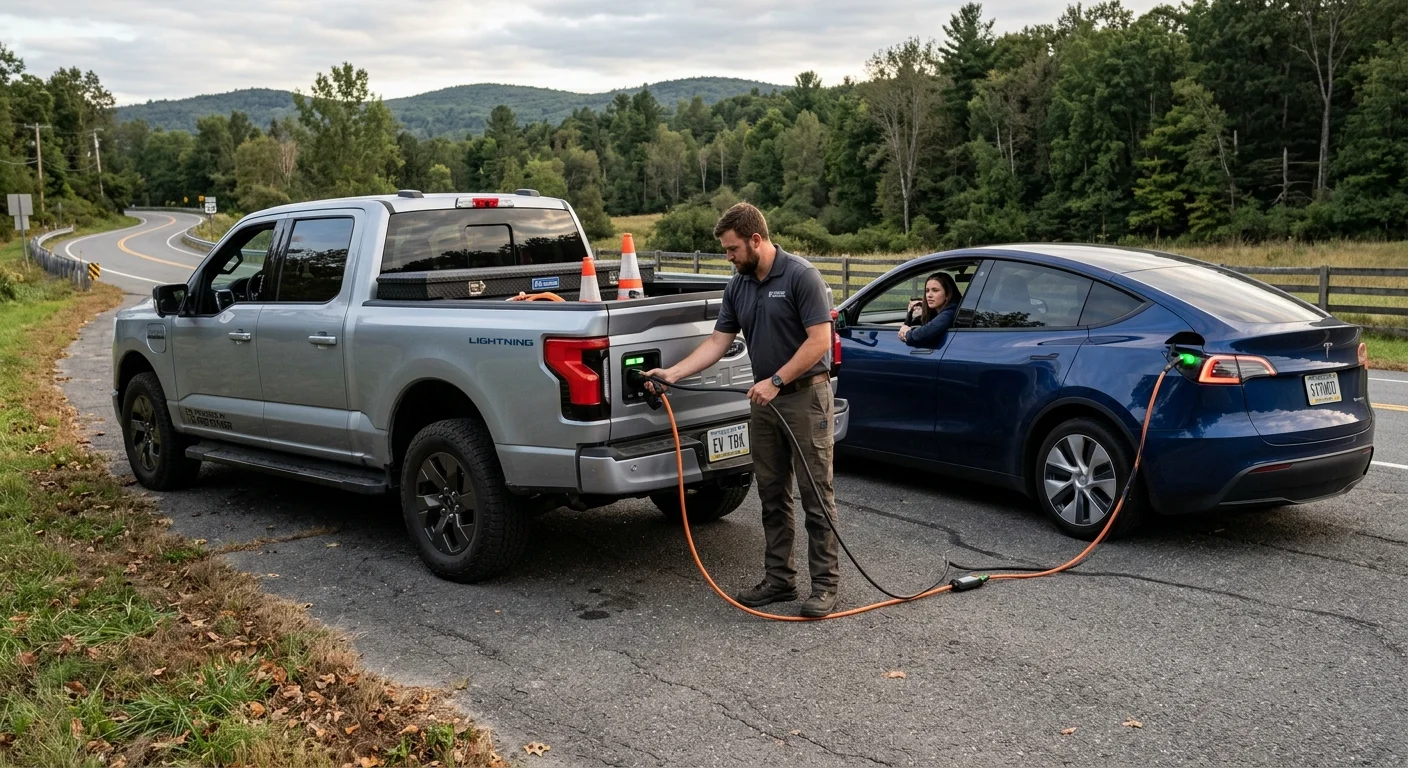
If the pack is too low to reach a DC stall, those numbers don’t help. Operators we connect you with bring a 240-volt Level 2 source to the truck. For a non-Tesla EV they use a CCS or J1772 adapter as needed. They typically add 10 to 20 miles in 15 to 30 minutes of charging. That’s charging time on site, not when someone shows up.
The goal is enough miles to reach a working charger, not a full pack. Fontana warehouse rows and Chino work lots see this a lot. So does the 91 in Corona. Charge Pro IE is a referral line. We don’t own trucks, set prices, or employ technicians. The operator quotes you before starting and bills you directly. Start at mobile EV charging if that’s the call you need.
When the Lightning won’t charge at all
If the Lightning isn’t taking power at all, that’s not a time problem. A truck that won’t accept a charge often has a 12-volt issue. That’s not a dead traction pack. Same if it won’t start after you unplug. Walk through Ford F-150 Lightning won’t start: the dead 12V fix. If you’re asking whether this truck can feed another stranded EV, that’s a different job. We cover it in can an F-150 Lightning charge another EV on the shoulder.
If you’re already stranded inland
Charge Pro IE matches stranded EV drivers with independent local mobile rescue operators. We serve the Inland Empire. We don’t perform the charge. We don’t hold a contractor license for the work. The pros we connect you with bring Level 2 for Tesla and other EV brands. That includes the Lightning. They can jump or replace a dead 12V on site when that’s the actual fault.
Call (909) 250-2881 when you need that match. The operator on the other end quotes before starting.
Frequently asked questions
How long does a Ford Lightning take to charge at home?
On Ford’s Charge Station Pro, Standard Range typically fills in roughly 6 to 8 hours. Extended Range commonly runs 8 to 10 hours. Starting percent and your charger’s amperage both move those windows. A 48-amp unit runs longer than an 80-amp circuit.
How fast does a Ford Lightning charge on DC fast charging?
Ford’s published specs list about 41 minutes from 15 to 80 percent on Extended Range. Standard Range sits around 44 minutes on a stall that matches the truck’s peak rate. Real stations often run longer. Heat, a cool pack, and a weak stall all stretch the session.
What does a roadside Level 2 charge add on a Lightning?
It typically adds 10 to 20 miles in 15 to 30 minutes of charging. That’s enough to reach a working charger, not a full overnight fill.