The Lightning has been sitting in a Fontana warehouse stall since the morning drop. You tap the fob. Nothing. The screens stay black, and the front trunk won’t pop. That stall is usually a dead 12V battery, not an empty traction pack. The truck can still hold plenty of range in the high-voltage battery. It just can’t wake the computers that connect that pack.
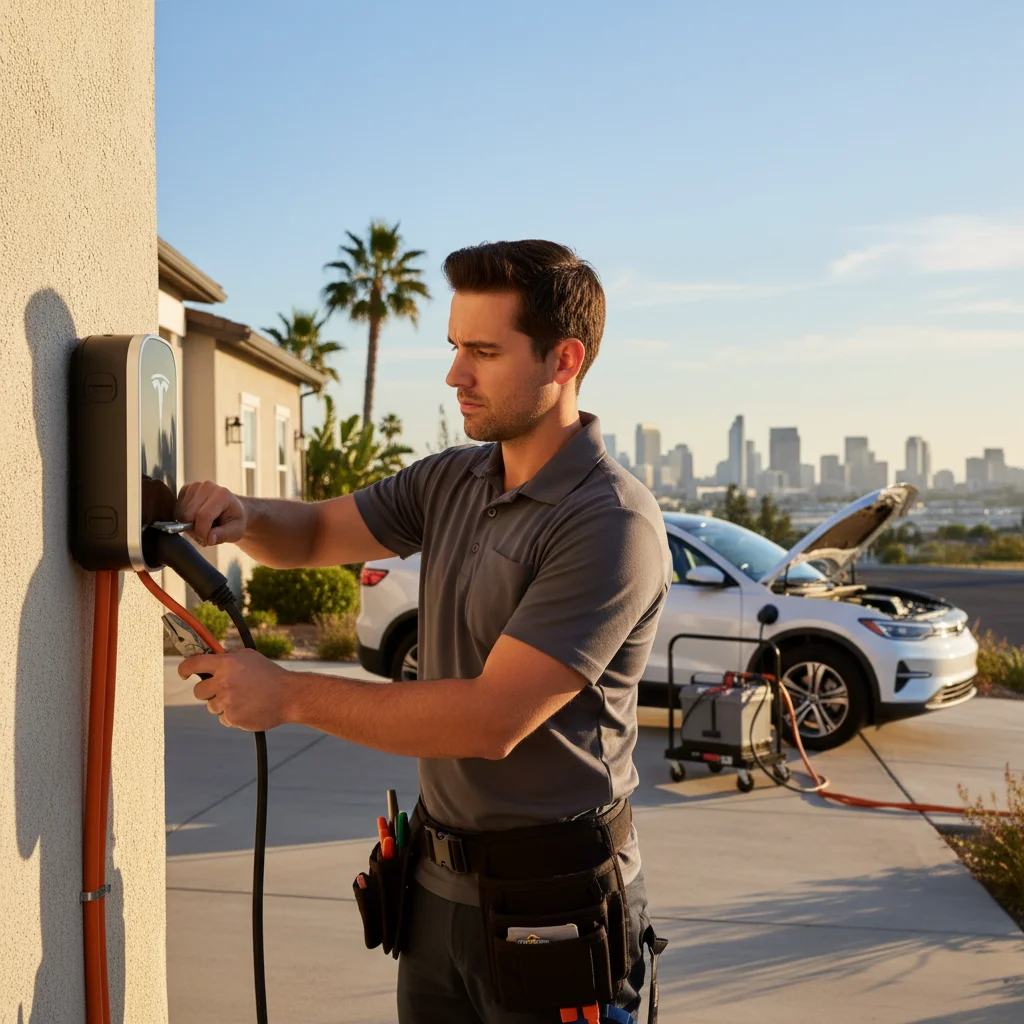
Work-site idle is what kills the 12V
Fontana, Ontario, and Chino run on warehouse time. Fontana has 214,169 residents in the ACS 2019-2023 count. Ontario has 180,547. Chino has 92,652. Those aren’t small towns. They’re the west-valley freight belt. Ontario has airport cargo lots. Fontana has long industrial rows off the I-10.
A Lightning used as a job truck spends hours parked. Doors get left ajar. Cabin screens stay half awake. Work lights, inverters, or Pro Power Onboard pull current while the truck is off. Short hops between docks never give the DC-DC converter a long run. The small 12V battery takes that load. The traction pack barely notices.
Bloomington sits unincorporated between those yards. A shift that ends there can leave the same dark truck. Jurupa Valley adds SR-60 freight. Rialto sits on the same belt. The streets change. The 12V failure doesn’t.
Southern California Edison serves Fontana, Ontario, and Chino. Riverside is different. Riverside Public Utilities has served that city since 1895. A crew can work a Fontana lot all day. Then they drive home to Riverside and plug into a different utility. That still doesn’t wake a Lightning that already went dark at the dock. The 12V has to come back first.
Charge Pro IE is a referral line. It matches stranded EV drivers with independent local mobile rescue operators. The pros we connect you with are licensed. The brand itself holds no license, owns no trucks, and employs no technicians. The operator quotes you before starting, then bills you directly.
Two batteries, and only one can wake the truck
The Lightning stacks two power systems. The traction pack is the large high-voltage battery under the bed. It turns the motors. The 12V is a small auxiliary battery. It’s like the starter battery in a gas F-150. It runs locks, lights, screens, and the contactors that close the high-voltage circuit.
No 12V means those contactors stay open. The truck can’t pull power from the pack to save itself. You sit in a Fontana stall with a full truck that won’t boot.
That’s why a Lightning can look completely dead after a long idle. The energy is still in the pack. The switch to use it isn’t. Other EVs fail the same way. Work-site Lightnings just hit it after sitting. When the 12-volt dies, why the EV looks completely dead walks through that split.
Walking back to a dark truck
You finish a long sit on an Ontario warehouse street. You reach for the fob. The truck doesn’t unlock. The phone app doesn’t wake it. That’s the first clue.
You get a door open somehow. The cabin is silent. No chime. Interior lights are dim or out. The center screen stays black, or it flickers and dies. Relays may click once. That’s the second clue.
The power frunk stays shut. The electric latch needs 12V, so the lid won’t release on command. That’s the third clue, and it blocks the jump terminals.
You try to plug in anyway. Nothing happens. The truck can’t start a charge session without the 12V computers. That’s the fourth clue.
An empty traction pack looks different. The screens usually still work. You get a low-range warning or reduced power. Or the truck won’t shift into Drive. The computers are awake. They’re guarding an empty pack. A 12V jump won’t add miles. A mobile charge might.
If nothing on the truck wakes, treat it as 12V until proven otherwise. If the truck lights up and then refuses to roll, treat it as a pack issue.
Ontario covers nearly 50 square miles. Fontana covers about 43. A stall in an airport cargo lot feels different from a Fontana industrial row. The 12V checks don’t.
A High Desert work lot is still a 12V problem
Most west-valley lots sit on Southern California Edison. Victorville is split. Residential Victorville is on SCE. Victorville Municipal Utility Services serves only the Southern California Logistics Airport and Foxborough Industrial Park. It doesn’t serve homes. A Lightning parked at that industrial park is on a different utility than a house across town. The 12V still dies the same way after a long idle. The home plug later is the part that changes.
Opening a dead frunk, then jumping the 12V
Ford put the 12V battery and the jump terminals in the frunk. That’s a problem when the latch has no power. The Lightning includes a manual release for this. It’s a mechanical tab or cable that pops the lid without electricity. The location varies by model year. Read your owner’s manual before you start pulling on trim.
With the frunk open, look for dedicated jump terminals. You want a positive post under a red cap, marked +. You want a negative ground nearby, often a bare metal stud or a body bracket. Clamp a jump pack or a 12V donor to those points. Don’t clamp onto orange cables. Those are high voltage. You’re only reviving the 12V system.
If you can’t tell the jump terminals from the high-voltage hardware, stop. Don’t guess. Call for a non-Tesla EV rescue. Charge Pro IE connects you with an operator who will do that clamp work. How to jump start an electric car without frying the 12V covers the cable order.
Once the 12V comes back, give the truck a minute to boot. Locks should answer. Screens should light. Then see if it will shift. If it wakes and still won’t move, you have a different problem than the 12V.
What a local operator does in the lot
The operator the network sends will test the 12V first. If it’s only discharged, they jump it at the Ford terminals. When the truck wakes, the DC-DC converter can refill the 12V from the pack. If the 12V won’t hold, they can replace it on site.
They don’t install home chargers. They don’t rewire Pro Power Onboard. They don’t diagnose a high-voltage fault beyond getting you rolling. A licensed electrician or a Ford dealer handles that once the truck can leave the lot.
On a Chino work lot the order is the same as Fontana. Confirm 12V, jump or replace, then test Drive. Chino’s work-lot write-up is here: EV roadside assistance in Chino when a work-lot pack is dead. Fontana warehouse rows: A dead EV by a Fontana warehouse: who you actually call. Ontario airport and warehouse streets: EV rescue around Ontario airport lots and warehouse rows.
If the traction pack is the one that’s empty
A true empty pack is a different call. Jumping the 12V won’t create miles. The operator brings a 240V Level 2 source to the Lightning. For a non-Tesla they use a CCS adapter. Typical charging time is 10 to 20 miles of range in 15 to 30 minutes. That clock is charging time. It isn’t an arrival time.
Charge Pro IE doesn’t set the price. The operator quotes before they start. Ask while you’re on the line. For a pack that’s at zero, use out-of-charge recovery.
If your Lightning is dark on a warehouse lot, call (909) 250-2881. That number matches you with a local operator. The operator quotes before any work starts.
Frequently asked questions
Why won’t my Ford F-150 Lightning start after a long work idle?
The traction pack can still be full. The truck needs a healthy 12V battery to boot the computers. Those computers close the high-voltage contactors. A long sit in a Fontana, Ontario, or Chino lot can drain that 12V. Accessories, a door ajar, or Pro Power Onboard all add load. A 12V jump usually wakes the truck. Then the DC-DC converter can recharge it from the pack.
How do I get the frunk open with no power?
The power frunk latch needs 12V, so a dead auxiliary battery leaves it shut. Ford gives you a manual release, a mechanical tab or cable, for this. Check the owner’s manual for your model year. Once the lid is up, you can reach the jump terminals. Look for the red positive cap and the nearby ground.
Do I jump the 12V, or do I need a mobile charge?
Jump the 12V when the truck is fully dark: no screens, no fob, no frunk. A mobile charge is for an awake truck with no range left. If you’re unsure, describe the symptoms to the operator before they start. They quote the job they think you have, and they bill you directly.