You searched mobile EV charging near me. In the Inland Empire, that means a van at the car. Charge Pro IE is the referral line that matches that call. We connect you with an independent local operator. That operator quotes you before they start. Then they bill you directly.
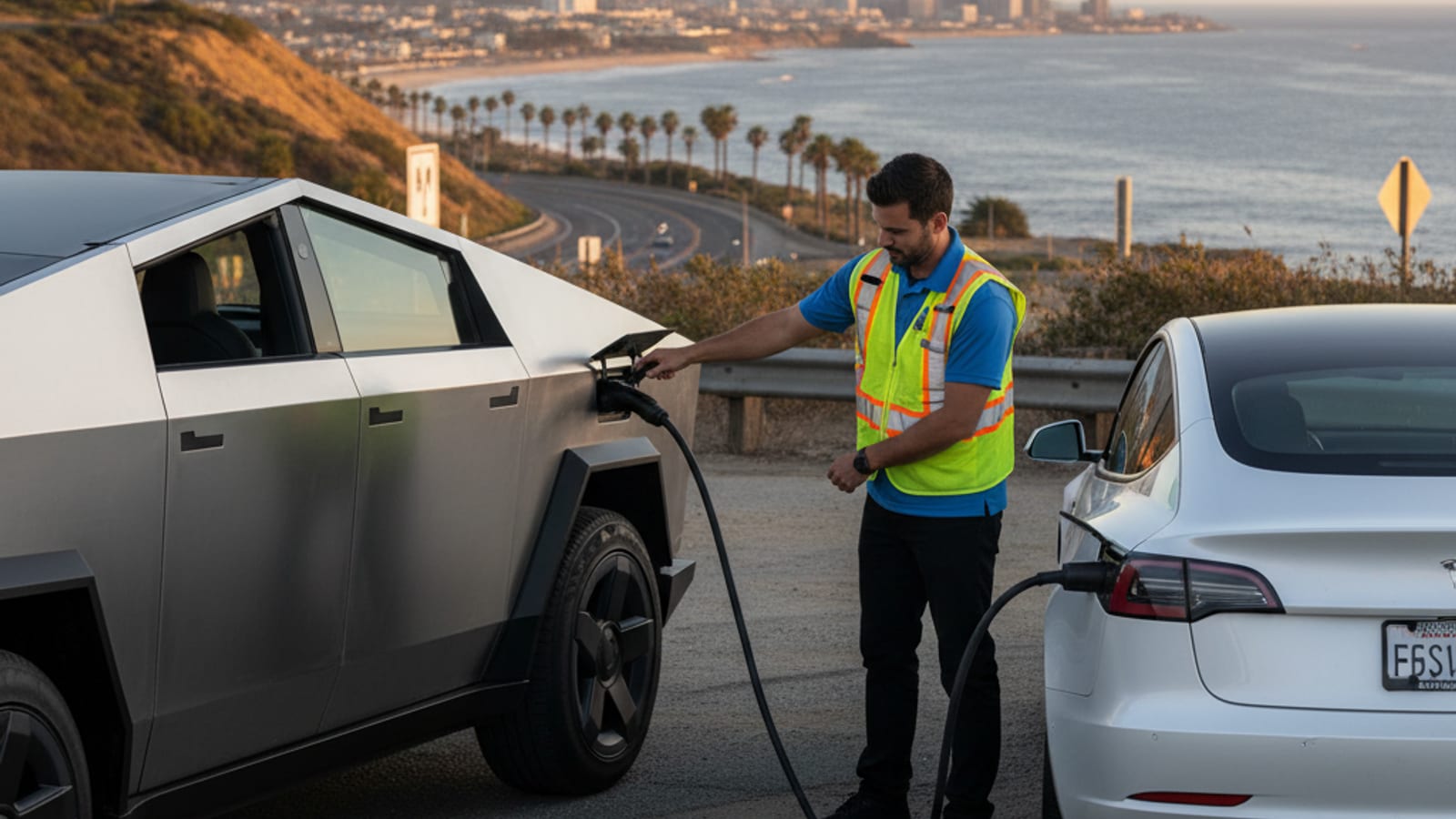
We don’t roll a branded fleet. We don’t own the Level 2 source in the bed. We don’t employ the person who plugs in. We serve the Inland Empire as a matchmaker, not as the crew on scene. The mobile EV charging visit is the operator’s job. That starts after you accept the quote.
What that search actually asks for here
“Near me” in this market spans two counties, not one suburb. Riverside County holds about 2,478,600 people on the ACS 2019-2023 count. San Bernardino County holds about 2,197,104. The same query can mean a stall on I-10 through Colton. It can mean a warehouse row in Fontana. It can mean a new Eastvale street. It can mean the Cajon climb toward Victorville.
Those places don’t share one electric utility. Southern California Edison serves a long list of cities. That list includes Chino, Ontario, Fontana, Corona, Temecula, and Hemet. Riverside is different. Riverside Public Utilities has served the city since 1895. Colton owns the electrical infrastructure inside its boundaries. Banning runs a city electric utility.
Rancho Cucamonga is split. SCE covers most of the city. Rancho Cucamonga Municipal Utility covers a southeast pocket. That pocket has over 3,900 metered businesses and residents. Named areas include The Enclave, Day Creek Square, The Resort, and the Victoria Gardens area. Moreno Valley is split too. Moreno Valley Utility has served newer development since 2004. It publishes an address lookup. Check the meter before you assume SCE.
San Jacinto still takes delivery from SCE. San Jacinto Power supplies the generation. Apple Valley is similar. SCE delivers. Apple Valley Choice Energy procures. Big Bear Lake and Big Bear City sit on Bear Valley Electric Service. That utility also names Lake Williams, Erwin Lake, Sugarloaf, Moonridge, Fawnskin, and Boulder Bay. Lake Arrowhead and Crestline aren’t on that list. They sit with SCE. Victorville homes are on SCE. Victorville Municipal Utility Services only covers the Southern California Logistics Airport and Foxborough Industrial Park. It doesn’t serve residential streets.
None of that tells you who shows up on the shoulder. A home charger in Riverside isn’t the same setup as one in Fontana. Utility cost context lives in what shapes Tesla charging cost across Inland Empire utilities. On the road, the job is simpler. You need a 240-volt Level 2 hookup at the car.
Housing stock isn’t one pattern either. ACS 2019-2023 figures show 56.4% of Riverside city housing was built before 1980. San Bernardino city is 60.9%. Ontario is 50.7%. Montclair is 68.5%. Crestline is 77.7%. Eastvale is 2.2%. Temecula is 6.5%. French Valley is 2.3%. Older panels and newer tracts fail in different ways. That’s a home-charging story. Don’t use it to guess the next public plug from where you stopped. We didn’t confirm a county-wide charger count from the sources for this page. Don’t plan a trip off a blog number.
Where Inland Empire drivers actually stall
We don’t guess the distance to the next charger. Those figures weren’t confirmed in the sources for this page. What we can name are the roads and lots where drivers call.
I-15 through the Cajon Pass is one. The climb toward Victorville is a real range eater. The car’s estimate can look fine in Rancho Cucamonga. Then it falls on the grade. Cajon stalls have their own walkthrough in out of charge on I-15 at the Cajon climb toward Victorville. I-215 through Moreno Valley and Perris is another long inland run. I-10 cuts Colton, Redlands, Calimesa, Beaumont, and Banning. SR-60 crosses Jurupa Valley. SR-91 through Corona backs up on weekdays. The Ortega near Wildomar is a two-lane mountain road. Lake Arrowhead, Crestline, Running Springs, and Big Bear add grade on the way up.
We didn’t confirm a published elevation figure for those climbs. Your car’s trip planner is the check.
Warehouse rows, airport lots, and overnight shifts
Fontana’s logistics lots fill with delivery vans after a long shift. Ontario’s airport parking is a full-day sit. Bloomington and Rialto catch the same end-of-shift pattern. The car may have idled on climate control. It may have sat with the 12-volt draining. Give the operator the dock number, the lot name, or a pin.
The 10, the 60, and the 91
I-10 is the east-west spine. Colton, Redlands, Calimesa, Beaumont, Banning, and Cabazon all sit on it. A stall there is usually a shoulder. Sometimes it’s a destination lot just off the ramps. SR-60 through Jurupa Valley carries mixed freight and commute traffic. SR-91 through Corona is stop-and-go more than it is a grade. Stop-and-go still burns range. We didn’t confirm a published figure for how much. Watch the car’s own estimate, not a rule of thumb.
South county and the wine-country miles
Temecula, Murrieta, French Valley, Winchester, Menifee, and Hemet are newer housing on this ACS vintage. Eastvale is newer still. That doesn’t put a Level 2 pedestal on every driveway. A new street can still leave you on a 120-volt trickle. Some driveways have no home plug at all. Canyon Lake, Lake Elsinore, and Wildomar sit west of that cluster. If you stop on a residential street, stay out of the travel lane. Send a pin.
High Desert after the Cajon
Victorville, Hesperia, Adelanto, Apple Valley, and Phelan sit on the far side of the pass. Homes in Victorville, Hesperia, and Adelanto are on SCE. Apple Valley adds the choice-energy layer on top of SCE delivery. Don’t assume a municipal truck is coming to a Victorville house. That municipal utility isn’t in the homes.
Mountain towns
Big Bear Lake and Big Bear City are Bear Valley Electric Service territory. Lake Arrowhead and Crestline are SCE. That split is easy to mix up. It matters for the house. It doesn’t change the roadside plug. Grade does. Going up costs range. If you’re already stopped in Running Springs or Crestline, stay put. Don’t nurse a sliver down the mountain. Get the car into a safe pull-out, then call.
What the operator actually brings
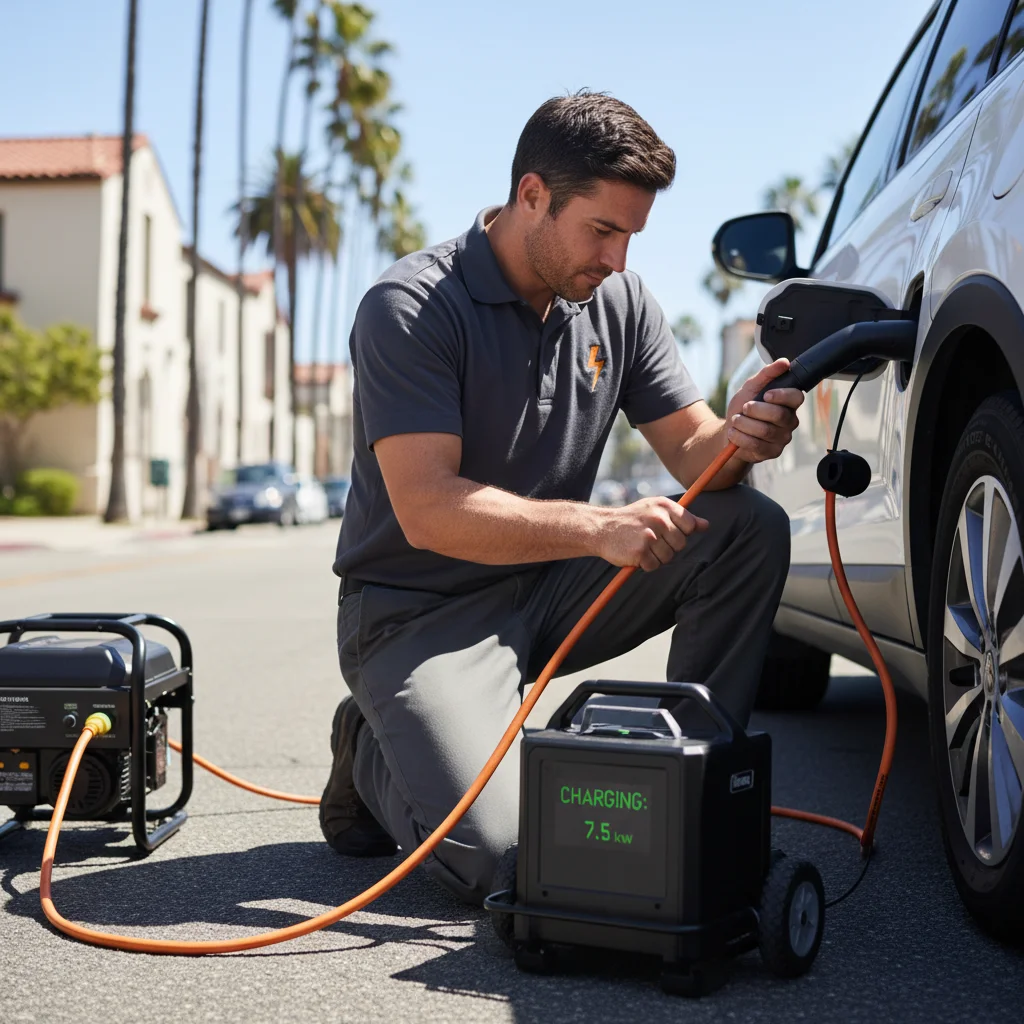
The operators we connect you with bring Level 2 power. It’s a 240-volt source at the car. Tesla drivers get a native NACS plug. Other EVs get a CCS or J1772 adapter. That covers Tesla and every major EV brand the network handles.
This isn’t a Supercharger on wheels. It isn’t a full pack fill. The typical on-site charge adds about 10 to 20 miles of range. That takes 15 to 30 minutes of charging time. That window is charging time. It isn’t an arrival time. Nobody here promises when the operator’s vehicle will pull up.
The visit without the gloss is in what a mobile EV charging visit actually is, and isn’t. The short version is a boost to roll again. You get enough range to reach a charger you already trust. Or you get home if home is close. Then you stop using the roadside hookup.
Operators can also jump or replace a dead 12-volt battery on site. A dark dash is often the 12-volt, not an empty pack. We don’t diagnose that over the phone as a certainty. The operator sees the car.
How the call actually works
You call the referral line. You give a location a person can find. Use a freeway mile marker, a cross street, a lot name, or a pin. You give the make, model, and year. Say if the car is silent. Say if it shows zero miles. Say if it’s still rolling on a sliver of range.
We match you with an independent operator who can take the job. That operator quotes you before any cable goes in. You accept or you don’t. If you accept, they bill you directly. Charge Pro IE doesn’t set that price. We also don’t publish a rate card, a deposit, or a fee. If a page invents a number, ignore it.
Stay in the car if that’s the safe move. Hazards on. Doors locked. If you have to step out, exit away from traffic. We don’t quote a wait. Traffic on the 91, the 60, and the Cajon can change the operator’s clock. That clock is theirs to state.
Empty pack or dead 12-volt: don’t mix them up
A lot of “the EV died” calls aren’t an empty traction pack. Most EVs still use a 12-volt battery to wake computers, locks, and contactors. If that 12-volt is flat, the car can look fully dead. The main pack may still hold miles.
Tesla, Rivian, Ford, Hyundai, Chevy, and the rest all have their own 12-volt layouts. The roadside pattern is the same. Lights don’t come up. The charge port may not open. The app may not talk to the car. That’s a 12-volt job, including on Tesla. A mobile Level 2 charge doesn’t fix a 12-volt that won’t hold. Jump or replace that battery first.
If the cluster shows zero range, check whether the car drove until it stopped. If it did, that’s the pack. Then the Level 2 visit is the right call. It isn’t a 12-volt jump.
Heat in the valleys pulls range. Mountain grade pulls it too. How much either one pulls wasn’t confirmed from the sources for this page. Use the car’s estimate.
A mobile charge versus a tow
A tow moves the car. A mobile charge tries to make the car move itself. For an out-of-charge stall, many drivers want the second one. A mechanical no-start, a crash, or a pack that won’t take power is different. A tow may still be the honest path.
EVs often need a flatbed so the drive units aren’t dragged. Not every tow truck is set up for that. We don’t keep a verified list of which local tow companies have the right bed. Ask before the hook goes on. The comparison is in mobile EV charging or a tow, which gets you moving.
What’s true: the car can stay on its wheels. The operator quotes before they start. You aren’t committed to a drop-off charger you haven’t chosen.
Home charging is still the daily plan
The roadside visit is the backup, not the routine. Most Inland Empire driving still starts from a home plug. A workplace or a stall you already use counts too. SCE publishes a residential EV rate called TOU-D-PRIME. Riverside Public Utilities publishes an Electric Vehicle Rate. Other cities have their own pages. Dollar figures on those pages change. This post doesn’t reprint them. Confirm the current rate with your utility before you plan around it.
Older housing in San Bernardino, Riverside, Ontario, and the mountain towns is a panel conversation. New tracts in Eastvale, Menifee, and French Valley are often a different one. The house is new. The charger still isn’t in. The car sat on a 120-volt trickle, or on nothing. Either way, a dead pack on a public road is the same problem. You still call for a Level 2 source at the bumper.
What to do in the next few minutes
If range is falling and you’re still rolling, get off the travel lanes. A lot, a wide shoulder, or a side street beats a live lane. Hazards on. If you’re already stopped on I-10 in Colton, stay put. Same if you’re on I-215 in Perris. Move only if a highway officer or an official freeway truck tells you to. We didn’t confirm a published patrol schedule for this page. Treat that official unit as the traffic authority, not this article.
Then decide pack versus 12-volt with the clues you have. Zero miles after a long grade is usually the pack. A car that sat for hours and won’t wake is often the 12-volt. Don’t keep hitting the start button on a weak 12-volt. Don’t stand in a live lane to check the port.
If it’s the pack, that’s out-of-charge recovery. That’s the mobile Level 2 visit. If it’s the 12-volt, say so on the call. Then the operator brings jump gear, not only the charger.
City coverage is on the Inland Empire EV charging hub. Service-area coverage is the whole market. Arrival is still the operator’s to state, city by city, call by call.
What this brand won’t promise
Charge Pro IE won’t quote a price. The operator will. We won’t promise a clock. The operator will tell you what they can do that hour. We won’t claim a license, a yard, or a warehouse of adapters. We won’t claim a past job we finished. The people we connect you with handle Tesla and the other major EV brands. They bill you. You keep the quote.
If a listing says we own trucks, it isn’t this brand.
When you’re ready to get matched, call (909) 250-2881. Give your location and the vehicle. That’s the referral line. The operator you get is independent. The quote comes before the plug.
Frequently asked questions
Who shows up after I search mobile EV charging near me?
Charge Pro IE doesn’t. We match the call to an independent local operator. That person brings the 240-volt Level 2 source, quotes you, and bills you directly.
How much range does a roadside Level 2 visit add?
The typical charge is about 10 to 20 miles. Charging time is usually 15 to 30 minutes. It’s a boost to roll again, not a full pack. Your car and starting state change the exact result.
What if the dash is dark and the pack might still have miles?
Treat that as a 12-volt problem until the operator proves otherwise. A Level 2 cable on a car that won’t wake often does nothing. Say the dash is dark when you call. Then the operator can jump or replace the 12-volt on site.