A dead Ford Lightning can need mobile charging, low-voltage help, or a tow. Identifying the likely problem first helps you request the right kind of roadside assistance.
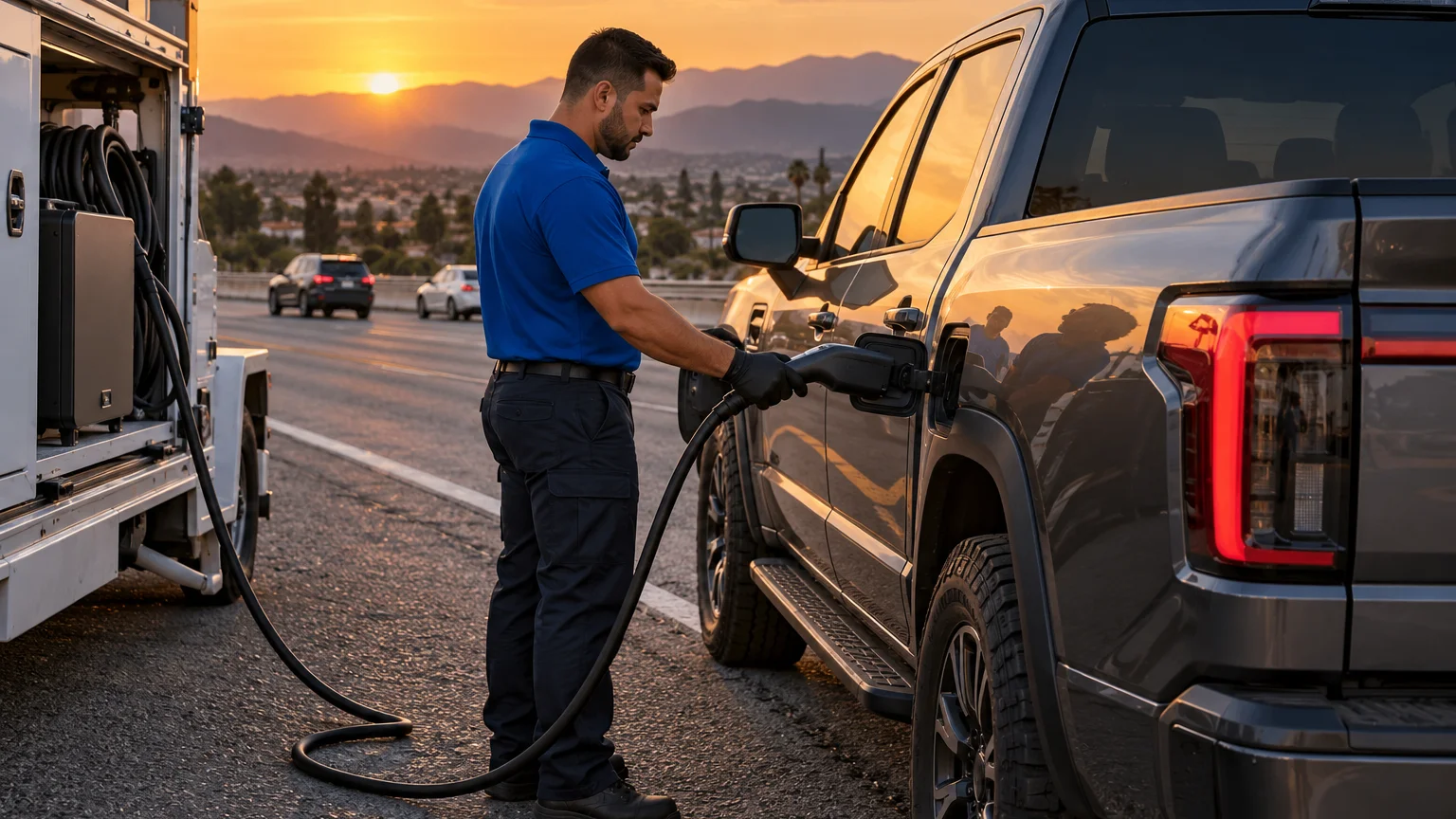
Identify an empty pack or low-voltage failure first
Start with what happened before the truck stopped. A falling range estimate followed by lost driving power points toward an empty main pack. A truck with remaining range but no normal response may have a different problem.
Don’t treat one dark screen as a complete diagnosis. Record what still works. Check whether the doors respond, displays wake, exterior lights operate, and charging begins when connected. Photograph any warning message before it disappears.
A low-voltage problem and an empty traction pack call for different equipment. Mobile charging adds energy to the main pack. Low-voltage support addresses a truck that can’t complete its normal startup process. Neither service replaces repair when the truck reports a fault.
Ford procedures can vary by model year and configuration. The approved claims available for this page don’t confirm Lightning jump points, access steps, or restart instructions. Check the owner’s manual tied to your truck before anyone connects a jump pack. Don’t rely on a procedure copied from another Ford EV.
Our guide to an F-150 Lightning that won’t start offers a focused decision path. It doesn’t replace Ford’s current instructions for your vehicle.
Tell the operator what happened, what the display showed, and whether the charge port responds. Share your exact location and whether the truck blocks traffic. Those details help distinguish a charging request from a low-voltage or towing call.
What Ford roadside coverage may include
Ford roadside coverage for a Lightning couldn’t be confirmed from the approved source ledger. That means we can’t state that your truck receives a particular tow, jump, charging service, mileage allowance, or payment benefit.
Check the Ford owner app, your current roadside agreement, and the documents connected to your VIN. Those materials control your coverage. Look for limits on tow distance, eligible destinations, covered events, and out-of-pocket charges. Confirm whether an empty high-voltage pack is treated differently from a mechanical failure.
Ask Ford support what service is being arranged before accepting it. A general roadside truck may be prepared for a tire or low-voltage issue but not mobile EV charging. Likewise, a tow benefit doesn’t necessarily mean the destination will have a compatible charger.
Your location matters across the Inland Empire. Freeway Service Patrol operates on named corridors, but its published pages don’t mention electric vehicles. Riverside County lists service along SR-91, I-215, parts of SR-60, and I-15 from SR-60 south to Temecula Parkway. San Bernardino County lists I-10, I-15, I-215, SR-60, and SR-210.
Those patrol programs publish certain roadside services and no-charge towing to a CHP-approved location. They don’t promise a tow to your home or chosen repair shop. Coverage areas and operating schedules can change, so confirm current availability when you’re stranded.
Ford help and a local operator aren’t interchangeable. Ford coverage is policy-controlled. Charge Pro IE is a referral service that connects drivers with licensed, independent local operators.
Why vehicle-to-vehicle power is not the default answer
A nearby Lightning may appear to offer an easy rescue. That doesn’t make vehicle-to-vehicle charging the right first choice.
The approved source ledger doesn’t confirm Ford’s current power-output ratings, supported adapters, or vehicle-to-vehicle charging procedure. Those details were removed from earlier material because a readable Ford primary source wasn’t available. Check the owner’s manual for the exact truck supplying power.
A visible outlet also doesn’t answer every question. The driver still needs to confirm the connected equipment, its rating, and the receiving vehicle’s charging requirements. Roadside position matters too.
The separate article about charging another EV from an F-150 Lightning addresses that narrow situation. This page focuses on choosing roadside help after the Lightning itself becomes disabled.
For a stranded Lightning, start with the failure type. An empty pack may be a candidate for mobile charging. A low-voltage problem may call for model-appropriate support. A fault, unsafe position, collision, or truck that won’t accept energy may require towing.
Don’t let a convenient power source replace diagnosis. Giving the operator accurate symptoms is more useful than requesting a specific connection before the problem is understood.
If the truck is stopped on a controlled-access freeway, California law generally prohibits leaving it standing outside listed exceptions. One exception covers a disabled vehicle after assistance has been summoned. Use the hazard lights when a disabled vehicle is on the roadway and the truck’s four-way flashers work.
Manufacturer help versus mobile charging
Manufacturer roadside support is tied to Ford’s current terms for your truck. Mobile EV charging is a local service option for a vehicle that needs enough energy to continue safely or reach charging.
The approved rescue figure is 10 to 20 miles of range during 15 to 30 minutes of Level 2 charging. That describes charging time only. It isn’t an arrival promise, and actual added range can depend on the vehicle and conditions.
That limited range may fit a Lightning sitting safely in a Fontana work lot, an Ontario parking area, or a Riverside driveway. It may not solve a warning message, damaged connection, or truck that refuses to charge.
A mobile EV charging operator should be told the truck’s location, displayed state of charge, connector situation, and destination plan. Confirm the operator understands that the disabled vehicle is a Ford Lightning. Ask what charging connection will be used before agreeing to service.
Ford support may make more sense when your owner materials show applicable coverage or the truck reports a fault. Mobile charging may make more sense when the pack is depleted, the truck accepts charging, and a small range addition reaches a suitable station.
Neither path should be selected from battery percentage alone. Read any warning text and check whether the charge port responds. If the symptoms remain unclear, use our mobile charge or tow guide to organize the decision.
Charge Pro IE doesn’t set operator prices or coverage terms. The independent operator quotes and bills the driver directly.
What towing a Lightning requires
A Lightning shouldn’t be handed to an unprepared tow operator. However, the approved source ledger doesn’t contain Ford’s current towing procedure for the truck. We can’t publish a wheel position, tow mode sequence, lift method, or equipment requirement without that source.
Use the owner’s manual tied to your model year. Tell the tow operator that the vehicle is an electric Ford F-150 Lightning before a truck is assigned. Confirm that the operator will follow Ford’s current loading and transport instructions.
Share whether the Lightning powers on, rolls, steers, shifts, or releases its parking brake. Mention any collision damage, smoke, unusual odor, or visible battery-area damage.
Location changes the immediate decision. The I-15 climb from Devore to Cajon Summit gains roughly 2,080 feet. A disabled truck there presents a different access problem than one parked in a level warehouse lot. On Riverside County freeways, published patrol corridors include I-215 and specified sections of I-15, SR-60, and SR-91.
If a vehicle can’t be repaired at the roadside, the Riverside County and San Bernardino County Freeway Service Patrol programs publish no-charge towing to a CHP-approved location. CHP also states that Freeway Service Patrol can’t tow to a private repair shop or residence.
A CHP-arranged tow and a privately requested tow aren’t the same transaction. The approved source ledger contains no statewide private towing price. Ask the towing company for its current rate and destination terms before service when circumstances allow.
When the choice remains unclear, compare towing with mobile charging before requesting equipment.
How to match the right local operator
A useful request begins with the truck’s symptoms, not a guessed repair. Say whether the Lightning lost range gradually, went dark unexpectedly, rejected a charging connection, or displayed a fault.
Then provide the practical details:
- Exact roadway, direction, exit, or parking-lot location
- Whether the truck is safely outside moving traffic
- Displayed charge level and warning text
- Whether doors, lights, screens, and charge port respond
- Whether there’s visible damage
- Whether you need charging, low-voltage assessment, or towing
- The destination you’re trying to reach
Those details help a local operator decide whether the available equipment fits the call. They also reduce the chance of sending charging equipment to a truck that needs transport.
The Inland Empire covers 49 cities and communities across eight regions. Conditions differ between a Corona parking lot, the Cajon Pass, and a mountain road near Big Bear Lake. Named Freeway Service Patrol corridors don’t include SR-18, SR-38, SR-74, SR-79, SR-138, SR-330, or US-395.
For a non-Tesla call, use a provider familiar with EV roadside decisions. Charge Pro IE can connect you with a licensed, independent operator through its non-Tesla EV rescue service. The matched operator performs the physical work, sets the quote, and bills you directly.
Before accepting service, confirm what the operator plans to do. Ask whether the call is for mobile charging, low-voltage help, or towing. For any Ford-specific procedure, compare the plan with the current owner materials for your truck.
If the vehicle remains in a traffic lane, contact emergency services.
When to call us
Call when your Lightning is safely accessible and you need a local operator for mobile charging, low-voltage help, or an EV-aware tow decision. Charge Pro IE will match you with a licensed, independent operator, but doesn’t perform the roadside work.
Call us at (909) 250-2881 and we’ll connect you with a local EV rescue operator.