Your Tesla is dark in an Inland Empire lot. That’s usually Tesla 12V battery failure, not a dead pack. Valley heat, a long park, and mountain cold hit the small battery first. The high-voltage pack can still hold range. The car just won’t open, light up, or roll until that 12V wakes.
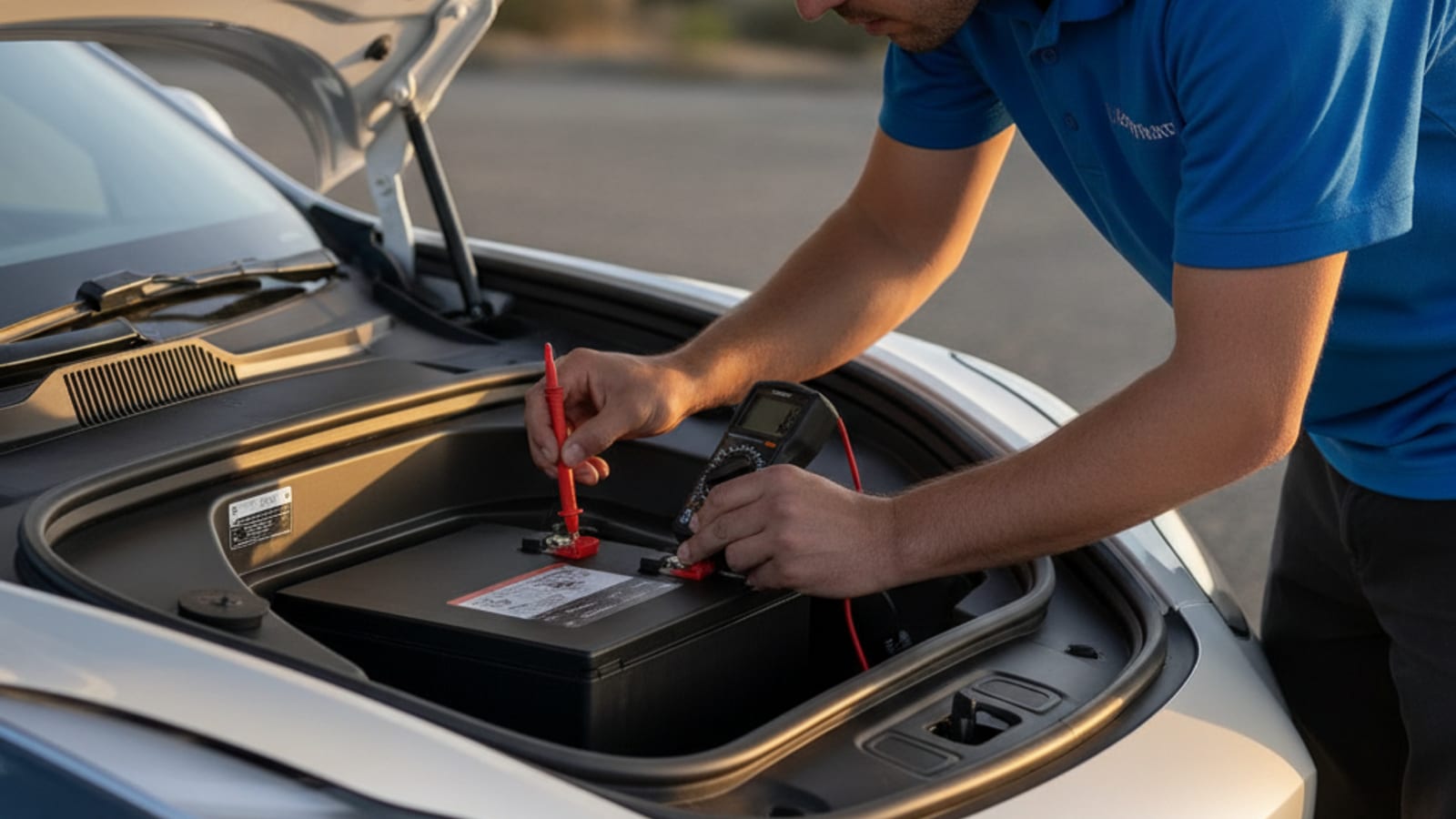
Why a healthy pack still leaves you stranded
A gas car uses the 12V to crank an engine. A Tesla has no engine to crank. The small battery still runs the parts you meet first. It powers door handles and electronic latches. It powers the screen and the car’s computers. It also powers the relay that lets the pack feed the motors. If that relay stays open, the pack can sit at a healthy charge. The car still looks dead.
That’s the mix-up. You walk up and nothing moves. Handles stay flush, the app won’t unlock, and the cabin stays black. It feels like the traction battery failed. It usually didn’t. Do Teslas have a 12V battery? A model-by-model guide maps the 12V by model.
Heat on the valley floor
Inland Empire summers cook a parked Tesla. Fontana warehouse rows bake through a shift. Ontario work lots do the same. Riverside street parking holds that heat after dark. The pack can take the day. The 12V is the one that quits.
A dark car after a hot Fontana day is a 12V scene. Same story after an Ontario warehouse shift. Same story on a Corona or Moreno Valley curb. Chino and Rancho Cucamonga work parks see the same hot-sit failure. You didn’t empty the pack by sitting still. You stressed the small battery that wakes the car.
Long parking, not empty miles
A Tesla tops up its 12V from the pack through a DC-DC converter. When the car sleeps in a lot, that top-up isn’t a constant trickle. A long sit can sag the 12V even when the pack still has miles.
Ontario airport lots are a common version. You fly out, come back, and the car is dark. You didn’t drive the pack empty. The 12V just couldn’t hold. EV rescue around Ontario airport lots and warehouse rows covers that stall.
A weekend at a cabin does the same thing. So does a car left in a Fontana yard between shifts. Hours of sleep, then a key that does nothing. Sentry Mode, cabin overheat protection, and heavy app checks keep modules awake. Tesla hasn’t published a failure rate for those features. It didn’t turn up in the sources this site can cite. They still add load on a long sit. If you parked for days, check the 12V first.
Cold nights after a valley drive
The other local pattern is the opposite of heat. You leave the valley warm. You end the night in Big Bear Lake or Big Bear City. Lake Arrowhead, Crestline, and Running Springs see the same overnight drop. A lead-acid 12V loses punch in the cold. Later Model 3 and Model Y cars use a lithium 12V. They still fail. They just fail on a different chemistry.
A car can climb with plenty of range. It can still refuse to wake at the cabin. The grade used the pack. The cold night used the 12V. Those are two different batteries. EV roadside assistance in Big Bear Lake when you cannot get down covers the mountain stall.
Wrightwood has the same swing. So does the High Desert after the Cajon climb. Victorville, Hesperia, and Apple Valley swing hard from a hot afternoon to a cold night and a long sit. Then a car that won’t wake.
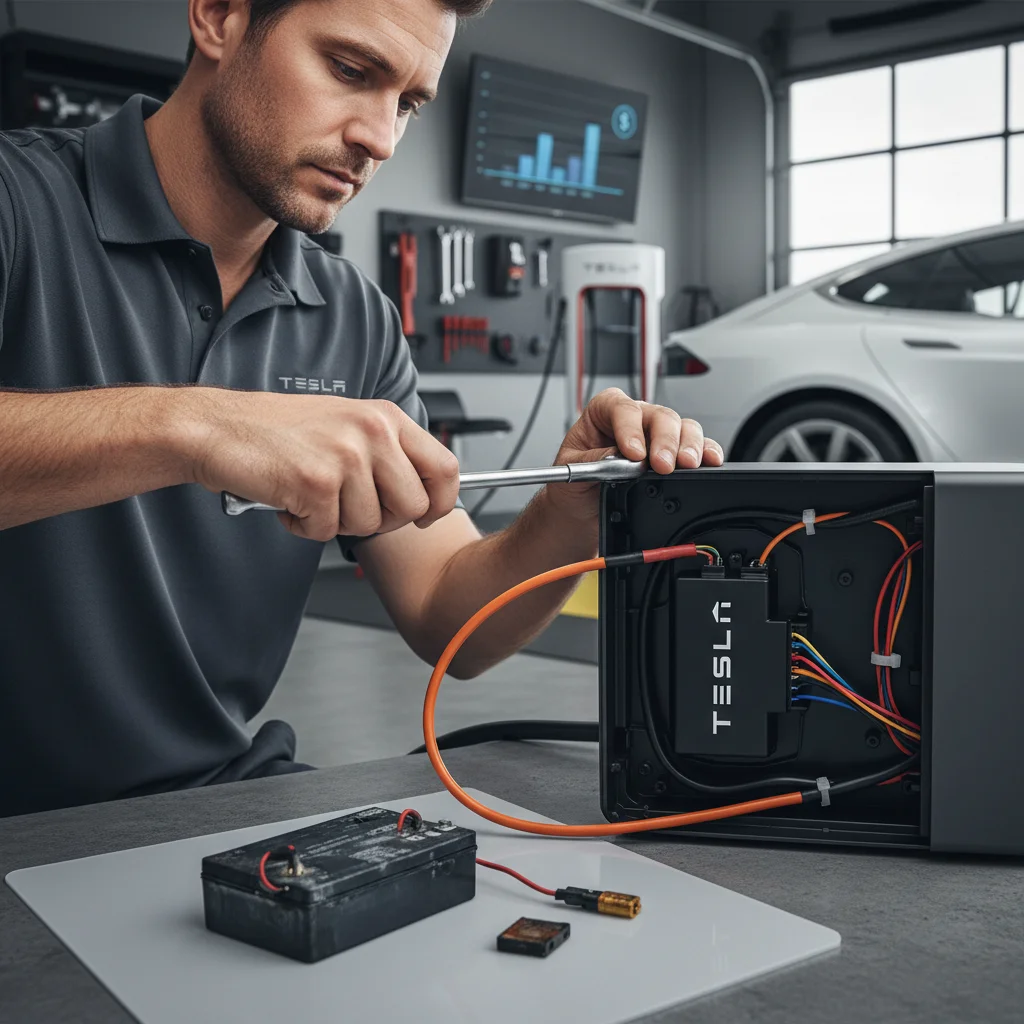
What Tesla 12V battery failure looks like
Catch it early and the Tesla app may show a 12V battery low alert. The car might still open. Don’t treat that as optional. Get it checked before the next long park. Tesla 12V clues you can catch before a stranding lists the early tells.
Miss the warning and the failure is sudden. Handles stay in. The screen stays black. The phone key does nothing. You can’t start a Supercharger session. The car won’t handshake with the stall. You can’t drive to a stall either. The car won’t unlock.
That’s when people ask for a pack tow. Dead Tesla: how to tell 12V failure from a dead pack is the split. A fully dark car is the 12V until proven otherwise. A pack problem usually still powers the cabin. It throws a message. It rarely goes fully black with no display at all.
If you jump the 12V and the car wakes, look at pack percentage. A healthy number means the small battery failed. The pack did its job.
What you can try at the curb
Tesla publishes a 12V jump point on most models. You don’t jump the charge port. You don’t jump the traction battery. You use the 12V terminals Tesla marked for that job.
A portable jump pack can wake the car. Lights come on, doors unlock, and the display may show pack charge. That’s a test, not a repair. Remove the jump pack and a failed 12V often dies again.
How to tell your Tesla 12V is dead, then jump it has the model steps. If you’re not set up to jump it, skip the experiment. Stay out of the travel lane. Call for help. Don’t borrow another EV’s traction battery. Don’t clamp onto high-voltage orange cables. Don’t guess at posts you can’t identify.
Who actually shows up
Charge Pro IE is a referral line. It matches you with independent local mobile rescue operators. It holds no licence, owns no trucks, and employs no technicians. It sets no prices and promises no arrival time.
The operators in that network jump or replace a dead Tesla 12V on site. They handle Tesla and every major EV brand. The operator quotes you before starting. The operator bills you directly.
If the 12V wakes and the pack is actually empty, that’s a different job. Operators can bring a 240V Level 2 source to the car. Native NACS on Tesla. CCS or J1772 adapter for other EVs. That typically adds 10 to 20 miles of range. That takes 15 to 30 minutes of charging. That clock is charge time, never an arrival time.
A tow still has a place when the car can’t be made safe to drive. Jump versus charge versus tow is a diagnosis, not a default.
What we could not confirm
Owner forums and complaint databases get cited a lot for this failure. A verifiable share of NHTSA complaints didn’t turn up in the sources this site can publish. Neither did a published owner failure rate. Neither did a standard replacement price.
Tesla service centers set their own parts and labor. Independent operators set theirs. Confirm the current quote before anyone opens the frunk. The same rule applies to how many years a 12V should last. Tesla’s app warnings and service messages are the authority on your car. A blog interval isn’t.
Lead-acid versus lithium is a real split on Tesla’s lineup. Early Model S, Model X, and early Model 3 cars used a conventional 12V. Later Model 3 and Model Y cars moved to lithium. Model X falcon-wing doors add electrical load when they operate.
Frequently asked questions
How do I know it is Tesla 12V battery failure
A fully dark car, with no app unlock and no screen, points at the 12V. A pack issue usually still shows a message. If a jump wakes the car and the pack percentage looks healthy, the 12V failed. If the app already showed a 12V battery low alert, believe it.
Can I jump a Tesla from another car
You can jump the Tesla 12V jump point with a jump pack. You use Tesla’s marked 12V terminals, not the charge port. Never jump from another vehicle’s traction battery. If you’re unsure which posts are which, wait for an operator.
What does a local operator do on site
The operator checks whether the car is a 12V failure or an empty pack. They can jump the 12V. They can replace it on site when that’s the job. They quote before they start. If the pack is empty instead, they can add roadside Level 2 charge. Charge Pro IE doesn’t do that work itself.
If your Tesla won’t wake, call (909) 250-2881. We’ll help you sort 12V versus pack on the phone. Then we connect you with a local operator.