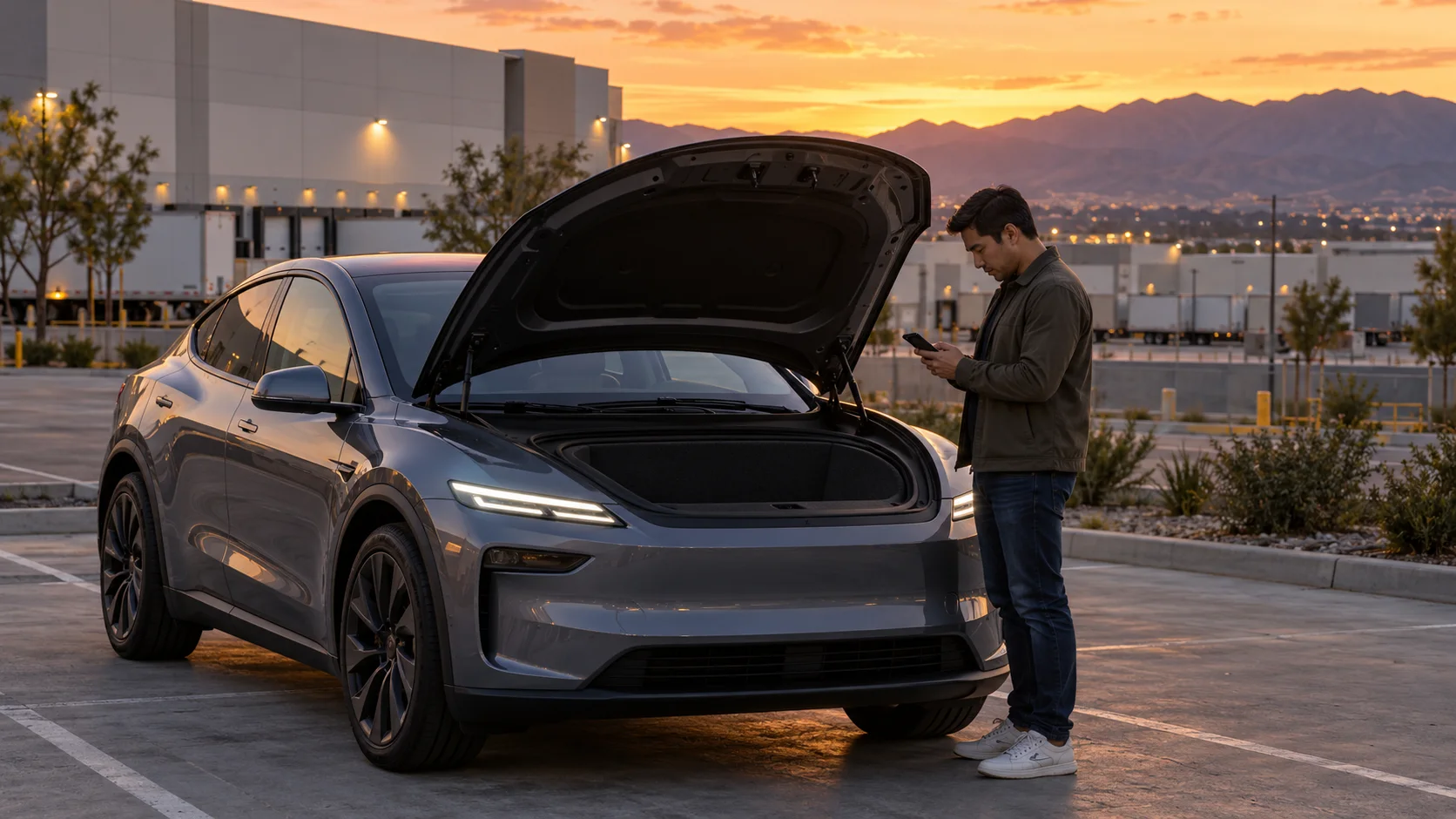
A Tesla’s low-voltage battery or jump points are under the hood area, but there is no single universal “Tesla frunk battery” location. Model, build date, low-voltage chemistry, and current manual change the layout. On Model 3 and Model Y, the external terminals behind the front tow-eye cover release the hood. They are not the points used to charge the low-voltage battery.
Two sets of terminals do two different jobs
This is the most important distinction on a dark Tesla.
The first set is outside the closed hood, behind the front tow-eye opening on current Model 3 and Model Y documentation. Applying an external low-voltage source there releases the hood latches when the vehicle has no low-voltage power. Tesla says those terminals do not charge the low-voltage battery.
The second set is under the opened hood. Tesla’s current manuals identify model-specific positive jump posts and grounding points for the low-voltage jump procedure. Their positions are not interchangeable with the hood-release terminals.
Do not connect charging equipment to the tow-eye hood-release leads. Do not assume any visible under-hood terminal is correct. Match the car to its current Tesla manual first.
Model 3 and Model Y: open first, then find the jump points
Tesla’s Model 3 no-power hood procedure and Model Y no-power hood procedure use the tow-eye opening when low-voltage power is absent. The temporary external source only unlatches the hood. Remove it once the hood releases.
That method also has a limit. Tesla says it does not open a locked car that still has low-voltage power. If the car is locked but not electrically dead, use the authenticated access methods in the manual or Tesla app. Do not pry the hood.
Once the hood is open, the current Model 3 jump-start page places the positive jump post beneath a cover under the maintenance panel and identifies a grounding bolt near the brake-fluid reservoir. The current Model Y jump-start page uses its own positive-post and negative-point directions around the maintenance-panel and HEPA area.
Those are current manual descriptions, not a promise that every Model 3 or Y build looks identical. Tesla’s documentation distinguishes low-voltage system and build variations. Use the illustration that matches the car.
Model S and Model X have their own layouts
Do not transfer Model 3 or Y instructions to a Model S or X.
Tesla’s current Model S manual uses under-hood positive-post and ground locations specific to Model S. It notes that the positive-post cover and location can differ around a January 2023 manufacturing split.
Model X has a different owner procedure again. Tesla’s public DIY instructions include access around the low-voltage connector housing and a positive point near the wiper-motor and fluid-reservoir area. Its documentation also notes build-related variation.
The safe high-level answer is that the low-voltage system is reached from the front compartment, but the exact point depends on the model and build. A photo from another Tesla is not enough.
For a deeper Model 3 comparison, see Model 3 low-voltage and pack locations. For the battery roles themselves, read Do Teslas have a 12V battery?.
What to check in a parking lot
A dark screen, unresponsive locks, and a hood that will not open through the normal touchscreen or app path can point to missing low-voltage power. They do not prove a failed battery. Record the vehicle model, approximate build information, last range reading, warnings, and whether any lights or locks respond.
In a Fontana warehouse lot or an Ontario parking area off I-10 or I-15, first make the scene safe. Do not kneel near traffic or work where another vehicle can strike you. Then open the manual for the exact car through Tesla’s owner information.
Confirm three things before any connection:
- The illustration matches the model and visible trim.
- You can distinguish hood-release terminals from jump points.
- The manual names the positive post and approved ground you can see.
Stop if polarity is unclear, the trim differs, a cable is damaged, the area is wet, or the vehicle shows crash damage, smoke, leaking fluid, or unusual heat. Those are not conditions for a DIY low-voltage attempt.
When a jump is the job, and when it is not
A low-voltage jump is meant to restore the systems that wake the vehicle. It does not add driving range to an empty high-voltage pack. If the Tesla reached zero range before shutting down, the driver may need charging or a tow even after the low-voltage system wakes.
If the hood is closed and the car is dark, follow the exact no-power hood procedure before the jump instructions. The Tesla locked-out rescue sequence explains that order without treating the bumper terminals as battery posts.
If the vehicle wakes and then loses low-voltage power again, stop repeating roadside attempts. The system needs diagnosis through Tesla service or another qualified repair path. A jump can help with access and wake-up. It does not certify battery health.
The referral role
Charge Pro IE does not open frunks, jump batteries, repair Teslas, or own roadside trucks. It refers drivers to licensed independent local operators. The operator verifies the model and proposed scope, quotes the work, and bills the driver directly.
A confirmed low-voltage problem may fit a Tesla 12V battery jump referral. An empty traction pack or uncertain roadside condition may fit broader Tesla roadside rescue or towing. Tesla’s current manual remains the authority for the connection points on the specific car.
Frequently asked questions
Is the Tesla battery inside the frunk storage tub?
The low-voltage system is under the hood area, but its battery, positive jump post, and approved ground vary by model and build. Do not remove the storage tub based on a generic photo. Use the exact current manual.
Are the wires behind the tow-eye cover the 12V jump points?
No. On current Model 3 and Model Y instructions, those external terminals release the hood latches when low-voltage power is absent. Tesla says they do not charge the low-voltage battery.
Can I use Model 3 jump instructions on a Model Y, S, or X?
No. Each has model-specific access and connection guidance, with further build variation. Select the correct model and compare the manual illustration with the vehicle before proceeding.