A Tesla shouldn’t jump-start another car. Tesla’s owner’s manuals warn that using yours as a donor can damage it. The 12-volt battery wakes screens, locks, and contactors. It isn’t built to crank a neighbor’s engine. On Fontana and Ontario warehouse rows, that ask still shows up at shift change. Say no to the cables. Help another way.
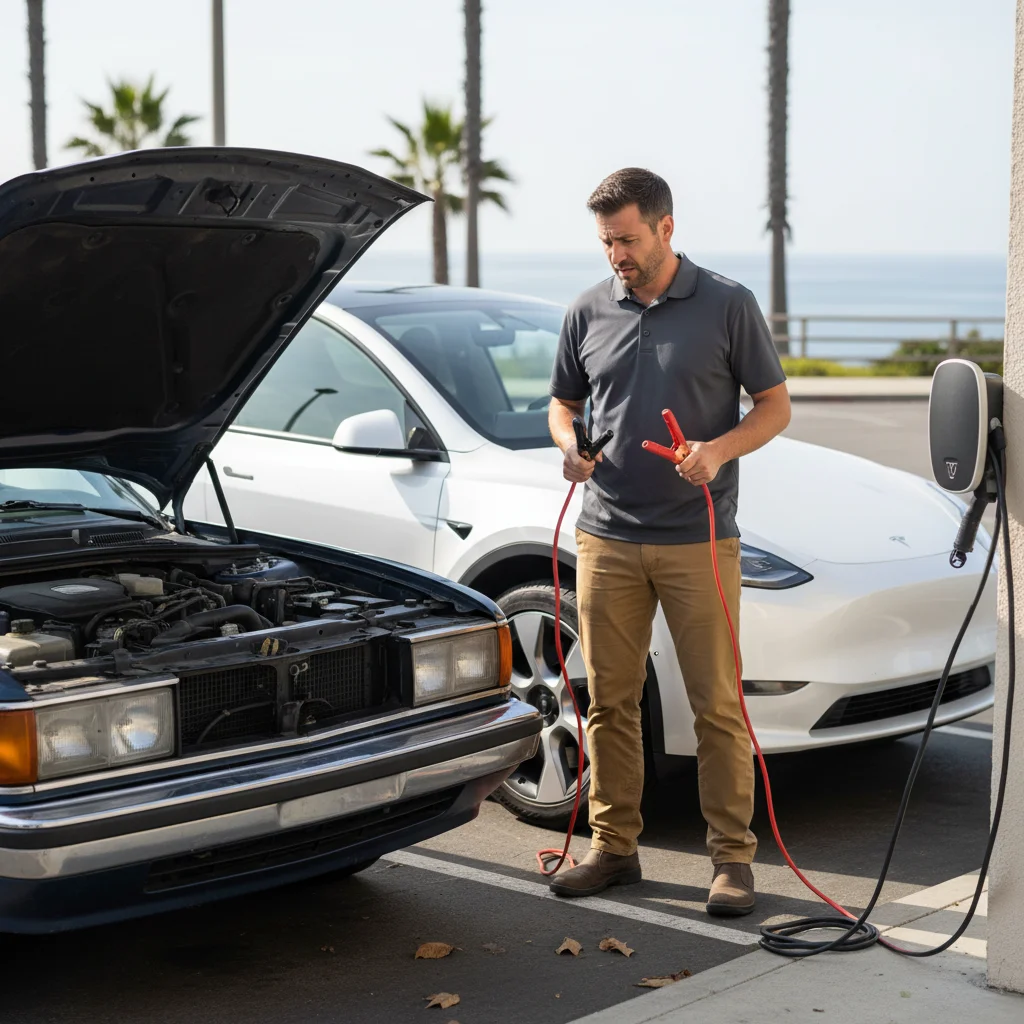
The warehouse-lot version of an old favor
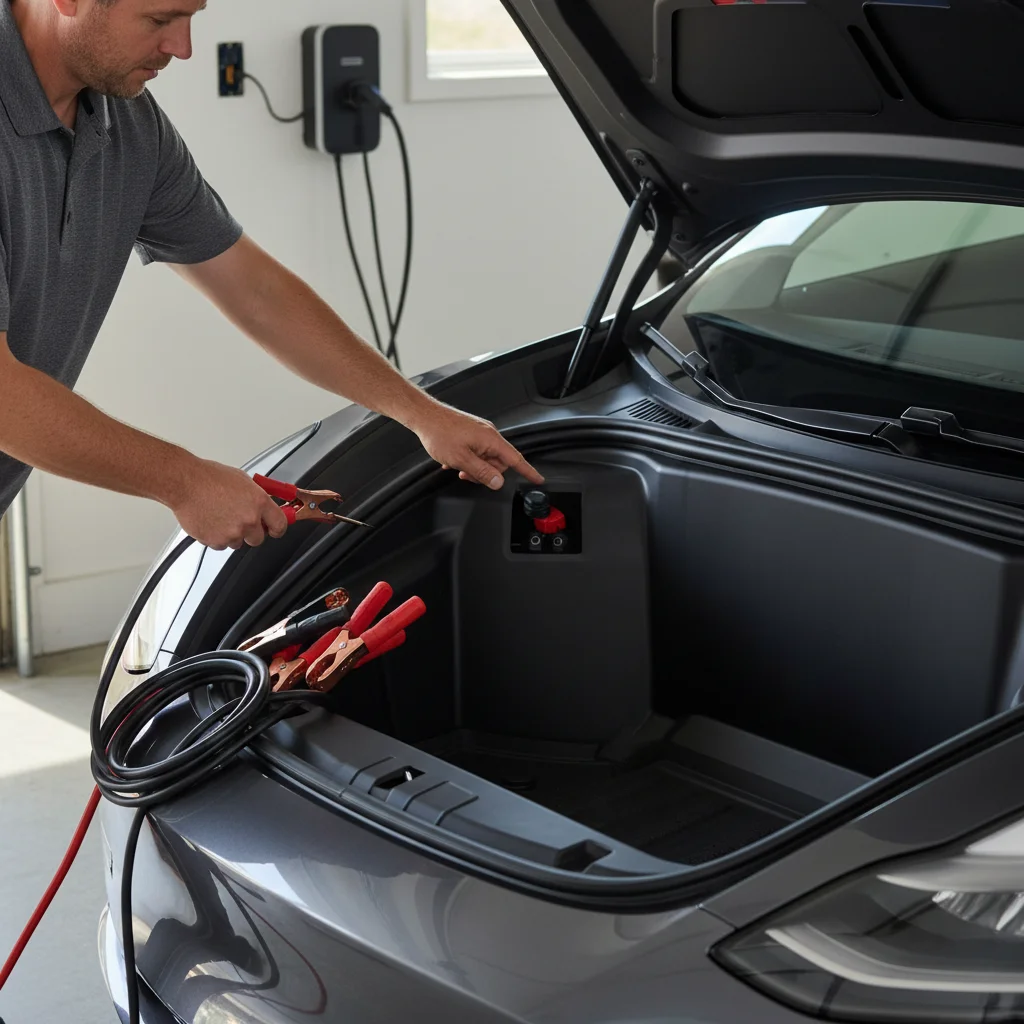
People learned jump-starts on two gas cars and a set of cables. A Tesla still has a 12-volt battery. Terminals sit under a frunk panel. That layout looks familiar. The job isn’t the same.
You left Eastvale or Chino Hills in a Model Y. You parked on a Fontana warehouse row. A coworker pops a hood on a gas car. They’ve seen your charged Tesla. They ask for cables. The ask feels small. It puts your car at risk.
Chino’s ACS 2019-2023 population is 92,652. Eastvale’s is 70,633. Those west-county cities feed the same warehouse corridor. The Tesla in that lot still shouldn’t be the donor.
Fontana’s ACS 2019-2023 population is 214,169. Ontario’s is 180,547. Both sit on San Bernardino County’s logistics spine. Lots mix Teslas with work trucks and older gas cars. Bloomington is unincorporated, with 25,698 residents on that same ACS vintage. Its Hispanic or Latino share is 85.0%. Shift lots there look like Fontana’s. Jurupa Valley and Rialto sit on the I-10 and SR-60 corridor. Southern California Edison serves Fontana, Ontario, Jurupa Valley, and Rialto. Your utility doesn’t rewrite Tesla’s 12-volt design.
Riverside Public Utilities serves the city of Riverside. A commute from Riverside into a Fontana lot doesn’t either. Colton runs its own electric utility inside city limits. San Bernardino city’s ACS 2019-2023 population is 222,724. I-215 lots there still follow the same Tesla rule. None of that turns a Tesla into a jump pack.
A full traction pack isn’t jump power
Neighbors see a Tesla with a high state of charge. They assume extra miles equal extra cranking current. Those aren’t the same tank. The traction pack moves the car. The 12-volt system runs the brains. A DC-to-DC converter ties them together for a modest, steady feed. It doesn’t turn the 12-volt into a starter battery.
That’s why a “full” Tesla can still be the wrong donor. Pack miles don’t protect the converter. They don’t make the 12-volt larger. They don’t cancel Tesla’s notice. A Cybertruck on that same row isn’t a workaround. Tesla’s low-voltage architecture still isn’t a jump pack.
If the stalled neighbor is also in an EV, skip your cables. They still aren’t the fix. Their dark dash is usually their 12-volt, not your pack. Their empty traction pack needs a charge, not a jump. Don’t couple two low-voltage systems together to guess.
What Tesla’s 12-volt system is built to do
A gas car’s 12-volt battery exists to crank a starter. Tesla’s low-voltage pack does different work. It powers computers, the touchscreen, door latches, and cabin loads. Most important, it closes the contactors. Those contactors connect the high-voltage pack to the drive unit. No healthy 12-volt, no ready state.
The high-voltage pack keeps the 12-volt topped off through that converter. Some Teslas still use a lead-acid 12-volt. Newer ones use a lithium 12-volt. Neither one is a jump pack. We walk through the hardware in Do Teslas have a 12V battery? A model-by-model guide.
You can receive a jump on those posts. You shouldn’t send one out. That’s the split that matters on a warehouse row.
Tesla’s manuals already answered this
Tesla’s Model 3, Y, S, and X manuals are clear. Don’t jump-start another vehicle with the car. The usual notice says doing so can result in damage. Pull the PDF for your exact year on Tesla’s site. The wording is a manufacturer limit, not a suggestion.
I couldn’t confirm any Tesla page that blesses using the car as a donor. The accessible terminals are inbound. They let an external source wake a dead 12-volt. Then the car can close contactors and use the main pack. They aren’t an outlet for a stalled neighbor.
Ignore that notice and you’re arguing with the engineers who sized the parts. A clip of someone who got away with it isn’t a procedure. You don’t see a 12-volt that fails later. You don’t see a converter that acts up after the weekend shift. For the broader EV version of this limit, see Can an EV jump-start a gas car? The honest limit.
Why the current spike is the problem
Don’t connect jumper cables from your Tesla to a gas car. You’re asking a low-capacity system for a starter surge. That surge is what a lead-acid gas-car battery is built for. Tesla’s low-voltage side isn’t.
A few paths match Tesla’s own damage warning. The DC-to-DC converter can take a hit. It’s built to feed the 12-volt, not to dump current into another vehicle. The 12-volt battery itself can be stressed. Lead-acid and lithium 12-volt packs both dislike that draw. They weren’t sized for it. Voltage can sag on the Tesla while modules are awake. Computers that run locks and the center screen expect a clean, stable feed.
Tesla’s published notice is about damage. I couldn’t confirm, from Tesla’s public warranty pages, whether that damage would be covered. Check your Tesla account and the warranty booklet for your VIN. Don’t guess from a forum thread. A longer walkthrough of the same trap is in Why jumping a gas car with your Tesla can go wrong.
What you can do on a Fontana or Ontario row instead
You can still help. You just shouldn’t use your Tesla as the power source.
A portable lithium jump pack is the clean swap. It lives in the frunk. It isn’t tied to your car’s electronics. Clamp it to the stalled gas car, not to your Tesla. Confirm the pack’s rating on the box before you buy one. Charge Pro IE doesn’t sell them and doesn’t set those specs.
If you don’t carry a pack, help the driver call their own roadside plan. Stay out of travel lanes while you wait with them. Fontana warehouse rows mix trucks, vans, and passenger cars. So do lots around Ontario’s airport. Standing between bumpers isn’t a favor. I-10 shoulders through Fontana aren’t a jump station. I-15 lanes near Ontario aren’t either. Get clear of traffic first.
A ride to a safer waiting spot is often the kindest offer. You’re not cranking their engine. You’re not tying two electrical systems together.
If the stalled car is another EV with a dark dash, that’s their 12-volt. It isn’t a reason to cable your Tesla to theirs. If their traction pack is empty, they need a charge, not a jump. Operators we connect you with bring a 240-volt Level 2 source. That’s typically 10 to 20 miles of range in 15 to 30 minutes of charging. That’s charging time, never an arrival time. They use a native NACS plug. Non-Tesla EVs get a CCS or J1772 adapter. The Fontana warehouse-lot rescue piece covers that scene. So does EV rescue around Ontario airport lots and warehouse rows.
When your Tesla is the one that won’t wake
The 12-volt in a Tesla can fail. When it does, the car can look dead. Doors may not open the usual way. The screen stays black. The app may already have shown a 12-volt service warning. That’s a receive-a-jump problem. It isn’t a reason to hunt for another Tesla to cable into.
Tesla’s manuals do explain how to accept an external 12-volt source. The steps differ by model. Read yours first. A wrong clamp can still cause damage. How to jump a Tesla Model 3, Y, S, or X the safe way walks the owner-side checks.
Many owners don’t want to do that between trailers. Independent local operators can bring a stable 12-volt source. They can jump or replace a dead 12-volt on site. The pros we connect you with are licensed. Charge Pro IE is a referral line. It matches you with those operators. It doesn’t own trucks. It doesn’t employ technicians. It doesn’t set prices. The operator quotes you before starting and bills you directly.
If the pack is empty rather than the 12-volt, that’s a different call. A mobile Level 2 hookup is the tool for a depleted Tesla. A 12-volt jump won’t fill a traction pack.
How to get a safe 12-volt jump in the Inland Empire
If you’re stuck on a Fontana, Ontario, or Bloomington warehouse row, decline the donor role. Don’t let a random gas car feed yours until you’ve read Tesla’s steps for your model. The Tesla 12V battery jump page explains the service operators run.
Call (909) 250-2881 when you want that match. We’ll connect you with an independent local operator who quotes before any work starts.
Frequently asked questions
Can a Tesla jump start another car?
No. Don’t use a Tesla as the donor. Tesla’s manuals warn that doing so can damage your car.
Can a Tesla jump start a gas car?
No. A gas starter wants a surge Tesla’s 12-volt side isn’t built to give. Use a portable jump pack, or help them call roadside help.
Can another car jump a Tesla?
A Tesla with a dead 12-volt can receive external power. Follow the manual for your model. Or have an operator bring a clean 12-volt source.