A gas truck sits dead in a mixed warehouse row. Your EV is parked one stall over. An EV can jump-start a gas car only through its small 12-volt battery. You usually shouldn’t. The drive pack never feeds jumper cables. Tesla’s public guidance tells owners not to use the car as a donor.
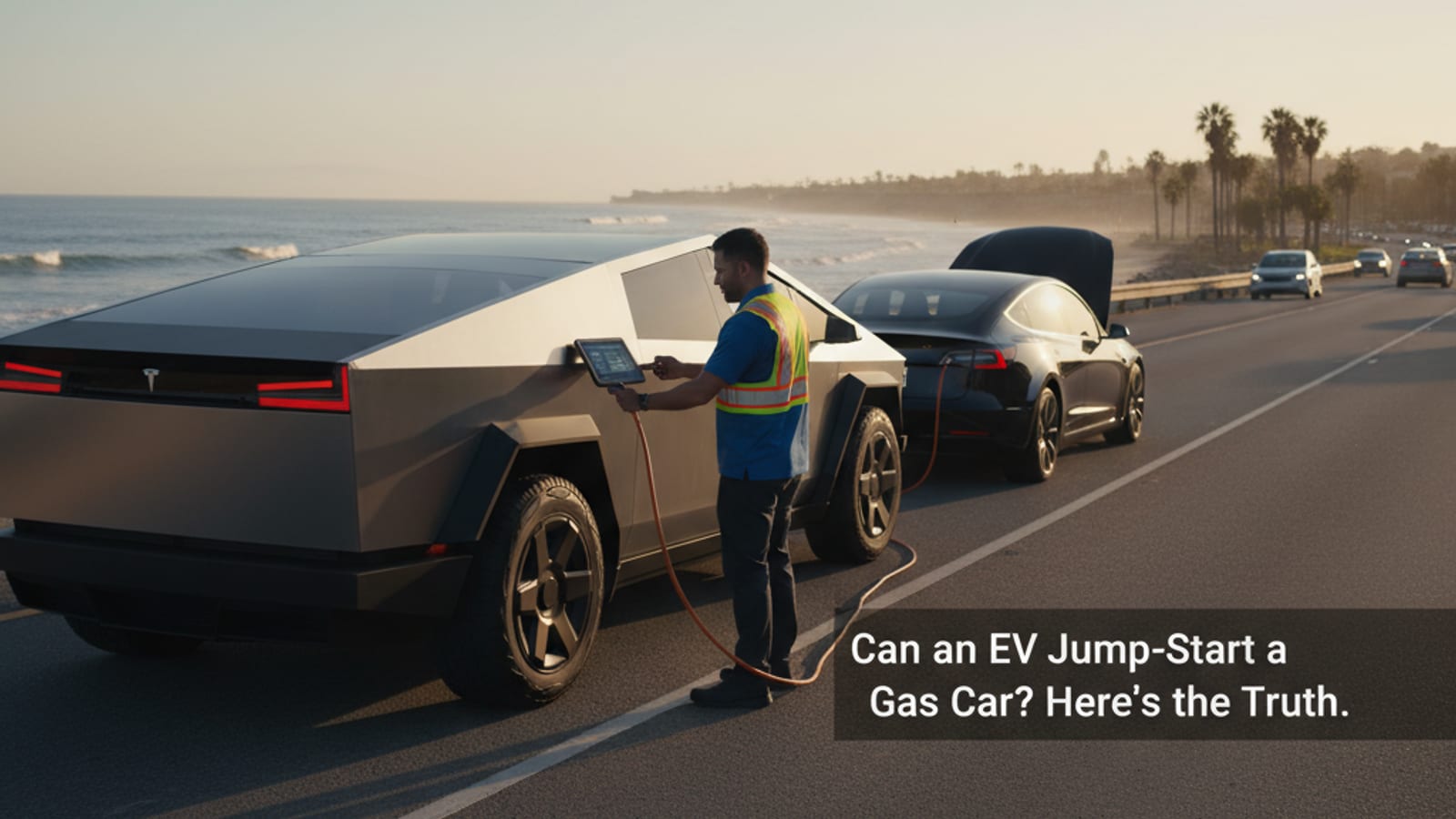
Mixed lots are why inland drivers ask this
West-valley work lots mix powertrains in the same painted stalls. Fontana warehouse rows park EV vans beside diesel day cabs. Ontario airport lots and warehouse rows repeat that pattern around cargo and rental stalls. Bloomington and Jurupa Valley yards look the same at shift change. A coworker asks for a jump. You drove electric. That’s the Inland Empire version of this question.
Fontana is a city of 214,169 people. Logistics work there puts EVs next to gas trucks. Ontario is a city of 180,547 with airport-adjacent warehouse shifts. Chino work lots see the same mix. This isn’t two sedans in a quiet garage. It’s a pickup that sat overnight beside a Model Y or an F-150 Lightning.
Temecula and Murrieta parking is a different daily mix. Wine-country lots aren’t Fontana’s trailer rows. The question still comes up. The electrical limit doesn’t change with the city. The scene that triggers it does.
Don’t borrow the pack-to-pack story. Sending miles from one EV to another is a different setup. A 12-volt jump into a gas starter isn’t that. If that’s your question, read whether one EV can charge another.
Two batteries, two jobs
Every EV still has a 12-volt battery. It wakes computers, locks, lights, and relays. It doesn’t crank an engine. A gas truck’s 12-volt does that job. Then the alternator takes over.
On the EV, a DC-DC converter fills the 12-volt from the pack. That happens while the car is on. That pack is large. It’s also isolated on purpose. Cables on the 12-volt posts never tap traction power. If a coworker says your huge battery can spin their starter, they’re mixing those systems.
A dead gas 12-volt needs a short, hard push so the starter can turn. Your EV’s 12-volt wasn’t built as a starting battery for a work truck. Many are closer to an accessory battery in a small car. Newer Teslas and some other EVs use a lithium 12-volt. Those units protect themselves. A starter draw can trip that protection. It can also flatten the cell and leave you dark.
A Lightning in a work stall still has a 12-volt system. Accessory outlets and EV-to-EV charging, when a truck even offers them, aren’t jumper cables. Don’t treat a tool circuit as a starter pack for a neighbor’s gas truck.
What the cables actually do
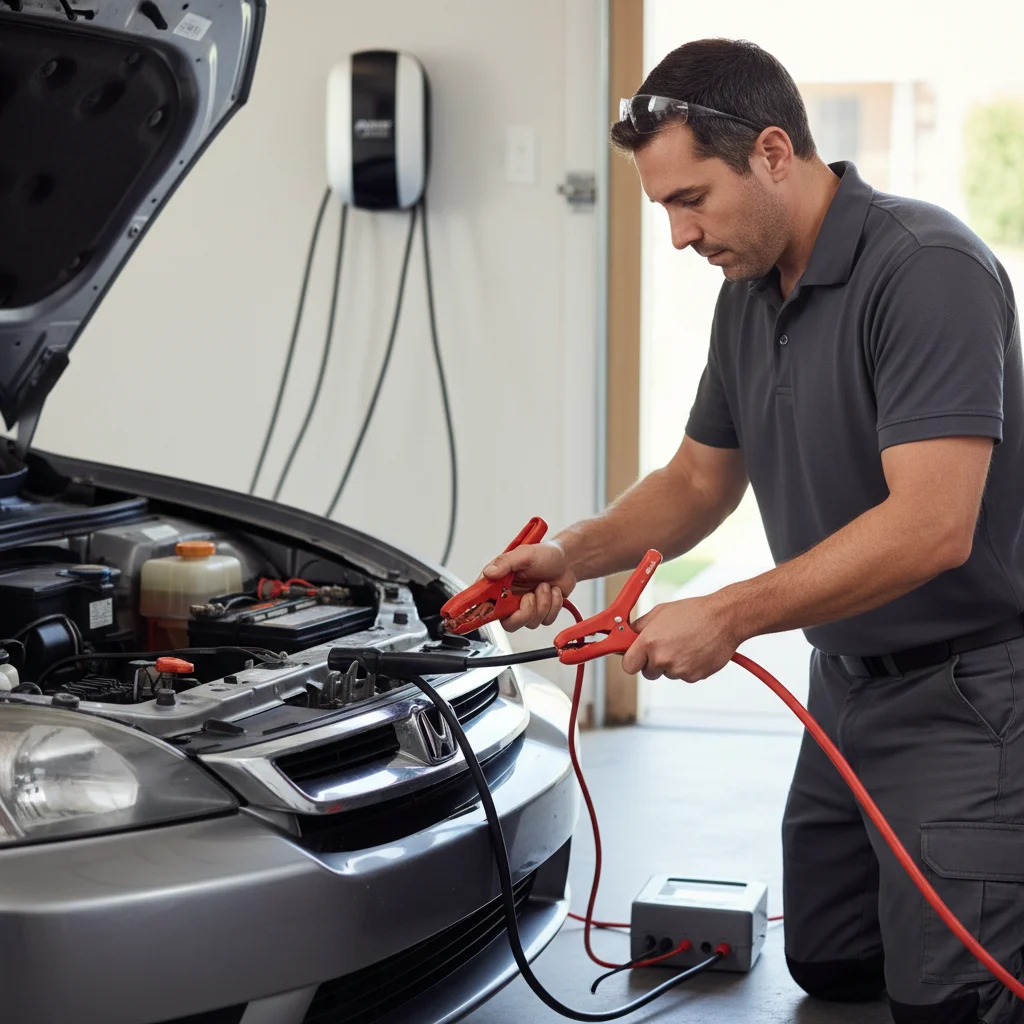
You’re paralleling two 12-volt batteries for a moment. Clamp positive to positive. Clamp the negative to a clean metal ground on the dead truck. Keep it away from the battery when you can. Reverse that and you spark. You can wreck electronics. You can hurt yourself. NHTSA publishes jump-start safety guidance. Read it before you hold clamps over a case.
The EV still only donates what its 12-volt can spare. There’s no hidden high-voltage path in those cables. That’s the honest limit. It’s why the answer isn’t a clean yes.
Tesla’s support pages are where you confirm model-specific language. The general stance is don’t use the car to jump another vehicle. Check Tesla’s support site for your model. If the donor is a Tesla, start with why a Tesla jump usually fails. Then read the risks of jumping a gas car with a Tesla.
How you end up with two dead vehicles
Inland heat already works the 12-volt. A warehouse lot at the end of a shift doesn’t rest it. Drain that battery into a stubborn truck and your own car may not wake. Then you’re the stranded EV in the next stall.
A voltage spike can upset low-voltage electronics. EVs carry more computers than an old pickup. The DC-DC converter sits in that path. You won’t see a fried module from the curb. You’ll see a car that stays dark with a full pack.
If the EV is already the dead one, stop offering it as a donor. A dark EV with a charged pack is often the 12-volt. The pros we connect you with jump or replace that battery on site. They handle Tesla and every major EV brand. Don’t spend your last 12-volt on a gas starter first.
Roadside help for an EV 12-volt isn’t the same job as jumping a gas truck. Can roadside help jump-start an EV, or only the 12V walks that split.
Leave the EV out of the gas-car problem
Keep a dedicated jump pack in the gasoline truck if this lot keeps eating batteries. Call ordinary roadside for the gas vehicle. Don’t make your EV the donor.
If you already clamped on, the EV may now sit dark. Treat that as an EV stall. Charge Pro IE is a referral line. It matches stranded EV drivers with independent local mobile rescue operators. It owns no trucks. It employs no technicians. It sets no price. It publishes no arrival time. The operator quotes you before work starts and bills you directly. If the EV is the car that won’t wake, call (909) 250-2881.
Can an EV jump-start a gas car?
Only from the 12-volt auxiliary battery. The traction pack stays out of the circuit. Most owners shouldn’t try it. Check the owner’s manual or the in-car documentation for your model.
Can I jump a warehouse truck with a Tesla?
Treat it as a 12-volt favor you’re not supposed to make. Lithium 12-volts can protect themselves and quit. Exporting charge to another EV is a different question. Don’t confuse those jobs.
What if my EV dies after I try?
Stop. You likely flattened or upset the 12-volt. Don’t keep cycling the gas starter. Call for an EV 12-volt jump or replacement on site.
Frequently asked questions
Can an EV jump-start a gas car?
Yes. It can only donate through the 12-volt auxiliary battery, not the traction pack. Jumper cables parallel those two 12-volt batteries for a moment and never tap driving power. Skip the attempt when you can, and check the owner’s manual or the in-car documentation for your model before you use the car as a donor.
Can I jump a gas truck with a Tesla?
No. Don’t use the car to jump another vehicle. Check the owner’s manual or the in-car documentation for your model. A Tesla still only offers its 12-volt, and a lithium 12-volt can trip protection under starter draw. That protection can pop, drain the 12-volt, and leave your Tesla unable to wake.
What if my EV dies after I try to jump a gas car?
Stop. The 12-volt is probably drained or thrown off, even if the pack still shows charge. Don’t keep cranking the gas truck, and don’t offer the EV as a donor again. Independent local operators can jump or replace that 12-volt at the car, then quote you and bill you directly.
Should I use my EV as a donor to jump-start a gas car?
No. Keep the EV out of the gas vehicle’s 12-volt problem. If that lot keeps killing batteries, store a jump pack in the gas truck and call a standard gas-car roadside service for the truck. Pushing your 12-volt into a hard-to-crank truck can leave your EV unable to wake.