An EV rapid charger near me search is a range question, not a map question. You need a DC stall the car can still reach. A queued or dead stall still leaves you needing a quoted mobile charge. Drive to a confirmed, compatible station if the car can get there. If it can’t, stop somewhere legal and stay with the car.
A listing is a lead, not a working stall
A search result only names a place to verify. Hours, access rules, and plug types change without notice. Confirm those details before you spend remaining miles.
Open the network’s own app or site first. Then match that listing against the car’s own navigation. Aggregator maps help you scan, but they aren’t proof a cabinet will handshake today.
Run this list before you commit the last bars:
- The connector matches the car, or a maker-approved adapter.
- The operator still shows the stall in service.
- You can enter the property from the posted approach.
- The stall isn’t limited to customers, tenants, or employees.
- The car’s energy estimate covers the whole route, with a buffer.
The US Department of Energy charging guide lists the DC connector families. It names CCS, CHAdeMO, and J3400 for DC fast charging. Your EV may not take every connector family. An adapter doesn’t unlock every cabinet on its own. Follow the vehicle maker’s notes for that model.
Live status is only a signal, not a hold. Another driver can plug in before you arrive. The screen, cable, or payment reader can still fail.
If the car is still moving, save more than one compatible stop. See EV charging apps to check before you strand for that habit.
Near me has to survive the actual inland route
A pin’s straight-line distance doesn’t tell you if you’ll arrive. Inland Empire driving adds exits, frontage roads, warehouse loops, and grades.
On I-15, the Cajon climb toward Victorville changes what a low pack can finish. A station that looks close after the pass may sit past the grade. Read the real elevation in the car’s route, not the pin.
On I-215 through Moreno Valley and Perris, check which side the lot uses. A cabinet across the median can mean a long detour.
On I-10, confirm the exit and lot entrance in Colton, Redlands, Beaumont, and Banning.
SR-60 through Jurupa Valley and the 91 through Corona have the same trap. The stall may be one off-ramp away on the listing. Review both directions before you spend the last miles.
Warehouse rows in Fontana can hide a stall behind a gate. Airport lots in Ontario add height bars and closed rows. Downtown Riverside listings often sit in structures with one usable ramp. Ontario or Riverside on a pin isn’t an address. You need the driveway the operator actually published.
Mountain miles toward Lake Arrowhead and Crestline spend range on the way up. The risk on the way down is arriving too empty to leave. Confirm a mountain lot the same way you’d confirm a freeway site.
A stall that’s easy to enter can be a long way back. Check the leave path toward Temecula, Eastvale, or the High Desert.
Don’t choose a stall only because it says rapid or ranks first. A working, reachable charger is the one that actually moves you.
Make sure a reachable stall is still real
Treat the dashboard range as an estimate, not a promise. Add the exit, the local turns, any garage ramp, and the last driveway. If that path leaves no buffer, keep rolling and you may stop short.
Read the dash before you hunt more pins. A reduced-power warning, a charging fault, or a locked port is a different problem. A public rapid charger won’t clear those faults. Write the exact message, then check the manual.
Verify at least one compatible stall from the network’s own source. Note status, connector, access, and the driving path.
When you arrive and nothing starts, write down what you see. Try another compatible stall only if it’s safe and the operator allows it. See Public EV charger not working: what to do instead of waiting. It helps you separate a station fault from a car fault.
If no reachable stall remains, stop hunting a pin you can’t reach. Move to a legal, visible spot if the car still can. Don’t push it without guidance if it can’t.
A queued or dead DC stall is still a stranding
This is the fork the search hides from you. You found the rapid charger, then the line is long. The cabinet itself may also sit fully dark. Sitting in a queue still uses 12V loads. An offline stall doesn’t come back because you already drove there.
Packed or offline Tesla stalls still need a next move. See When the Calimesa Tesla stalls are packed or offline.
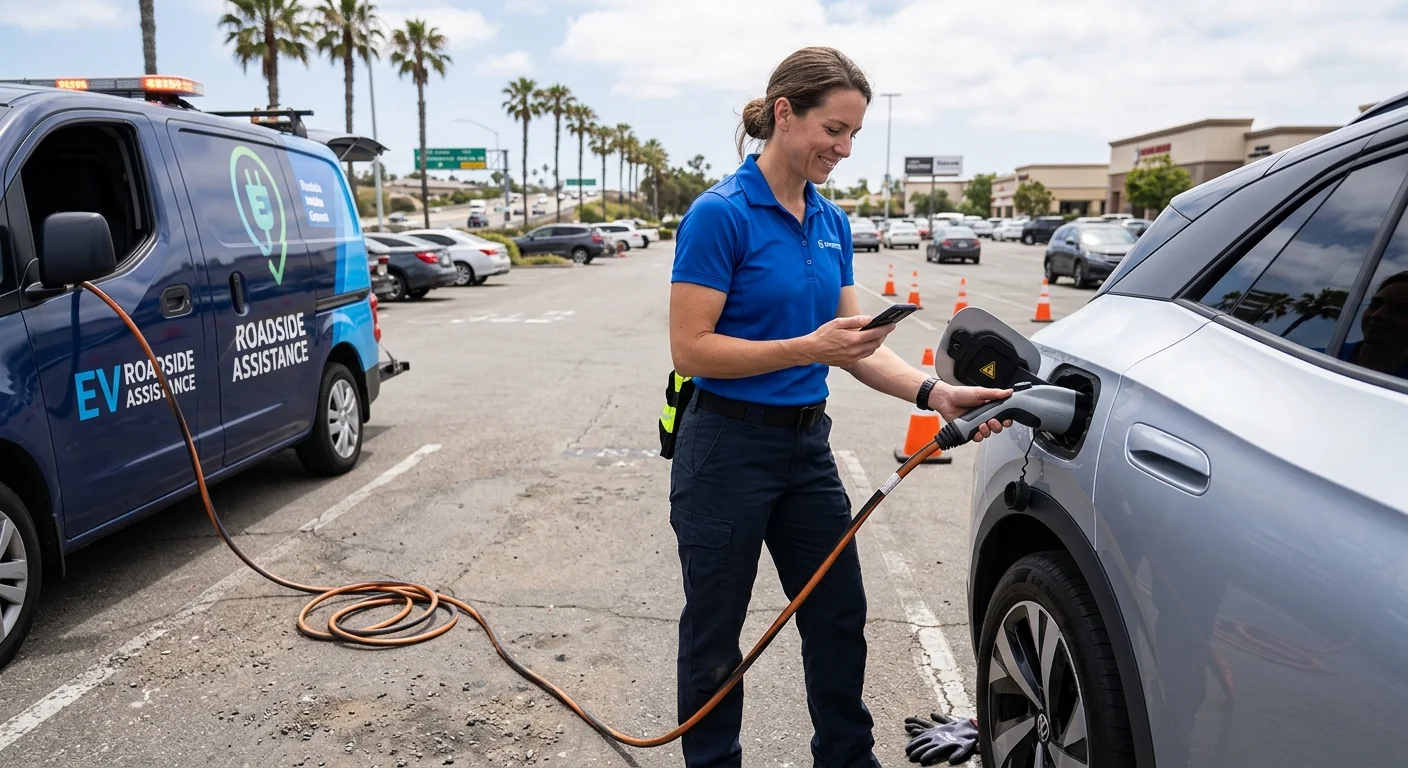
A roadside Level 2 visit isn’t a DC session. Independent operators typically bring a 240V source to the car. Native NACS for Tesla, and CCS or J1772 adapters for other EVs. The usual goal is 10 to 20 miles of added range. That takes 15 to 30 minutes of charging on the plug. That’s charging time on the plug, not an arrival time. It’s a bump to a working stall, not a full pack. See EV charging levels, explained for a driver already stranded.
Home power in the Inland Empire isn’t one utility. Riverside Public Utilities serves the city of Riverside. The City of Colton Electric Utility owns the wires inside Colton. The City of Banning Electric Utility serves that city. Big Bear Lake and Big Bear City sit on Bear Valley Electric Service. Rancho Cucamonga and Moreno Valley each split Southern California Edison with a municipal pocket. Apple Valley Choice Energy and San Jacinto Power handle generation on SCE delivery. None of that is a rapid charger on the shoulder. A dark garage still leaves you looking at a public stall. You can also ask for a quoted mobile visit.
Ask for a Level 2 visit that’s quoted first
Mobile charging can fit when the car is parked safely and the pack is empty. Charge Pro IE is a referral line, not a shop. We match stranded EV drivers with local mobile rescue operators. We don’t perform the work, and we don’t own trucks or equipment. We don’t employ technicians, set prices, or publish hours. The operator quotes you before starting and bills you directly.
Before you request mobile EV charging, gather what the operator needs:
- Year, make, and model.
- The exact dash message.
- Displayed pack percent, if you have one.
- The port you can see: NACS, CCS, or J1772.
- A precise pin, plus the road, direction, and nearest exit.
- Gates, height bars, garage ramps, or property rules.
- Whether the car can shift, steer, and unlock.
Saying you’re on the 91 isn’t a location an operator can dispatch from. A Fontana warehouse row needs a pin and a building number. An Ontario airport lot needs the lot name. Ortega Highway near Wildomar needs the highway and the direction. See What a mobile EV charging visit actually is, and isn’t.
Mobile charging may not fit if the car won’t accept power. A 12V failure can block access to the car. An unsafe parking spot can rule the visit out. Describe the symptoms you can see from the seat. Don’t guess the cause when you talk to the operator.
When transport is the better match
Transport may fit when charging can’t solve the immediate problem. The car won’t take energy, or the port won’t open. There’s a serious fault, or collision damage is visible. The car may also have stopped where staying with it isn’t safe.
A dead traction pack and a dead 12V can look identical from the seat. You might see a dark screen, locked doors, or a car that won’t shift. That display doesn’t prove you need a charge. Tell the independent operator the symptoms you see. Let that operator say which job it is.
If every confirmed stall sits beyond remaining range, stop driving toward the pin. Use the real route and the car’s own estimate.
Our out-of-charge recovery connects you with an independent local operator. Charge Pro IE doesn’t tow vehicles, set operator pricing, or warrant the work. Confirm the proposed service, the current price, the equipment, and the destination before you agree.
If a tow is recommended, follow the maker’s towing instructions. EV load rules differ by model, so say what the car can still do. Tell the operator whether it can enter transport mode.
Call when a confirmed stall isn’t in reach
Call when the EV can’t safely reach a confirmed rapid charger. We’ll connect you with an independent local operator. That operator assesses the scene and quotes the available work.
Call (909) 250-2881 and we’ll connect you with a local EV rescue operator.