After a day around Lake Arrowhead, the risk isn’t the climb you already finished. It’s the return on SR-18 or SR-330 with too little pack. Valley drivers plan the ascent. They treat the lake as the reward. The mountain still has you until you reach Highland or San Bernardino. If the car dies on the Rim, that’s a roadside call. EV roadside assistance in Lake Arrowhead is how you reach an independent mobile operator.
The downhill is what actually strands people
Lake Arrowhead sits at about 5,100 feet. That’s roughly a mile above the valley floor. You feel it on SR-330 from Highland. You feel it on SR-18 out of San Bernardino. You feel it on SR-189 from Crestline. Every one of those is a steep two-lane mountain highway. They’re the ordinary ways in, and the same ways out.
Regen on the descent can put some energy back. It doesn’t rewrite a pack you already spent coming up. Cabin heat draws from that same battery. So does a long Village walk. So does a cold soak while you tour the lake. The downhill run still needs a car that wakes. It still needs a 12V that will close the contactors. It still needs enough traction pack to roll and steer.
Weekend visitors are the first pattern. They leave the valley with a dash number that looked fine in town. They didn’t budget the climb. Second-home owners are the second pattern. The car sat at a cabin in the cold. Village and lakefront parking with a long dwell is the third. Winter chain controls are the fourth, and they’re honest. They can stop you even with a healthy pack.
You’re not in an incorporated city. Lake Arrowhead is an unincorporated CDP in San Bernardino County. There’s no city of Lake Arrowhead. Help still comes. You just have to describe the community and the road you’re actually on.
Three ways up, and the same commitment back down
Most valley drivers take SR-330. It leaves Highland around 1,300 feet. It climbs to over 5,000 feet in roughly fifteen miles. It’s the steepest of the three ordinary routes. It’s also the fastest, which is why people choose it. It reaches this side of the Rim through Running Springs. Then it runs west toward the lake. If you go empty on that grade, you’re on a committed mountain highway. There’s no casual frontage road to duck onto.
The Running Springs pin has its own writeup. See when your Tesla dies at the Running Springs junction. The junction is where a lot of valley trips become mountain trips.
SR-18 is the Rim of the World Highway. It comes up from San Bernardino. People remember it from the views. It’s still a steep mountain highway. Chain controls can hit it in winter, same as the others. A stall on the Rim isn’t a mall parking problem. Shoulders are uneven, and turns are tight. Night comes earlier in the pines.
SR-189 ties Crestline into this side of the lake. Drivers who already came through Crestline use it. It’s not a bypass around elevation. It’s another two-lane mountain road. Empty in Crestline is the sibling pattern if that’s the pin you have.
Once you’re up here, the numbered highways aren’t the only places cars die. Lake Gregory Drive. Hook Creek Road. Kuffel Canyon Road. Daley Canyon Road. SR-173. Callers stall on those as often as on SR-18. Pin the map. Read the last sign. A generic Lake Arrowhead drop can sit far from where you’re standing.
The car that made it up isn’t proof it’ll make it down. You already spent the climb. The estimate on the dash at the Village is the number that matters. Not the number you had in Highland. Not a hope that downhill regen will invent a buffer.
Village hours, the Queen, and a pack that sat too long
Lake Arrowhead Village is where days disappear. Shops, food, a walk along the water, a ride on the Arrowhead Queen. SkyPark at Santa’s Village pulls families for hours. None of that is a charging plan by itself. Climate control while you wait spends energy. A car locked in the cold spends energy too. You wanted that energy for SR-18 or SR-330.
This page won’t invent a stall count for those lots. It won’t guess how far the next public plug sits. Those figures were not confirmed in the research behind this piece. A fake number is worse than telling you to check. Open your car’s map. Open a live charging app. Confirm a stall is actually working. Don’t treat it as your way home until you do. If it’s offline, full, or the wrong plug, use the miles you have.
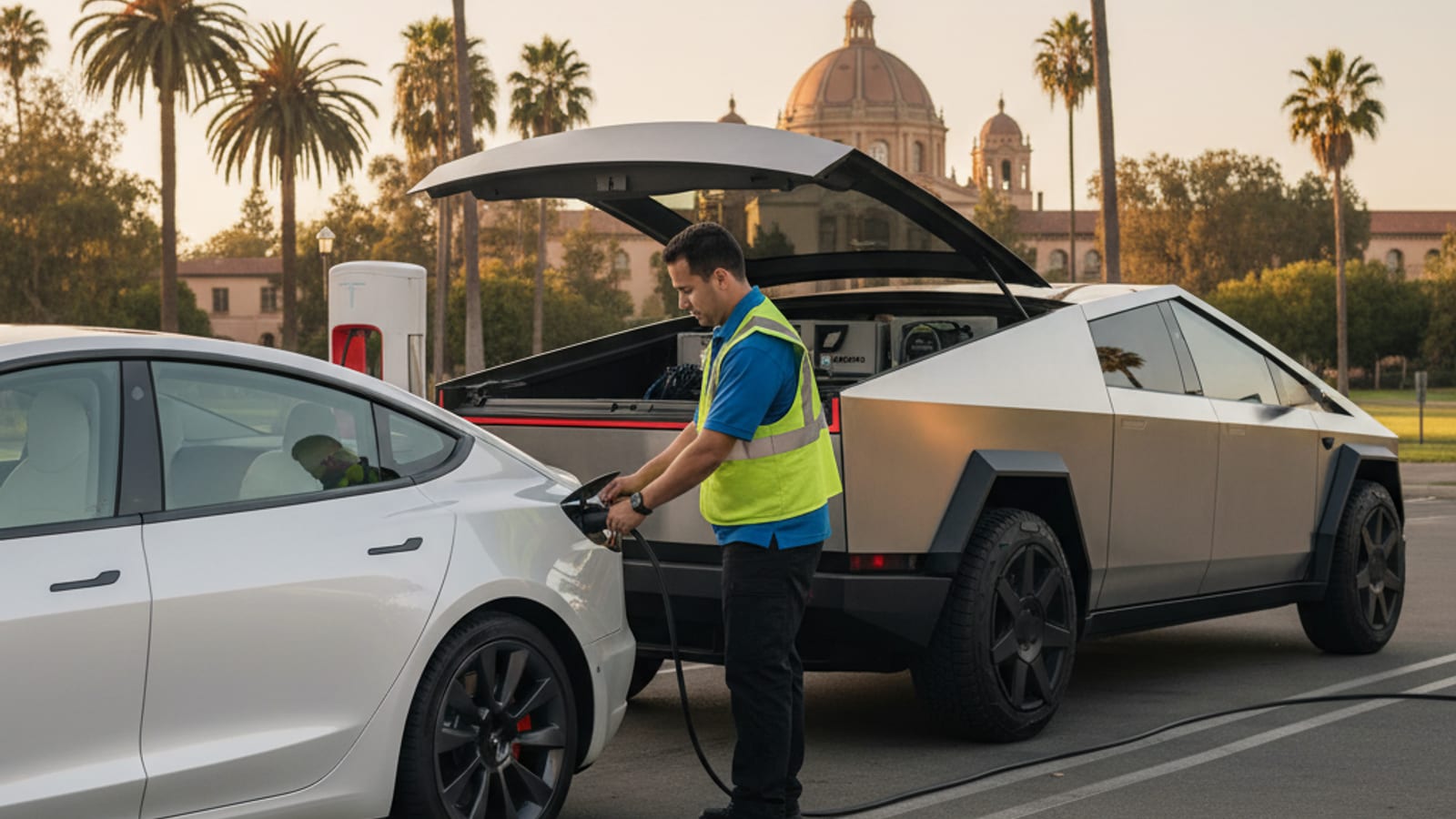
That’s when out-of-charge recovery is the useful call. An independent operator can bring a 240V Level 2 source to the car. We don’t own that truck. We don’t employ the technician. The operator quotes you before starting. They bill you directly.
A Level 2 top-off typically adds 10 to 20 miles of range. That’s on the shoulder or in a lot. That’s in 15 to 30 minutes of charging. That’s charging time, not arrival time. We don’t publish an arrival window. Ten to twenty miles is often enough to leave the Rim. It can be enough to roll toward Running Springs, Highland, or San Bernardino. It isn’t a full recharge. It isn’t a tow.
Callers say Blue Jay, not Lake Arrowhead
The CDP covers about 17.68 square miles. Census lists six ZIP codes that overlap it. Those are 92317, 92321, 92352, 92378, 92385, and 92391. Those ZIPs smear across a scatter of named communities. About 10,639 people live here, ACS 2019-2023. There’s no separate 2024 city estimate, because this isn’t a city.
So the pin on a phone is often wrong. People say Blue Jay, Cedar Glen, or Skyforest. They say Twin Peaks, Rimforest, Deer Lodge Park, Agua Fria, or the north shore. Neighbors include Crestline and Running Springs. If you’re on the phone, use the name on the last road sign. Use a cross street. Use a business you can see from the car.
Blue Jay sits in the commercial mix people treat as town. Cedar Glen and Skyforest are easy to overshoot if you’re navigating by the lake. Twin Peaks and Rimforest read as pass-through names until you’re stuck on them. Deer Lodge Park and Agua Fria don’t show up for valley drivers. The north shore is its own scatter. Say those names. Don’t make an operator hunt 17 square miles of pines.
Housing is older than a lot of valley tracts. 57.9% of units were built before 1980, ACS 2019-2023. Empty cabins in the cold are often a 12V story. Hispanic or Latino share is 25.0% in that same Census pull. It doesn’t change the grade on SR-330. It doesn’t change chain controls. For a local folder on this community, use the Lake Arrowhead charging page.
Cold, snow, and chains on every access road
This side of the Rim is slightly lower than Big Bear. It’s slightly milder. Research is plain: not milder enough to change the driving math. You still get real snow. You still get real cold. Chain controls can hit every access road in winter. SR-18, SR-330, SR-189, and the rest. That’s an operational limit worth saying out loud.
Cold hits an EV two ways. The traction pack has to heat itself. Cabin heat draws more on top. An estimate that looked fine in Highland can shrink on the way up. Then it shrinks again while the car sits. That sit might be the Village or a cabin. If you came up SR-330 with a thin buffer, winter is when it vanishes.
Chain controls can stop you even with miles left. If you can’t legally proceed, you’re parked until the restriction lifts. Keep the 12V from going flat while you wait. Don’t run the cabin down to empty. Don’t assume a closed road will reopen on your clock. Caltrans and CHP set those controls. Confirm them before you leave the valley.
Summer still exists up here. It just isn’t the main stranding story. The climb still costs energy in any season. A long dwell still costs energy. The return still has to happen.
The 12V in a cabin that sat empty
Plenty of cars up here aren’t out of charge. They just won’t wake. That’s the 12-volt battery. Teslas have one. So does every major EV brand operators see. It runs computers, contactors, and door logic. When it dies, the big pack can still hold energy. The car still looks completely dead.
Second homes and weekend cabins sit for days. Older housing stock, cold nights, and a car left unplugged are a bad mix. You come up Friday, park, and Saturday morning nothing happens. That’s not a downhill-range problem. That’s a 12V problem. Operators can jump or replace a dead 12V on site. That’s a different job from a Level 2 top-off.
If the dash is dark and the doors won’t handshake, start there. Don’t assume you burned the traction pack on the Rim of the World Highway. A jump can get you moving. If the 12V dies again after a jump, that’s a clue. You’re in replacement territory with a shop. A second death in a day isn’t bad luck.
Tesla, Rivian, Ford, Hyundai, Chevy, and BMW all see this. The mountain doesn’t care which badge is on the liftgate.
What a roadside Level 2 hookup is, and isn’t
Public DC fast charging is a different tool. It’s not the same as a truck that comes to you. A Supercharger, or any DCFC stall, pushes DC into the pack. That’s at highway speed. That’s for a working car that can still drive to a site. This page won’t name a specific stall up here. Research didn’t confirm one for publication.
A mobile visit is Level 2 AC. Operators bring a 240V source to the car. Native NACS for Teslas. CCS or J1772 adapters for other EVs. Typical add is 10 to 20 miles of range. That’s in 15 to 30 minutes of charging. Again, that’s charging time. We don’t promise when someone arrives.
Read what a mobile EV charging visit actually is. It walks the sequence without brochure tone. The mobile EV charging page is the service itself.
Ten to twenty miles can be the difference on SR-18. It can be the difference between sitting and rolling toward Highland. It can’t fill a weekend. It can’t replace a dead 12V. If the car won’t wake, ask for the 12V path first.
Towing is the other fork. A dead EV often needs a flatbed. Don’t let a hook drag a motor. If the operator says the honest next step is a tow, that’s the answer. We don’t pretend a Level 2 visit fixes every stall.
Plugs, adapters, and which cars show up on the Rim
North American EVs use NACS, CCS, or J1772. Tesla popularized NACS. Many newer non-Tesla models now ship with it. Older CCS cars need an adapter for some Tesla stalls. Teslas can use a NACS-to-CCS adapter at other DC sites. Confirm your port and your adapters before you leave the valley. Don’t learn that on Daley Canyon Road.
Operators in this referral network handle Tesla and every major EV brand. A Model Y on SR-330. An Ioniq 5 in a Village lot. A Lightning at a cabin in Cedar Glen. The plug plan is the operator’s job to match on site. Bring your adapter if you have one. Don’t assume the public stall you hoped for will fit.
Power on the Rim is SCE, not Bear Valley
Lake Arrowhead and Crestline sit in Southern California Edison territory. That’s from SCE’s tariff Index of Communities, plus SCE mountain-community outage releases. Bear Valley Electric Service covers Big Bear Lake and Big Bear City. It also names other pockets on that side of the mountains. Its own service-area page doesn’t list Lake Arrowhead or Crestline. Don’t mix the two utilities when you report an outage. Don’t mix them when a cabin wall connector is dark.
SCE publishes a residential EV rate called TOU-D-PRIME. Names and program pages change. Confirm the current plan on SCE’s site before you assume a home rate. This page won’t quote cents or daily charges. Those figures move, and a made-up number doesn’t help you. If the cabin power is out, a wall connector does nothing. That’s separate from a car already empty on SR-18.
SCE also publishes EV programs with their own rules and funding limits. Check those pages if you’re shopping a home setup. They don’t rescue a car that’s already sitting on the Rim.
If you’re already stuck on SR-18 or SR-330
Stay in the car if you’re on a live lane. Keep the hazards on. Wheels pointed with traffic if you can manage it. Mountain two-lanes don’t give you a wide shoulder everywhere. A Village lot is a safer dwell. So is a cabin driveway or a SkyPark parking row. Still drop a pin on the exact spot.
Then separate pack from 12V. Dark dash, no handle response, no wake: think 12V. Car wakes, shows low miles or zero, won’t go far: think traction pack. Either way, this referral line’s path is a mobile operator. Charge Pro IE matches stranded EV drivers with independent local operators. We perform no work. We own no trucks. We employ no technicians. We set no prices. We hold no license. We publish no business hours.
The operator tells you the price before they start. You pay them. If they need a better pin, give the community name. Blue Jay, Cedar Glen, Twin Peaks, or the highway mile you can see. Give a ZIP if you know it. 92317, 92321, 92352, 92378, 92385, or 92391 may all be in play. Don’t fight the map. Describe what you see.
CHP handles highway safety. Caltrans handles the road and the chain signs. This brand isn’t either of those. It’s a match with a mobile operator who can charge or jump on site.
A plan that fits this mountain, not a valley errand
Start with more pack than the in-town map suggests. The climb from Highland on SR-330 is the one most valley drivers take. It burns energy you wanted for the lake and the return. Coming up SR-18 from San Bernardino is the same physics in a different postcard. SR-189 from Crestline isn’t a free pass.
Watch the estimate after you park. A four-hour Village walk in the cold changes the car. It’s not the same car you locked. Precondition only if you still have margin. Heated seats aren’t free on a thin buffer.
Name your backup before you need it. That backup can be a public stall your app currently shows as working. It can be a mobile operator if the car can’t move. It shouldn’t be a hope that regen on the descent will invent miles. You already spent those miles coming up.
If you own a cabin, keep the 12V from sitting dead between weekends. An unplugged EV in a pre-1980 garage is a classic 12V failure. January nights make it worse. Jump it once. If it fails again, you’re replacing it, not wishing.
Winter: check chain controls on SR-18, SR-330, and SR-189 before you leave the valley. Every access road can get them. Carry what the restriction requires. An EV still needs chains when the sign says so. A low pack plus a chain control stacks two problems. That’s how a lake day becomes a night on the Rim.
Keep the community names in your head on the way up. Blue Jay. Cedar Glen. Skyforest. Twin Peaks. Running Springs behind you. Crestline off to the west. When you call, those names beat somewhere near the lake.
Frequently asked questions
Does driving down from Lake Arrowhead put enough charge back to skip a plan?
Regen helps. It doesn’t replace a plan. If you arrived already low, a long Village sit can erase the buffer. The return still has to clear SR-18, SR-330, or SR-189. Those are steep two-lane mountain highways. Treat leftover miles as the real ticket home, not the elevation drop.
What if the EV won’t start at a cabin or in a Village lot?
Check for a 12V failure before you assume an empty pack. A dark dash and dead handles usually point at the 12-volt battery. Cold, empty cabins make that more likely. If the car wakes and shows zero miles, you’re in out-of-charge territory. Either way, a mobile operator can jump a 12V on site. They can also add a Level 2 top-off. They quote before they start.
Who actually shows up for EV roadside assistance around Lake Arrowhead?
Charge Pro IE is a referral line for the Inland Empire. It matches you with an independent local operator. It doesn’t send its own fleet. Tell them the community you’re in, and the road. Blue Jay, Cedar Glen, Twin Peaks, or Skyforest all change the pin. So does SR-18, SR-330, or a cabin driveway. Confirm the quote with that operator before any work begins.
If the pack is already gone on the Rim
The search is EV roadside assistance Lake Arrowhead for a reason. People don’t get stuck on the postcard. They get stuck on the way back to Highland and San Bernardino. If you’re already there, call (909) 250-2881. That’s the Charge Pro IE line. An operator quotes you before they start. They bill you directly. Nobody here can promise when the truck rolls. They can bring a 240V Level 2 source once they’re on site. They can jump a 12V too.