The Hyundai Ioniq 5 charge port stuck problem inland shows up at public posts. You end a session in Ontario, Fontana, or Riverside, and the CCS handle stays locked. Unlock the doors. Stop the station. Then pull the driver’s-side trunk release if the pin still holds.
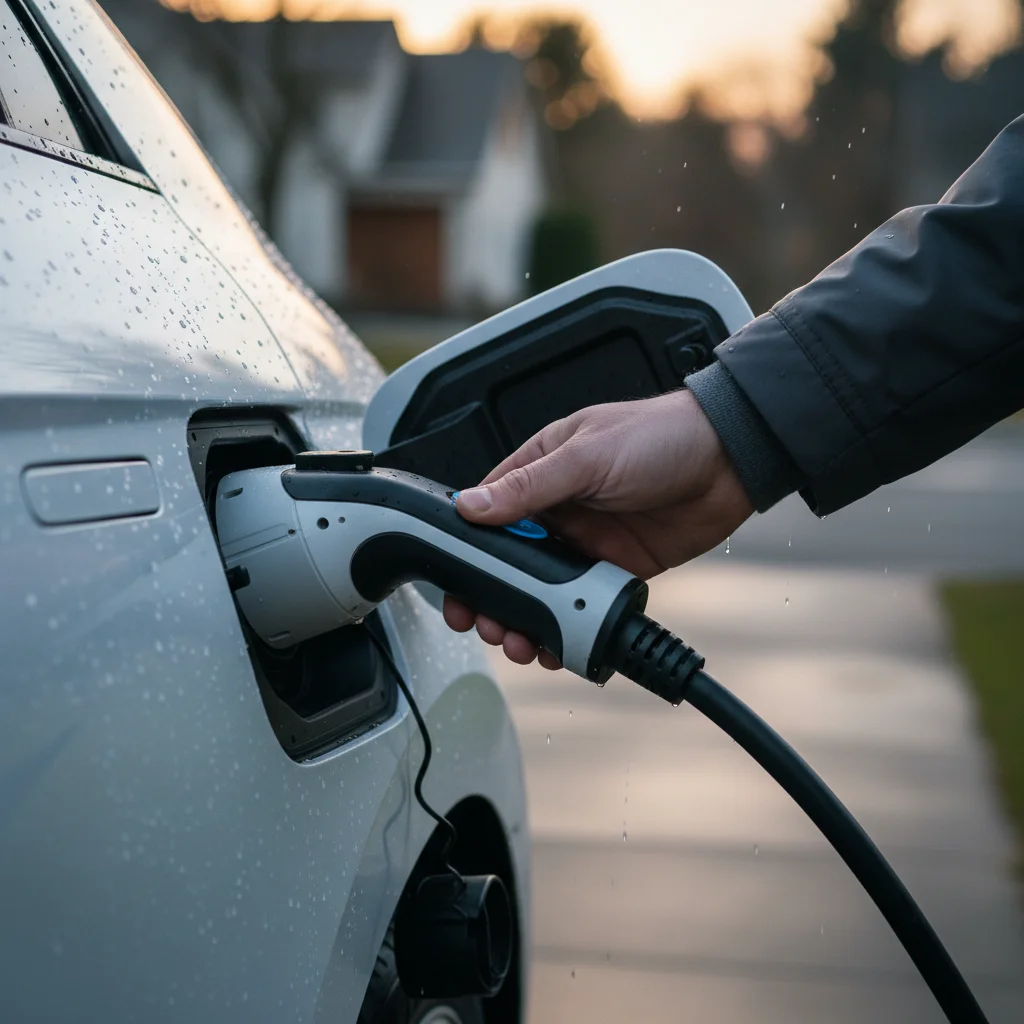
Valley retail lots, warehouse rows, and freeway cabinets are where this latch seizes. A home Level 2 plug in Chino or Eastvale rarely traps the handle the same way. The public DC handshake is pickier. The car and the cabinet have to agree the session is over. When they don’t, the lock pin stays in the CCS notch.
Public posts across the valleys, not the driveway
Ioniq 5 drivers here charge away from home a lot. Fontana’s warehouse belt and the Ontario airport lots turn CCS stalls all day. People coming off I-10 through Colton and Redlands stop at the first working post they find. I-215 through Moreno Valley and Perris Valley repeats that pattern. SR-60 in Jurupa Valley adds more plaza cabinets. So does the 91 through Corona. Temecula and Murrieta traffic uses those posts after wine-country miles. High Desert drivers who just cleared the Cajon climb on I-15 often plug in next. That’s the run toward Victorville, Hesperia, or Adelanto.
That isn’t a count of stalls in any city. It’s where you’re standing when the handle won’t come out. Cabazon destination lots play out the same way on event days. So does the Glen Helen amphitheater parking field. Pechanga parking after a long sit can too. You’re physically tied to the cabinet. Other drivers are waiting. The fob feels useless.
Your home utility doesn’t unlock that pin. Fontana, Ontario, and San Bernardino sit on Southern California Edison. So do Highland, Loma Linda, Grand Terrace, Redlands, and Yucaipa. Riverside runs Riverside Public Utilities and has since 1895. Riverside is absent from SCE’s served-cities list. Colton owns the electrical infrastructure inside city limits. That’s City of Colton Electric Utility. Banning has City of Banning Electric Utility. Big Bear Lake and Big Bear City sit on Bear Valley Electric Service. That utility also names Lake Williams, Erwin Lake, Sugarloaf, Moonridge, Fawnskin, and Boulder Bay.
Moreno Valley is split. SCE covers part of the city. Moreno Valley Utility serves newer development since 2004. MVU lists more than 6,500 customers and publishes an address lookup. Rancho Cucamonga is mostly SCE. Rancho Cucamonga Municipal Utility covers a southeast pocket. That pocket includes over 3,900 metered businesses and residents. Named areas include The Enclave, Day Creek Square, The Resort, and the Victoria Gardens area. San Jacinto gets delivery from SCE. San Jacinto Power supplies the generation as a community choice aggregator. Apple Valley is similar. SCE delivers. Apple Valley Choice Energy procures. None of those bills, TOU plans, or rebate pages can retract a charge-port pin. Not at a public cabinet. The stuck handle is a car-and-station problem.
Valley heat, mountain miles, and High Desert sits
The Inland Empire isn’t one scene. A post in downtown Riverside sits in the two-county market’s largest city. ACS 2019-2023 puts Riverside at 319,069 people. The 2024 estimate is 323,757. The home meter there is Riverside Public Utilities, not SCE. Temecula, Murrieta, and Eastvale are newer towns. The stuck-cable story there is still usually a retail DC cabinet after a drive.
High Desert cities after the Cajon climb are spread out. Victorville covers 73.71 square miles. Apple Valley covers 77.006. You can finish a session, then notice the handle is still captured, with a lot of open asphalt around you. Mountain towns flip the weather. Big Bear Lake runs on Bear Valley Electric Service. Lake Arrowhead and Crestline are unincorporated. SCE’s tariff index and mountain outage releases name them. Bear Valley’s service-area page doesn’t list either. A wet port after the descent is worth drying. That isn’t a proven ice lock of the Ioniq 5 pin.
Inland heat and mountain grades send Ioniq 5 trips through public DC. The San Bernardino Valley, the Perris Valley, and the High Desert after Cajon are long and hot. Range gets spent on the climb. That’s why the lockup you remember is usually at a post, not in a garage.
Stop the session before you open any panel
Work the electronics first. The Ioniq 5 uses a motorized charge door. It also uses a separate pin that slides into the CCS handle. The pin’s supposed to retract when the session ends. It’s also supposed to retract when you unlock the doors. A messy handshake at a public DC cabinet can skip that retract command. The software still thinks the handle should stay captured.
Lock the car with the fob. Wait a few seconds. Then unlock. Do that a few times. Don’t mash the button. If you’ve got Hyundai Bluelink on your phone, end the session from the app. Walk to the cabinet and press the station’s stop control if it has one. Watch the screen. Some units sit in a half-ended state until someone hits stop.
If the handle still won’t move, call the number printed on the cabinet. Read the station ID off the unit. Network support can force-stop the session from their side. Try that before you open the hatch.
That’s the same sequence as any EV that won’t unplug. The guide to freeing a charging cable stuck in an EV covers that shared path. The Ioniq 5 just hides its mechanical override in a specific cargo panel.
A cabinet that says connected and does nothing is a different failure. If the session never really started, read what to try when a public charger is connected but not charging. Don’t assume a silent cabinet has already unlocked you.
Don’t cut the handle. Don’t soak the port with a bottle of water. If you see water in the inlet before you retry, dry it first. The water in the charge port checks apply after a wet run into Lake Arrowhead or Crestline.
The trunk override on the driver’s side
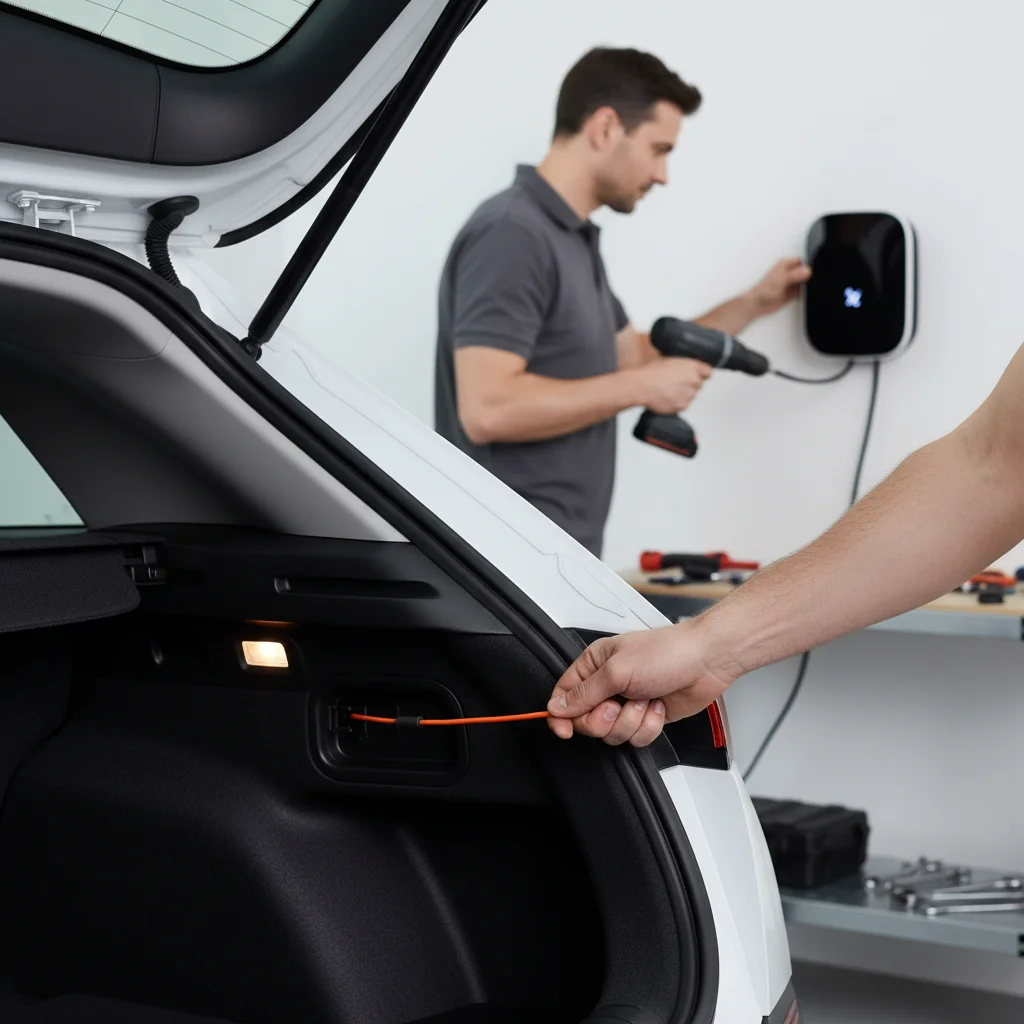
Hyundai put a mechanical pull in the cargo area for this lockup. Use it after the fob, the app, and station support have failed. Open the rear hatch with the car unlocked and off. Stand in the cargo opening and look to the driver’s side. That’s the left side on a U.S.-spec Ioniq 5. There’s a small rectangular panel in the liner, nearly behind the tail lamp.
Pop that panel with your fingers. A plastic trim tool is gentler than a key if the cover is tight. Inside you should see a short cable with a loop or a small handle. It sometimes has an orange tab. That’s the manual charge-port release. Pull it toward the center of the cargo area. Keep the pull short and steady. A clunk at the port is the pin dropping. Walk back to the CCS handle and pull it out the way you always do.
If you want the diagram for your model year, use Hyundai’s published manuals. They’re at the Hyundai Owner’s Manual page. Match the year and trim. The liner layout can shift slightly across years. Driver’s-side cargo panel, short pull, then remove the handle.
Snap the panel back when the cable is free. You can leave the lot. Report the stall to the network if the session wouldn’t end on its own.
If the trunk cable is extremely hard to pull, stop. If you pull it and hear nothing at the port, stop. That’s no longer a software reset. Keep yanking and you can leave the override slack the next time you need it.
When the pin is software, and when it isn’t
A public-post lockup is often a logic freeze. The car never sent retract. The fob cycle, a Bluelink stop, or a network force-stop clears it. An interrupted session does the same thing to that logic. So does walking away while the handshake is still running. So does unlocking in the middle of the start sequence. Older or poorly kept DC cabinets make that handshake worse. That’s session logic, not a named network at a named lot. No stall-by-stall inventory for these cities turned up in the sources behind this page.
Hardware is the other bucket. The actuator can stick. Grime in the port can block the pin. A damaged handle on the cabinet can keep the pin from clearing its slot. You’ll feel that difference on the override. No clunk, no release. At that point the job is careful disconnection, not another fob click.
Home charging under a different utility doesn’t change this diagnosis. An RPU meter in Riverside and an SCE meter in Upland both end a Level 2 session more quietly than a public DC cabinet. If your handle sticks at home, still start with lock and unlock. Then use the same trunk panel. The geography around you is different. The pin isn’t.
A dead 12V looks like a stuck charger
The latch is an electronic actuator. It needs the 12-volt system. If that small battery is dead, the fob may do nothing. Bluelink may not wake the car. The charge-door logic has no power to retract the pin. You can be tied to a public post with a dark dash and a handle that won’t move.
That’s a different job than a software lockup. It’s the same 12V failure Ioniq 5 owners already hit when the car won’t start. Run the Ioniq 5 12V checks if the dash is dead and the fob is mute. An operator who works non-Tesla EVs can jump the 12V on site. That restores power to the latch. Then they release the handle.
Charge Pro IE doesn’t do that work. It’s a referral line. It matches stranded EV drivers with independent local mobile rescue operators. It owns no trucks, employs no technicians, and holds no license. It sets no prices and publishes no hours. The operator quotes you before starting and bills you directly.
Warehouse overnight parking in Fontana and airport-adjacent lots in Ontario are where a long sit can drain that 12V. Don’t keep cycling the fob until the last bit of 12V is gone. If you’re in that Ontario geography, EV rescue around Ontario airport lots maps the setting. Fontana’s industrial rows have their own write-up in Fontana warehouse EV help.
When to stop DIY and call for an operator
Call for help if the trunk cable does nothing. Call if it feels like it’s about to part. Call if the car is dark and you can’t open the hatch the normal way. Call if you’re on a shoulder of I-10 in Colton. Don’t stand in a cargo area with traffic going by. Same for I-215 in Moreno Valley. Same for the 91 in Corona. A busy Glen Helen lot after a show is the same call. So is a packed Cabazon destination lot. So is a work-lot stall in Chino or Bloomington after a shift.
The operators in this network work Tesla and every major EV brand. For an Ioniq 5 they bring CCS familiarity. They can jump the 12V if that’s the real fault. They can bring a 240-volt Level 2 source if you also need range after you get free. They use a native NACS plug, with a CCS or J1772 adapter for non-Tesla EVs. Typical roadside charging adds 10 to 20 miles of range in 15 to 30 minutes of charging. That’s time on the plug. It’s never a promise of when someone arrives.
If the latch itself is broken, that’s repair, not rescue. An operator can help you unplug without making the port worse. A dealer handles the actuator. Don’t mix those jobs. For CCS and other non-Tesla ports across Riverside County and San Bernardino County, start with non-Tesla EV rescue.
When the trunk pull isn’t enough
If the Ioniq 5 is still tied to a public post and the trunk pull failed, stop forcing the handle. Same if the 12V is clearly dead. Call (909) 250-2881. That line connects you with a local operator. You get a quote before any work starts. Nobody here can promise an arrival window. The point is a person who knows the Ioniq 5 latch, the 12V, and the CCS handle, without you guessing in a live lane.
Frequently asked questions
Why does an Ioniq 5 charge port stay locked after charging
The port pin is meant to hold the CCS handle during a session. If the car and a public cabinet never finish the end-of-charge handshake, the pin can stay in the notch. Lock and unlock with the fob. End the session in Bluelink. Press stop on the cabinet. Those steps usually send the retract command. Inland, this shows up at valley public posts more than at a quiet home plug.
How do you release a stuck Ioniq 5 charging cable
Start with the fob, the app, and the station stop. If you’re on a public unit, call the support number on the cabinet and ask them to force-stop the session. Use the manual release only after that. It lives in the cargo area on the driver’s side, behind a small liner panel near the tail lamp. Pull the loop toward the center of the trunk, then remove the handle. Confirm the layout in Hyundai’s owner manual for your year.
What if the Ioniq 5 12V is dead and the charger won’t release
The latch needs 12-volt power. A dead 12V leaves the fob, the buttons, and the electronic release quiet. That’s an operator call, not another DIY yank. The operator jumps the 12V, restores power to the latch, and then frees the handle. Charge Pro IE only makes the match. The operator on site does the work.