When a Kia EV9 won’t start after a family trip, start with the 12V. The traction pack can still hold a real charge. The smaller 12-volt battery still has to wake every computer. Until those modules boot, the EV9 stays dark. You’ll get no dash, no Ready mode, and no drive. Inland Empire heat and all-day parking make that 12V sag.
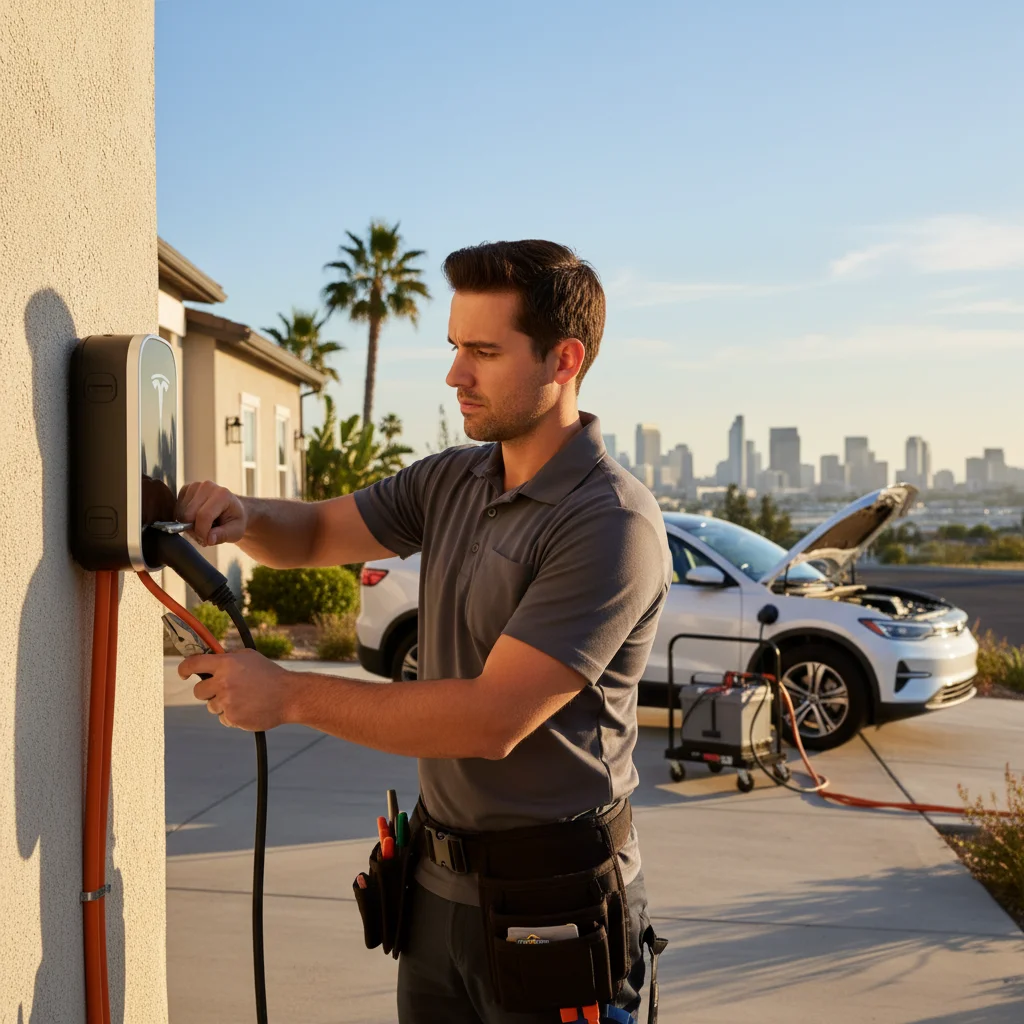
A dark cabin after a long sit is the tell
You park the three-row EV9 for hours. You come back and the start button does nothing. That’s a 12V failure, not an empty pack. Families leave the car all day at Pechanga, then find a silent cabin. Cabazon destination lots produce the same black screens. Ontario airport garages do too after a flight home. You can get that black cabin in Highland or Yucaipa after a mountain day. The car looks fully dead, even when the pack still has range.
The EV9 uses Kia and Hyundai’s E-GMP platform. That layout needs 12-volt power before high voltage can engage. No 12-volt boot means the car can’t ask the pack to work. When an EV 12V dies on the road, this is the pattern.
These clues point at the auxiliary battery, not the pack:
- The instrument cluster never lights
- Interior lamps are dim or gone
- Walk-away lock and Kia Connect stop answering
- The charge-port light doesn’t react to a cable
- You may hear one chime, then silence
If the car wakes with a low-voltage warning, the 12V is fading, not gone. Get that battery tested, and don’t keep stretching it on I-15.
How this differs from an empty pack
An empty traction pack usually leaves some electronics alive. You may still see a range number or a charge-now message. A dead 12V takes the screens with it. Doors can feel dumb, and the selector never goes to drive.
That mix fools people on Inland Empire grades. You came down from Lake Arrowhead with range to spare. You parked, ran errands, and came back to a black dash. It’s easy to blame the descent, so check the 12V first. A pack with energy left can’t help until the computers boot.
Valley heat tells a similar story after a grocery run. A lead-acid 12V sags when it sits hot in a closed cabin. Riverside lots bake an EV9 the same way San Bernardino lots do. That still doesn’t prove the traction pack failed. The small battery may have dropped overnight in that heat.
A dark EV9 also won’t talk to a home charger. Riverside Public Utilities serves the city of Riverside. Southern California Edison covers most of the rest of this market. Colton and Banning each run a city electric utility. Bear Valley Electric Service covers Big Bear Lake and Big Bear City. None of that matters until the 12V wakes the port computers. If the cabin is black, the panel isn’t your first problem.
Jump points live under the hood
Open the hatch to find the EV9’s 12V. It sits on the left, behind cargo trim, ahead of the rear wheel well. That’s a poor swap on a freeway shoulder. For a jump, Kia puts remote terminals in the front bay.
Positive sits under a red cap on the right side of the bay. Negative is a chassis ground stud or a nearby unpainted bolt. Your owner’s manual has the exact ground for your build date. Clip the cables to those points, not to the buried battery. Use a known-good jump pack or a running donor car. Wait a couple of minutes so the modules can boot. Press start only after that pause, then watch for Ready. Follow the printed sequence, and don’t improvise the order.
A careful jump is the usual driveway fix. Jumping an EV at the curb is a 12V job. It isn’t a charge of the big pack. If the EV9 wakes and then dies again, the battery is worn. A jump is only a bridge, not a lasting repair.
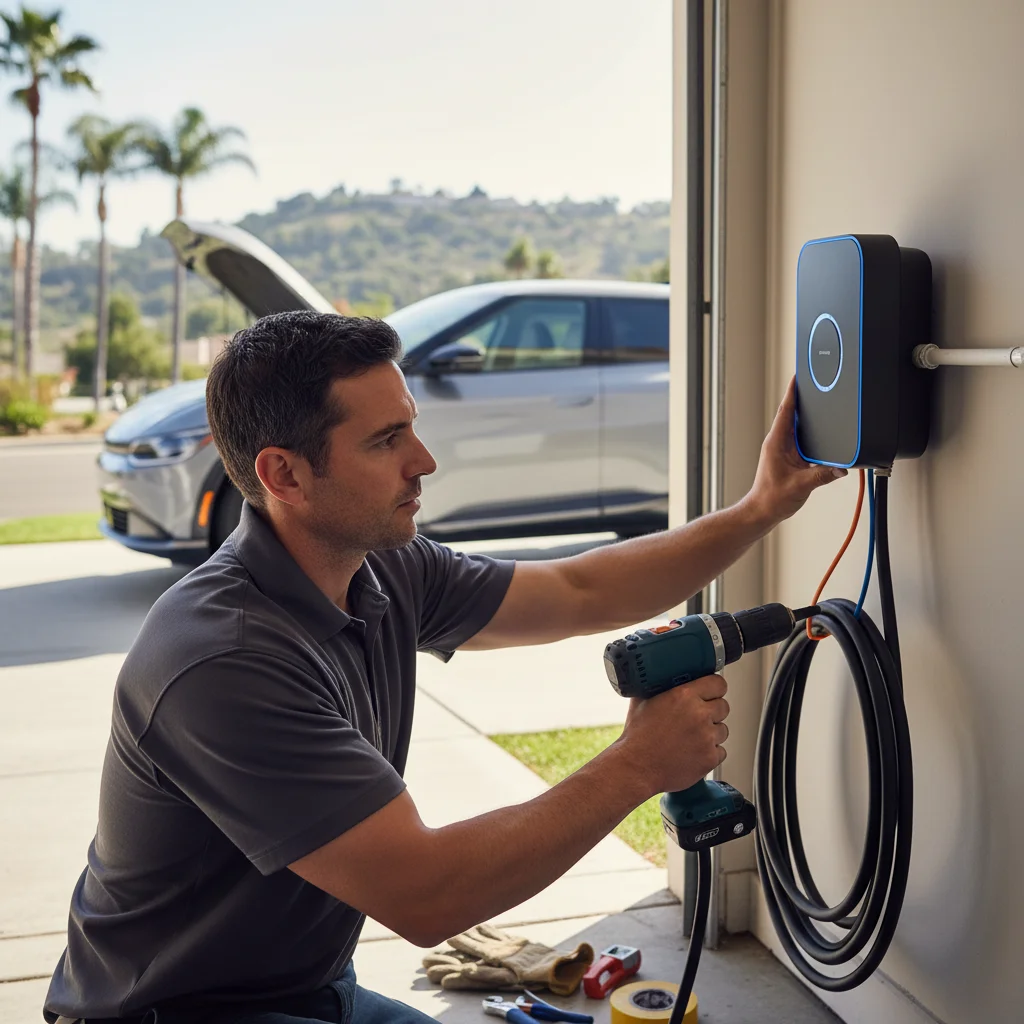
The 12V save setting is prevention, not a rescue
On 2024 and newer EV9s, Kia includes a 12V battery save function. You enable it in Vehicle, then EV Settings, then 12V Battery Saver. When it can run, the car tops up the auxiliary battery from the pack. It does that after a voltage dip while parked.
It can’t run if the 12V is already too low to boot. You need a living 12V for that converter to wake. Treat it as a habit for cars that sit between trips. It isn’t a roadside backup after the dash goes black. Turn it on before a weekend in a lot, not after.
A leftover scheduled departure can also make the car feel dead. Check EV settings once you have a screen again. A charge-port glitch after a long sit can confuse the modules. A brief 12V disconnect at the jump terminals sometimes clears it. Do that only as the manual describes. Persistent warnings after a wake-up belong at a Kia shop. Don’t clear a warning and then take the Cajon climb.
Where Inland Empire sits drain the small battery
Eastvale and French Valley are mostly new housing. ACS 2019-2023 puts Eastvale’s pre-1980 share at 2.2 percent. French Valley sits at 2.3 percent on the same vintage. Riverside is 56.4 percent pre-1980 on that vintage. The streets differ, but the 12V failure doesn’t. If your EV9 sits in one of those driveways after a trip, start with the 12V. A dark cabin is still usually the auxiliary battery.
Temecula and Murrieta send families toward Pechanga and I-15. A full day parked, then a dead start button, fits this. Ontario airport rows do the same after a flight.
Up the hill, Lake Arrowhead and Big Bear trips add confusion. Range on the descent is a real worry. A dark dash after you park is still a separate system. Don’t assume you need a pack charge when the screens never woke.
If the pack truly is empty, that’s a different call. Operators in this network can bring a 240-volt Level 2 source. They use CCS or a J1772 adapter on a non-Tesla EV9. That visit typically adds 10 to 20 miles of range. Plan on 15 to 30 minutes of charging, not an arrival time. Start with the 12V path before you assume the pack is empty.
A stall in Beaumont or Banning on the I-10 climb can confuse this too. Get the car out of the travel lane first, with hazards on.
What to try, in order
Confirm it isn’t a leftover schedule once a screen exists. Jump at the under-hood terminals and wait through the boot. If it returns to Ready, drive only if it stays stable. Get the 12V load-tested when you can reach a shop. If it dies again, stop treating jumps as a plan. The battery wants replacement, not another clip-on.
If nothing wakes, you’re past a driveway trick. An independent operator can jump or replace a dead 12V on site. Charge Pro IE is a referral line. It matches you with local mobile rescue operators. It doesn’t own trucks, and it doesn’t do the work. The operator quotes you before starting and bills you directly.
For a CCS family EV like the EV9, start with non-Tesla EV rescue. You may need a jump, a mobile charge, or a hook. For that choice, read charge, jump, or tow. A flatbed for a three-row EV9 is a last move. A 12V jump or swap at the curb can end the stall without a lift. No public price for that visit turned up in the sources checked for this page. Confirm the operator’s quote before they start.
I-10 through Colton is a bad place to wait on a dark SUV. So are I-215 through Moreno Valley and SR-60 in Jurupa Valley. Get well off the travel lane, and don’t pull cargo trim in traffic.
Sister platforms, same 12V logic
The Ioniq 5, Ioniq 6, and EV6 share this E-GMP boot sequence. If you’ve read the Ioniq 5 12V checks, the EV9 rhymes. A dark dash with a charged pack is the small battery until proven otherwise. Software can play a part, though it’s less common than a flat 12V. A bad schedule or a port handshake fault can lock the car. An interlock warning that keeps returning needs a dealer scan. Rescue gets you moving, and repair is a Kia job.
Frequently asked questions
Why does a Kia EV9 go dark when the main pack still has charge?
The traction pack and the 12V are separate. The pack moves the car once the computers allow it. The 12V runs those computers, the cluster, and the charge-port talk. If the 12V is dead, the EV9 can’t authorize drive. Range left on the big battery doesn’t change that.
How do you jump-start a Kia EV9?
Use the remote terminals under the hood. Clip positive to the red cover in the front bay. Clip negative to the nearby chassis ground. Wait a couple of minutes, then press start. Don’t clamp onto the cargo-area battery. Use your owner’s manual for the exact ground point on your build.
Can the EV9’s 12V save feature stop a no-start?
It helps while the car can still wake. It trickle-charges the auxiliary battery from the pack after a dip. It can’t start itself from a battery that’s already below the boot threshold. Turn it on as routine, and don’t count on it after the dash is black.
If your Kia EV9 won’t start in the Inland Empire, call (909) 250-2881. A dispatcher will take the location and connect you with an independent operator. That operator can jump or swap the 12V on site. They can also do a Level 2 top-up if the pack is the problem. Get the quote before they start.