Your pack hits empty on the Cajon climb toward Victorville. The car still looks healthy, and you still can’t roll. The choice in front of you isn’t which app looks busier. It’s whether someone adds range on the shoulder. The other path is a flatbed that hauls the empty car away.
CHP Freeway Service Patrol may already be part of that scene. Those trucks work some Inland Empire freeway shoulders. Confirm today’s FSP rules with CHP or Caltrans for your stretch. A short free shove to the next exit still leaves the pack empty. That limit is the whole point of the mobile ev charging cost vs tow decision. Range on the shoulder is the product you need. A tow only relocates a car that still can’t drive itself.
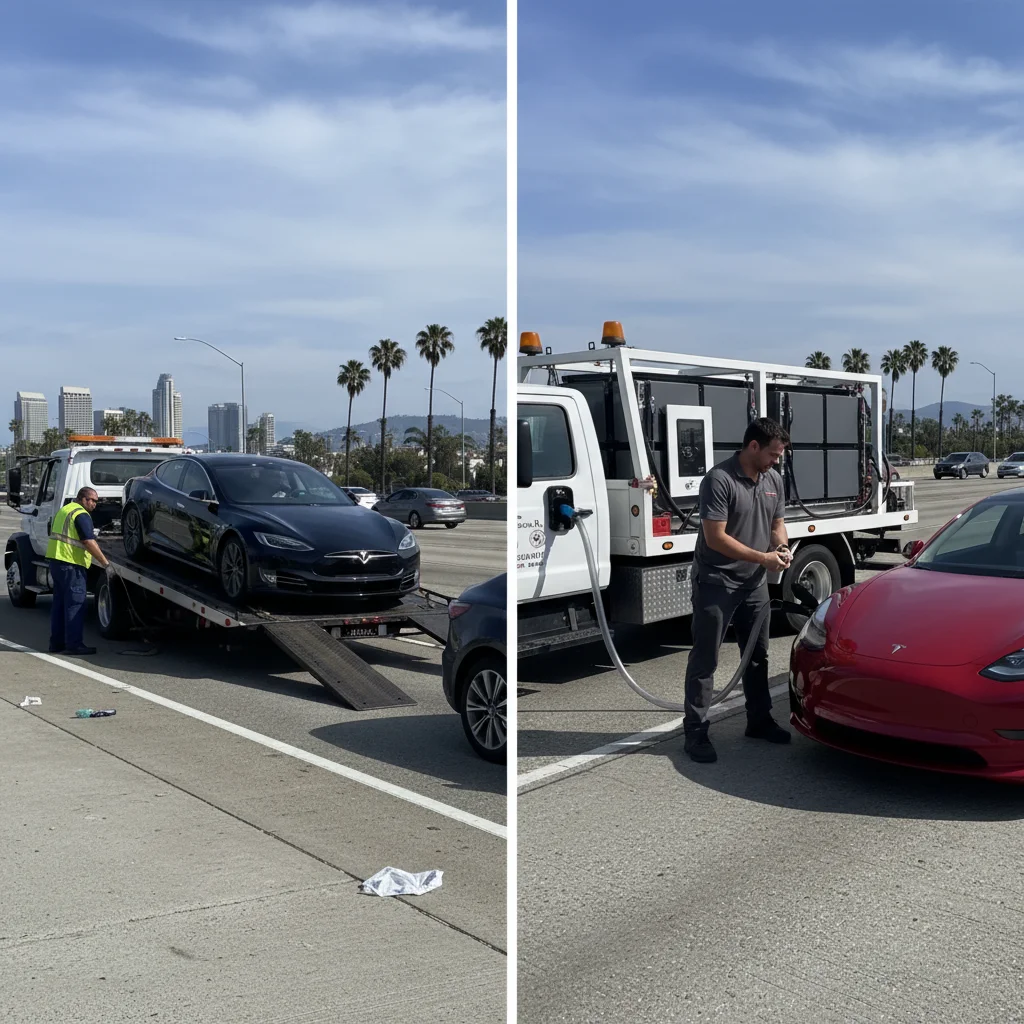
A free freeway shove still leaves you empty
FSP is a public freeway program, not a charging visit. The truck’s job is to clear the lane. It may push or tow a short way to a safer spot. It doesn’t refill the high-voltage pack. After the shove, you can still sit at an off-ramp with no miles left.
That’s why this comparison isn’t a hunt for the smaller-looking invoice. It’s which action solves the empty-pack problem. If FSP can get you off I-15, I-10, I-215, or SR-91, take that help. Then decide whether you still need range added, or a longer haul.
Don’t treat FSP as a promised service on every inland road. Coverage and hours are set by CHP, Caltrans, and the local program. This page couldn’t confirm a published mile cap for Riverside County or San Bernardino County FSP. Ask the driver who stops, or check with CHP, before you count on a free tow.
A Tesla flat tire versus freeway patrol guide covers the free-shoulder option in more detail. For an empty pack, the missing piece is still energy.
What a mobile charge actually does on the shoulder
The operators we connect you with bring a 240-volt Level 2 source to the car. Tesla owners get a native NACS plug. Other EVs use a CCS or J1772 adapter. The visit is mobile EV charging, not a shop on wheels.
Once the cable is on, charging time is typically 15 to 30 minutes. That window is charging time, never a promise of when someone arrives. In that stretch, the pack typically gains 10 to 20 miles of range. That’s often enough to reach a public fast charger, or to get home if you’re already close.
The operator quotes you before any work starts, and bills you directly. Charge Pro IE doesn’t set that price, own the rig, or employ the technician. You’re matching with an independent local rescue operator.
If the 12-volt battery is the real failure, that operator can jump it or replace it on site. A dark dash isn’t always an empty pack. Tesla and every major EV brand can look fully dead when only the small battery has failed. Say what the screen shows, or that there’s no screen at all.
This is out-of-charge recovery when the high-voltage pack is spent. You stay with the car and drive it off under its own power.
What a flatbed tow actually does
A tow solves a different problem. It moves a vehicle that can’t, or shouldn’t, drive. Most EV makers want a flatbed so the drive wheels stay off the pavement. Tesla, Rivian, and Ford all publish that kind of towing caution. A hook-and-chain drag is the wrong tool for a dual-motor car.
The tow doesn’t add range. After the drop, the pack is still empty. You still need a charger at the destination. If that destination is a Supercharger, a dealer, or your driveway, the last step is on you.
On inland grades, that split matters. A stall on I-10 through Colton isn’t the same as a stall after the Cajon summit toward Victorville. A short FSP move might clear the lane. A long flatbed ride is what you want if the car has a powertrain fault. An empty but healthy car on the shoulder is usually a charge problem.
Tow yards set their own rates. This page doesn’t publish a typical Inland Empire tow bill. No verified hook-up fee, per-mile rate, or after-hours surcharge turned up for this market. Ask the dispatcher for a quote before the truck hooks up. Confirm who is paying: you, a club, Tesla, or an insurer.
The same honesty applies to a mobile visit. Read who sets the price for a mobile EV charge. Don’t assume a website average. There isn’t a published average on this site to trust.
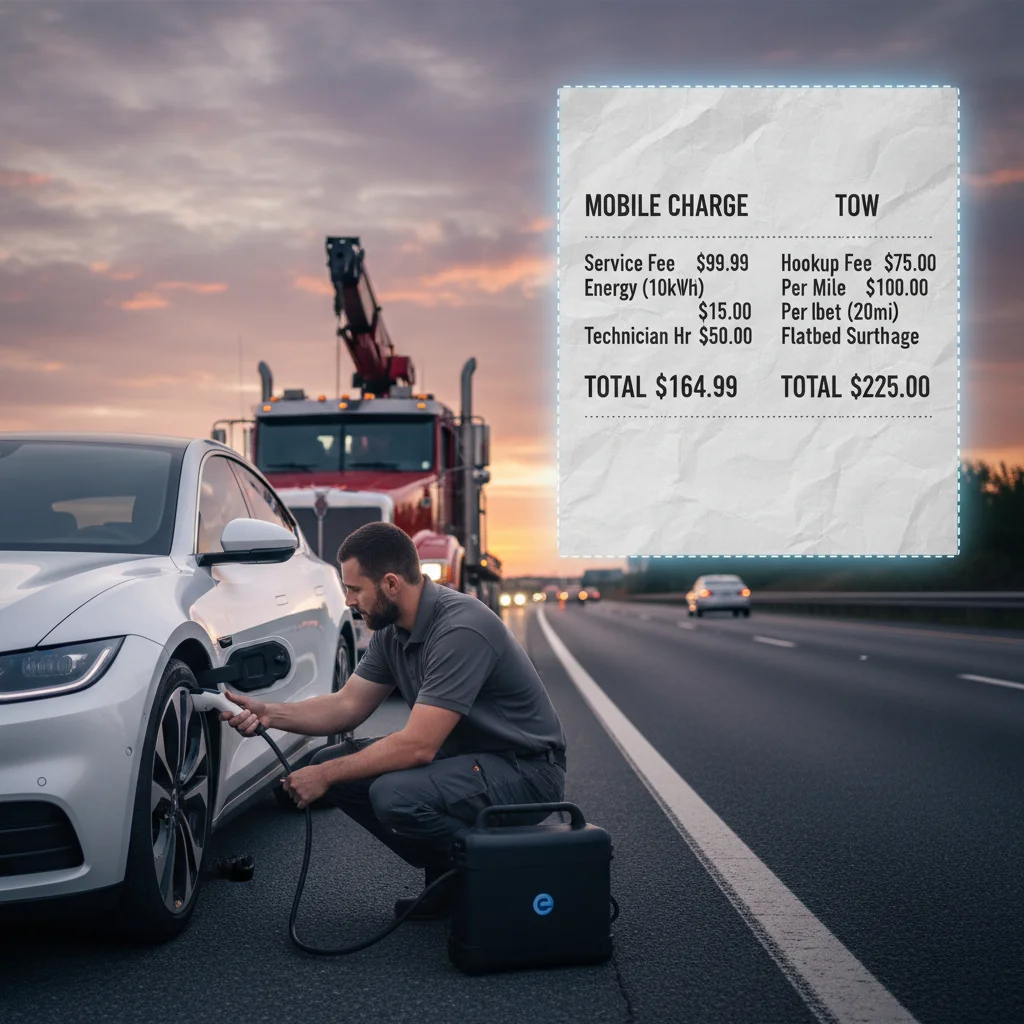
How the two bills get built
The operator quote versus a rolling tow ticket
A mobile charge is priced as a job. Dispatch, setup, and the energy delivered are the usual pieces. The independent operator names that number before the cable goes in. That’s the honest version of mobile ev charging cost vs tow math. One side can tell you the number while you’re still on the shoulder.
A tow bill often grows with miles, from hook-up through mileage and extra labor. Tight warehouse rows in Fontana, airport lots in Ontario, and steep streets toward Lake Arrowhead can add winching. Night and weekend work can change the quote. None of those extras has a verified public rate here. The tow company sets them, and you confirm them before you pay.
Home electricity is a different bill entirely. Southern California Edison serves most inland cities. Riverside Public Utilities serves Riverside. Colton Electric Utility serves Colton. City of Banning Electric Utility serves Banning. Bear Valley Electric Service serves Big Bear Lake and Big Bear City. None of those home rates is the roadside invoice.
Clubs, Tesla, and what they won’t promise
Many drivers spend a club tow on a short hop to a public stall. That can burn a benefit you may want later for a mechanical failure. This page couldn’t confirm current AAA mileage caps for Riverside or San Bernardino members. It also couldn’t confirm how often a club will send an EV charging truck here versus a flatbed. Check your card and the club app, and ask whether they’ll send a charge or only a tow.
Tesla publishes roadside rules at tesla.com/support/roadside-assistance. That page treats an empty pack as the driver’s problem more often than a warrantable breakdown. Tesla may cover a tow toward a public charger or Supercharger, with limits Tesla publishes. Repeat out-of-charge calls may not stay complimentary. A third-party mobile charge isn’t something Tesla promises on every inland stall. Confirm in the Tesla app before you assume it.
Standard insurance roadside add-ons vary by policy. This page couldn’t confirm a dollar cap that applies across Inland Empire carriers. Open the endorsement. Ask whether an empty EV pack is covered as a tow, a jump, or not at all.
For a tow versus a mobile charge inland, the useful question is still the same. The car needs energy, a 12-volt wake-up, or a shop.
When a tow is the only safe move
If the screen shows a powertrain failure or a high-voltage battery error, stop. Adding Level 2 energy won’t fix a broken drive unit. In those cases, a flatbed to a qualified shop is the path.
A dead 12-volt can mimic a dead pack, with a dark screen and dead handles. That’s often the small battery, not an empty tank. Operators in this network jump or replace that 12-volt on site for Tesla and other major EV brands. If the car wakes after a 12-volt jump and the pack still shows range, you may not need a tow or a charge.
If the pack reads zero and the car is otherwise healthy, a roadside charge is the on-the-spot fix. A tow still leaves you hunting a plug after the drop. Inland drivers see empty-pack events, 12-volt events, and real mechanical failures. If you’re unsure, tell the operator what the screen says before anyone plugs in.
Inland Empire places this choice actually changes
The valley floor, the High Desert, and the mountains don’t behave the same. The Cajon Pass on I-15 toward Victorville eats range on the climb. I-215 through Moreno Valley and Perris is a long, hot valley run. I-10 through Colton, Redlands, Beaumont, and Banning stacks freight traffic with a rise toward the desert. SR-60 through Jurupa Valley and SR-91 through Corona drain faster than the nav predicted.
Mountain trips change the math again. Coming down from Lake Arrowhead or Crestline, you may have regen. Going up toward Yucaipa, Big Bear Lake, or Running Springs, you spend it. An FSP truck on the freeway, if one stops, still doesn’t replace those miles. A Level 2 visit on the shoulder can.
Warehouse and airport lots are a third pattern. Fontana and Ontario rows are tight, and a flatbed may need extra room to extract a car. A mobile charger can often work in the stall if the operator can park safely. Confirm access with the lot and with the operator. Charge Pro IE doesn’t own a yard or a fleet. The independent operator you’re matched with makes that call.
Home charging isn’t the roadside bill. If you live in Riverside, your utility is Riverside Public Utilities, not SCE. If you live in Colton, it’s Colton Electric Utility. Banning has its own electric utility. Big Bear Lake and Big Bear City sit on Bear Valley Electric Service. Those names matter for overnight charging at the house. They don’t set the quote on I-10.
What to do next
Stay in the car if you’re on a freeway shoulder and it’s safer to stay buckled. If FSP or CHP is already there, take the lane-clearing help, then ask whether you still need range.
If the car is healthy and empty, ask for a mobile charge, not a default tow. If the 12-volt is dead, say that first. If the car is throwing high-voltage or drive-unit warnings, ask for a flatbed to a shop that works on your brand.
Charge Pro IE is a referral line for the Inland Empire. It matches stranded EV drivers with independent local mobile rescue operators. It doesn’t perform the work, set the price, or promise when someone arrives. Call (909) 250-2881. The operator quotes you before starting and bills you directly.