When an Inland Empire EV dies on the shoulder, nobody here publishes a menu price. The independent operator who would roll to you sets the mobile EV charging service cost. They quote you before they start. Charge Pro IE is a referral line. It matches you with that pro. It doesn’t bill you. Freeway Service Patrol is the other lane. On participating freeway stretches it stays free, inside the limits those agencies publish.
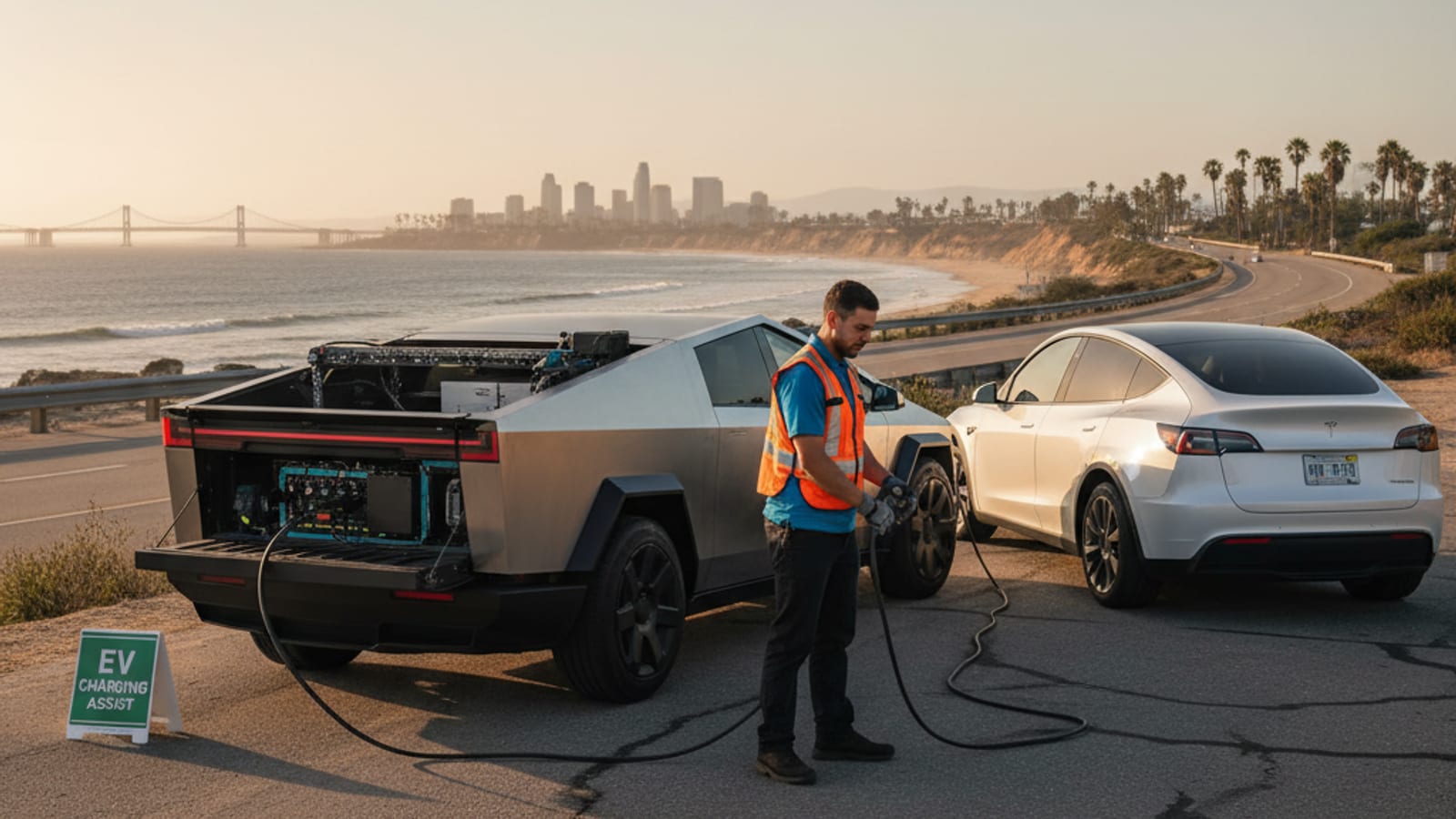
The quote is the operator’s, not a county rate
Charge Pro IE holds no license for this work. It owns no trucks or adapters, and it employs no technicians. It publishes no hours and no arrival window. The operator quotes the job, then bills you directly.
That quote is the only number that matters on the shoulder. A blog average isn’t a quote. A remembered fee from a friend isn’t a quote. If a page invents a typical Inland Empire rescue price, ignore it.
You’ll leave a location, a vehicle, and a state of charge. The operator uses those to quote. If the number is fuzzy, wait. Don’t wave a truck in until you’ve heard it.
The pros we connect you with are licensed. That’s a network claim. It isn’t Charge Pro IE claiming those papers.
Some operators price nights and holidays differently, and some don’t. This page has no after-hours table. No operator handed us a public schedule we can verify. Ask when they quote. If they won’t say how time of day changes the number, ask again. That answer is part of the quote too.
A scheduled visit to a low car in a work lot is still their quote. An urgent shoulder call is still their quote. Don’t assume one is automatically cheaper. Hear the number that applies to your pin.
Operators explain their own breakdown. Some name travel and energy as two lines. Some name one package. This site can’t publish either version as a rule. Charge Pro IE doesn’t set it. You need the total before they start. You don’t need a lecture on their cost accounting.
Nobody here should bill you for a home charger install. Nobody should sell you a full pack on the shoulder unless you asked for that longer session. They still have to quote that session first. A short 10 to 20 mile drop is the usual rescue. If you want more, say so up front so the quote matches.
The visit in plain steps is in what a mobile EV charging visit actually is.
What you’re paying for on the shoulder
A mobile charge is a 240-volt Level 2 source brought to the car. It isn’t a Supercharger on a trailer. Teslas take a native NACS plug. Other EVs take a CCS or J1772 adapter. The job is enough range to roll.
Operators we connect you with typically add 10 to 20 miles. That happens in 15 to 30 minutes of charging. That window is plug-in time. It is never an arrival time.
You’re buying a person, a truck, and a short energy drop. You’re not buying a full pack. You’re not paying Charge Pro IE per kilowatt-hour. You’re not buying a city permit.
A dark dash isn’t always an empty pack. The 12-volt battery can die while the traction battery still holds range. Lights, door handles, and the screen all lean on 12-volt. A traction pack with range and a dead 12-volt looks identical from the sidewalk. Operators can jump or replace that 12-volt on site. Ask for a 12-volt check in the same call. The operator can tell you which job they’re quoting. A 12-volt jump and a 12-volt replacement are different jobs. A jump may get you to a shop. A replacement on site is a parts-and-labor quote from that operator. This page doesn’t publish a parts price. Ask which one they’re offering before you say yes. Paying for a pack fill you don’t need is how people get mad at an honest number.
Tesla, Rivian, Ford, Hyundai, Chevy, and other major EV brands are in scope. Name the make when you call. Adapter setup should be in the quote. It shouldn’t appear as a surprise at the bumper.
Freeway Service Patrol is a free beat, not a Level 2 invoice
Two trucks can look like roadside help. Only one of them sends you a bill. California’s Freeway Service Patrol runs as public motorist aid. On participating Inland Empire freeway stretches, that aid is meant to stay free. It stays free inside published limits.
Those limits aren’t set by Charge Pro IE. They aren’t set by the charging operator. They’re set by the agencies that fund and dispatch that beat.
This page couldn’t confirm a minute cap we can publish. It couldn’t confirm a tow-to-exit distance for Riverside County. It couldn’t confirm one for San Bernardino County. A fake ten-minute-free line would be a fabrication. Confirm the current map and the current free window with the people who run that truck. Caltrans is the statewide name on the program. County transportation commissions fund local beats. Read what they publish for the stretch you’re on.
FSP is known for flats, a gas can, fluids, and a short bump off the lanes. An empty EV pack may not match those tasks. Don’t assume the next patrol truck carries 240 volts. Ask what they can do. If they can’t add range, a private mobile EV charging operator is the one who quotes.
For the freeway option next to Tesla tire help, see Tesla flat tire coverage and the Inland Empire’s free freeway option.
Off the freeway, the picture changes. A Fontana warehouse apron isn’t an FSP beat. Neither is an Eastvale HOA street. Neither is a Lake Arrowhead shoulder on a local road. City police or a private operator may be what you get. The operator quote is the one that applies on those sites.
Hemet, San Jacinto, and Perris sit in Perris Valley heat, not on the 10. I-215 is the spine through that corridor. An in-town stall in Hemet is a city-street quote. A shoulder stall on 215 is closer to the FSP question. Say which one you are.
Downtown Riverside is a city-street stall at the curb. Corona on the 91 can be a freeway problem if you stop in the lanes. Same referral line. Three different quotes, because the beat and the access are not the same.
Inland miles change the deadhead, not a secret menu
The Inland Empire is two counties, not one weather. Riverside County’s ACS 2019-2023 population is 2,478,600. San Bernardino County’s is 2,197,104. Riverside city alone is 319,069. Fontana is 214,169. San Bernardino city is 222,724. Ontario is 180,547. Moreno Valley is 211,666. A single IE price would have to cover all of that. It can’t, which is why nobody honest publishes one.
The San Bernardino Valley floor runs from Fontana through Colton to Redlands. It’s warehouse traffic, older neighborhoods, and I-10 heat. Temecula and Murrieta sit in a newer, rolling south county with wine-country miles. The High Desert begins in earnest once you finish Cajon. The mountain communities above Running Springs live in a different climate. An operator quoting a downtown Riverside stall isn’t quoting a Big Bear City lot. That’s the point of a live quote.
I-15’s Cajon climb toward Victorville is steep, long, and hot. Uphill miles eat estimates faster than flat ones. If you stall after that grade, you’re in High Desert spacing, not valley blocks. The operator still quotes first.
I-215 through Moreno Valley and Perris Valley mixes freight, heat, and commute traffic. I-10 through Colton and Redlands does the same on the valley floor. SR-60 through Jurupa Valley and the 91 through Corona add packed lanes. Ortega Highway near Wildomar is slower and narrower. Wine-country miles out of Temecula and Murrieta are rolling, not Cajon-steep. They still chew a buffer when you add HVAC and a late return. Winchester and French Valley sit on those rural edges. If you stall there, you’re on local roads. FSP may not apply. The operator quote does.
These are different places to stand. They aren’t claims that a charger is missing.
Warehouse rows in Fontana swallow cars on long shifts. Ontario airport lots do it on travel days. Cabazon destination parking does it on outlet and casino trips. Glen Helen concert parking and Pechanga event lots do it after dark. A pin drop still matters. A vague lot description isn’t a location.
Mountain dispatch is its own drive. Big Bear Lake and Big Bear City sit on Bear Valley Electric Service. That utility names Lake Williams, Erwin Lake, Sugarloaf, Moonridge, Fawnskin, and Boulder Bay too. Lake Arrowhead, Crestline, and Running Springs are a different climb. Many of those roads are in SCE territory. You don’t pay Bear Valley or SCE for a shoulder drop. You still name the town, because the drive isn’t a valley hop.
High Desert towns include Victorville, Hesperia, Apple Valley, Adelanto, Phelan, and Oak Hills. Victorville residential power is SCE. Victorville Municipal Utility Services covers Southern California Logistics Airport and Foxborough Industrial Park only. It states it doesn’t serve residential areas at this time. That split matters for a house meter. It doesn’t set a roadside quote.
Home utility rates aren’t the roadside quote
Searchers mash two bills together. Driveway charging is a utility tariff. A mobile visit is an operator’s quote. Only the second is mobile EV charging service cost.
Southern California Edison covers a long Inland Empire list. Ontario, Fontana, Chino, Chino Hills, Upland, and Montclair are on SCE’s served-cities sheet. So are San Bernardino, Rialto, Highland, Loma Linda, Grand Terrace, Redlands, and Yucaipa. Corona, Norco, Eastvale, Jurupa Valley, Perris, Menifee, and Lake Elsinore are on it too. Wildomar, Canyon Lake, Hemet, Temecula, Murrieta, Beaumont, Calimesa, Hesperia, and Adelanto round out that sheet. SCE’s residential EV plan is called TOU-D-PRIME. The plan page lists current cents. Those cents change. This post won’t reprint them. Confirm today’s off-peak and on-peak figures with SCE.
Riverside is absent from SCE’s list. Riverside Public Utilities has served the city since 1895. It publishes its own electric vehicle rate. Colton is absent too. City of Colton Electric Utility owns the electrical infrastructure inside city limits. Banning runs City of Banning Electric Utility. Those municipal systems set home tariffs. They don’t set the number you hear on I-10.
Rancho Cucamonga is split. SCE covers most of the city. Rancho Cucamonga Municipal Utility covers a southeast pocket. RCMU says it serves over 3,900 metered businesses and residents. That pocket includes The Enclave, Day Creek Square, The Resort, and the Victoria Gardens area. Moreno Valley is split as well. SCE plus Moreno Valley Utility. MVU serves over 6,500 customers in newer development since 2004. It publishes an address lookup. Use that lookup before you argue with a bill. Don’t use it to guess a rescue fee.
San Jacinto is a community choice overlay. SCE delivers the power. San Jacinto Power supplies the generation. Apple Valley is similar. SCE delivers. Apple Valley Choice Energy procures. Cabazon is unincorporated SCE territory on SCE’s community index. None of those arrangements is a mobile charging price.
For driveway math, use what shapes Tesla charging cost across Inland Empire utilities. Keep it in the garage tab. Keep the operator quote for the stall.
Housing age is another false proxy. ACS 2019-2023 puts Eastvale pre-1980 housing at 2.2 percent. French Valley is 2.3 percent. Temecula is 6.5 percent. Murrieta is 6.2 percent. Montclair is 68.5 percent. Norco is 68.8 percent. Bloomington is 62.5 percent. San Bernardino city is 60.9 percent. Redlands is 60.4 percent. Older panels change a home charger install. They don’t create a ZIP code rescue tariff.
Tesla roadside, AAA, and a local operator are three tickets
Manufacturer help, a motor club, and a local mobile charge don’t share a price list. Tesla publishes its own roadside policy. Read the current Tesla page. Some coverage tows. Some talk about charging. Some apply to a warrantable breakdown, not an empty pack. Limits can be time or mileage. This post won’t guess your VIN’s bucket.
AAA and insurance add-ons vary by tier. Some reimburse a third-party charge. Some send a tow. Some still hear battery and think 12-volt jump packs. Ask in precise words. Empty traction battery. Need a 240-volt drop on site. If they say no, you already know you’re in operator-quote territory.
Charge Pro IE doesn’t file those claims. The operator bills you. Reimbursement is between you and the club.
Compare process, not invented fees, in what Tesla roadside assistance covers versus a local mobile charge. Also see AAA or mobile EV charging when the pack hits empty.
A tow is another bill, not a discount charge
A tow moves the car. A Level 2 visit tries to let you drive it. Neither has a published Inland Empire average on this site. Flatbed rules and transport mode matter on Teslas and on other EVs. A bad hook-up can cost you in damage. That cost isn’t a number we’ll invent.
Waiting at a public stall avoids an operator invoice. It doesn’t always work from a live shoulder. Walking away from a car in a lane is a safety problem. If you can already reach a stall on the range you have, go. The Calimesa Supercharger is a named Tesla site on I-10. Check the live stall status in your app. Don’t use this page to guess distance from your pin.
Vehicle-to-vehicle charging is uncommon. A few trucks can donate range. Most EVs can’t. Don’t plan the night around a stranger’s Lightning.
What to say so the quote matches the car
Give a pin, not a mood. Westbound 10 near Colton is a start. A mile marker, an exit, or a lot name is better. Ontario airport needs a terminal or a lot letter if you have one. Fontana warehouses need a street or a building.
Say Tesla or not. Say NACS, CCS, or J1772 if you know. Say whether the car wakes. Say whether the charge port opens. Say if this might be 12-volt. A pack at 20 percent with a black screen isn’t an out-of-charge job.
Say freeway shoulder, HOA street, downtown Riverside, or High Desert dirt. Access belongs in the quote. It shouldn’t show up after the cable is out.
Operators still quote before they start. Access can change what they quote. A locked Fontana freight gate at shift change isn’t a freeway shoulder. The driver may need a name on a roster. Ontario airport lots can require a specific lot. Say that during the quote, not when the van is circling.
A HOA street in Eastvale or a private lot in Canyon Lake isn’t an FSP beat. The operator may need a gate code or a host who can wave them in. Tell the operator the rule you know. They’ll say if they can work there.
Pechanga and Glen Helen empty at the same time. A hundred cars want the same ramp. Your quote should reflect a real pin, not the concert lot. Stay with the car if you can do it safely. A moving target is a hard quote.
If you don’t like the number, decline. Charge Pro IE isn’t a contract you already signed. The operator should hear a yes before they start.
How people here end up buying a roadside drop
Inland heat isn’t a mild-coast story. Cooling the cabin and the pack eats range on the 10, the 60, the 15, and the 215. Grades do the rest. Cajon toward the desert. The pull toward Yucaipa. The climb to Lake Arrowhead. The Ortega. The run toward Big Bear. You don’t need a fake percent-loss statistic. Watch your estimate as it falls.
Event parking is a classic trap. You arrive at Glen Helen or Pechanga with a buffer. You leave after dark with a long drive. Cabazon lots do the same. Check charge before the show.
New streets in Eastvale, Menifee, French Valley, and Temecula can outrun a charger install. ACS 2019-2023 puts Eastvale pre-1980 housing at 2.2 percent, and Temecula at 6.5 percent. The houses are new. The wall unit may still not be live on move-in day. That starts as a driveway problem. It becomes a roadside problem if you commute on leftover bars.
Don’t treat zero as a sport. When the car warns you, pick a stall you already trust. Use your in-car map and the apps you already have. This page won’t rank them. It won’t invent a charger count for any city.
What Charge Pro IE does, and doesn’t do, with money
Charge Pro IE matches stranded EV drivers with independent local operators across the Inland Empire. It performs no work. It sets no prices. It promises no arrival. It publishes no business hours. The operator quotes you before starting. The operator bills you directly.
There’s no connection fee from this brand on top of that quote. If a caller won’t name a number before they start, that isn’t this process. Stop and call again.
The same matching line covers Tesla and non-Tesla EVs. Native NACS, CCS, and J1772 are equipment details. They shouldn’t be a hidden extra you learn at the bumper.
City context lives on the Inland Empire EV charging hub. The brand refers across this region. It doesn’t run a yard in each town.
When you want the matching line, call (909) 250-2881. That number reaches Charge Pro IE. It isn’t a promise that a truck is nearby.
Frequently asked questions
Who sets the mobile EV charging service cost?
The independent operator who would do the work. They quote before they start, then bill you. Charge Pro IE doesn’t set, mark up, or collect that number. Home utility rates and club benefits are separate. Confirm those with those organizations. Use the live quote for the stall in front of you.
Does Freeway Service Patrol pay for a mobile EV charge?
FSP is a public freeway program. It stays free inside published limits on participating stretches. It isn’t a coupon for a private Level 2 visit. This page couldn’t confirm a countywide minute cap. It also couldn’t confirm a published EV-charge benefit. Ask the FSP driver what they can do. Read the current rules from the agencies that run that beat. If they can’t add range, you’re back to an operator quote.
How much range does a roadside Level 2 stop add?
Operators we connect you with typically add about 10 to 20 miles of range. That’s in 15 to 30 minutes of charging time. It isn’t drive-over time. It’s enough to reach a charger you already had in mind. It can also cover a short limp home. It isn’t a full charge. It isn’t a Supercharger session.