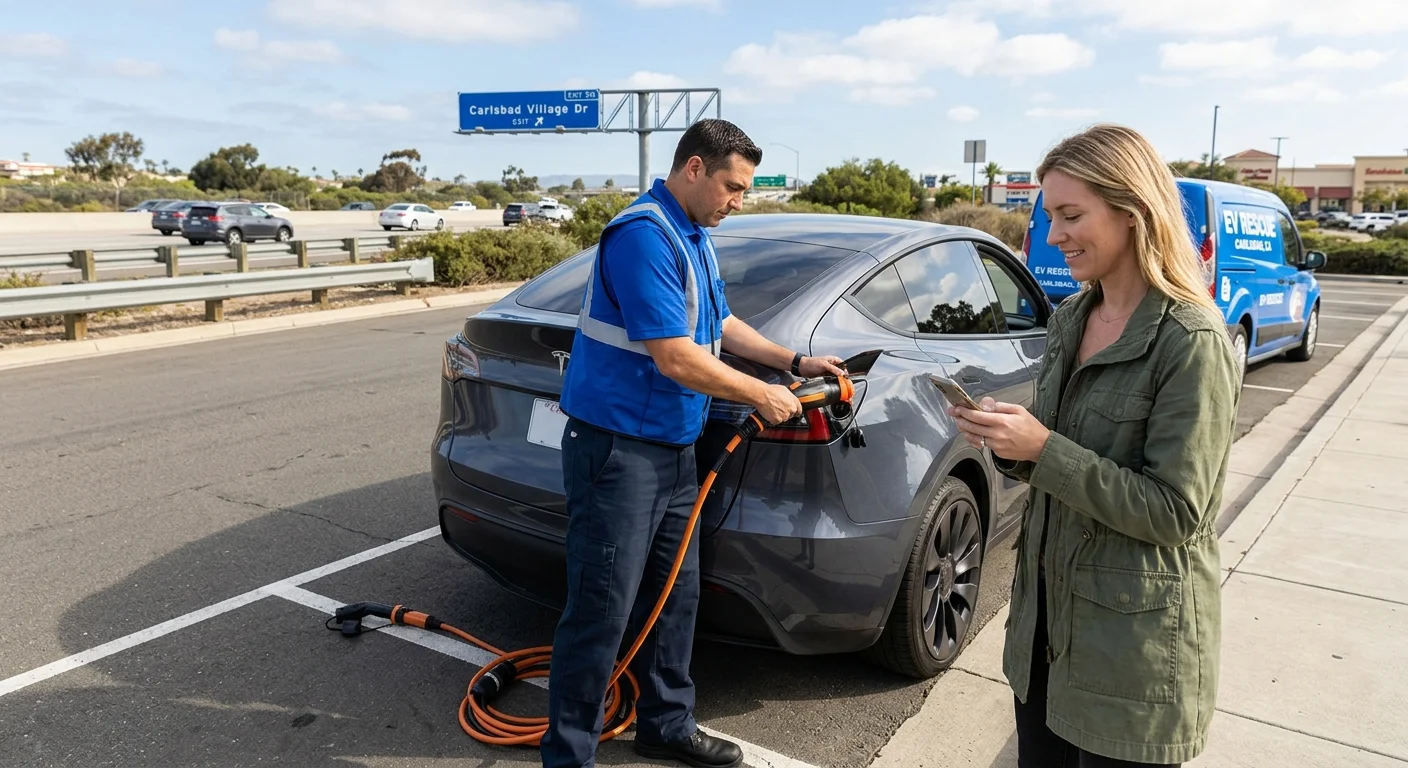
Your EV stalled near the lake in Lake Elsinore. Get to a safe stop first. Then have a local operator review a mobile charge or a tow. Heat around the water can pull range down fast. A long sit in a lakefront lot can do the same. So can a westbound start up the Ortega. Charge Pro IE is a referral line. We match stranded EV drivers with independent local operators. The pros we connect you with are licensed. They quote you before they start. They bill you directly.
Get the car out of live traffic
Your stopping place comes before any charging talk. If the car still rolls, leave the travel lane. Ease off I-15 when you can do that safely. The same goes for SR-74 and Lakeshore Drive. A live lane isn’t a place to plug in. Call 911 if the car is a hazard to other drivers.
Once you’re stopped, turn the hazards on. Don’t walk around the car beside passing traffic just to inspect it. Tell the operator what you can see from where you sit.
“Lake Elsinore” isn’t a location. On I-15, northbound and southbound use different approaches. Name the nearest exit you passed or still see. Railroad Canyon Road, Central Avenue, and Main Street aren’t interchangeable. A dropped map pin beats a neighborhood nickname.
On Lakeshore Drive, say which side of the water you’re on. Add the nearest ramp, park entrance, or business you can read. Grand Avenue and Riverside Drive need the same care. “Near the lake” covers too much ground.
A mobile operator has to decide whether the stop supports on-site work. That decision belongs to the independent pro on the call. If the shoulder is too thin, they may talk through a move. They may also talk through a tow instead.
Our mobile EV charging page covers what operators typically bring. Charge Pro IE doesn’t promise a truck. It doesn’t promise a connector, a charge size, or a clock.
Lake days keep you parked longer than you planned
Lake Elsinore sits in a hot inland valley. It sits at the base of the Santa Ana Mountains. The lake does little to cool the air. Parked cars cook in that heat. Range fades while you’re still on the water.
Boat-ramp lots and lakefront parking hold cars for hours. So do the Lake Elsinore Outlets. So does Skydive Elsinore. A Storm game at the ballpark is another long sit. Historic downtown on Main Street works the same way. You arrived with a buffer. You may not leave with one. Lakeland Village sits along the water too. Name that community if that’s where you are.
If you’re in a lot, name the lot. Say the entrance, the row, and which way the charge port faces. Surface lots, curbs, and gated garages are different jobs. Share gate codes you have and clearance signs you can see. Don’t assume a service vehicle can enter every space.
Walker Canyon poppy blooms have created huge traffic events in past years. Closures and access rules change. Check current restrictions before you drive that canyon as a bypass. Extra cars on I-15 ramps and Grand Avenue make a vague description useless.
Country Club Heights and Tuscany Hills climb steeply off the valley floor. Canyon Hills, Rosetta Canyon, and Summerlake have their own slopes. A driveway on those hills isn’t a Lakeshore curb. Say the street, the grade, and whether there’s room beside you.
Wildomar sits on the south edge of town. Canyon Lake is next door. Perris and Murrieta aren’t far. Corona sits up the Temescal corridor. If the sign in front of you says a neighbor city, say that name. Don’t use Lake Elsinore as a stand-in.
For a city overview, see EV charging in Lake Elsinore. Your rescue still starts with the pin, not the city page.
Treat the Ortega as a last resort, not a shortcut
SR-74 is the Ortega Highway. It’s the only direct road from this west end over the Santa Ana Mountains. That route heads toward south Orange County. It’s two lanes, steep, and it winds hard. Long stretches have almost no shoulder. Cell coverage is patchy. There often isn’t a safe place to pull off and wait.
If the pack is already low at the lake, don’t head west on SR-74. Turn around in town while you can still roll. Lookout points along the Ortega are viewpoints, not a plan for the car. If you’re already on that climb, stay with the car. Describe the nearest lookout or marker you can see.
Stalled on the Ortega near Wildomar is the companion page for that road. This page is for the stall that starts at the water. It also covers the outlets, downtown, and I-15.
I-15 through town carries traffic between Corona and Temecula. Temescal Canyon toward Corona is a long rural stretch. It follows the old highway beside I-15. A gore point on a ramp isn’t a boat-ramp stall. Tell the operator about barriers and shoulder width. Tell them how you’d want them to approach.
Tell an empty pack from a dead 12-volt
Drivers say “dead battery” for two failures. The traction pack may be empty. The 12-volt battery that wakes the car may have failed. They feel similar from the seat. The fix isn’t the same.
Share what happened before you stopped. Give the last percent or range you remember. Repeat the exact dash wording. Low-charge alerts, reduced power, charging errors, and low-voltage warnings all matter.
Then report what still works. Say whether the main screen turns on. Say whether the doors unlock as usual. Say whether you can shift to drive or neutral. Say whether the charge port responds. Don’t open panels. Don’t touch high-voltage hardware.
A black screen doesn’t prove the pack is empty. A percent on the display doesn’t prove the 12-volt is fine. The matched operator reviews the car, the messages, and the stop. Some jobs are a 12-volt jump or swap on site. Some are a traction charge. Some are a tow.
The out-of-charge recovery service is for a pack that looks depleted. The operator still confirms fit for that vehicle and that site.
The U.S. Department of Energy explains EVs and charging in general terms. It can’t diagnose this stall. Follow the automaker’s steps for warnings and towing.
Don’t keep tapping controls through a warning you don’t understand. Photograph the message if you can do that safely.
Operators in this network handle Tesla and every major EV brand. They typically bring a 240-volt Level 2 source to the car. Teslas use a native NACS plug. Other EVs use a CCS or J1772 adapter. A typical session adds about 10 to 20 miles of range. That takes 15 to 30 minutes of charging. That’s charging time, not an arrival time.
Southern California Edison serves electric customers in Lake Elsinore. That home utility doesn’t run this roadside visit. The operator sets the quote. Confirm it before you approve work.
Decide between a mobile charge and a tow
A mobile charge isn’t the default for every stalled EV. The operator checks battery state, warnings, connector match, port access, and the stop.
On-site charging can fit when the traction pack looks empty. The site also has to hold the work. Charge Pro IE doesn’t promise a connector. It doesn’t promise power output or energy delivered. It doesn’t promise the range you’ll gain. Ask what the charge is for. Read the display before you drive on.
Transport can fit when the site can’t support a hookup. It can also fit when the symptoms point past an empty pack. Pick a real next destination before you choose. A short roadside charge isn’t a repair. If the 12-volt failed, charging the pack may not wake the car.
What a mobile EV charging visit actually is spells out the on-site job. Mobile EV charging vs a tow helps you sort the fork.
No verified flat price for Lake Elsinore turned up. Charge Pro IE doesn’t set operator rates. Ask for the current amount and the terms before anything starts. Your insurer, automaker, or club plan may apply. Don’t treat it as automatic.
The right call fits this EV, this battery, and this stop. Precise details let the operator decide without guessing.
When to call
Call when the car has stopped in Lake Elsinore and you need that review. Have the pin, the road, and the make and model ready. Have the last range and the warning text too. Other local stall patterns are in EV roadside assistance in Lake Elsinore. Call (909) 250-2881. We’ll connect you with a local EV rescue operator.