A disabled Model X can create two separate decisions. First, determine whether the car needs roadside help now. Then check whether Tesla may treat the underlying problem as a warranty matter.
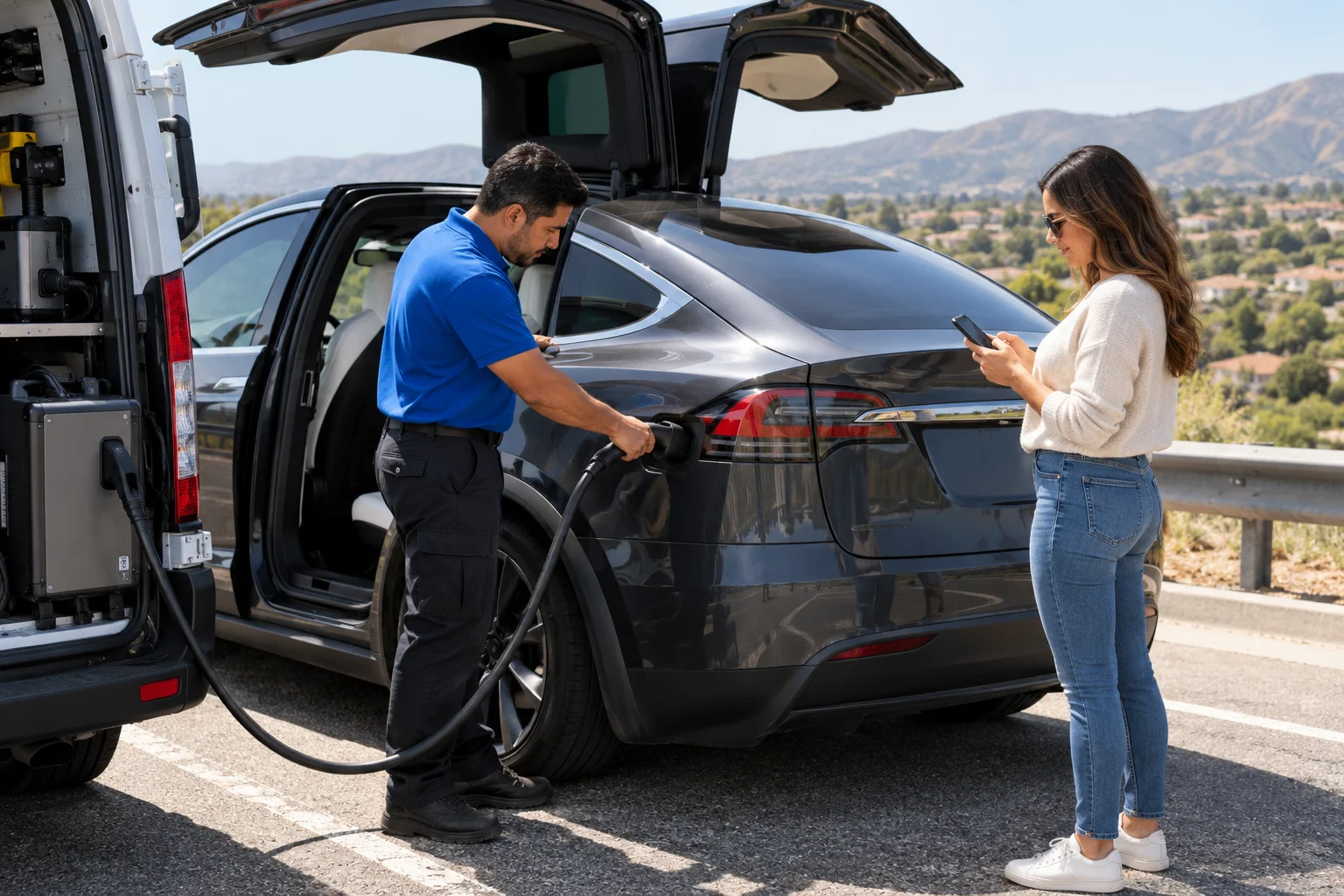
Battery coverage and roadside help solve different problems
A warranty question concerns responsibility for an underlying vehicle problem. Roadside help concerns the immediate situation, such as a car that can’t move or accept a charge. One answer doesn’t automatically settle the other.
Specific Model X warranty limits, exclusions, dates, mileage terms, and capacity thresholds couldn’t be confirmed from the approved sources for this page. Check the warranty document assigned to your vehicle. Your current Tesla app and vehicle records are the places to start.
Don’t assume that roadside help confirms warranty coverage. A roadside operator can assess the immediate problem within that operator’s scope. That operator doesn’t decide whether Tesla will approve a warranty claim. Charge Pro IE doesn’t make that decision either.
The reverse is also true. A possible warranty issue doesn’t make the vehicle safe or practical to leave where it stopped. A Model X stranded on I-10, I-15, or I-215 still needs an immediate plan. The warranty review can follow after the car and occupants are out of danger.
Our broader guide to Tesla battery warranty questions explains why the document tied to the vehicle controls. For the immediate roadside decision, compare the symptoms with Tesla Roadside Rescue.
Keep the two questions separate:
- What help does the Model X need right now?
- What does the current warranty document say about the diagnosed cause?
That order prevents an uncertain coverage question from delaying practical roadside help.
Start by identifying which battery system failed
“Dead battery” isn’t a precise diagnosis. Before discussing a Model X battery warranty, record what the vehicle is doing.
Start with visible behavior. Note whether the screen works, the doors respond, the charge port responds, or the car shows a warning. Photograph any message before power changes. Save the time, location, displayed charge level, and what happened immediately beforehand.
A dark or unresponsive car shouldn’t automatically be labeled an empty main pack. It also shouldn’t automatically be labeled a low-voltage failure. The exact cause needs confirmation through the current Model X documentation or qualified service.
Our Model X won’t-start checklist provides a symptom-first way to organize those observations. It doesn’t replace the manual for your specific build.
Avoid forcing the charge-port door or trying procedures copied from another Tesla model. Approved Tesla guidance available for some other models shows that access points and low-voltage arrangements can vary. That’s enough reason to use the current Model X instructions, not a generic online shortcut.
When you contact Tesla or a local operator, describe what you can observe. Say “the screen is dark and the doors don’t respond,” not “the battery is defective.” Clear symptoms help the next person choose the right equipment and procedure.
Diagnosis matters because roadside charging, low-voltage support, towing, and warranty service are different paths. The right path begins with evidence, not a label.
An empty pack isn’t automatically a warranty failure
A Model X that reaches an unusable charge level presents an immediate roadside problem. That condition alone doesn’t establish why it happened. It also doesn’t prove that Tesla will treat the event as a warranty claim.
The approved record for this site doesn’t contain current Tesla terms covering depleted batteries, roadside charging, towing benefits, or related exclusions. Those details couldn’t be confirmed for this page. Review the current warranty and roadside documents assigned to your vehicle before relying on coverage.
Ask what happened before the stop. Did the displayed range fall gradually during the drive? Did the car stop accepting power at a charging location? Did the screen go dark while charge remained displayed? These observations don’t decide coverage, but they separate different service conversations.
A depleted pack may call for enough mobile energy to reach a suitable charging location. The approved rescue figure for this site is 10 to 20 miles of range during 15 to 30 minutes of Level 2 charging. That’s charging time, not an arrival promise. Actual results remain specific to the vehicle and operator.
A car that won’t accept energy may need a different response. Adding more energy isn’t useful until the reason for the failed session is understood. A tow may also be more appropriate when the car can’t be safely supported where it stopped.
Our comparison of a depleted pack and a breakdown explains that roadside split. Keep the invoice and service notes afterward. Tesla may need the diagnosis, not merely the fact that roadside help was requested.
Model year and vehicle records affect the answer
The words “Model X warranty” don’t identify one universal set of terms. The approved sources don’t confirm a single coverage period, mileage limit, capacity promise, or roadside benefit that applies to every Model X.
That means the vehicle’s own record must lead the review. Gather the vehicle identification number, delivery or purchase records, current mileage, and the warranty document shown for that car. If it was purchased used, include any transfer records and prior service paperwork you have.
Don’t copy a warranty figure from another Model X listing. Don’t rely on a Model S, Model 3, or Model Y summary. Even a Model X page from another year may not govern your vehicle.
Service history can also sharpen the conversation. Save earlier warnings, charging records, repair orders, and dates when the same symptom appeared. If Tesla previously inspected the issue, keep that paperwork with the new roadside record.
This matters across the Inland Empire because Tesla ownership is common. The California Energy Commission counted 52,490 Tesla zero-emission vehicles in Riverside County and 42,487 in San Bernardino County for 2025. Still, a large local vehicle population doesn’t make one owner’s coverage terms transferable to another car.
Use your records to ask a narrow question: “Does the current document assigned to this VIN cover the diagnosed cause?” That’s more useful than asking whether all Model X batteries are covered.
Charge Pro IE can connect a stranded driver with a licensed independent operator. We don’t interpret Tesla’s contract, approve claims, or promise reimbursement.
What to confirm in the current Tesla documents
Open the current warranty material assigned to your Model X. Read the actual document, not a search-result summary. Specific Tesla warranty figures couldn’t be confirmed for this page, so no mileage, date, degradation, or capacity number is presented here.
Look for the document’s exact wording on:
- The covered vehicle and applicable warranty section
- The coverage start point and any stated end point
- Mileage conditions, if the document lists them
- Battery or drive-unit language
- Capacity or degradation language, if present
- Exclusions tied to use, damage, charging, or outside work
- Required steps for requesting service
- Towing or roadside terms, if any
- Rules for used, transferred, or repaired vehicles
Also confirm whether the document separates warranty service from roadside benefits. Don’t treat those headings as interchangeable. A roadside request may solve the immediate location problem without answering who pays. A warranty review may address a covered repair without resolving how the car reaches service.
Capture screenshots or download the current document when possible. Keep the version date visible. Coverage pages can change, while the document assigned to the vehicle remains the relevant record for your question.
When speaking with Tesla, ask for the answer in writing. Request the specific document language used to approve or deny the claim. If the car needs outside roadside help first, ask what records Tesla wants preserved.
Keep receipts, photographs, warning messages, and the operator’s written notes. Don’t ask the operator to declare that a failure is covered. Ask for observed facts, work performed, and the vehicle’s condition before and after service.
When a matched local operator is still needed
A warranty review doesn’t move a stranded Model X. Local roadside help may still fit when the vehicle is safely accessible and needs mobile energy, low-voltage support, or transport arranged by the appropriate provider.
Location changes the practical decision. A Model X stopped in a Chino Hills driveway presents a different access problem from one disabled near the Cajon Pass. The I-15 climb from Devore to the Cajon high point is roughly 2,080 feet. Road position, traffic exposure, weather, and remaining vehicle power all affect what help makes sense.
On a controlled-access freeway, California law generally prohibits leaving a vehicle stopped. A disabled-vehicle exception depends on assistance having been summoned. If the car is in a traffic lane or anyone faces immediate danger, contact emergency services first.
Freeway Service Patrol may also be relevant on listed Inland Empire corridors. The Riverside County program lists SR-91, sections of I-15 and SR-60, and I-215. San Bernardino County lists I-10, I-15, I-215, SR-60, and SR-210. Those agency pages don’t mention electric vehicles, so EV-specific help couldn’t be confirmed. Coverage and operating periods can change.
Charge Pro IE is a referral service. We connect drivers with licensed, independent local EV professionals. The operator quotes and bills the driver directly. We don’t perform the work, set the price, decide warranty coverage, or promise an arrival time.
Tell us the Model X symptoms, displayed charge level, exact location, and whether the car can roll. That helps identify the kind of operator the situation may require.
When to call us
Call when your Model X is stranded and the immediate need can’t wait for a warranty decision. A matched local operator can assess whether mobile EV rescue fits the situation, while Tesla determines any coverage question separately.
Call us at (909) 250-2881 and we’ll connect you with a local EV rescue operator.