A Tesla Model S that won’t start after an Inland Empire stop often looks completely dead. Black screen. Flush handles. App offline. That’s the same stall Model 3 and Model Y owners hit in the same lot. The traction pack can still hold a usable charge. The car still won’t wake until that small 12V battery comes back first.
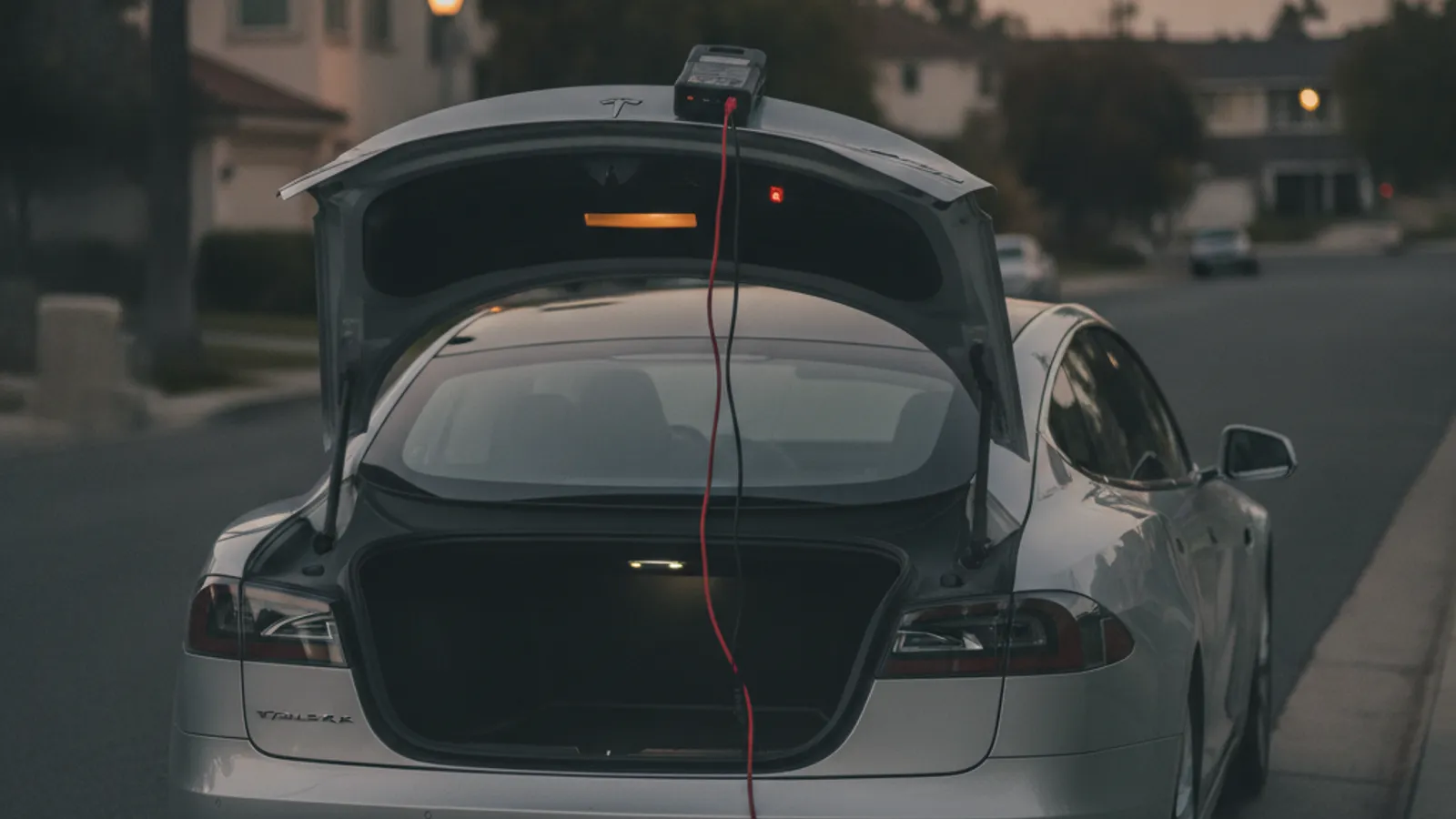
Black screen first, then the Model S extras
Treat a dark dash as a 12V problem until the screen proves otherwise. On every Tesla, the low-voltage battery wakes the computers. Locks, display, and contactors all wait on it. Yesterday’s pack percent in the app doesn’t save you. It doesn’t help if the 12V is flat this morning.
The Model 3 and Y fail this way in Ontario and Fontana lots. So does the Model S. The difference is access. Flush handles on the S need 12-volt power to present or unlatch. Classic cars auto-present the handles. Refresh cars use touch-to-open handles. Both stay flush when the low-voltage pack is dead. You can stand at the door and get nothing. That isn’t a broken handle. It’s the battery. If you’re locked out, skip the trim pry. Use the locked-out Tesla rescue sequence.
A live screen changes the diagnosis. If it boots and tells you to plug in, the traction pack is empty. That needs charge, not a jump. Charge Pro IE connects you with local operators. They bring a 240V Level 2 source to the car. They typically add 10 to 20 miles of range in 15 to 30 minutes of charging. That’s charging time, never an arrival time. See out-of-charge recovery when the pack is at zero. For 12V versus an empty pack, read dead Tesla, 12V versus a dead pack.
Classic AGM versus the refresh lithium pack
You need the generation before you go hunting terminals. Classic Model S cars from 2012 through 2020 use a lead-acid AGM 12V. It sits in the front trunk, under the floor liner near the firewall. Refresh cars from 2021 on use a lithium-ion low-voltage battery. Tesla moved that pack in the redesign. A full lithium unit sits around 16 volts. Same job. Different chemistry. Different wake behavior after a jump.
The cabin is the fast tell if you aren’t sure. Refresh cars have the wide horizontal center screen. They also have a yoke or a round wheel. Classic cars have the tall portrait screen.
AGM packs in the older cars often fail with almost no warning. The sedan drove home last night. It’s a black brick in the driveway this morning. Lithium packs in the refresh cars often last longer. When they go, they still go fast. A jump can wake either one. A jump isn’t a new battery. If the 12V is worn out, the same stall can return. Replacement is a shop visit. Charge Pro IE doesn’t sell parts and doesn’t do the work. The pros we connect you with can jump the 12V on site. Then you can drive to service.
Inland heat, long lots, and the utility that isn’t the issue
Inland Empire parking is hard on a lead-acid 12V. Cars sit through long days in Ontario, Fontana, and Rancho Cucamonga. They also sit through trips in Ontario airport lots and warehouse rows. Sentry mode and Cabin Overheat Protection keep computers awake while you’re gone. That draw runs on the 12V. Leave Sentry on for a long sit and a weak pack can go flat. Turn those features off before you leave the car. Let it sleep.
A dark house charger is a different problem. Confirm the wall has power before you assume the car died. Most Inland Empire cities sit on Southern California Edison. Riverside homes sit on Riverside Public Utilities, which has served the city since 1895. Colton runs City of Colton Electric Utility. It owns the electrical infrastructure inside city limits. Banning has City of Banning Electric Utility. Big Bear Lake and Big Bear City sit on Bear Valley Electric Service. That map also names Moonridge, Fawnskin, Sugarloaf, and Boulder Bay. Rancho Cucamonga is split. SCE covers most of the city. Rancho Cucamonga Municipal Utility serves a southeast pocket of over 3,900 metered businesses and residents. That pocket includes The Enclave, Day Creek Square, The Resort, and the Victoria Gardens area. Moreno Valley is split between SCE and Moreno Valley Utility. MVU serves over 6,500 customers in newer development since 2004. It publishes an address lookup. San Jacinto gets delivery from SCE and generation from San Jacinto Power. Apple Valley gets delivery from SCE and supply from Apple Valley Choice Energy. Victorville homes sit on SCE. Victorville Municipal Utility Services only serves two industrial sites. Those are the Southern California Logistics Airport and Foxborough Industrial Park. It doesn’t serve residential areas. If the house still has power, look at the car. A brick Model S with power at the wall is a 12V job.
Older housing stock is common in parts of the valley. ACS 2019-2023 figures put pre-1980 housing at 60.9% in San Bernardino. Riverside sits at 56.4%. Eastvale sits at 2.2%. A 1960s garage and a new Eastvale driveway can both hide a dead Model S. The 12V doesn’t care which street you parked on. An older panel can fail a home charger. That’s a separate call from a car that won’t wake.
How to get 12 volts back without frying the bus
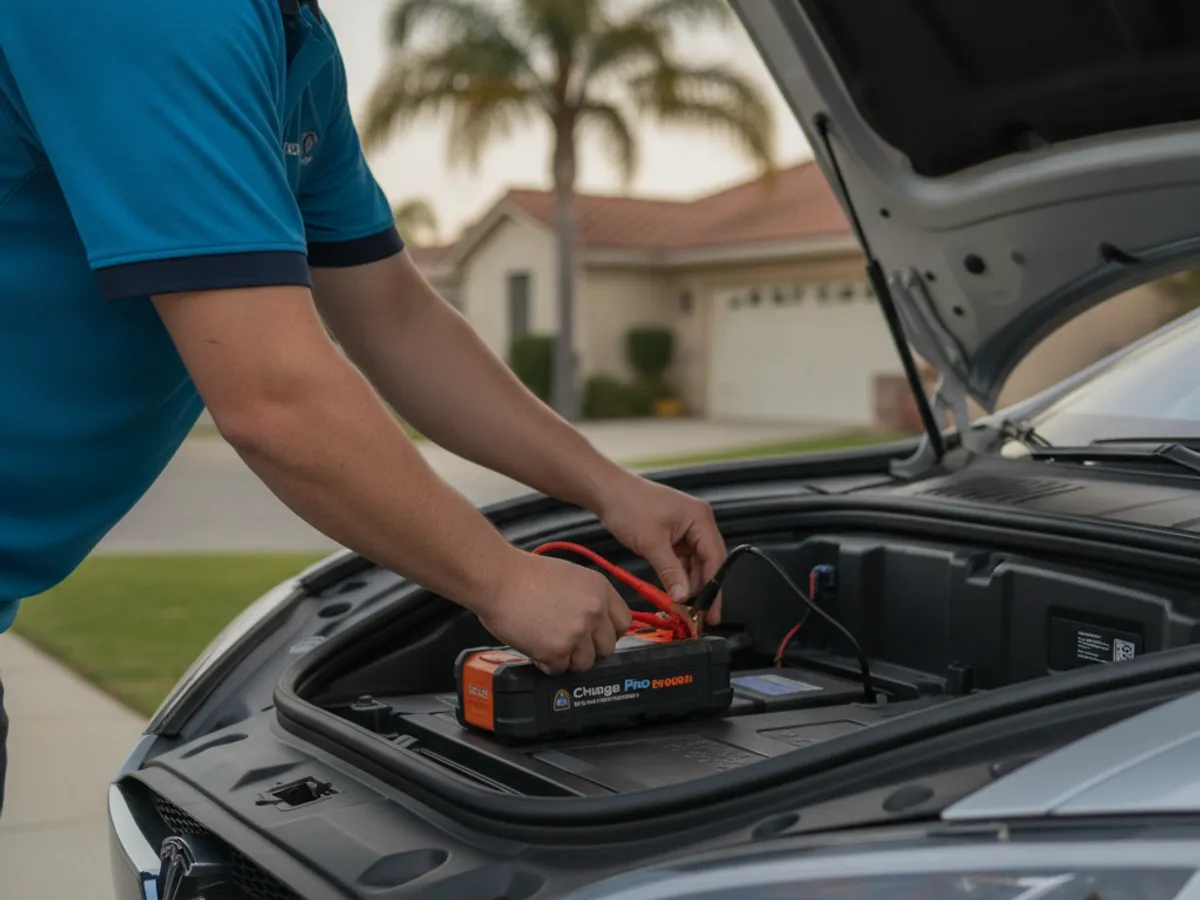
The safe wake-up is a lithium jump pack on the Model S 12V terminals. Never jump a Tesla from a running gas car. A combustion alternator can push an uncontrolled spike onto the low-voltage bus. That spike can damage the gateway and other modules. A quality lithium pack supplies a steady 12 volts. The pros we connect you with jump or replace a dead 12V on site. They handle Tesla and every major EV brand.
The catch on a fully dead Model S is getting to those terminals. With no power, the frunk latch and the door handles can both be asleep. You often need to feed external 12V before anything opens. The exact feed point changes by model year. That’s where owners get stuck. Don’t pry at trim. If you can’t reach the posts, stop and wait for the operator.
Once you’re in, follow the Tesla Model 3, Y, S, and X jump steps. After the car wakes:
- Give it about a minute before you grab a handle or tap the screen.
- When the display comes on, go to Controls, then Service, then 12V Battery.
- Plug in at home, or stop at a Supercharger. Let the DC-DC converter refill the 12V.
A jump gets you rolling. It doesn’t rebuild a worn AGM pack.
What to rule out before you call it a 12V
Not every silent Model S is the low-voltage battery. Run this list first.
Empty traction pack. The screen turns on and reads unable to drive, plug in vehicle. That’s charge, not a jump. Operators bring Level 2 to the car when you can’t reach a stall.
PIN to Drive. A live keypad on the screen isn’t a battery failure. Enter the PIN, or reset it from the app on another phone.
Firmware update stuck. A frozen progress bar wants a soft reboot first. Hold both scroll wheels for 10 seconds.
Sentry or cabin overheat drain. If the car was fine a few hours ago, a background feature may have flattened the 12V. You still need a jump. The battery itself may still be healthy.
If the screen is black, treat it as a dead 12V. Flush handles and an offline app point the same way. For every Tesla no-start cause, use the Tesla won’t start seven-step checklist.
Same lots as a Model 3, from Riverside to the High Desert
A Model S that goes dark on the shoulder still follows the same split. No screen and no app usually means 12V. A live screen that begs for a plug means the pack is empty.
Riverside is the largest city in this market. ACS 2019-2023 puts its population at 319,069. San Bernardino sits at 222,724. Fontana sits at 214,169. Ontario sits at 180,547. A Model S that sat all day in those lots fails like one in Canyon Lake or Norco. The 3 and Y in the next stall hit the same 12V wall. The S just makes the lockout worse.
After a drive into Victorville, Hesperia, or Adelanto, check the screen first. A dark car in the driveway is still usually the 12V if nothing lights. Same in Corona, Moreno Valley, and Jurupa Valley after a workday sit. Same in Temecula, Murrieta, and Menifee after a long afternoon. The traction pack spent miles. The 12V spent hours keeping modules alive in the heat. Those are different batteries.
Mountain day trips add another setting. Lake Arrowhead and Crestline sit on SCE. Big Bear Lake and Big Bear City sit on Bear Valley Electric Service. A Model S that won’t wake in a mountain driveway is still usually the 12V if the screen stays black. The downhill run toward Highland and San Bernardino is where an empty traction pack shows up instead. Read the screen. Don’t guess.
Most valley cities sit on SCE. Banning does not. If you’re in Banning, house power comes from City of Banning Electric Utility. The car still needs the same lithium jump pack.
Who actually shows up
Charge Pro IE is a referral line. It matches stranded EV drivers with independent local mobile rescue operators. It performs no work, owns no trucks, and employs no technicians. The operator quotes you before starting and bills you directly. Operators jump or replace a dead 12V on site. They also bring Level 2 charging when the traction pack is empty.
Call (909) 250-2881 when the Model S won’t wake. Confirm whether the screen is black and whether the app shows the car offline. That’s the 12V triage. For the on-site jump, see Tesla 12V battery jump.
Frequently asked questions
Why won’t my Tesla Model S start or turn on?
A Model S that won’t start is usually a dead 12V battery. When that pack dies, the screen stays black. The handles stay flush. The car shows offline in the app. Nothing on the car powers up until the 12V does. A healthy traction pack won’t wake the vehicle on its own. A lithium jump pack on the correct terminals is what brings it back.
Where is the 12V battery on a Tesla Model S?
It depends on the year. On the classic Model S built from 2012 to 2020, the 12V is a lead-acid AGM battery. It sits in the front trunk, under the floor liner near the firewall. On the refreshed Model S from 2021 on, Tesla uses a lithium-ion low-voltage battery. That pack was relocated in the redesign. Both sit toward the front of the car. Both can need external 12V once the pack is fully dead.
Can I jump start a Tesla Model S with another car?
No. Don’t connect a running gas vehicle to a Tesla’s low-voltage system. It can send a voltage spike through the control modules. Use a lithium jump pack that delivers a steady 12 volts instead. Connect it to the correct terminals for your model year. Give the car a minute, then plug in so the converter can recharge the 12V.