The official Tesla roadside assistance number in the United States is (877) 798-3752. That line is national. Calling it still sends a contractor, not a Tesla employee from a local bay. If you’re stopped on I-15 at the Cajon climb, that’s the number Tesla publishes. The same goes for a stall on I-10 through Colton. Charge Pro IE is a separate Inland Empire referral line. It matches stranded Tesla drivers with independent mobile operators. Those operators quote you before they start, and they bill you directly.
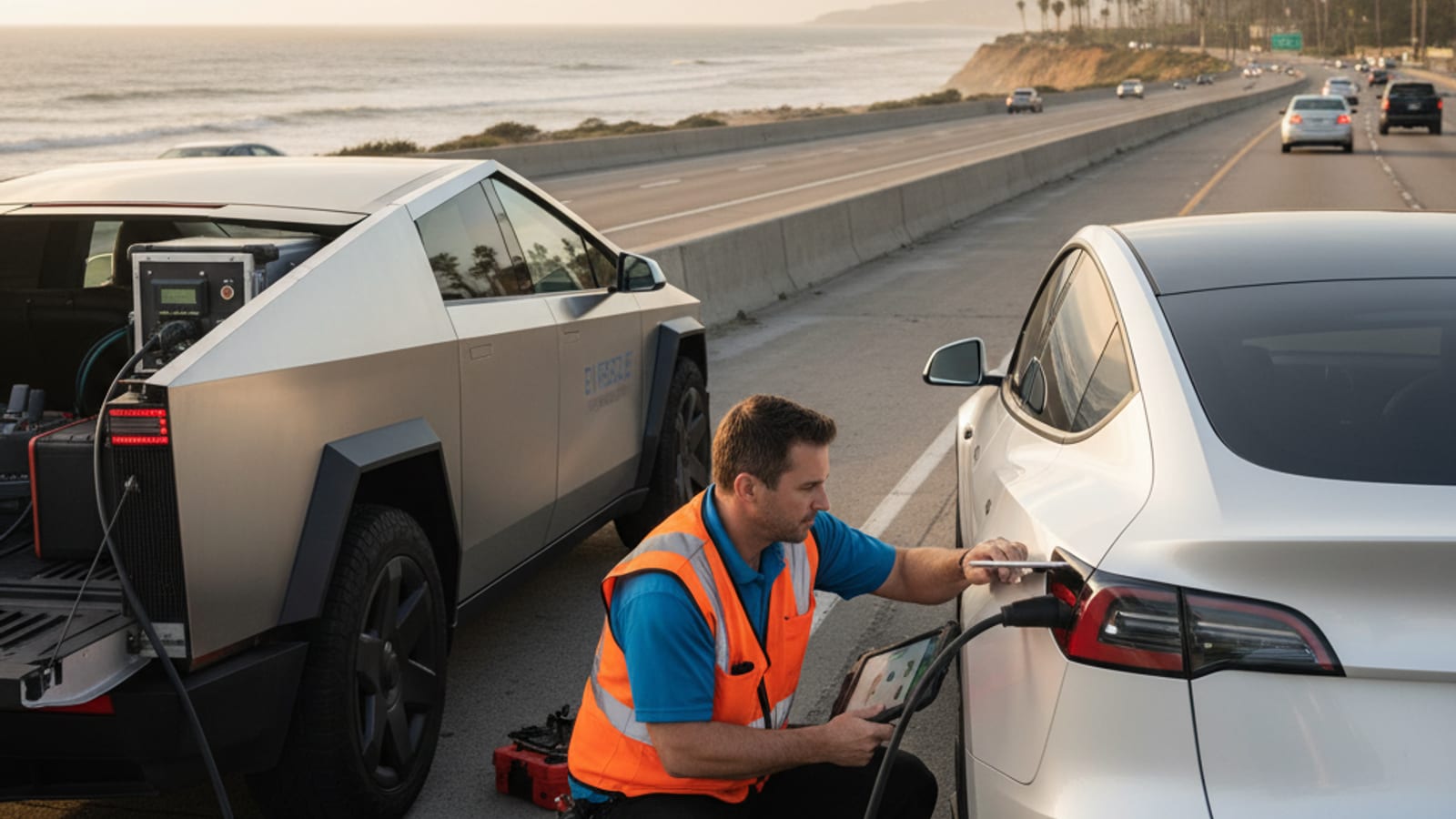
The number Tesla actually publishes
Save (877) 798-3752 in your phone before you need it. Tesla’s own support pages list that as the U.S. roadside line. A Tesla representative will ask for your VIN. They’ll also want your location and a short description of the stall. Have those three things ready before you dial.
You can also request help inside the Tesla app. Open Roadside and follow the prompts. The app can pass location and some vehicle data. You won’t have to read a mile marker out loud. Phone and app aren’t the same path. One puts you on a voice call. The other submits a request through Tesla’s system. Tesla roadside by app or by phone: which path reaches a person compares those two doors.
Neither path puts a Tesla-employed technician in your driveway by default. Tesla’s nationwide line still routes the job to a contractor. That contractor may arrive with a flatbed. They may arrive with a service van. Tesla’s published roadside pages are the place to confirm what your warranty or plan covers. Those terms change, and a referral line can’t quote them for you.
If the car’s under a Tesla plan, some events may be included. If it isn’t, Tesla can still take the request. Confirm the current terms on Tesla’s support site before you assume a free truck. Charge Pro IE doesn’t set Tesla’s coverage. It doesn’t bill through Tesla either.
Here’s the short version of Tesla’s two doors:
- Call (877) 798-3752 and stay on the line until a ticket exists.
- Open the Tesla app, choose Roadside, and submit from the car’s location.
Don’t call Tesla’s sales line. Don’t call a Supercharger stall and expect a truck. Don’t text a Service Center and assume roadside is watching. Roadside is its own queue.
What dispatch means on inland freeways
On paper, Tesla roadside is simple. You call. Tesla records the stall. A truck is assigned. On Inland Empire pavement, the person who shows up is still that contractor. They aren’t a Charge Pro IE employee. Charge Pro IE holds no trucks and employs no technicians. It’s a match line only.
That distinction matters on I-215 through Moreno Valley and Perris Valley. It matters on SR-60 in Jurupa Valley. It matters on the 91 through Corona. A national queue doesn’t know whether you’re on the shoulder in Fontana warehouse traffic. It also doesn’t know an Ontario airport lot from a Corona on-ramp. The contractor Tesla sends may still handle the job well. You should still know you can call a local operator instead. The contractor Tesla sends, and the operator you can call instead walks through that split.
Tesla’s published path for an empty pack often means a tow toward a Supercharger or a service center. Confirm that on Tesla’s site. Don’t treat a blog as the policy. Tesla can also address a dark 12V in some cases. It can arrange a tow if the car won’t wake. Flat tires and lockouts, when Tesla lists them, live on Tesla’s program pages. Charge Pro IE doesn’t advertise tire work or lockouts. The operators it connects you with bring a 240V Level 2 source to the car. They can also jump or replace a dead 12V on site.
A contractor tow and a mobile charge are different jobs. One moves the car. The other adds enough range to drive. Tesla doesn’t run Charge Pro IE. Charge Pro IE doesn’t dispatch Tesla’s contractors. Pick the job you actually need. Then pick the number that does that job.
Where inland Tesla owners actually stall
The Inland Empire is two counties, not one corridor. Riverside County’s ACS 2019-2023 population is 2,478,600. San Bernardino County’s is 2,197,104. Tesla roadside is the same 877 number in both. The roads aren’t the same.
Start with the Cajon. I-15 climbs toward Victorville, Hesperia, Oak Hills, and Adelanto. Range drops on that grade. A flat warehouse loop in Fontana never asks the same of the pack. If you’re empty on that climb, you’re on a mountain freeway shoulder. That’s not a city curb. Out of charge on I-15 at the Cajon climb toward Victorville is written for that stall. Hesperia’s ACS population is 100,775. Victorville’s is 137,627. Adelanto’s is 37,964. Those are High Desert cities, not valley suburbs. Apple Valley is a town of 75,473. Edison delivers power there, and Apple Valley Choice Energy procures the generation. Tesla’s contractor still has to cross the pass to reach any of them.
I-10 is a different problem. Colton, Redlands, Loma Linda, Beaumont, Banning, Calimesa, and Cabazon sit on that east-west spine. Colton owns the entire electrical infrastructure inside city limits. Banning runs its own electric utility. Most of the rest of that stretch is Southern California Edison territory. None of that changes Tesla’s phone number. It still changes what home means. That’s true if you were trying to limp back to a garage charger. Calimesa has Tesla stalls that fill or go offline. That’s a stall-site question. It isn’t a claim about every other plug on the corridor. Beaumont sits before the climb. Banning sits on it. Cabazon is an unincorporated stop with destination parking. A Tesla that sits in a Cabazon lot all afternoon is a parked-car problem. It isn’t a freeway-shoulder problem.
I-215 cuts Moreno Valley and Perris. Moreno Valley’s ACS population is 211,666, and the electric map is split. Southern California Edison serves part of the city. Moreno Valley Utility serves newer development. MVU has more than 6,500 customers and publishes an address lookup. Perris has 80,511 residents. Riverside, just west, isn’t Edison at all. Riverside Public Utilities has served the city since 1895. The city itself has 319,069 residents. A Tesla that dies downtown in Riverside is in a municipal-power city. A Tesla that dies a few miles east may be in Edison territory. Tesla’s contractor doesn’t bill your electric utility. Your utility also won’t roll a truck to the shoulder.
SR-60 through Jurupa Valley is warehouse and through-traffic. Jurupa Valley has 107,011 residents. Fontana has 214,169 and feeds that freight pattern. Ontario sits next to it, with 180,547 people. Airport lots there can swallow a car for a long work shift. Bloomington is unincorporated, with 25,698 residents, and Rialto has 104,143. Those work-lot stalls look the same. The shift ends and the pack is empty. The car won’t make the next freeway hop. Tesla’s 877 line still works. A local Level 2 visit is the other door.
Rancho Cucamonga is split too. Edison covers most of the city. Rancho Cucamonga Municipal Utility covers a southeast pocket of more than 3,900 metered businesses and residents. That pocket includes the Victoria Gardens area, The Enclave, Day Creek Square, and The Resort. A house charger that stays dark in that pocket is an RCMU or Edison outage. It depends on the meter. It isn’t Tesla roadside. The city’s ACS population is 175,411. That doesn’t change who you call when the car’s already on the street.
South county is another climate. Temecula has 111,167 residents, and only 6.5% of housing was built before 1980. Menifee, Murrieta, Lake Elsinore, and Hemet sit in the same south-county heat. The Ortega near Wildomar is a two-lane mountain road. A Model Y that stops there isn’t in the same setting as a Model 3 in a Chino work lot. Chino has 92,652 residents. Norco has 25,054, and 68.8% of its housing was built before 1980. Eastvale is the opposite vintage. Only 2.2% of its housing is pre-1980, and the ACS population is 70,633. Newer streets still leave Teslas stranded when a home charger was never finished. San Jacinto has Edison delivering power, with San Jacinto Power supplying generation.
Mountain communities are a fourth map. Big Bear Lake and Big Bear City are Bear Valley Electric Service territory. That utility names Lake Williams, Erwin Lake, Sugarloaf, Moonridge, Fawnskin, and Boulder Bay, plus the two Big Bear places. Lake Arrowhead and Crestline are on Edison’s mountain list. Crestline housing is old: 77.7% built before 1980. Running Springs is a junction community of 4,917. Tesla’s 877 number doesn’t change at the tree line. The contractor who draws the ticket still has to climb. High Desert miles around Phelan are long. Phelan is named in Edison’s tariff index. Wrightwood appears in that tariff index too. No separate Edison service-area page was confirmed here. If house power is the question in Wrightwood, verify the utility with the agency. Roadside for a Tesla is still Tesla’s number, or a local operator. It isn’t the power company.
San Bernardino city has 222,724 residents. Tesla’s app still works there, and in Upland, Highland, Yucaipa, and Grand Terrace. The person you reach on (877) 798-3752 is still a national queue.
Empty pack, dead 12V, or a car that won’t wake
Most “my Tesla died” calls are one of two failures. The traction pack is empty, or the 12V is dead. They look similar from the sidewalk. They aren’t the same job.
An empty pack usually still shows some life. You may see a low-battery warning. Locks and screens can still work. The car simply won’t roll far. Tesla’s published roadside path for that event often means a tow. Independent operators Charge Pro IE connects you with can instead bring 240V Level 2 to the car. That’s a native NACS plug for Tesla. CCS or J1772 adapters cover other EVs if a non-Tesla is the one that stalled. That visit typically adds 10 to 20 miles of range in 15 to 30 minutes of charging. That’s charging time. It isn’t an arrival time. Charge Pro IE doesn’t promise when someone shows up.
A dead 12V is a different scene. The screen stays black. Doors may not open from the app. The car looks fully dead even if the main pack still has energy. Teslas still need that 12V to wake computers, unlock, and close contactors. Operators can jump or replace a 12V on site. See Tesla 12V battery jump for that path. Tesla roadside rescue covers the Tesla-specific match. Mobile EV charging is the Level 2 visit when the pack is the problem.
Don’t guess which failure you have if the car is dark. Tell Tesla, or tell the operator, what the car is doing. No lights and no app control points at 12V. A low-battery message with a car that still unlocks points at the pack. Either way, stay out of the travel lane.
Model 3 and Model Y owners on I-15 see the same 877 number as Model S, Model X, and Cybertruck owners. The 12V access points differ by model. The Tesla roadside assistance number does not. Newer Model 3 and Model Y cars may use a lithium 12V. Older cars may use a lead-acid 12V. Both can fail. A jump that dies again usually means the 12V is finished, not that the pack is empty. Charge Pro IE doesn’t diagnose at a service-center level. The operator on scene can often get the car to wake. A Tesla Service appointment is still Tesla’s job if a module needs replacement.
Tesla won’t quote Charge Pro IE’s operators. Charge Pro IE won’t quote Tesla. The operator you’re connected with quotes you before work starts. You pay that operator. That’s the whole billing path.
Why a local backup line exists
Tesla’s number is the right first save in your contacts. It isn’t the only useful number in Riverside and San Bernardino counties. Charge Pro IE exists because a nationwide contractor ticket is one option. A local mobile charge is another.
We connect you with independent local mobile rescue operators. We don’t hold a contractor license for the work. We don’t own a fleet, a yard, or parts inventory. Charge Pro IE publishes no hours and sets no prices. Those operators handle Tesla and every major EV brand. They bring a 240V Level 2 source. They jump or replace a dead 12V. They don’t replace Tesla’s warranty. They don’t replace a tow when a tow is what the car needs.
If the car needs a service-center diagnosis, a mobile charge is only enough miles to get there. If the car needs a flatbed because something mechanical has failed, charging won’t fix it. If you’re simply empty on I-10 in Redlands, a Level 2 hookup can be the whole job. The same is true after a shift in a Bloomington or Rialto lot. Confirm the quote on the call. Decline if the quote isn’t a fit.
Home power is a third story. A dark panel in Riverside is Riverside Public Utilities. A dark panel in Colton is Colton Electric. A dark panel in Banning is Banning’s municipal utility. A dark panel in Fontana, Ontario, Chino, or Upland is Edison. So is a dark panel in San Bernardino, Rialto, Highland, Loma Linda, Grand Terrace, Redlands, or Yucaipa. A dark panel in the MVU pocket of Moreno Valley is Moreno Valley Utility. San Jacinto still has Edison delivering power, with San Jacinto Power supplying generation. Apple Valley is similar, with Edison delivering and Apple Valley Choice Energy procuring. Bear Valley Electric Service is the mountain utility in Big Bear. None of those agencies dispatch Tesla roadside. Don’t call Tesla to restore house power. Don’t call your utility to charge a car on the 91.
Glen Helen concert parking, Pechanga destination lots, and Ontario warehouse rows produce the same pattern. The car sits for hours. Climate control or a small load drains what you thought you had. You return, and the Tesla won’t go. Tesla’s 877 line is still valid. A local operator with Level 2 is the backup. That’s the path when you want the car charged in place instead of towed.
What to have ready before you dial Tesla
VIN first: it’s on the app, the title, and the windshield plate. Location second: use an exit number, a mile marker, or a cross street. “I’m on the 15” isn’t enough. “Northbound I-15, Cajon, before the High Desert” is better. “Ontario airport Lot 2, row C, plus a dropped pin” is better still.
Describe the failure in one sentence. Screen black and doors dead, or pack at zero and hazards on. Then stop talking and let the agent assign the ticket. If you also want a local operator, that’s a second call. Tesla won’t transfer you to Charge Pro IE.
Keep a phone pack charged. The Tesla app dies with the phone. Hazard lights on. Seatbelts on if you stay in the car. On a freeway shoulder, stay in the vehicle unless it’s unsafe. Exit on the side away from traffic if you must get out. Inland heat makes water useful while you wait. Mountain nights around Running Springs, Crestline, and Lake Arrowhead make a jacket useful. Neither fact is an arrival claim. It’s only what the climate does while you wait for whoever you called.
A portable tire kit helps because Teslas don’t carry a spare. That kit is yours, not a Charge Pro IE tool. Tesla may list tire help on its own roadside pages. Confirm there. A Mobile Connector in the trunk doesn’t charge the car from a wall that isn’t there. It also doesn’t replace a 240V operator visit. Navigation in the car is still the best range warning you have. Trust it on the Yucaipa climb, the Beaumont grade, and the run toward Big Bear. Don’t treat leftover single-digit percent as a plan.
CHP freeway patrol can sit with you on some state highways. That’s a safety stop, not an EV charge. Tesla roadside is still Tesla. A local operator is still a local operator. Know which call you’re making.
After you hang up
If Tesla assigned a contractor, wait for their update in the app or by text. That’s only if Tesla sends one. If you instead want a mobile charge or a 12V jump from an independent operator, Charge Pro IE is the Inland Empire match line. The number to call is (909) 250-2881. The operator quotes before starting. Charge Pro IE doesn’t promise an arrival window.
For a wider map of charging context across the two counties, start at EV charging in the Inland Empire.
Frequently asked questions
What is the Tesla roadside assistance number?
The U.S. number Tesla publishes is (877) 798-3752. Confirm it on Tesla’s support site if you want Tesla’s own page as the source. That line still sends a contractor. Charge Pro IE is a separate local match line for independent operators.
Is Tesla roadside assistance free?
It depends on the car’s warranty or plan. Tesla publishes those terms. Charge Pro IE can’t confirm your coverage. Ask Tesla when you call. Read the current support page too. No dollar figure for Tesla roadside was verified for this page, so none is listed.
What if the Tesla is completely dead and won’t respond?
Treat it as a 12V failure until proven otherwise. A dark screen and dead locks are the usual 12V picture. An empty pack usually still shows some low-power life. Tesla can take that call. Independent operators can jump or replace the 12V on site.