A Tesla roadside request in the Inland Empire usually reaches a third-party tow contractor. Tesla’s app is only the dispatcher. The truck that shows belongs to an independent tow company. Charge Pro IE matches a local operator who quotes you first.
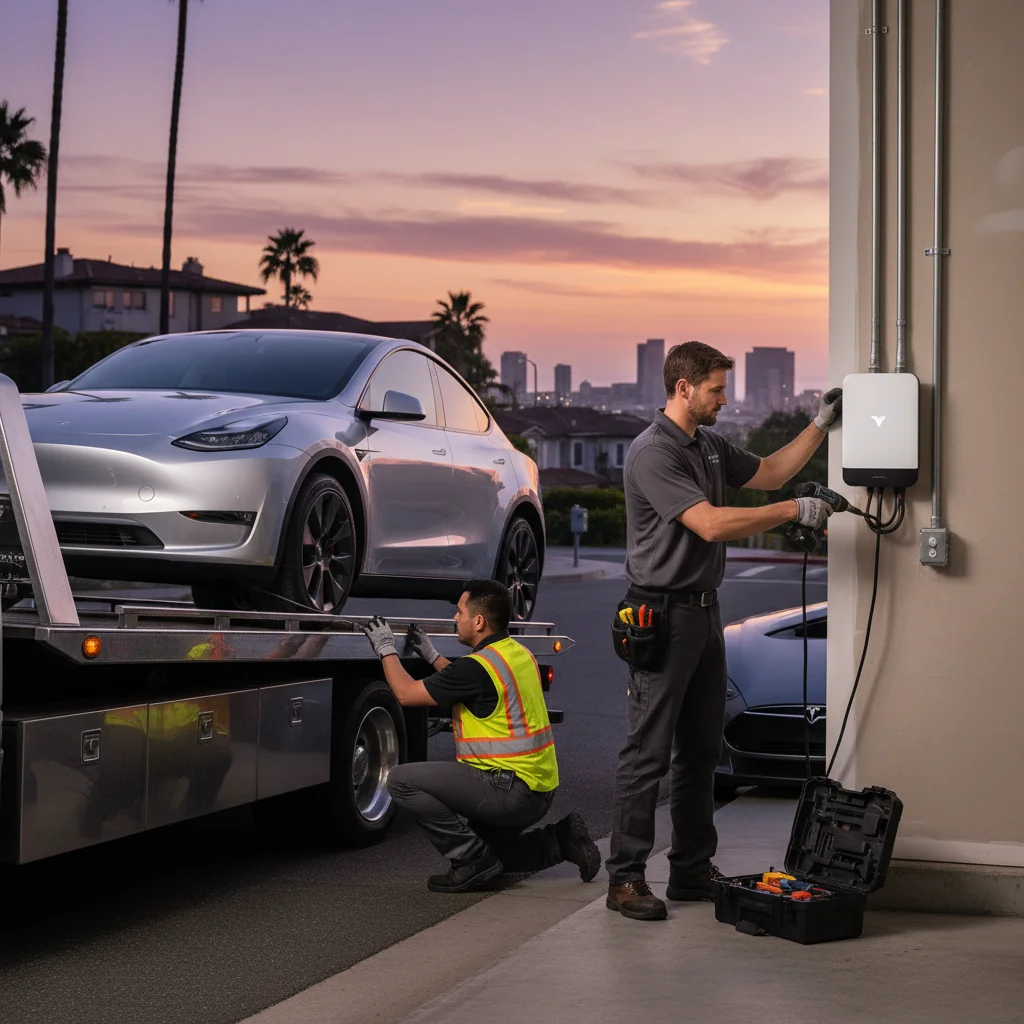
Tesla’s contractor, not Tesla’s truck
You tap Request Help, and a timer starts on the screen. That timer isn’t a Tesla employee en route. Tesla’s roadside system sends your pin to contracted tow companies. The first partner who accepts gets the job.
Tesla publishes what the program covers. The truck in your mirror isn’t Tesla’s own crew. The person who arrives works for a local tow shop. That shop also takes motor-club calls, insurance jobs, and gas-car hooks.
Tesla’s 2026 roadside policy is about coverage. It isn’t a resume for the driver. You can have a valid request and still get a generalist.
Tesla’s roadside number feeds the same kind of dispatch. The path you pick doesn’t pick the driver’s EV history.
Why Inland Empire dispatch is a wide net
This market isn’t one compact city. Riverside County’s ACS 2019-2023 population is 2,478,600. San Bernardino County’s is 2,197,104. Tesla’s contractor pool has to span both counties.
That map includes warehouse rows around Ontario and Fontana. It includes the I-15 Cajon climb toward Victorville. It includes I-10 through Colton and Redlands. It includes SR-60 in Jurupa Valley. It includes I-215 through Moreno Valley and Perris. It includes the 91 through Corona.
Mountain towns sit on a different grid. Big Bear Lake and Big Bear City run on Bear Valley Electric Service. Lake Arrowhead and Crestline sit on Southern California Edison. A contractor may have just cleared a gas-car hook in Hemet. The next ping can still be a dead Model Y. That car might sit on the Cajon grade.
Downtown Riverside is another split. Riverside Public Utilities serves the city. Colton and Banning each run a city electric utility. Moreno Valley is split between Southern California Edison and Moreno Valley Utility. Rancho Cucamonga is split between Edison and a municipal pocket around Victoria Gardens. None of that changes Tesla’s dispatch. The system still needs a partner to accept.
Eastvale’s ACS 2019-2023 share of pre-1980 housing is 2.2 percent. San Bernardino city’s is 60.9 percent. Temecula’s is 6.5 percent, and Crestline’s is 77.7 percent. The contractor who accepts your pin may have started elsewhere. You won’t see that on the timer.
What the contractor is built to do
These shops are real local businesses. They run flatbeds, wheel-lifts, and wreckers. Their daily book is mixed. Lockouts, crashes, and dead gas cars share the radio. The occasional EV does too.
EVs are still a smaller slice of that book. The driver who shows may have loaded Teslas before, or they may not. You can’t see that from the app. You only learn it when the truck arrives.
A tow contractor’s tool is a winch. That’s the right tool after a crash. It’s the wrong default when the car only needs a 12V jump. It’s also the wrong default for an empty pack. The car may still wake.
If the pack is empty and the car still wakes, skip the winch. A mobile EV charging visit is the other path. The operator we connect you with brings a 240V Level 2 source. Native NACS for Tesla, and adapters for CCS or J1772. Typical add is 10 to 20 miles of range. That takes 15 to 30 minutes of charging. That’s charging time, never an arrival time. The operator quotes before they start, then bills you directly.
The 12V problem a tow truck often isn’t set up for
A lot of “dead Tesla” calls aren’t an empty pack. They’re often a dead 12-volt. Newer Model 3 and Model Y cars use a low-voltage lithium pack. That small battery runs the computers, the latches, and the screen. When it dies, the car looks fully dead.
A trained EV operator often starts with a 12V jump. That can wake the screen. It can open Transport Mode. It can spare you a tow. How to tell your Tesla 12V is dead walks through that sequence.
A general tow driver may not lead with that. They may treat the car as a brick that has to ride. Dragging a Tesla with the parking brake set can chew tires and brakes. Forcing doors or the frunk without a 12V boost can do worse.
You don’t have to accept the first hook. If the car might only need a 12V rescue, say so. Ask whether they plan to jump the low-voltage battery before they winch. If that question draws a blank, you’re looking at the wrong truck.
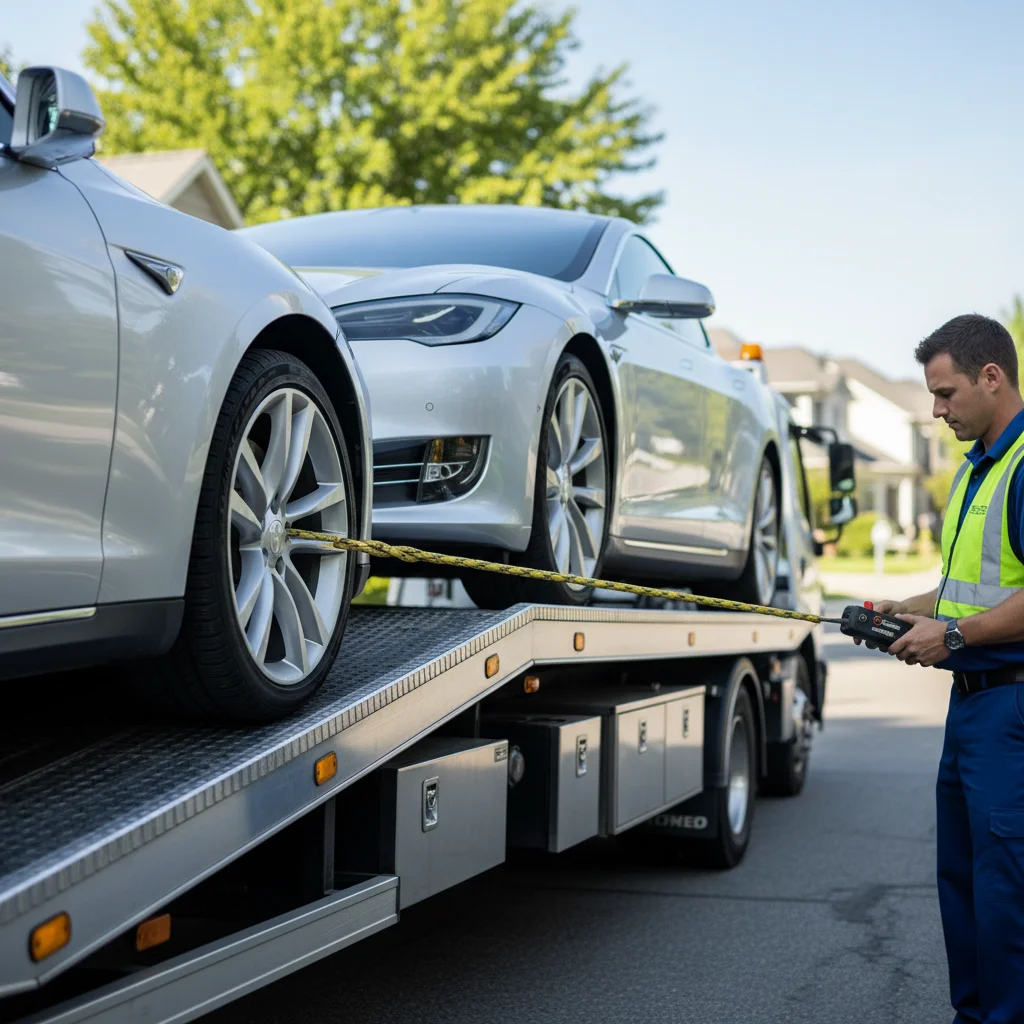
If a tow is truly needed, the load has to be right
Some stalls do need a flatbed. A crash or a bent suspension is a tow job. So is a car that won’t roll after a 12V jump. Tesla’s published towing guidance is strict. The car belongs on a flatbed. Two wheels on the pavement isn’t a Tesla-safe tow. Dual Motor cars are especially unforgiving of a two-wheel drag. A wheel-lift or hook-and-chain can damage the drive units.
Keep the no-power Tesla tow checklist in your notes. Watch the load even when Tesla dispatched the truck.
Transport Mode, or the car fights the winch
Wheels need to spin. The screen path is Controls, then Service, then Towing. That’s Transport Mode. It releases the parking brake so the car can be winched. Skip it and the truck is dragging a locked car.
A dark screen changes the whole job
No 12V means no screen. Transport Mode is then locked behind dark glass. The fix is usually to restore 12V power first. If the wheels still won’t free, use wheel dollies. They slide under each tire so the car can roll. An operator with no dollies and no 12V plan is guessing.
The tow eye, not the suspension
The winch cable belongs on the designated tow eye. That eye screws into a hidden point in the bumper. Hooking suspension arms, the subframe, or control arms can bend them. You don’t want that tested on I-10 in Colton. If you see the hook going anywhere else, stop the job.
When to cancel Tesla’s contractor
You can cancel a dispatch that looks unsafe in the app. You’re not stuck with the first truck that accepted.
Watch for these tells. The truck isn’t a flatbed: decline it. The driver doesn’t know Transport Mode: pause the load. They reach for a control arm instead of the tow eye: stop them. If the screen is dark and they’ve got no 12V plan, stop. If they can’t explain how all four wheels stay off the ground, wait. Don’t let them hook yet.
None of this means tow companies are careless. It means Tesla’s contractor model fills an open truck. It doesn’t fill an EV specialist slot you can inspect in advance. What Tesla roadside covers is still worth reading. You should know when the program will send a truck at all.
High Desert miles around Adelanto, Hesperia, and Apple Valley sit far out. That isn’t a valley shop’s usual loop. A stall above Running Springs isn’t a Fontana warehouse job. The contractor who accepts may be strong at one and new at the other. That’s the gap the app won’t show you.
Calling an operator who quotes first
If the pack is empty, you often don’t need a tow. A dead 12V often doesn’t need one either. You need someone who treats the car as an EV.
Charge Pro IE is a referral line. We don’t own trucks, and we don’t employ technicians. We don’t set prices or promise an arrival window. We match stranded Tesla and other EV drivers with independent local mobile rescue operators. The operators we connect you with are licensed.
They handle Tesla and every major EV brand. They can jump or replace a dead 12V on site. They can bring that Level 2 source to the shoulder. They can also meet you at a warehouse stall or a mountain turnout. For Tesla-specific stalls, start with Tesla roadside rescue.
Ask for the quote before any cable goes on the car. If a Tesla contractor already rolled up, look at the load. You can still change course.
Call (909) 250-2881 when you want that match. The operator quotes you, then bills you directly.