Apple Valley Choice Energy procures power for the Town of Apple Valley. Southern California Edison still delivers it on the wires. Neither one can put miles into a dead EV on Bear Valley Road. EV roadside assistance in Apple Valley means an independent operator at the car. It’s not a utility dispatch, and it’s not a tow by default.
Two names on the bill, zero trucks at the car
Homes in ZIP 92307 and 92308 often see two names on the bill. Apple Valley Choice Energy buys the generation. Edison delivers it. That split’s real. Most residents still don’t know why both names appear. It doesn’t matter once the pack’s already at zero.
A community choice aggregator doesn’t carry a NACS plug. It doesn’t jump a 12V in a Jess Ranch driveway. It doesn’t meet you at the Apple Valley Golf Course lot. When the car won’t roll, you need EV roadside assistance. You don’t need a billing department.
The official name is the Town of Apple Valley. It’s a town, not a city. San Bernardino County and the Census both treat it that way. Locals notice when copy gets that wrong. ACS 2019-2023 put the population at 75,473. The 2024 estimate is 75,029. The figure that shapes an empty-pack day is the land.
Distance is the local problem, not the power company
Apple Valley covers about 77 square miles. That’s the largest land area of any place in this market. An errand that’s trivial in Montclair can eat real range here. Jess Ranch, Sitting Bull, Desert Knolls, Bell Mountain, Rancherias, and Solera sit far apart. The rural eastern parcels toward Lucerne Valley sit farther still.
High desert heat does the rest. A car can look fine leaving the Bear Valley Road commercial corridor. It can drop faster on Apple Valley Road with the AC running. Navajo Road, Dale Evans Parkway, and Central Road add more surface miles. You can burn a lot of battery before you ever see a freeway on-ramp.
This town sits off the interstate. I-15 clips past Victorville. You reach Apple Valley on Bear Valley Road or SR-18. That’s the Happy Trails Highway. A stall here is usually on an arterial or in a lot. Sometimes it’s a residential street. It’s not a freeway shoulder. That changes the stop. You and the operator are working a surface road in a spread-out High Desert town.
Roy Rogers and Dale Evans heritage is still on the signs. Happy Trails is the highway name, not a slogan on this page. The Mojave Narrows sit to the west. Apple Valley Airport sits in the mix. None of those landmarks charge the car for you. They just tell us where you actually are.
Corridors that run you out of miles
You don’t need a call log to see where range gets tight. Follow the roads people actually use.
Bear Valley Road is the commercial spine. Lots along that corridor are easier, safer places to wait than a live lane. Drivers stack one more stop after the golf course or the airport area. A Happy Trails errand can do the same. They often realize the percent too late in a stall.
SR-18 is the other spine. West, it ties you toward I-15 and Hesperia. East, it runs toward Lucerne Valley and the Mojave. That eastbound stretch is long and lightly built. It also leaves the towns this site maps. If your range is already thin in town, don’t keep rolling east on hope. Lucerne Valley isn’t a Charge Pro IE coverage page.
Bell Mountain and the eastern parcels are remote. An empty pack out there is a serious stop. Quiet roads around the airport and out toward the Mojave Narrows have the same spread. Adelanto, next door, has even more of that High Desert pattern. If you died on those empty miles, read the Adelanto High Desert stranding note.
Driveway stalls overnight in Jess Ranch or Solera are often a different failure. The car never woke. That’s usually the 12V.
Tell the 12V failure from a dead pack
If you drove until the range display hit zero, the traction pack is empty. You need energy in the high-voltage battery. A small jump pack won’t put highway miles back into that pack.
If the screens are dark and the handles act odd, start with the 12V. The car won’t wake. Teslas and most other EVs still use a small 12V battery. It boots computers, contactors, and locks. That battery can fail in a Sitting Bull driveway on a cool morning. The pack can still hold range. Operators who handle a Tesla 12V battery jump work that on site. If the 12V won’t hold after a jump, they can quote a replacement. That happens before anything else starts.
Don’t guess in the call. Say whether the car rolled until empty, or never woke at all.
What the operator actually brings
Charge Pro IE is a referral line. It matches stranded EV drivers with independent local mobile rescue operators. It performs no work. It owns no trucks. It employs no technicians. It sets no prices and publishes no arrival window. The operator quotes you before starting, and bills you directly.
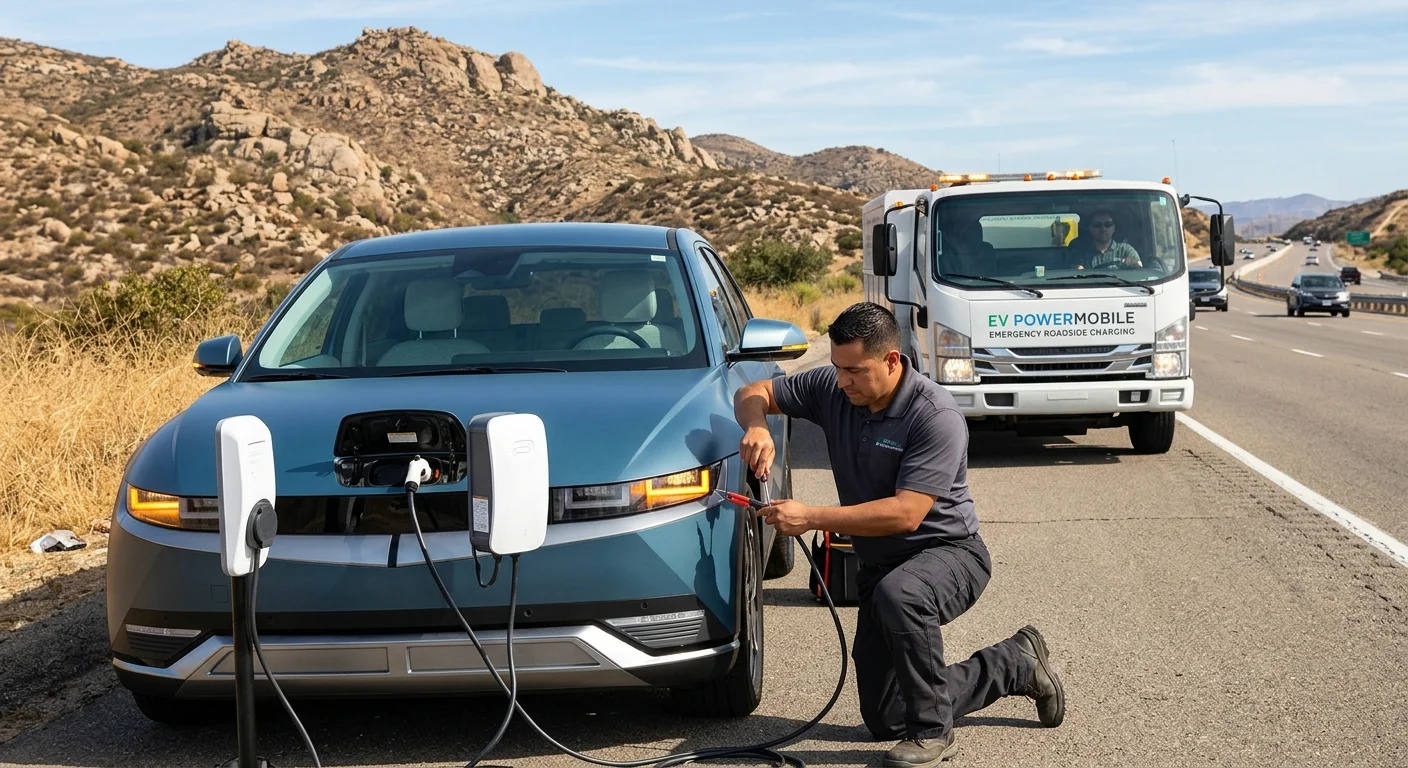
What those operators typically bring is a 240V Level 2 source. Tesla owners get a native NACS plug. Other makes get a CCS or J1772 adapter. A passenger EV usually gains 10 to 20 miles of range. That takes 15 to 30 minutes of charging at the car. That clock is charging time at the car. It’s not how long anyone takes to arrive.
Those miles are meant to reach a charger you already planned. Or they get you home to the driveway. They’re not a full High Desert day. Ten to 20 miles may not cross from Jess Ranch to Bell Mountain in one hookup. That’s the point of a recovery charge, not a full top-off. How a mobile EV charging visit works walks through the sequence. Mobile EV charging across the High Desert puts the same visit in Victorville, Hesperia, Apple Valley, and Adelanto terms.
Operators handle Tesla and every major EV brand. That includes Rivian, Ford F-150 Lightning, Mustang Mach-E, Hyundai Ioniq 5 and 6, Kia EV6 and EV9, Chevy Bolt and Equinox EV, Polestar, and Nissan. Give the make and model so the connector’s right before anyone rolls.
A charge where you sit, or a tow
If the only problem’s an empty pack, keep the car in place. A Level 2 hookup at the bumper does that. A tow means a hook and a destination. You still need a plan to get off Bear Valley Road. Charge Pro IE doesn’t publish tow rates or rescue rates. The operator on scene quotes the job. For the decision itself, read towing a dead EV versus a mobile charge.
A tow still wins when energy isn’t the issue. That includes a flat tire or a charge port that won’t release. A drivetrain fault needs a shop, not a charge. An empty pack on Happy Trails Highway needs power.
Club and insurer roadside programs vary by policy. Some send a 12V jump. Some send a tow. Confirm what your card covers. Don’t assume a 240V source is on that truck. The local backup’s still an independent operator who carries one.
The wall at home can’t reach SR-18
About 26.8% of Apple Valley housing was built before 1980, per ACS 2019-2023. That’s newer than San Bernardino County overall, where 43.8% of units predate 1980. It isn’t a promise your panel can take a Level 2 install. A licensed electrician has to read the panel in front of them. Charge Pro IE doesn’t install chargers and doesn’t hold a contractor license.
A working wall unit also can’t reach a car already stopped on Dale Evans Parkway. Apple Valley Choice Energy and SCE shape what you pay to charge in the driveway. They don’t move electrons onto SR-18. Keep those jobs in separate buckets.
Town-level coverage lives on the Apple Valley EV charging page. Victorville, Hesperia, Spring Valley Lake, and Adelanto sit next door. The same High Desert heat applies. The same long surface miles apply. The utility story isn’t identical in every neighbor, so don’t copy one bill onto another. Victorville’s residential power is SCE. Apple Valley uses the CCA-plus-delivery split. Don’t mix them.
What to say when you call
Skip the speech. Give a pin and a symptom.
Say you’re in the Town of Apple Valley. Give the cross street: Bear Valley Road, Apple Valley Road, Navajo Road, Dale Evans Parkway, Central Road, or SR-18. Note a lot, a Jess Ranch or Solera driveway, or a shoulder. Name the model. Say whether the car died while rolling, or never woke.
If you’re in a live lane, stay in the vehicle with hazards on. If you can roll into a lot on the Bear Valley Road corridor, do that first. A stall’s a better meet point than a through lane.
Charge Pro IE doesn’t promise when anyone arrives. The operator who accepts the job quotes their own window after they hear the pin. Eastern parcels toward Lucerne Valley and Bell Mountain are remote. That’s geography. It isn’t a published clock.
When you’re ready, call (909) 250-2881. The operator quotes the work before it starts.
Frequently asked questions
Does Apple Valley Choice Energy send a truck if my EV is dead?
No. Apple Valley Choice Energy procures generation for the town. Southern California Edison delivers it. Neither dispatches a mobile charger. A dead pack still needs an independent operator at the car.
If my Tesla won’t start in a Jess Ranch driveway, is the main pack empty?
Usually not. A dark screen and odd door behavior point to the 12V. The traction pack can still hold range. Tell us the car won’t wake. They’ll match you with someone set up for a 12V jump, not only a Level 2 charge.
Can operators help a non-Tesla on Happy Trails Highway?
Yes. Rigs carry a native NACS plug plus CCS or J1772 adapters. That covers Rivian, Ford, Hyundai, Kia, Chevy, Polestar, Nissan, and most other EVs sold here. Give the make and model when you call.