French Valley homes sit on rural roads, not a downtown grid. You can leave a Leon Road or Briggs Road subdivision with a comfortable buffer. Then Auld Road, Benton Road, or a wait at French Valley Airport spends it. Heat and open-valley speed drain a pack here. EV roadside assistance in French Valley is the call when that buffer is gone.
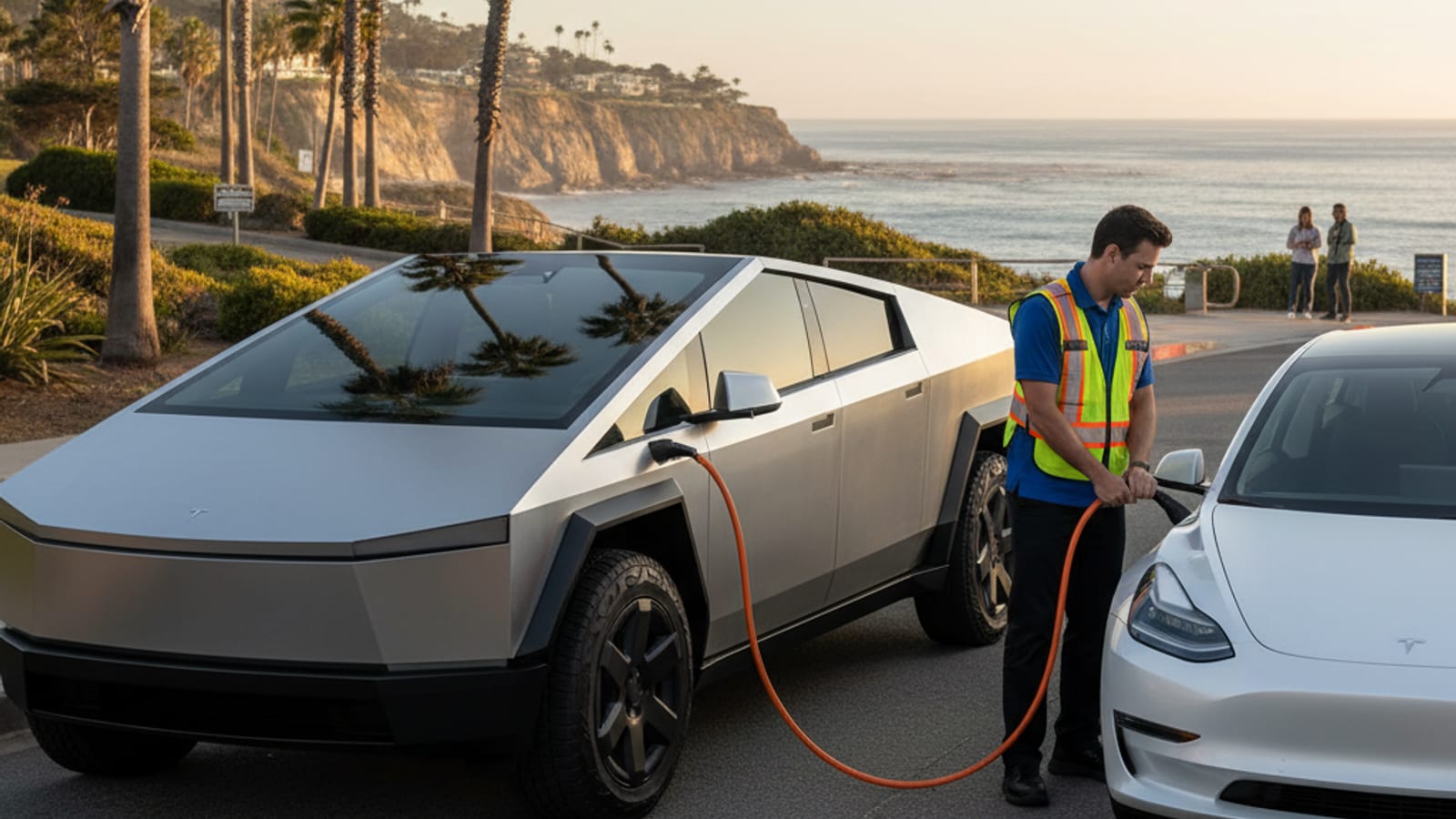
Charge Pro IE doesn’t roll a branded truck. We match stranded drivers with independent local operators. That operator quotes you before any cable goes in. They bill you directly. The work is theirs. The match is ours.
This place is a census name, not a city hall
French Valley is unincorporated. It’s a Census designated place in Riverside County. There’s no city council. The Riverside County Board of Supervisors governs it. Mail often reads Murrieta or Winchester. Callers use all three names, plus Temecula, for the same driveway.
The American Community Survey for 2019 through 2023 puts the population at 45,269. That’s a lot of people for a CDP. French Valley has more residents than Wildomar, Calimesa, Canyon Lake, and Big Bear Lake combined. It covers about 10.87 square miles. The ZIP codes that overlap it include 92563 and 92596.
Housing is almost all twenty-first century. Only 2.3 percent of units were built before 1980. That ties Eastvale for the newest stock in this market. Subdivisions along Leon, Briggs, Pourroy, and the Morgan Hill area went in fast. The commercial strip is Winchester Road, which is SR-79. There’s no old downtown core to aim for.
People here usually charge in the garage. New houses were built with that habit in mind. The stall you miss is the one away from home. That’s the French Valley EV charging pattern worth planning around. A full pack on the driveway doesn’t help once you’re on Benton with the warning lit.
Winchester, the small CDP next door, had 4,555 residents in that same ACS vintage. French Valley is an order of magnitude larger, and it still isn’t a city. That mismatch is the whole story. Forty-five thousand people live on a rural grid with a strip of shops. Your pin on the map may say Murrieta. The shoulder under the tires can still be French Valley.
A rural connector isn’t a city block
A city curb still has lighting, traffic, and nearby lots. Auld Road and Benton Road don’t feel like that. They’re long, fast, and exposed. Agricultural land sits beside new tracts. You can be between houses and still feel alone.
I-215 sits to the west. SR-79 carries the Winchester Road commercial run. Briggs Road and Leon Road feed the subdivisions. Pourroy Road ties more of the same grid. None of these are coastal hills. They’re valley-floor miles. You hold a higher speed than you think. The pack notices.
If you told a friend you stalled in Murrieta, you might still be in French Valley. The naming trap is real. Tell the operator the nearest named road. French Valley Airport is a landmark people actually recognize. Winchester Road is the other one. A subdivision name like Morgan Hill helps only if you also give a cross street.
Neighbors matter because your next planned stop may sit in one. Murrieta sits west. Temecula sits south. Winchester sits along the same valley logic. Menifee and Hemet sit farther out. A short hop on paper is still a rural hop with an empty pack.
Murrieta’s ACS population is 112,064. Temecula’s is 111,167. Both are incorporated cities. French Valley isn’t. That legal line doesn’t change the pavement. It does change which name you should say on the phone. Use the road. Use the airport. Don’t assume the mailbox city is the pin.
Heat, wind, and a flat valley floor
French Valley sits on an open valley floor between Murrieta and Winchester. It’s hot, exposed, and windy. There’s very little terrain to blame. This is a heat and speed profile, not a grade profile.
Climate control on a parked car still draws from the 12V and the pack. Sentry mode, cabin overheat protection, and preconditioning all nibble. A day at the airport lot is a classic version of that. You fly. The car sits in sun. You come back to a warning you didn’t expect.
Highway speed on I-215 or I-15 does the rest. Range estimates assume a mixed day. A fast rural connector isn’t a mixed day. If the display said you had enough, treat that as a guess, not a promise. Headwinds on this floor are real. So is a packed cabin with the A/C on high.
Summer inland heat is hard on both batteries. The small 12V hates sitting hot. The traction pack hates high-speed miles in that same heat. You can have a healthy estimated range at 8 a.m. and a problem by midafternoon. Plan the return trip with that in mind, not the morning number.
Phantom drain isn’t a myth. It’s a parked car doing its jobs. Cameras, alarms, scheduled climate, and the computer that waits for your phone all cost energy. Two hours at a Winchester Road lot can be fine. A long day at the airport is a different math. If you already started low, don’t add a long sit.
Where cars actually sit when they won’t move
French Valley Airport
The county-operated general aviation airport gives the community its name. Owners park, fly, and come back hours later. Phantom drain plus heat is a bad mix. A Level 2 visit on the lot can add enough range to reach home charging. It can also wake a car whose 12V quit in the heat.
Tell the operator you’re at the airport, not just near Murrieta. Pin the lot if you can. Aviation parking is easy to miss on a map pin that says Winchester. Note the row or a hangar letter if you see one. A vague pin wastes the first conversation.
Stay with the car if the lot is safe and staff will allow it. Don’t leave a dead EV blocking a taxi lane. If you must catch a flight, say that on the call. The operator still quotes before they start. You’re buying a charge or a 12V jump, not a parking service.
Winchester Road and the SR-79 strip
The commercial corridor is a strip, not a downtown. Errands stack. You bounce between lots. You assume the next stop is close. Then the car won’t ready. Stay with the vehicle if it’s safe. Hazard lights. Then call.
Winchester Road is the name locals use. SR-79 is the name a map uses. Give both if you’re unsure. A grocery lot, a school pickup, and a medical office park all look the same from a highway pin. The operator needs the driveway you’re actually in.
Don’t roll a dead EV across the lot on residual creep unless you can do it safely. A few feet into a stall is better than sitting in a through lane. If you can’t move, stay put and make the car visible.
Auld, Benton, Leon, Briggs, and Pourroy
These are the residential and farm-edge connectors. Shoulders can be narrow. Soft dirt sits next to pavement. Don’t coast into a ditch to get off the road. Hold a safe line. An operator can work from a legal pull-off more easily than from a slope.
Leon Road and Briggs Road are subdivision spines. Pourroy Road ties more of that grid. Auld Road and Benton Road feel longer because they are. Speed stays high between signals. That’s why a buffer that looked fine at the house can vanish before the next turn.
If you’re between tracts, describe the nearest named cross street. Agricultural edges don’t have house numbers that help a GPS. A gate, a nursery, or a school name is more useful than “out in French Valley.”
I-215 on the west side
If you made it to the freeway and the buffer vanished, stay in the vehicle when the shoulder feels unsafe. Use hazards. Follow the shoulder rules you already know. A mobile EV roadside assistance visit can add range on site when the pack is simply empty. A tow is a different job.
I-15 is the other freeway people name from these subdivisions. The two are not interchangeable on a pin. Say which one. Say the direction. Say the last exit you passed if you know it. A westbound pin that actually sits on a frontage road will send the operator to the wrong fence.
What the operator brings, and what they don’t
Charge Pro IE is a referral line. We perform no work. We own no trucks or equipment. We employ no technicians. Independent local mobile rescue operators do the visit.
They bring a 240V Level 2 source to the car. Teslas take a native NACS plug. Other EVs take a CCS or J1772 adapter. A session isn’t a full charge. It’s enough range to roll. Typical charging time is 15 to 30 minutes. That window is charging time, never an arrival time. In that charging window, the visit typically adds 10 to 20 miles of range. Your car, the heat, and how empty you are will move that number.
They can jump or replace a dead 12V battery on site. That’s a different failure from an empty traction pack. Tesla and every major EV brand show up on these roads. The operator should confirm your plug before they leave their yard.
They quote you before they start. Distance, time of day, and how much range you need all move the price. We don’t set that price. They bill you directly. If the quote isn’t a fit, you can decline before the cable goes in.
A wall outlet at a stranger’s house isn’t the same tool. Level 1 is slow in a way that doesn’t help a shoulder. Level 2 is the roadside tool these operators carry. DC fast charging stays at a public stall. Nobody is towing a Supercharger to Auld Road. Read what a mobile EV charging visit actually is if you want the sequence without the gloss.
Empty pack, or a car that won’t wake
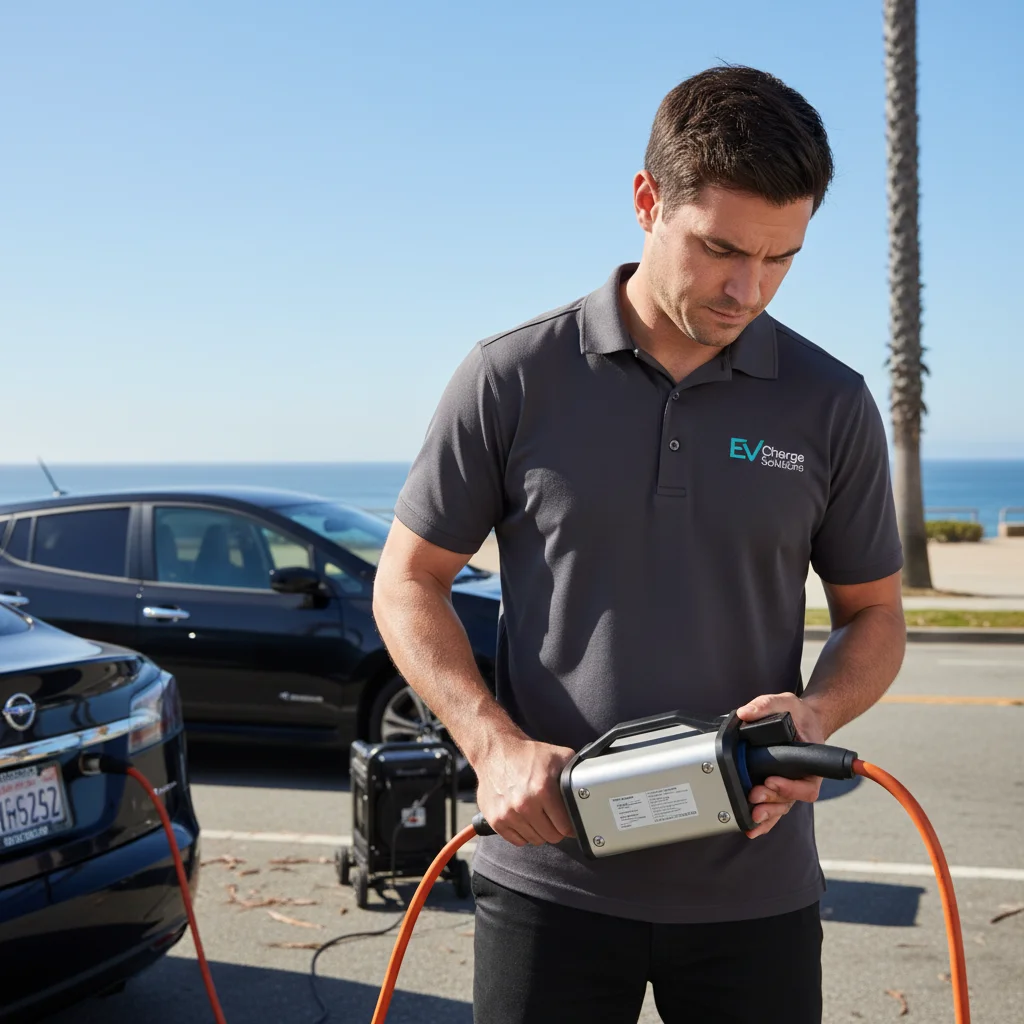
Two failures look identical from the sidewalk. One is a traction pack at zero. The other is a 12V that won’t wake the car. The high-voltage pack can still be fine.
A dark dash, silent door handles, and a car that won’t present a charge port often point at the 12V. Teslas are famous for this. Other EVs do it too. A Tesla 12V battery jump on site can restore enough electronics to drive or to take a charge.
An empty pack still wakes. You can usually open it, sit in it, and see a range number you don’t like. That’s when mobile EV charging is the fit. Charging a brick that won’t unlock is the wrong first move.
If you’re not sure, say so. Describe what the dash does. Describe the last range number you saw. The operator would rather hear that than guess from a highway pin. A car that clicked once and went silent is a 12V story until proven otherwise. A car that shows zero miles and still has lights is a pack story.
Non-Tesla drivers should name the brand. CCS and J1772 aren’t the same plug as NACS. Ford, Chevy, Hyundai, Kia, Rivian, BMW, and the rest all show up in these subdivisions. The 12V still sits under a cover, and it still fails in heat. Don’t assume a luxury badge changes that.
After a jump, watch whether the car holds. A 12V that dies again in the same afternoon usually needs a replacement, not a second jump as the plan. The operator can talk through that on site. We don’t diagnose from a blog paragraph. We also don’t sell a shop repair as a roadside charge.
A tow is a different tool
An empty pack doesn’t always need a hook. Many EVs shouldn’t be flat-towed. Drive units can take damage when wheels spin without the right procedure. A flatbed is the usual tow path when a tow is truly required. That’s slower logistics. It also needs a place that can accept a dead EV.
If the car will roll after a short Level 2 session, you skip that chain. You drive to your own garage or to a public stall you already trust. We don’t name a nearest stall from here. Which subdivision you started from changes the map. Use the car’s nav and a charging app you already know.
If the 12V is dead and a jump won’t hold, a tow to a shop may be the honest next step. Rescue and repair aren’t the same visit. Ask which one you’re buying before anyone hooks up. A charge that adds 10 to 20 miles won’t fix a failed 12V that keeps dropping.
What moves the mobile-charge price is ordinary. How far the operator travels. What time you call. How many miles of range you need added. A longer session is more time on the clock. Rural pins on Benton or at the airport aren’t the same trip as a Winchester Road lot. None of that is a published rate on our side. The person who shows up quotes it.
Don’t wait on a tow thinking it’s automatically cheaper or faster. We don’t publish those comparisons because we don’t set tow rates either. Decide on the job you need. Empty pack that will accept a plug: charge. Dark car: 12V first. Broken car: shop. Mixing those three on one call is how people buy the wrong truck.
Home charging still fails sometimes
Almost none of this housing predates 1980. Panels are newer than the rest of the Inland Empire on average. That doesn’t mean the garage circuit always works. A tripped breaker, a dark home battery, or a dead wall unit still leaves the car at zero in the driveway.
If the house can’t feed the car, a roadside Level 2 visit can still add range in the driveway. That’s a different article. We cover the home-battery version in Powerwall at home in French Valley, and an EV that still won’t move. The short version is simple. A home battery that keeps the lights on may not be configured to charge the car. Don’t assume it will.
New construction is a blessing until the charger wasn’t in the option list. Eastvale has the same ultra-new housing share. French Valley’s version of that problem sits on longer roads. You can have a beautiful garage and still strand on Auld because yesterday’s charge never happened.
Overnight Level 2 at home is still the normal way this community drives. The rescue call is for the day that pattern breaks. Guest parking at a relative’s house, a weekend at the airport, or a missed plug after a late return are the usual versions. None of them are a freeway mystery. They’re a rural-home pattern with a long driveway behind you.
Tesla, and every other EV on these roads
Tesla density follows new high-income tracts. French Valley fits that housing profile. Model 3 and Model Y are the ones operators see most on suburban pins. Model S, Model X, and Cybertruck still show up. NACS is the native plug. The operator should arrive with it, not hope to borrow an adapter from you.
Other EVs are not an afterthought on SR-79. CCS and J1772 cover the rest of the major brands. Say the make in the first sentence. An adapter sitting in your frunk helps only if the operator’s source can use it. Don’t make that the plan. Let them bring the right lead.
Tesla in-car routing is good before you strand. It isn’t a tow. It isn’t a 12V jump. If the car is already silent, the app on your phone may still talk to it, or it may not. Say which one you’re seeing. A car that still pings is easier to meet than a brick with a cold phone key.
We don’t speak for Tesla’s own roadside program. We don’t speak for an insurer’s roadside add-on. Those are separate calls with their own rules. A local operator is the backup when you want a Level 2 source or a 12V jump quoted on the spot. You can try the other numbers first. You can call us first. Either order is fine.
How the call works
You call. You give a place that a person can find. French Valley plus a road is better than a city name that your mail uses. Airport, Auld, Benton, Leon, Briggs, Pourroy, or a Winchester Road lot all parse. Say Tesla or the other brand. Say whether the car wakes.
We pass that to an available independent operator. We don’t publish an arrival window. Traffic on I-215, a turn from Temecula, or another stop already in progress will change it. The operator should give you their own window when they take the job. That’s their estimate, not a Charge Pro IE promise.
They arrive in their own vehicle. They confirm the quote. They connect Level 2, or they work the 12V. You watch the session. When there’s enough range to move, you disconnect and go. The goal is motion, not a full pack.
While you wait, stay visible and stay off live lanes. Don’t stand behind the car on a fast connector. Don’t pop the charge port into blowing dust if you can help it. Have the key or phone ready. If the car is a Tesla with a dead 12V, you may need the operator’s help to open it. Say that early.
If a CHP or sheriff unit is already on scene, tell the operator. A freeway shoulder is a different work environment than a subdivision cul-de-sac. The operator still quotes before they start. You’re not buying a police tow by calling us.
Nearby miles that still count as this call
Winchester is the small CDP along the same valley. Temecula sits south. Murrieta sits west. Menifee and Hemet sit farther along that inland pattern. A trip that started in a French Valley garage can die in any of them. The operator who works this grid already thinks in those names.
I-15 is the freeway people name for wine-country and peak-hour miles. Plan the return with heat in mind. A buffer that worked in March can fail in August. Keep a charging app on the phone. Tesla drivers already have Supercharger routing in the car. Other brands have their own maps. Those tools help before you strand. They don’t help much after the car won’t roll. That’s when a person with a 240V source has to come to you.
Don’t treat French Valley as a tiny outlier. 45,269 residents on 10.87 square miles is a real place. It’s just a place without a city hall. The Riverside County Board of Supervisors is the local government. That fact doesn’t change a dead EV. It does explain why your mail, your GPS, and your neighbor all disagree on the name.
For EV roadside assistance in French Valley, call (909) 250-2881. We match you with a local operator. They quote before they start.
Frequently asked questions
My mail says Murrieta or Winchester. Does that still count as French Valley?
Yes. French Valley is unincorporated. Many addresses use a neighbor’s post office name. Tell the operator the road, a cross street, and a landmark if you have one. French Valley Airport and Winchester Road are the names that land. ZIP 92563 or 92596 can help. The county line and the city limit aren’t the same thing as your mailbox.
Do you send a Tesla-only truck?
No. Charge Pro IE refers Tesla and non-Tesla jobs. Operators bring NACS for Tesla. They bring CCS or J1772 adapters for other EVs. Name the make when you call. A Model Y and a CCS hatchback aren’t the same hookup. The 12V jump path exists for both families.
Will this fill the battery?
No. A roadside Level 2 visit adds range to move. Typical charging time is 15 to 30 minutes. Typical added range is about 10 to 20 miles. That’s enough to reach a stall or a garage you already planned. It isn’t an overnight charge. If you need a shop diagnosis, say that up front so you’re not buying the wrong visit.