Wine-country day-trippers run out of charge in Murrieta on the drive home. It happens on rural roads, far from their own driveway. EV roadside assistance in Murrieta is a mobile charge or a 12-volt jump at the car. An independent operator brings a 240-volt Level 2 source, or jumps a dead 12-volt battery.
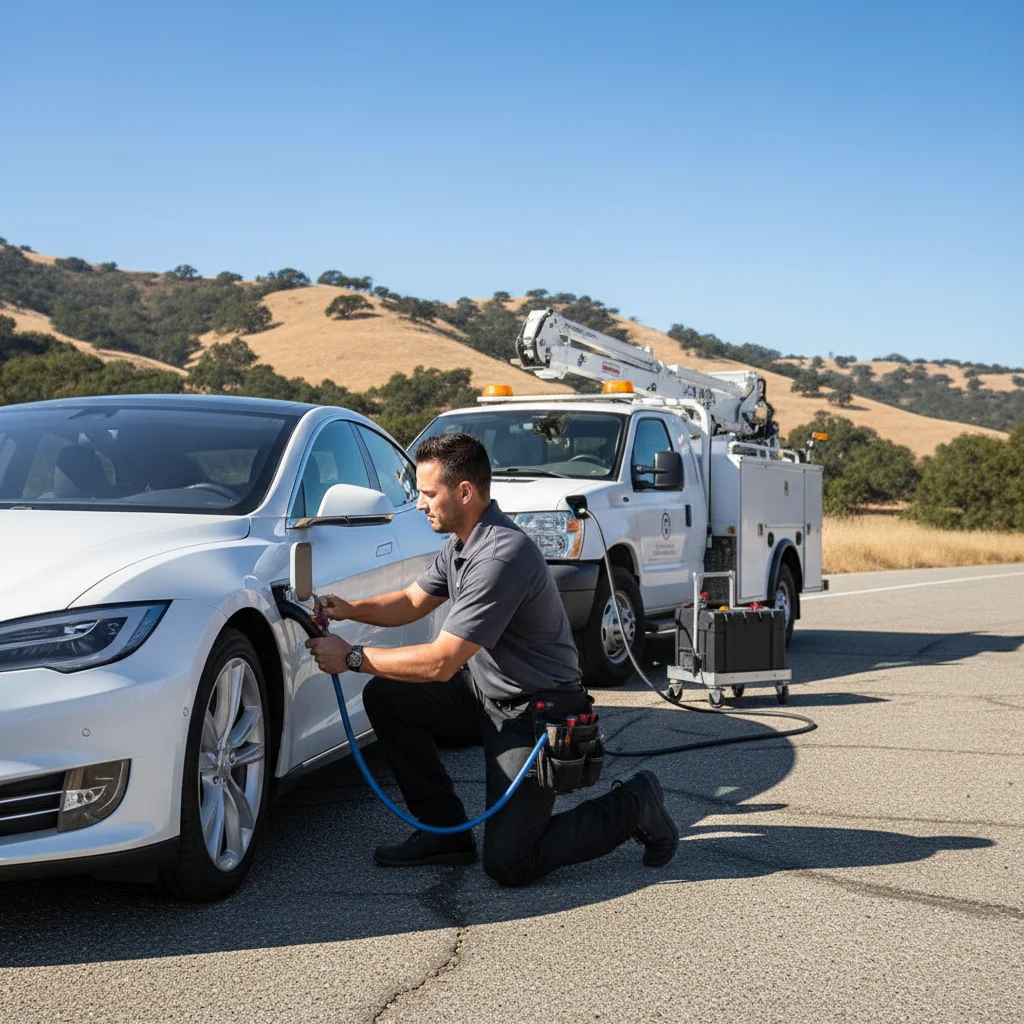
Wine country hours, then Murrieta miles that aren’t yours
You spent the afternoon in Temecula: tasting rooms, a long lunch, slow walking between lots. The range number still looked polite when you pulled out. Then you pointed north, and Murrieta was the next city. It’s where I-15 and I-215 divide. It’s also where Clinton Keith Road climbs west toward the Santa Rosa Plateau Ecological Reserve.
A day-tripper from the rest of the Inland Empire isn’t in the garage yet. They’re on someone else’s grades and someone else’s heat. They’re on streets they don’t drive every week. That’s the Murrieta roadside pattern. The pack didn’t fail at the tasting room. It failed on the way through.
Temecula sits immediately south, and Winchester and French Valley sit east. Wildomar and Lake Elsinore sit west and northwest, and Menifee sits up I-215. If the day was wine, and home is north or west, you thread that knot. EV roadside assistance in Temecula covers the tasting-room side of the same trip. This page is what happens once you’ve already left.
Murrieta is a Riverside County city of 112,064 people in the ACS 2019-2023 count. The 2024 estimate is 112,539. Only 6.2% of housing was built before 1980, among the newest stocks in this market. ZIP codes you’ll hear are 92562 and 92563. This is a new-housing city, so many owners charge at home. The stranding that fits this city is a road problem, or a 12-volt problem.
The I-15 and I-215 split is the local problem
I-15 and I-215 split in Murrieta, and that junction is why this page exists. Northbound you choose your fork. Stay on I-15 and you’re aimed at Lake Elsinore and Corona. Take I-215 and you’re aimed at Menifee and Perris. Those are different trips. They pass different exits and different public charging sites. A low pack plus the wrong fork turns a wine-country return into a shoulder stop.
Confirm live stalls on the U.S. Department of Energy AFDC station locator before you commit to a fork. Don’t guess from memory, because station status changes.
Murrieta Hot Springs Road, Jefferson Avenue, and California Oaks Road feed that split. So do Los Alamos Road and Winchester Road. Historic Downtown Murrieta sits on the older grid near the Murrieta Creek corridor. Useful names include Alta Murrieta, The Colony, Greer Ranch, and Bear Creek. Copper Canyon, California Oaks, and the Clinton Keith corridor help too.
If you’re already on the shoulder, stay put with the hazards on. Don’t crawl on a sliver of range hunting a lot you can’t confirm. The Murrieta EV charging hub is the local planning page if you still have time. If the car is done, you need energy where it sits.
Western grades and long stops on the plateau
Clinton Keith Road west is a real grade. Western neighborhoods climb toward the Santa Rosa Plateau. A little marine air occasionally reaches inland through the Santa Margarita gap. Murrieta runs milder than Perris or Hemet, and it’s still hot. Heat, a climb, and cabin cooling will spend range the estimate treated as flat.
People park at the Santa Rosa Plateau Ecological Reserve and walk. Then they start the car in late-day sun. The return isn’t the inbound drop. The same long-dwell pattern shows up after hours at historic Murrieta Hot Springs. It also shows up after a slow afternoon in Historic Downtown Murrieta. A Pechanga parking stall that won’t wake is the casino-lot version of this, just south of town. Murrieta’s version is the plateau, the springs, and the streets that feed I-15.
Don’t keep rolling west hoping the next pullout solves it. Park safe, then call for a charge at the car. Copper Canyon, Bear Creek, and Greer Ranch sit in that western and hillside mix. California Oaks and Alta Murrieta sit closer to the local arterials. None of those streets is a freeway shoulder, and none of them is your home charger.
Hospital lots after a long shift
Murrieta has a genuine hospital cluster. Loma Linda University Medical Center Murrieta sits in that medical corridor. So does Southwest Healthcare’s Murrieta hospital campus. Twelve-hour shifts mean long-dwell staff parking, and visitors sit even longer. You come back to a pack that spent the day on accessories. Or the 12-volt has been cooking in the lot.
This is the other Murrieta call, and it isn’t wine country. It’s a car that won’t wake in a garage after a shift. Treat a dark dash as a 12-volt first. Treat a live car at zero percent as a depleted pack.
Southern California Edison serves Murrieta. A dark home charger is an SCE outage or a panel issue. That’s a different problem from an empty pack on Clinton Keith. The operator still works at the car either way.
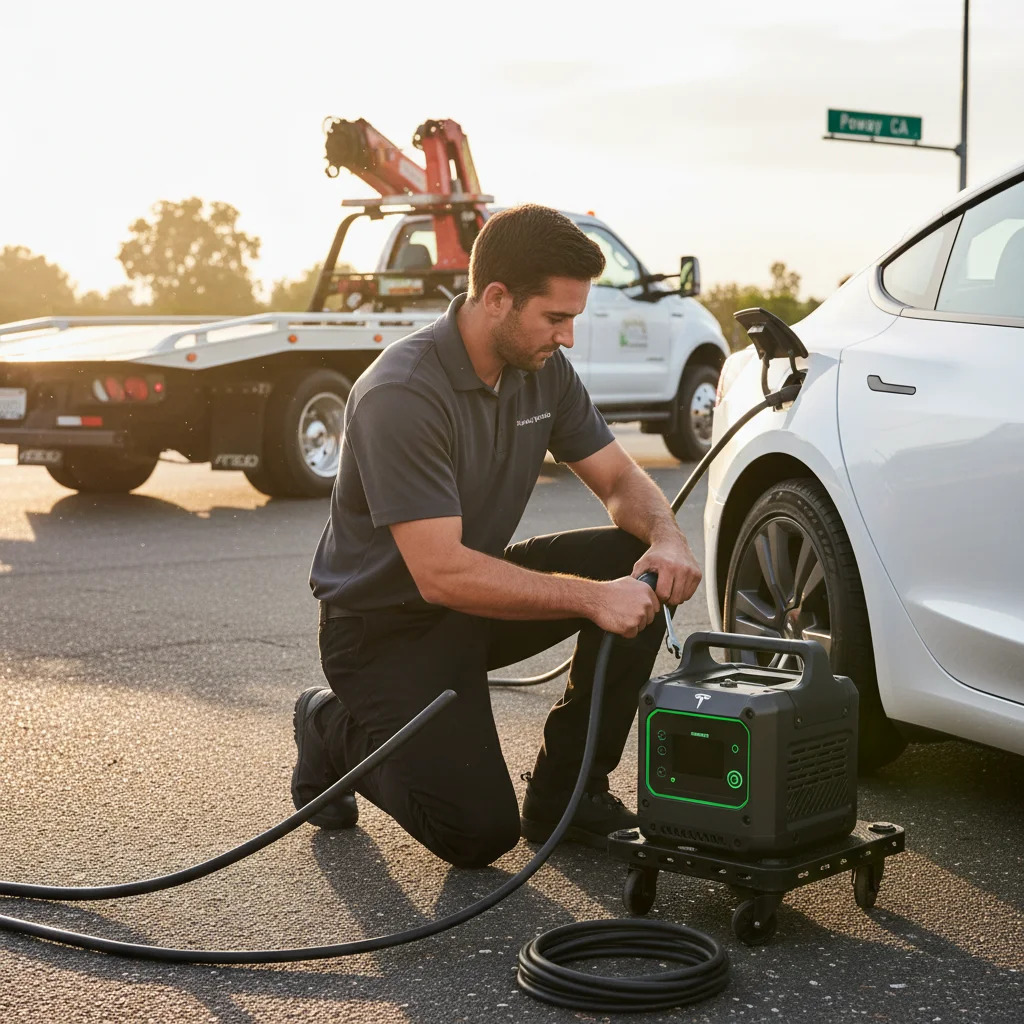
What the operator brings to the car
Charge Pro IE is a referral line. It matches stranded EV drivers with independent local mobile rescue operators. It owns no trucks, employs no technicians, and performs no work. The operator quotes you before starting, then bills you directly.
The pro brings a 240-volt Level 2 source to the car. That’s mobile EV charging at the bumper, not a public stall. Teslas take a native NACS plug. Other EVs use a CCS or J1772 adapter. That typically adds 10 to 20 miles of range in 15 to 30 minutes of charging. That’s charging time, not an arrival window.
Those miles are usually enough to reach a public charger you can confirm on a map. They’re also enough to get home if you’re already close. Operators jump or replace a dead 12-volt battery on site. They handle Tesla and every major EV brand. The pros we connect you with are licensed.
Empty pack or a 12-volt that won’t wake
If the screens are dead and the handles are fussy, start with the 12-volt. Every EV still uses a small 12-volt battery to boot the car. The drive pack can be full, and you’ll still sit there. When the 12-volt dies on the road, the car looks completely finished. A jump on site is the first move. Replacement is next if it dies again.
If the car is on and the number is zero, that’s a depleted pack. You need energy into the charge port. A tow isn’t the first fix. Tesla’s app path for an empty pack is often a tow. Read what the app is actually sending before you tap yes. You can still ask a local operator for a Level 2 charge instead.
Ford, Hyundai, Kia, Rivian, Chevy, and other non-Tesla EVs fail the same two ways. Either the pack is empty, or the 12-volt took the boot sequence down. Tell us which one you’re looking at. The operator’s setup isn’t identical.
A mobile charge versus a tow
A flatbed is right for a tire, a crash, or a fault that won’t clear. An empty pack isn’t that. Mobile charging or a tow is the choice after wine-country miles. Don’t push a pack that’s already at zero. Some makers treat deep depletion as a warranty concern. Park, put the hazards on, and wait for a charge.
If you’re on I-15 or I-215, stay out of the travel lanes. A Murrieta Hot Springs Road curb is easier than a freeway shoulder. So is a hospital garage stall or a downtown lot. Move only if you still have range and a safe pocket. If you don’t, stay where you are.
What to tell us
Four facts help dispatch send the right operator.
- Your exact spot. Murrieta covers 35.40 square miles. Clinton Keith west of the 15 is usable, or a hospital campus name. An I-15 mile marker works too. Historic Downtown, Murrieta Hot Springs Road, Jefferson, California Oaks, Los Alamos, and Winchester Road are names dispatch can work with.
- Make, model, and year, so the pro brings NACS, CCS, or J1772.
- State of charge, even a guess. Zero versus a few percent changes whether you can creep.
- Whether the car will power on. A dark car is the 12-volt path. A live car at empty is a charge.
Don’t keep rolling at zero to get closer to town. Town in Murrieta is already a spread of neighborhoods, creeks, and grades. Closer isn’t always safer. Charge Pro IE serves Murrieta and every city in the Inland Empire.
When the wine-country day is over and the car isn’t moving
If your EV is empty on the Murrieta side of a wine-country day, that’s the call. Same if you’re on the I-15 or I-215 shoulder at the split. Same west on Clinton Keith, or in a hospital lot that won’t wake the car. EV roadside assistance is the referral line. Call (909) 250-2881. An operator quotes you before any work starts.