Your EV just died in Victorville after the northbound Cajon climb. You need EV roadside assistance: a mobile charge or a 12V jump. You don’t need a tow you didn’t ask for. Charge Pro IE is a referral line for the Inland Empire. We connect you with an independent local operator. That operator quotes you before starting, then bills you directly.
The Cajon climb is the whole problem
Victorville sits about 2,878 feet up in San Bernardino County. It’s the largest city in the High Desert. The 2019 to 2023 ACS count put the population at 137,627. A 2024 Census estimate put it at 140,721. I-15 is how most EVs arrive from the valley. Northbound, you pay for the grade in range, not just in minutes.
Drivers describe the same stretch the same way. Estimated range falls far faster than the miles do. You watch the number drop every few seconds while you’re still climbing. Southbound, regeneration on the descent can give some of that back. That doesn’t help you on the way in.
The city covers 73.71 square miles of desert grid and freeway. I-15, US-395, and SR-18 all run through it. In town, SR-18 is Palmdale Road and D Street. Bear Valley Road, Hesperia Road, Mojave Drive, and Air Expressway carry the local trips. The old Route 66 alignment is still here too. The surprise is a pack that already spent itself on the mountain.
Cajon Pass isn’t Cajon Summit
People treat those names as one place, and they aren’t. USGS lists Cajon Pass and Cajon Summit as separate gaps. Ground elevation at the named Pass is about 3,779 feet. Cajon Summit is about 4,261 feet. The I-15 high point is Cajon Summit, north of the pass proper.
You start much lower, at the Devore junction of I-15 and I-215. The road there is around 2,030 feet. Then you climb the rest of the way to Cajon Summit. Then you drop into Victorville at about 2,878 feet. The expensive miles are the ones to the summit.
A widely repeated 4,190-foot figure for the I-15 summit couldn’t be confirmed. Caltrans and USGS didn’t support that number. A published grade percent couldn’t be confirmed either. If you want the elevation, use the USGS names.
You don’t need the exact percent to drive it. You need to treat northbound I-15 into Victorville as a range tax. See Out of charge on I-15 at the Cajon climb toward Victorville.
Heat by day and a real freeze at night
The High Desert isn’t the valley with extra dust. Victorville averages roughly 42 days a year at or above 100 degrees. That’s twice as many as Riverside. Summer air conditioning runs from morning to night. You’re also nearly three thousand feet up. Winter nights here actually freeze, and valley towns don’t see that swing.
That pairing is hard on both batteries in the car. Cold cuts pack range more than heat does. Heat wears the 12V harder than most drivers expect. A car that rolled at noon can refuse to wake at dawn. That happens after a January night in Eagle Ranch or Brentwood. The same 12V can fail in a work lot by the logistics airport.
If the dash is dark or the handles don’t pop, think 12V first. The car can act fully dead with miles still in the pack. Jumping or replacing that small battery on site is part of what operators do.
Town charging doesn’t undo the climb
Victorville has public charging in town. There are two Tesla Supercharger sites, 16 stalls each. Electrify America, ChargePoint, and EVgo have locations here too. The problem is the climb, the heat, and the miles you already burned.
Only 19.6 percent of units were built before 1980 in the 2019 to 2023 ACS. Eagle Ranch and Brentwood came with the desert booms. So did the tracts off Bear Valley Road. Old Town Victorville is the older grid. Spring Valley Lake and Mojave Heights sit on other edges of town. Visitors often treat all of that as one pin. The pack doesn’t treat them that way.
I-15 after the summit
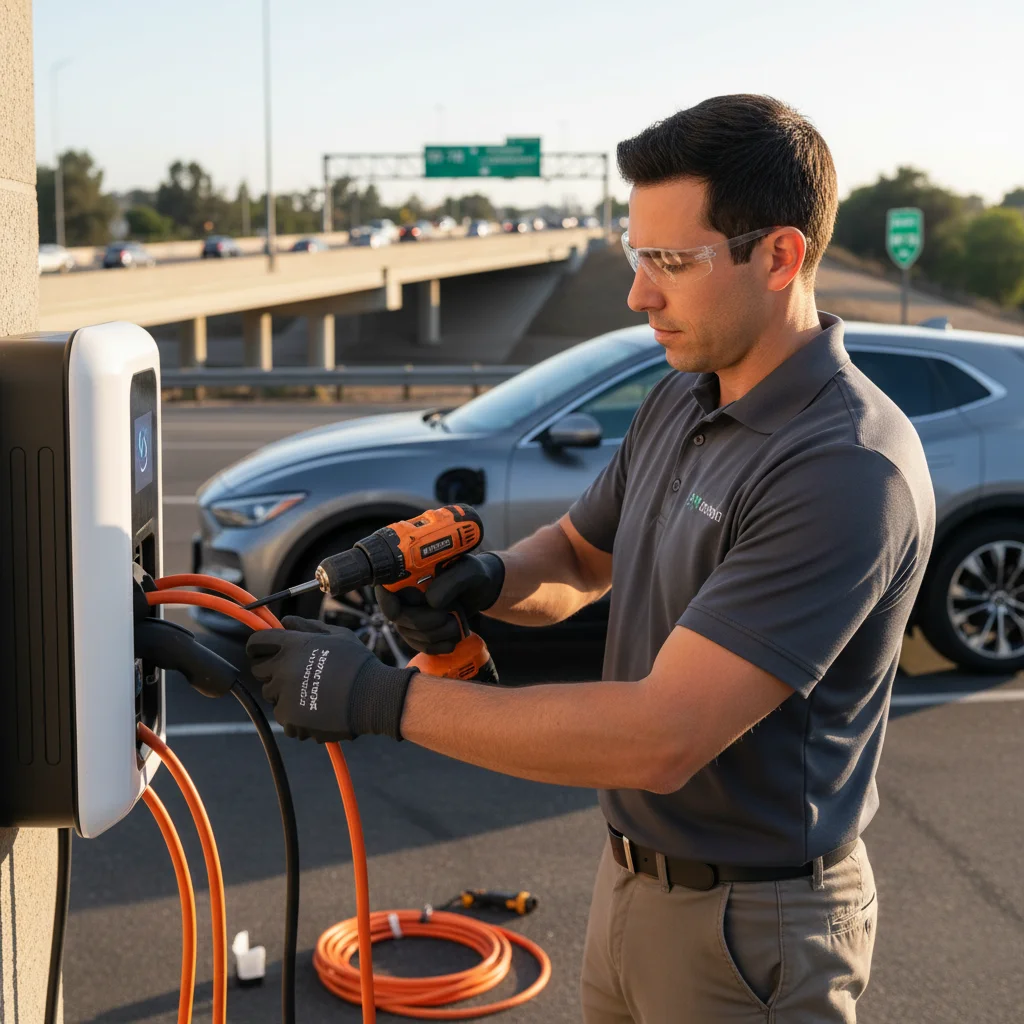
You’ve cleared Cajon Summit and you’re dropping toward the Victor Valley. Range that looked fine at Devore is gone. You’re on a freeway shoulder, so put the hazards on and stay put. Call from a real mile marker, not a vague note about the 15.
US-395, Air Expressway, and the airport
The Southern California Logistics Airport sits on the former George Air Force Base. Air Expressway is the road into that district. Warehouse vans make this fleet EV territory. Shift-change cars run out on those last miles too. Victorville Municipal Utility Services serves the airport and Foxborough Industrial Park only. It doesn’t serve homes, because residential Victorville is Southern California Edison. If someone says the city utility covers your street, check that. That’s the industrial park, not your house.
SR-18, Bear Valley Road, and in-town miles
Palmdale Road, D Street, and Bear Valley Road stack up errand miles. Hesperia Road adds more of those miles. The Mall of Victor Valley and Victor Valley College are real stops. So are the California Route 66 Museum and Mojave Narrows Regional Park. Stop-and-go miles after a pass crossing add up. Spring Valley Lake and Old Town sit off the freeway pattern.
Hesperia is next: EV roadside assistance in Hesperia after you clear Cajon. Adelanto sits northwest on long High Desert roads. Oak Hills and Phelan sit on two-lane roads west of town. Apple Valley is the neighbor to the east. For the roads past town, read Out of charge on empty High Desert miles near Adelanto.
Staging for Las Vegas on I-15 north
I-15 north of Victorville is the road to Barstow, Baker, and Las Vegas. Drivers stage here, or in Barstow, before that run. Get the pack honest before you leave town. Victorville still has city streets, public plugs, and operators you can reach. Treat it as the pause, not the gamble.
You can still strand inside town on the way to that pause. That can be a lot at the mall or a warehouse row at the airport. It can also be a driveway in Brentwood. The climb already took its cut.
What the operator brings, and what we don’t
Charge Pro IE doesn’t own trucks or employ technicians. We don’t set prices, and we don’t promise an arrival time. We match you with an independent mobile rescue operator. Read What a mobile EV charging visit actually is, and isn’t.
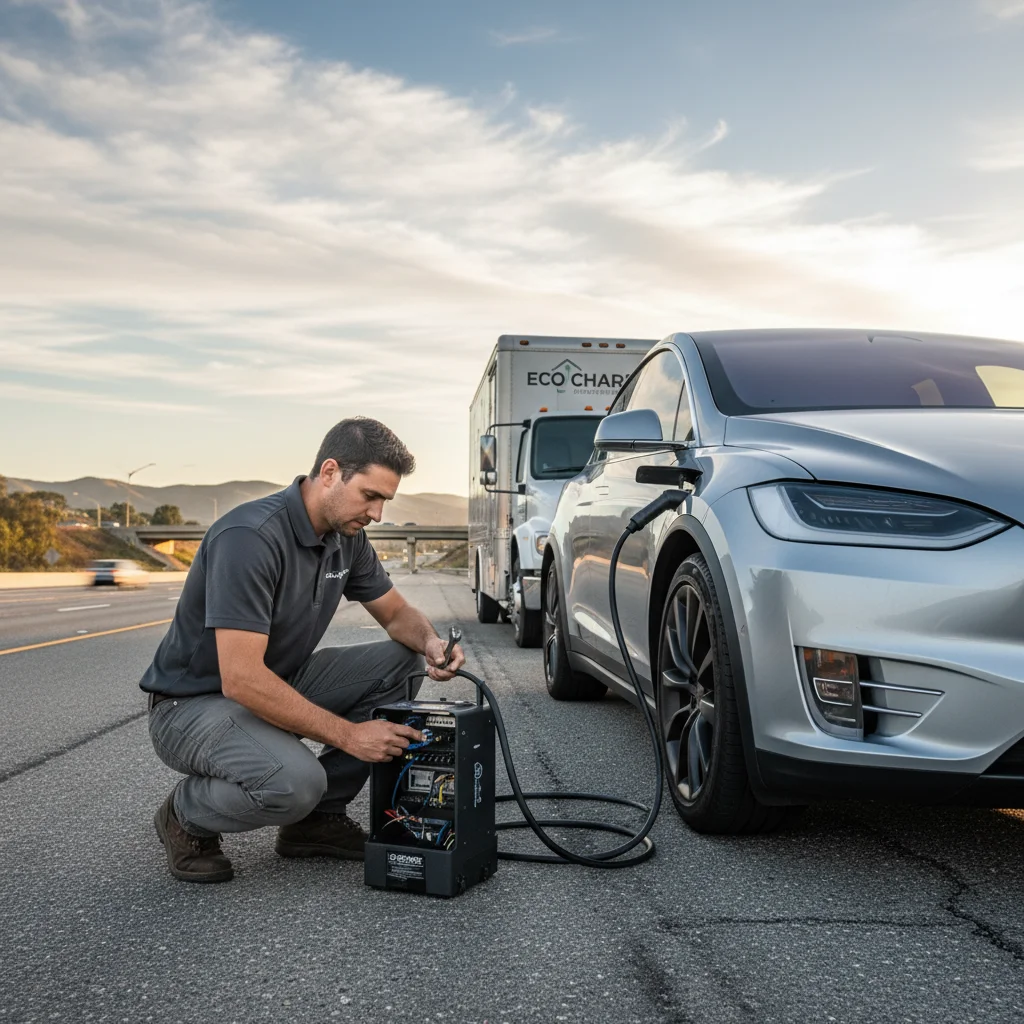
The operator brings a 240-volt Level 2 source to the car. Teslas take a native NACS plug. Other EVs use a CCS or J1772 adapter. That visit typically adds 10 to 20 miles of range. That’s in 15 to 30 minutes of charging. Those minutes are charging time only. They’re not a clock on when someone shows up.
Operators also jump or replace a dead 12V on site. They handle Tesla and every major EV brand. They quote before they start, then bill you directly. We never send that invoice.
Give a pin, a mile marker, or a named road. Air Expressway near the logistics airport is a location. A space at the Mall of Victor Valley is a location. A driveway in Old Town is a location. A pin that only says the desert isn’t one.
Charge it, jump the 12V, or tow it
If the traction pack is empty and the car is otherwise fine, you want energy. Mobile EV charging or a tow: which gets you moving is the usual choice. A tow still leaves you needing a charge at the other end. EVs also prefer a flatbed when they must be towed. A wheeled pull can hurt a drive unit that isn’t spinning on its own.
Tow when something else is wrong with the car. That means a flat tire or a charge port that won’t release. It also means a drivetrain fault on the dash. A 12V that dies again after a jump belongs here too. An empty pack on I-15 after Cajon isn’t that list.
Stay out of live lanes and use your hazards. Wait with the car unless you’re in immediate danger. The operator sets up behind you once there’s room to work.
Call before the number hits zero
You don’t have to wait for a dead car. If the estimate is collapsing on the climb, call while you can still roll. Don’t wait if you don’t trust the remaining miles into town. Creeping to a wider shoulder or an exit is your judgment on the ground. We don’t tell you that you’ll make it.
Same if you sat at Spring Valley Lake and then ran US-395. Call if the pack isn’t matching the miles you have left. Same if a van at the logistics airport won’t wake after a hot shift.
Charge Pro IE refers Victorville calls across the Inland Empire network. The Victorville city page is the local hub. When you need an operator, call (909) 250-2881. The person who plugs in is the independent operator. They’ll quote the job before any charge starts.