A thin pack at Lake Arrowhead is a downhill problem. You’re already about 5,100 feet up on Southern California Edison mountain roads. Every way back to the valley is a steep two-lane highway. Charge Pro IE matches stranded Tesla and other EV drivers with independent local operators. Those operators bring a 240-volt Level 2 source to the car. They can jump or replace a dead 12-volt battery on site. They quote you before they start, and they bill you directly.
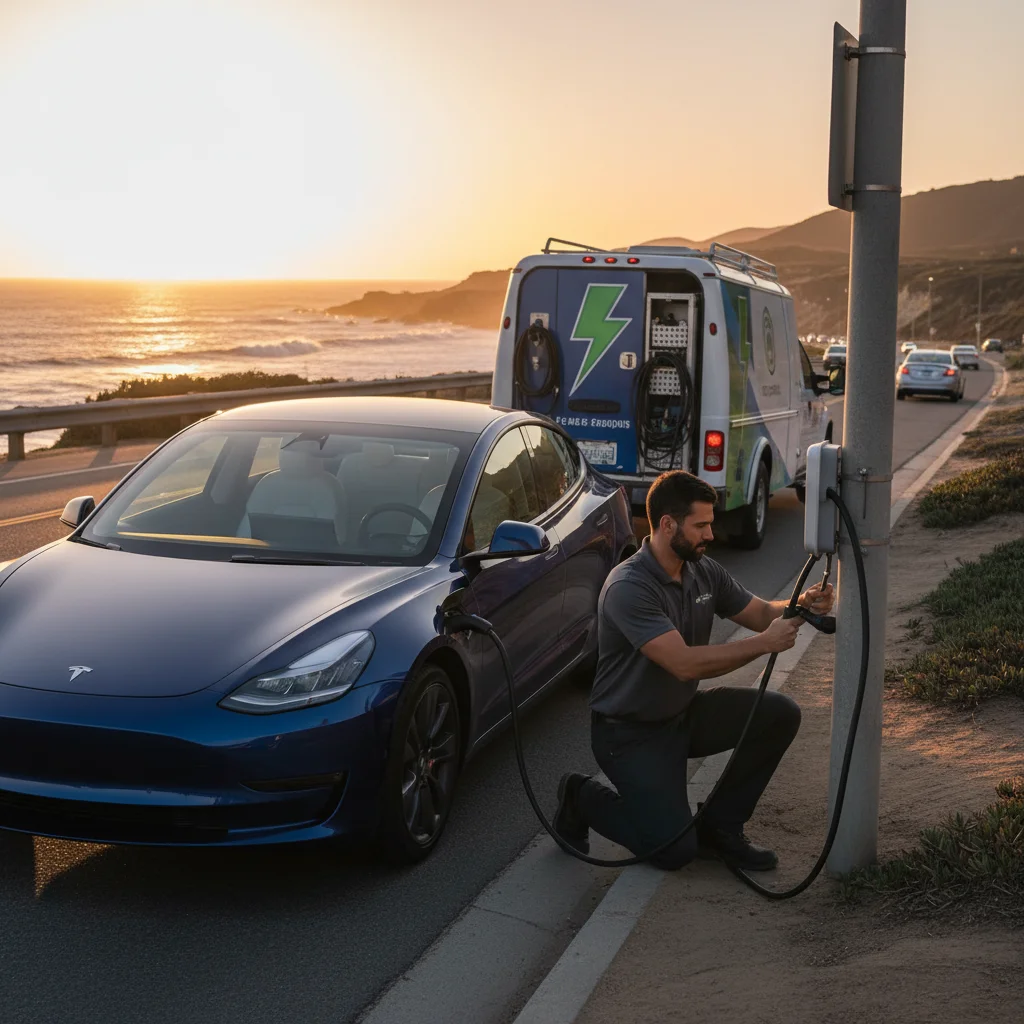
The climb already spent the pack
Lake Arrowhead is an unincorporated census-designated place in San Bernardino County. There’s no city of Lake Arrowhead to call. About 10,639 people live here, per ACS 2019-2023. They’re spread across 17.68 square miles, not one downtown grid. The lake, the Village, and the Rim of the World Highway sit in that spread. Blue Jay, Cedar Glen, Skyforest, and Twin Peaks sit there too. So do Rimforest, Deer Lodge Park, Agua Fria, and the north shore.
You don’t arrive on flat valley pavement up here. You take a mountain highway in instead.
SR-18 comes up from San Bernardino as the Rim of the World Highway. SR-189 is the connector over from Crestline. SR-330 comes up from Highland through Running Springs, then west toward the lake. SR-330 is the steepest and fastest of those three. It climbs from about 1,300 feet to over 5,000 feet. That climb covers roughly fifteen miles, and it’s the road most valley drivers take.
Weekend visitors often budget the view, not the grade. Second-home owners do the same after a Friday drive. You leave Highland with a comfortable percent showing. Then the two-lane climb spends that buffer. You park at Lake Arrowhead Village with less buffer than you planned. SkyPark at Santa’s Village is the same pattern after that grade.
Hook Creek Road and Kuffel Canyon Road still climb after you leave the highway. Daley Canyon Road keeps that same pattern going. Lake Gregory Drive does too if you came across from Crestline. None of that is simple freeway range math. It’s mountain-highway math on SCE lines here.
If you want the local map first, open the Lake Arrowhead charging page. Read EV roadside assistance in Running Springs for an approach stall.
Callers name Blue Jay, not the lake
This place overlaps six ZIP codes, not one town boundary. Those ZIPs are 92317, 92321, 92352, 92378, 92385, and 92391. A stranded driver is more likely to say Blue Jay. Cedar Glen, Twin Peaks, Skyforest, and Rimforest come up the same way. Tell the operator the named community, not just Lake Arrowhead.
The Village and the lakefront lots are long-dwell parking. You walk the shops, ride the Arrowhead Queen, and eat. The car sits in the cold while you’re gone. That soak hits the 12-volt in the driveway. It’s a different failure from an empty traction pack. From the curb they look the same, and nothing wakes.
Crestline sits next door on the same SCE mountain system. Running Springs sits on the SR-330 approach from Highland. Those two aren’t interchangeable streets when you call. Pin that named community before you call.
Why a low pack is a downhill problem
People treat those downhill miles as free range. Regen can help on a grade once the car is moving. The pack still has to accept that charge. A pack that’s already very low isn’t a free ride down SR-18. You still have to keep the car awake. You still have to run lights, heat, and the drive unit. You still have to honor chain controls if winter has the road.
The commitment on this mountain is the trap. You spent the energy on the way up. You’re now on a steep two-lane mountain highway. Climbing back toward Running Springs isn’t a plan. Waiting for a public stall you haven’t confirmed isn’t a timed plan. A mobile EV charging visit is a Level 2 hookup at the bumper. Operators typically add 10 to 20 miles of range. That takes 15 to 30 minutes of charging. That’s charging time, and never an arrival time.
That buffer is often enough for the drop toward Highland. San Bernardino is the other common bottom of the climb. It’s not a full charge, and it’s not a Supercharger session. It’s enough to stop treating the descent as a gamble.
Read out of charge after Lake Arrowhead for the day-trip version of this grade. This page is the stall at the lake itself.
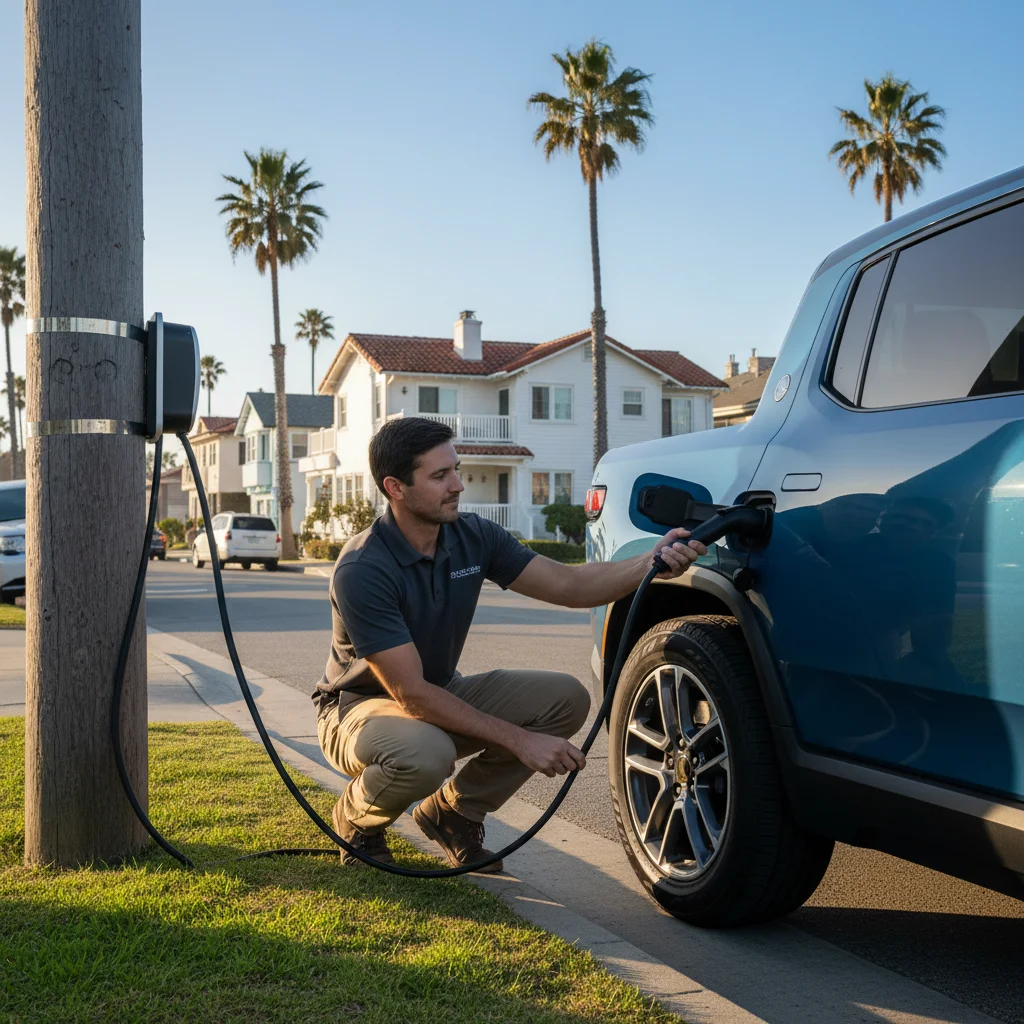
Empty cabins, cold nights, and the 12-volt
The traction pack isn’t the only way an EV dies up here. Cabins sit empty in the cold all winter. That’s the 12-volt pattern on this mountain.
Lake Arrowhead sits roughly a mile above the valley. There’s real snow and real cold on these roads. Every access road can take chain controls in winter. It’s slightly lower and slightly milder than Big Bear. That gap isn’t large enough to change the driving math. A car that sat for a week in a dark driveway can look fully dead. It can still have miles left in the pack.
Tesla still uses a 12-volt system to wake the car. So does every major EV brand the operators handle. If the 12-volt is down, the screens stay dark. The charge port may not open at all. The car won’t roll off that driveway. A pack charge won’t fix that by itself.
Independent operators can jump or replace that 12-volt on site. Tesla owners can start with Tesla roadside rescue when the in-app path fails. Non-Tesla drivers with CCS or J1772 still get that 12-volt work on site. Read when an EV 12V battery dies on the road for those steps.
More than half the housing here was built before 1980. ACS 2019-2023 puts that share at 57.9 percent. It tells you this is cabin country, not a new tract. It doesn’t diagnose your car on its own. Confirm the 12-volt first, then decide if the pack is actually empty.
Chain controls are an honest limit
Winter on SR-18, SR-330, and SR-189 isn’t a footnote. Chain controls can slow or stop every access road. An operator still has to reach you on those roads. Charge Pro IE doesn’t own trucks or set an arrival clock. The independent operator quotes you before any work starts. If chains are up, say so on the call. Don’t hide the weather when you describe the road.
A Level 2 visit on a clear Saturday in Blue Jay is one job. A stall on SR-173 in a storm is another. The operator needs the road name and the community name. They need to know whether you can stay with the car.
Don’t promise yourself a downhill escape through a control you haven’t checked. We couldn’t confirm a standing published window for when those controls lift. Check posted controls on SR-18, SR-330, and SR-189 first. Don’t commit to the descent until you have.
Cabin power is SCE here, not Bear Valley Electric Service. Bear Valley’s published service area names Big Bear Lake and Big Bear City. It doesn’t list Lake Arrowhead or Crestline on that page. If the cabin panel is dark, the wall charger won’t save you. Confirm current outage status with SCE for your ZIP. Don’t assume the house circuit is live because the lake still has lights.
What a mobile visit actually does
Charge Pro IE is a referral line for stranded drivers. It matches you with independent local mobile rescue operators. It doesn’t perform the work on your car. It owns no trucks and employs no technicians. The operator quotes before starting and bills you directly.
What those operators do on site is specific. They bring a 240-volt Level 2 source to the car. Tesla gets a native NACS plug on that visit. Non-Tesla EVs get CCS or J1772 through an adapter. Typical output is 10 to 20 miles of range. That takes 15 to 30 minutes of charging. They also jump or replace a dead 12-volt on site. They handle Tesla and every major EV brand.
That’s EV roadside assistance for an out-of-charge or 12-volt stall. It’s not an EV repair shop on wheels. If the car has a mechanical failure beyond power, a tow may be next. The operator can tell you that after they look at the car. Don’t assume a tow is the first move on a Village side street. A mobile charge leaves you driving down under your own power.
Charge Pro IE doesn’t publish a price for the visit. The operator sets the quote you hear. You decide after you hear that quote.
Tesla and every other EV on these roads
Tesla owners often try the in-app roadside path first. That’s Tesla’s process, and it isn’t ours. If that path stalls, a local operator is the backup. Native NACS on the operator’s Level 2 unit is the usual Tesla hookup.
Rivian, Ford, Hyundai, Kia, Chevy, and BMW still show up in Village lots. They show up in cabin driveways on the north shore too. They need CCS or J1772 for a pack charge. The operators we connect you with carry those adapters. Don’t wait on a brand app for a mountain plan it doesn’t have.
A dead pack and a dead 12-volt feel identical from the sidewalk. Say which screens still light on the dash. Say whether the charge port will open. Say whether you just finished the SR-330 climb. That’s the difference between a jump and a Level 2 session.
The pros we connect you with are licensed. Charge Pro IE isn’t the crew on the bumper.
How to call it in
Stay with the car if you can do that safely. Pin the named community when you call. Blue Jay isn’t Cedar Glen on these roads. The Village isn’t the north shore either. Give the highway if you’re on SR-18 or SR-189. Name SR-173 or SR-330 if that’s where you sit.
If the car is dark, try the 12-volt basics your owner’s manual already lists. Don’t keep cycling the start button on a dark dash. Don’t treat the traction pack like a gas-car jump point. The 12-volt is a small battery with its own posts.
If the car still drives but the percent is gone, stop adding errands. Don’t loop the Village looking for a stall you haven’t confirmed is open. A confirmed plug is the only plug that counts. An assumed one is how people strand on the Rim.
Then call Charge Pro IE at (909) 250-2881. We connect you with a local operator who quotes before starting. There’s no arrival clock on that call. You decide after you hear the operator’s quote.