Your Hyundai Ioniq 6 sits dark in an Ontario airport stall. The start button does nothing, and the key fob is silent too. That’s usually a dead 12-volt battery, not an empty traction pack. The drive battery can still hold miles while the whole car stays black.
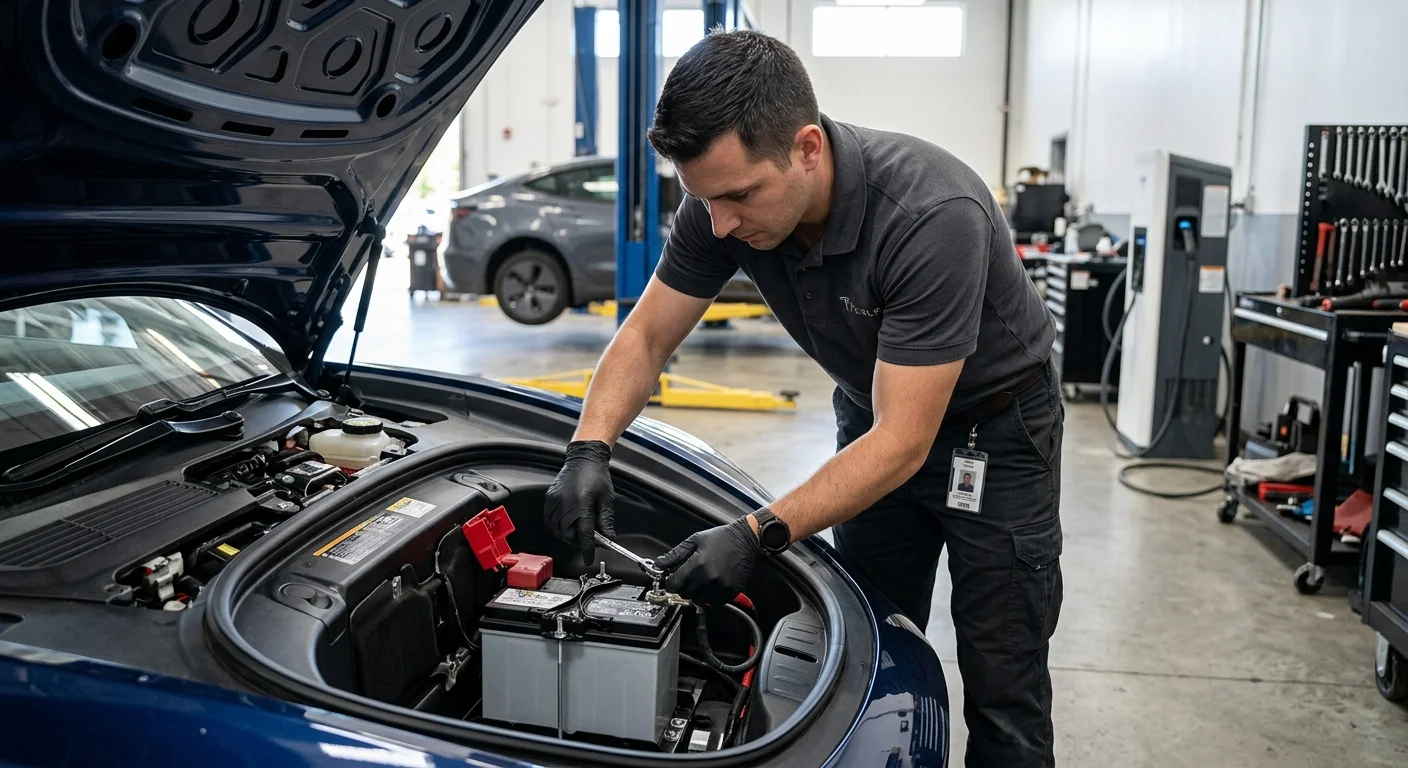
This sedan shares Hyundai’s E-GMP platform with the Ioniq 5. Both cars need a small 12-volt battery to wake the computers. Without that battery, the high-voltage system never comes online. Locks, windows, lights, and the start button all go quiet. A healthy traction pack doesn’t override that.
The Ioniq 6 is a sedan, not a crossover. The 12-volt isn’t where Ioniq 5 owners reach first. Inland heat, long sits, and a low pack push that small battery over. Work through the checks below before you call anyone.
A dark Ioniq 6 is usually the small battery
An E-GMP Hyundai runs two batteries at once. The large traction battery turns the wheels. The 12-volt auxiliary battery boots everything else. It powers the modules that talk across the car. If that small battery is flat, the traction pack is locked out. The sedan can’t start.
There’s a second trap on this platform. When traction charge falls very low, the system can stop topping off the 12-volt. Park a few days after that and the auxiliary battery can drain out. You may still have miles on the main pack. The car can still refuse to wake.
Inland heat makes a weak 12-volt fail sooner. A Fontana warehouse stall soaks an AGM battery all afternoon. A San Bernardino curb does the same. Overnight cooling in the valley doesn’t always bring it back. High Desert parking in Victorville or Hesperia works that battery even harder. Nights in Big Bear Lake or Lake Arrowhead run cooler. The car may still have baked on the climb up I-15 or through Highland.
Open driveways are common on newer streets in Eastvale and French Valley. Street parking is common in older parts of Riverside and Redlands. Neither layout causes a failure by itself. Both leave the 12-volt in the sun for hours. After a hot week, a tired auxiliary battery can quit overnight.
For heat and grades here, see How to care for an EV battery in Inland Empire heat.
When the 12-volt dies, why the EV looks completely dead explains the cascade on any brand.
How to tell 12-volt failure from an empty pack
Don’t call for a charge until you know which battery failed.
A fully dark dash and a dead fob point to the 12-volt. The dash still shows range, but the plug won’t start a charge. That’s a charging problem, not a 12-volt failure. It drove, then rolled to a stop with a low-battery warning. That may be an empty traction pack. Those three cases need different help.
An empty pack needs energy at the charge port. A dead 12-volt needs a jump at the hood. Then it needs time on a charger once it wakes. Mix those up and you’ll wait at a stall. The car still won’t unlock.
Look at the car, not the mile marker. A silent Ioniq 6 on I-10 in Redlands is the same electrical problem. So is a silent one in a Menifee driveway. The freeway just makes the wait harder. Don’t assume you ran out of range on Cajon or the 91.
The Ioniq 6 keeps the 12-volt in the trunk
Ioniq 5 owners look under the hood first. That’s the wrong map on the 6. On the crossover, the 12-volt lives up front. On the Ioniq 6 sedan it sits in the trunk. Look on the driver’s side, under the cargo floor trim. Open the trunk and pull the liner on the left. That AGM battery, absorbed glass mat, is the real 12-volt.
Don’t jump from those trunk posts. Use the hood jump points instead.
The hood still opens on this sedan. There’s no frunk storage like the Ioniq 5. The interior release still pops the panel. Find the black fuse box cover on the driver’s side of the bay. The positive jump terminal sits under a red cap. Ground is a bare chassis bolt in the engine bay. It’s not the negative post in the trunk.
| What you need | Where it is |
|---|---|
| 12-volt AGM battery | Trunk, driver’s side, under the cargo trim |
| Positive jump terminal | Hood, driver’s side fuse box, red cap |
| Negative ground | Unpainted chassis bolt in the engine bay |
| Auxiliary battery save | Instrument cluster, while the car is still awake |
Clamp the negative lead to clean metal on the chassis. A strut-tower bolt or a firewall bolt is the usual pick. Leave the trunk negative terminal alone.
Auxiliary battery save only helps before the stall
The Ioniq 6 has an auxiliary battery save mode. The Ioniq 5 doesn’t present it the same way. You turn it on from the cluster while the car still wakes. It limits accessory draw so a long sit doesn’t flatten the 12-volt.
It won’t revive a battery that’s already dead. Use it before you wait. A long stay in an Ontario airport lot is one case. A full day parked at Pechanga is another. So is sitting through a Glen Helen show. Menu paths shift with trim and software. On most cars it’s Settings, then Vehicle, then Auxiliary Battery.
If the cluster won’t light, you’re already past prevention. Using the cabin as a waiting room is a 12-volt drain. Phones on the pad, climate on, cluster lit. The traction pack can still look fine, and the small battery takes the hit.
Jump the hood, then get it on a charger
Use a jump pack or a second car with cables. Use the hood points only.
- Pull the interior hood release and open the hood.
- Find the black fuse box cover on the driver’s side of the bay.
- Flip the red cap off the positive terminal.
- Clamp the red lead to that terminal.
- Find a bare, unpainted chassis bolt for ground.
- Clamp the black lead to that bolt.
- If a second car is helping, hook it up and start that car.
- Give the Ioniq 6 a couple of minutes to take a charge.
- Press start, and the wake sequence can run a few seconds longer than usual.
If it starts, get it on a charger before you shut down again. One jump doesn’t rebuild a tired AGM. If it dies again within the hour, the 12-volt needs replacement, not another jump.
Don’t connect the negative clamp to the trunk battery. Don’t rest a clamp on painted metal and hope. Don’t mash start over and over if nothing wakes. Give it a couple of minutes, try once more, then call for help.
How to jump start an electric car without frying the 12V covers the clamps and the mistakes.
The Ioniq 5 uses a different battery map. Hyundai Ioniq 5 won’t start: what to check before you call puts that 12-volt up front.
Inland Empire places this stall actually happens
The battery failure is the same, but the setting isn’t.
Long airport parking is a regular trigger for this stall. Drivers leave an Ioniq 6 in an Ontario airport lot for days. If the pack was already low at drop-off, the 12-volt may not top off. You come back to a brick.
Warehouse rows in Fontana and Bloomington do it on a work clock. A car that sat through a hot shift can be dead at pickup. The commute didn’t empty the pack. The 12-volt quit in the sun. Chino and Rancho Cucamonga work lots see the same pattern after a long day. So do Rialto and Colton yards along the I-10 belt.
Freeway shoulders are the other pattern. Think I-10 through Colton and Redlands, or I-215 through Moreno Valley and Perris. Think I-15 over Cajon toward Victorville, or SR-60 in Jurupa Valley. SR-91 through Corona is the same 12-volt test. If the dash went black at a stop, treat it as 12-volt first. If it still showed a dying range number, you may need a port charge.
Day trips add a sit-then-start failure. Temecula and Murrieta lots after a long lunch. A Lake Arrowhead afternoon or a Cabazon destination stall can do it. You parked with a live fob and return to silence. Heat and time are the usual story.
The climb toward Yucaipa, Beaumont, and Banning heats the cabin and the battery bay. Sun and sitting time hit harder toward Adelanto, Apple Valley, and Phelan. Coming back from Big Bear City or Crestline, a parked car can refuse to start. That’s still the 12-volt talking, not the grade by itself.
Hemet, San Jacinto, and Winchester add long, hot sits in town. Norco and Eastvale add overnight driveway parking with little shade. Upland and Montclair add older blocks where the car lives at the curb. None of those towns changes the electrical facts. They change how long the 12-volt cooks before you notice.
The name on the power pole doesn’t wake this battery. Riverside Public Utilities serves the city of Riverside. It won’t jump your trunk AGM. Colton Electric Utility owns the wires inside Colton, with the same limit. Moreno Valley is split between Southern California Edison and Moreno Valley Utility. Neither one is the 12-volt in the car. Banning runs City of Banning Electric Utility. Big Bear Lake and Big Bear City sit on Bear Valley Electric Service. A dark Ioniq 6 still needs a jump, then a charger. The name on the bill doesn’t change that.
SCE covers a large share of this market. That includes Fontana, Upland, Corona, Menifee, Hemet, and Temecula. That still doesn’t change the roadside sequence. A dark sedan is a 12-volt job first. A live car with no miles left is a charge-port job.
Charge Pro IE is a referral line. It matches stranded EV drivers with independent local operators. It doesn’t own trucks, and it doesn’t set prices. The operator quotes you before they start and bills you directly. The pros we connect you with can jump a dead 12-volt on site. They can replace it there too. They can also bring a 240-volt Level 2 source to the car. Native NACS plug, plus CCS or J1772 adapters for a Hyundai. That roadside charge typically adds 10 to 20 miles of range. That’s in 15 to 30 minutes of charging. That number is charging time, not an arrival time.
For a non-Tesla EV, start with non-Tesla EV rescue. Operators in the network handle Hyundai and the other major brands.
If this stall keeps repeating, see EV 12V battery replacement: signs it’s going, and next steps.
Frequently asked questions
What should you try first when an Ioniq 6 won’t start?
Treat a black dash as a 12-volt failure first. Confirm the fob and handles are dead too. Then jump from the hood terminals, not the trunk battery. If it showed range and then stopped, you may need a port charge.
Where are the jump points on a Hyundai Ioniq 6?
The real 12-volt battery is in the trunk on the driver’s side. The jump points are under the hood. Positive is the red-capped post in the driver’s side fuse box. Negative is a bare chassis bolt in the bay. Don’t clamp to the trunk negative.
Can the Ioniq 6 stay dead with miles still on the pack?
Yes. The 12-volt battery wakes the computer that brings the high-voltage system up. If that small battery is dead, the traction pack can’t help. The car won’t boot, even with miles left.
If the Ioniq 6 is still dark after those checks, call Charge Pro IE. The number is (909) 250-2881. An operator quotes the job before they start and bills you directly.