When a Jaguar I-Pace won’t start in the Inland Empire, the 12V is the usual cause. The traction pack is usually still holding miles. The dash stays black and the cabin stays silent. The flush handles stay tucked when you walk up. The fob does nothing, even in your hand. The small battery never woke the computers that unlock the high-voltage system.
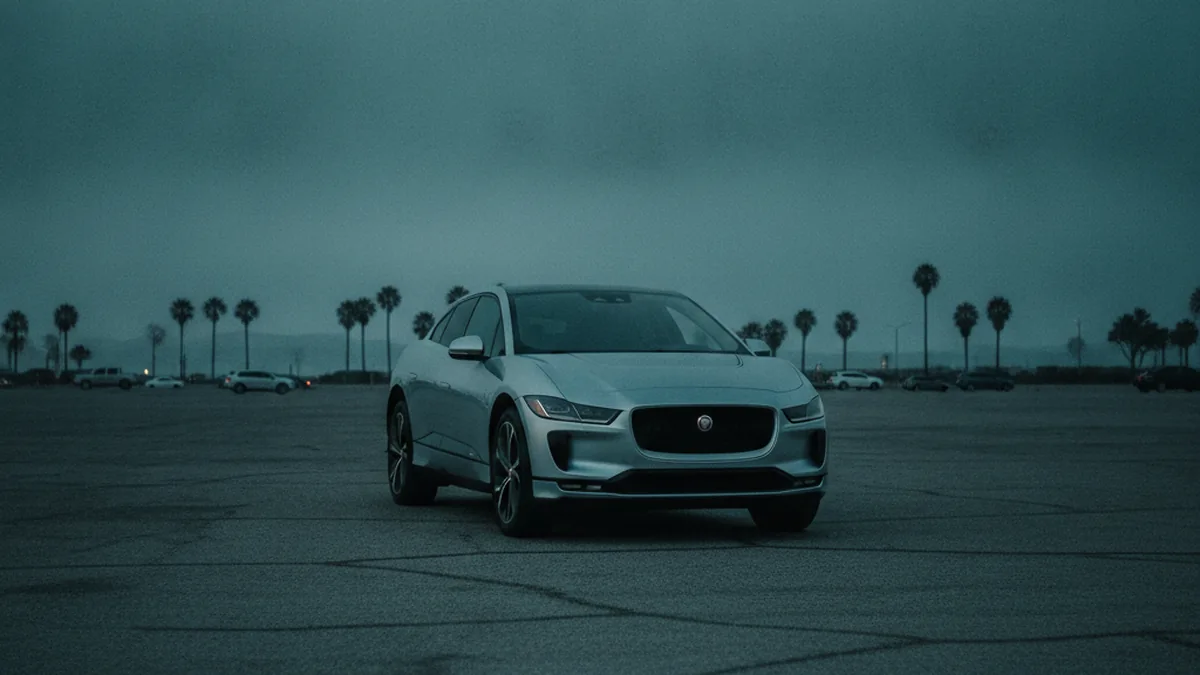
You’ll see that stall in more than one inland setting. A warehouse row in Fontana after a long shift. A parking row by Ontario airport after a trip. A Riverside driveway after the SUV sat through a hot afternoon. The I-Pace doesn’t care which city you parked in. Once the 12V drops, the car looks fully dead.
Early I-Pace years fail this way more often. 2018 through 2020 models are the ones that go dark first. Jaguar changed the 12V layout for the 2021 model year. If yours is from those early years, watch a slow wake. Treat it as a warning if the 12V has never been swapped.
The pack can be full and the car still dark
The I-Pace uses two electrical systems at once. The high-voltage pack is what moves the wheels. A conventional 12V battery runs the low-voltage electronics. Those electronics include the computers that unlock the traction system. Kill the 12V and the pack stays locked out. Range on the last screen you remember doesn’t help.
That’s why a dark I-Pace is usually a small-battery job. Owners see a dark cabin and assume the big battery died. It almost never did in this fault. The 12V simply can’t boot the car.
Watch for this clean 12V pattern:
- Flush door handles stay retracted when you walk up
- The key fob won’t unlock anything
- Dash, touchscreens, and interior lights stay off
- No welcome chime and no lock clunk
If the dash lights, throws a warning, then dies, stop guessing. That points to a different electrical fault. It needs a dealer scan, not another jump. For a dark, silent car, start with the 12V. The same split shows up across every EV brand. When an EV 12V battery dies on the road explains why the car looks completely gone.
Why inland parking is hard on an early I-Pace
The Inland Empire isn’t one climate. Valley lots in Ontario, Fontana, and San Bernardino bake through long afternoons. High Desert nights in Victorville, Hesperia, and Adelanto cool fast after the heat. Mountain trips toward Big Bear Lake and Lake Arrowhead add long grades. None of that empties the traction pack by itself. All of it is extra work for a weak 12V that already sits low.
Lead-acid cells sulfate when they sit partly discharged in heat. That capacity loss doesn’t come back later. The I-Pace is one of the older luxury EVs still in daily inland use. Pre-2021 cars used two 12V batteries under the frunk panel, not one. A weak cell can drag the whole low-voltage system down. A jump has to reach the right post.
Jaguar revised that 12V setup for 2021. Pre-MY21 cars are still the ones that fail most often. Confirm your model year before you pull a panel.
Older housing is common in parts of this market. ACS 2019-2023 figures put pre-1980 housing at 60.9% in San Bernardino. The city of Riverside sits at 56.4% on the same vintage. Eastvale sits at 2.2% on that same measure. A dark I-Pace in an older carport looks like one in a new garage. The 12V doesn’t care about the vintage of the house.
Riverside Public Utilities serves the city of Riverside. Southern California Edison covers Fontana, Ontario, and most of the valley. Colton runs its own electric utility inside city limits. None of that changes a dead 12V in the frunk. If you thought the wall charger failed overnight, check the 12V first.
Unlock the cabin before you touch the frunk
A dead 12V leaves the flush handles tucked. You can’t grab a door the usual way. The way in is the mechanical key inside the fob. Slide the small release on the fob. Pull the metal blade out of the fob body.
The driver’s door hides a lock cylinder behind that handle. Push the front of the handle inward, near the small button. The back edge should then pivot out. Pull the handle out as far as it travels. That move exposes the lock cylinder behind it. Insert the blade and turn it clockwise. The door unlocks with no power in the car.
Don’t pry on a flush handle to force it. You’ll spend more on a door skin than on a jump. Once you’re in the cabin, you can reach the manual frunk release. Other EVs with powered handles trap owners the same way. The Tesla version of that lockout is in locked out of a dead Tesla.
Open the frunk with the footwell cable
The I-Pace 12V sits in the frunk, under a removable center panel. A dead 12V is also what keeps that frunk latched. You can’t pop it from the outside.
After the cabin is open, look in the right-side footwell. There’s a black plug covering the cable. Behind that plug is the manual frunk release. Give that cable a firm, steady pull. The frunk should pop so you can reach the batteries.
Lift the center panel straight up and set it aside. On pre-2021 cars you’ll see two batteries. The positive posts wear red caps on top. Cars from MY21 and newer were revised. Match what you see to your own manual. Don’t guess at which post to clip.
Jump the 12V the safe way
Work in this order, and keep sparks off the battery:
- Clip the red lead to the exposed positive post under the red cap
- Clip the black lead to bare, unpainted chassis metal, not the battery negative
- Let the donor source feed the system for two to three minutes
- Then try to power the car and bring it to READY
Grounding to the body keeps any spark away from the cell. Always confirm the post and panel against your model-year manual. The pre-MY21 and MY21 layouts differ. For the same method on any EV, read how to jump start an electric car without frying the 12V.
A clean jump that brings READY is a 12V save. A clean jump that does nothing isn’t. Don’t keep stacking extra jumps on it. That’s when you stop and call for help.
What the dash is trying to tell you
| What you see | Likely cause | Next move |
|---|---|---|
| Handles stay in, dash dark, no chime | Dead 12V | Manual key, then jump the frunk posts |
| Car wakes, warns, then shuts off | High-voltage or DC-DC fault | Stop jumping, get a dealer scan |
| Wakes fine, then the 12V dies again in a few days | 12V near the end of its life | Load test and plan a replacement |
| Still dark after a clean jump | Deeper electrical fault | Road diagnosis or a tow |
| Dead in a garage with no second car | No donor source on site | Call for a mobile jump pack |
If the 12V takes a jump and then dies again, the battery isn’t holding a charge. EV 12V battery replacement signs covers what that usually looks like. A load test beats another overnight surprise.
Shoulder stalls that still start with the 12V
An I-Pace on the shoulder looks like an empty pack. Check the 12V first anyway, before you plan a charger hunt. A dark dash on I-10 through Colton or Redlands is still a 12V pattern. It matches a dark dash in a driveway. The same goes for I-215 through Moreno Valley and Perris. It also shows up on SR-60 in Jurupa Valley and the 91 through Corona. The Cajon climb toward Victorville is a range problem if the pack is low. It’s still a 12V problem when nothing on the car wakes.
You don’t need to guess miles to a public stall. If the car won’t unlock, a charger down the road doesn’t help yet. Get the cabin open before you plan a charge. Jump the 12V before you plan the drive. Then decide if you need a charger stop or just a drive home.
If the pack is also low after the car wakes, that’s a different job. Electric car died: charge it, jump the 12V, or tow it sorts those three paths. Operators on the referral line can bring a 240V Level 2 source. That hookup works on a non-Tesla EV with the right adapter. They typically add 10 to 20 miles of range in 15 to 30 minutes of charging. That’s charging time, not an arrival time. They also jump or replace a dead 12V on site.
When to stop and get a person to the car
Stop if the key blade won’t turn. Stop if the frunk cable won’t pop the hood. Stop if a clean jump leaves the car dark. Forcing a handle or the wrong terminal costs more than a service call.
Tight lots around Ontario airport lots and warehouse rows leave little room. Don’t run jumper cables across a lane. The shoulder of a grade is a poor place too. Set your hazards and stay with the car. Let someone with the right pack and adapters work from a safe spot.
Charge Pro IE is a referral line for stranded EV drivers. It matches stranded EV drivers with independent local mobile rescue operators. It doesn’t own trucks or a yard. It doesn’t employ technicians of its own. It doesn’t set the operator’s price for you. The operator quotes you before starting and bills you directly.
For a Jaguar I-Pace, ask for non-Tesla EV rescue. The I-Pace isn’t a Tesla, so say that up front. It needs CCS or J1772 on the charge side, not a native NACS plug. The operator should still be able to jump the 12V. They can load test the 12V on site. They can add range with a Level 2 hookup if the pack is low.
Frequently asked questions
Why won’t my Jaguar I-Pace start?
A dead 12V battery is the usual cause, not an empty traction pack. The I-Pace needs that small battery to power the computers that wake the high-voltage system. With the 12V down, the car stays dark even if the pack still holds range. Flush handles stay in, the fob does nothing, and the screens stay black. Jump the 12V first. If a clean jump still fails, the car likely needs a dealer scan.
How do I open an I-Pace when the handles won’t present?
Use the mechanical key inside the fob. Slide the release and pull out the metal blade. On the driver’s door, push the front of the handle inward so the back edge pivots out. Pull the handle fully out to expose the lock cylinder. Turn the blade clockwise to unlock. That gets you into the cabin with zero power in the car.
Where is the I-Pace 12V, and how do you jump it?
It sits in the frunk under a removable center panel, with positive posts under red caps. Pre-2021 cars have two 12V batteries there. 2021 and newer cars were revised. A dead 12V keeps the frunk shut. After you unlock the cabin, pull the footwell release behind the black plug. Clip red to the positive post and black to bare chassis metal, not the negative terminal. Feed it for two to three minutes, then try READY. Match the post to your model-year manual.
If the I-Pace is still dark after those checks, call Charge Pro IE at (909) 250-2881. An independent operator can quote the 12V jump, a Level 2 top-off, or a tow path before any work starts.