A Polestar 2 that won’t start in the Inland Empire is usually the 12V. Parked accessories drain it while the car sits. The drive pack can still hold plenty of range. That range does nothing until the 12V wakes the computers.
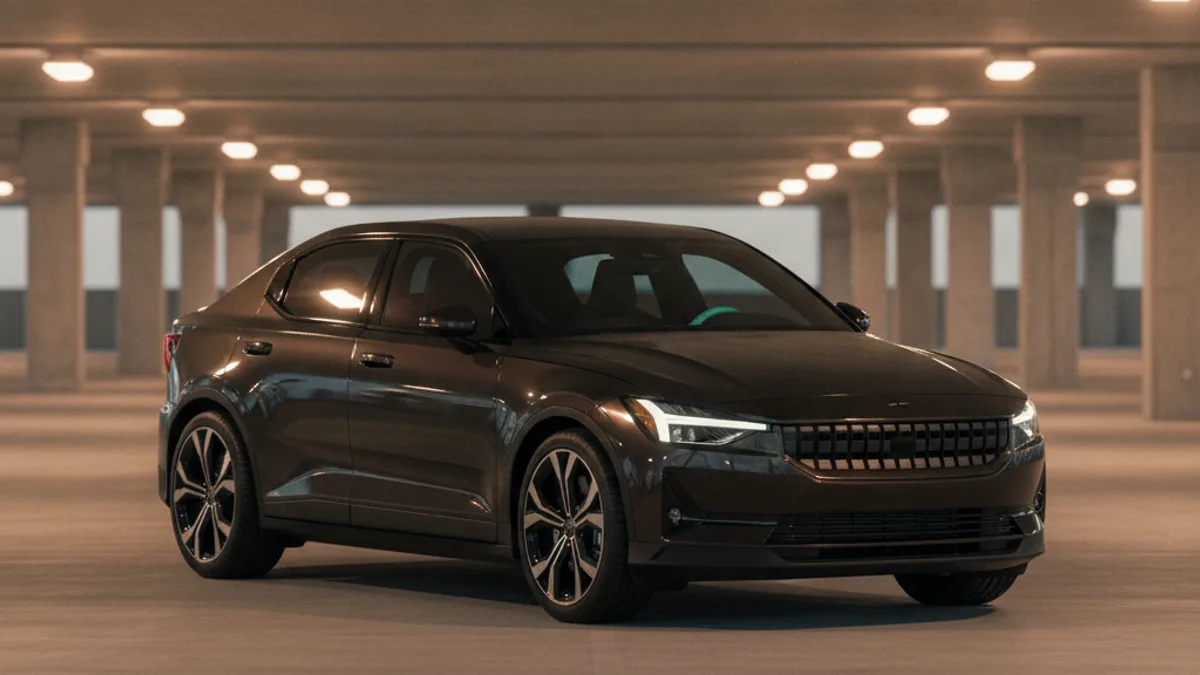
You’ll see this after a trip parked in an Ontario airport lot. You’ll see it after a Fontana warehouse shift. You’ll see it after a Lake Arrowhead weekend with the car idle. The high-voltage pack isn’t the failure. The small battery that boots every module is.
Parked accessories are the usual drain here
A Polestar 2 has no alternator. A DC-DC converter tops the 12V from the main pack while you drive. Park, and that top-up stops. Background features keep drawing power anyway.
Always-on connectivity is the steady sip. It keeps the app reachable from your phone. It keeps remote climate and remote diagnostics on tap. The digital phone key is the other draw. Bluetooth watches for you near the car. In a busy lot, foot traffic can wake that sensing again and again. A healthy 12V handles those pings. An aging one slowly sinks instead.
You don’t need a defect to explain the stall. Those draws are normal on this car. They add up when the car sits for days.
That’s the local pattern across both counties. Ontario airport structures and nearby warehouse rows keep cars parked between flights and shifts. Fontana industrial lots do the same after a long day. Eastvale and French Valley are newer-home places. ACS 2019-2023 puts Eastvale’s pre-1980 housing share at 2.2 percent. French Valley sits at 2.3 percent. A second car can sit in those driveways for days. Temecula and Murrieta skew new too, at 6.5 percent and 6.2 percent pre-1980. Wine-country weekends leave a Polestar 2 idle. Pechanga parking is a full-day sit. Cabazon destination lots work the same way. This isn’t a public-charging story. It’s a 12V that ran down while the car slept.
People sometimes blame the house charger first. Riverside runs on Riverside Public Utilities, not Southern California Edison. Colton owns its own electric utility. Banning runs a city electric utility too. Moreno Valley splits SCE and Moreno Valley Utility. Rancho Cucamonga is mostly SCE. A municipal utility pocket covers a southeast slice of the city. Named areas include The Enclave, Day Creek Square, The Resort, and the Victoria Gardens area. Those splits matter when a wall unit is dark. They don’t matter when the Polestar itself won’t wake. A dead 12V looks the same on every utility.
What a dark dash is actually telling you
Treat a no-start as a 12V failure until you prove it isn’t. The 12V runs the low-voltage electronics. Those electronics boot first, then close the contactors. Skip that handshake and the car stays inert. A high state of charge on the pack doesn’t override a dead 12V.
The center screen often fails first. It goes black under a light load. It reboots on its own. It may flash an energy-saving note, then quit. Android Automotive runs on the same low-voltage feed. When voltage sags under load, infotainment is the early warning.
Don’t file that under software and keep driving for weeks. A one-time soft reset can clear a glitch. Hold the bar at the bottom of the screen for about 20 seconds. If the screen keeps dying, or a low-voltage warning shows up with it, the 12V is tired.
A dark dash with silent door handles is further along. The app may ignore you too. Range from the last trip can still look fine in your memory. That number came from the pack, not from the 12V. The two batteries do separate jobs.
Symptom to likely cause
| Symptom | Likely cause |
|---|---|
| Dash fully dark, key and app ignored | 12V fully discharged |
| Center screen blacks out or reboots | 12V sagging under load |
| Doors and frunk stay dead, range still looks fine | 12V too weak to run low-voltage gear |
| Car wakes, then dies again | 12V can’t hold the load once awake |
| Another no-start days after a jump | 12V has failed and needs replacement |
If you’ve jumped it more than once in a few weeks, stop repeating the same rescue. A 12V that won’t hold a charge needs testing. Replacement is the usual next step, not another jump. See our guide to a 12V that dies again after a jump. It walks through that loop. When the 12-volt dies on the road explains the same failure from the shoulder.
The battery is in the frunk. You don’t jump it there.
The 12V sits in the front trunk, under the main storage tub. You lift the liner to see the battery. That’s useful when the car still has power and the frunk opens. It’s the wrong first move when the 12V is already dead. You often can’t get the frunk open in that state.
Polestar put dedicated jump points at the front of the car for this. They sit low under the hood on the left. A plastic cover hides those points. Five push-pin plugs hold that cover. You connect jumper cables there. You don’t clamp the battery posts.
How to jump a Polestar 2 at the panel
Press the locking pin in the center of each plug. A screwdriver or a pen works. Lift the cover away from the panel. Two charging points sit side by side. The positive point is the one closer to the center of the car.
Connect cables in this order:
- Red to the assisting battery or jump pack’s positive first.
- Red to the Polestar’s positive point, the inner one.
- Black to the assisting battery or jump pack’s negative.
- Black to a bare metal ground bolt on the Polestar’s chassis, not the charging panel.
Wait about a minute before you try. Then try to start the car. Pull the cables in reverse order. Black comes off first, then red.
Polestar is clear on one limit. These points are only for jumping this car. They aren’t meant to donate power to another vehicle. Doing that can blow a fuse. For the safety sequence that applies across EV brands, see how to jump start an electric car at the curb.
Match the polarity markings on the car even if this order is familiar. Confirm the steps against your owner’s information if anything on the panel looks different.
When the frunk and hood both stay shut
Sometimes the 12V is so far gone the hood panel won’t help. The frunk stays shut on you. The hood release ignores the request. Polestar added a small access port under the car for that lockout. It sits near the front left wheel. You can feed power into the 12V circuit from outside. You don’t have to open the frunk or the hood.
There’s one hard rule on that port. Never clamp a second 12V battery straight onto it. The terminal is fused at a low current. Push too much through it and the fuse blows for good. That’s a bigger repair than a dead battery. A proper jump pack is the right tool. Follow the positive and negative markings exactly. This is a last-resort port. Use the hood panel whenever you can reach it.
If you’re on a shoulder, stay out of traffic while you work. I-15 on the Cajon climb toward Victorville is a bad place to kneel under a bumper. So is I-10 through Colton and Redlands. SR-60 in Jurupa Valley and the 91 through Corona are the same problem. I-215 through Moreno Valley and Perris Valley is fast traffic too. If you can’t do this safely, wait. Call for help and stay in a protected spot.
Where Inland Empire owners actually stall
This is a two-county market, not one suburb with a name swap. Riverside County’s ACS 2019-2023 population is 2,478,600. San Bernardino County’s is 2,197,104. Housing age splits hard across the valley. Ontario’s pre-1980 share is 50.7 percent. Riverside city’s is 56.4 percent. San Bernardino city’s is 60.9 percent. Redlands is 60.4 percent pre-1980. Upland is 55.9 percent pre-1980. Those older streets still see this 12V failure. The car just sits in a different kind of driveway than Eastvale’s.
Warehouse and airport parking is the other inland twist. Ontario airport lots and warehouse rows are a repeat version of this stall. The car sits through a trip or a shift, then won’t wake. Fontana’s industrial lots do the same after a long day. Bloomington and Rialto sit on that same freight corridor. Glen Helen event parking is a long sit with accessories still polling in the background. A mountain weekend in Lake Arrowhead leaves the car unused. Crestline has the same idle-cabin pattern. Big Bear Lake and Big Bear City sit on Bear Valley Electric Service, not SCE. That changes home charging at the cabin. It doesn’t change a 12V that died in the driveway.
High Desert overnights after the Cajon climb show up too. Victorville, Hesperia, and Adelanto are where a car can sit after the grade. The pack may still have range left. The 12V may not wake. Corona on the 91, Moreno Valley on I-215, and the Ortega near Wildomar are the freeway versions. You’re not out of pack miles. You’re out of 12V instead. The car looks fully dead either way. That’s why people call for a tow they may not need.
Chino and Chino Hills add a work-lot version of the same stall. A Polestar 2 can sit through a long day on a business park. Then it refuses to wake at pickup. Montclair and Upland do it on older in-town streets. None of that means the drive pack failed. It means the 12V ran out of parked-accessory budget.
A public stall won’t wake a car that can’t close its contactors. If the dash is dark, plugging in isn’t the first move. Get the 12V up first. Then see whether the pack actually needs energy.
Jump, replace, or bring a charge
Operators we connect you with jump or replace a dead 12V on site. They handle Tesla and every major EV brand, Polestar included. They know the hood panel and the under-car port. On a visit they jump the 12V, then see whether it holds. If it doesn’t, replacement on site is the usual path. We don’t do that work ourselves. Independent operators handle the visit.
If the 12V comes back and the car still has no pack range, that’s a different job. Then you want a mobile EV charge, not another jump. Operators bring a 240V Level 2 source to the car. They use a native NACS plug, or a CCS or J1772 adapter for non-Tesla EVs. That typically adds 10 to 20 miles of range in 15 to 30 minutes of charging. That’s charging time on the car. It isn’t an arrival time.
Charge Pro IE is a referral line. We match stranded drivers with independent local mobile rescue operators. We don’t own trucks. We don’t employ technicians. We don’t set prices. We don’t publish hours or promise a window. The operator quotes you before starting and bills you directly.
For Polestar coverage beyond this no-start, read Polestar roadside assistance versus a local Inland Empire rescue. For CCS and J1772 cars in general, see non-Tesla EV rescue.
If the Polestar 2 is dark right now, call (909) 250-2881. We’ll connect you with an operator who can quote the 12V jump or a charge on site.
Frequently asked questions
Why won’t my Polestar 2 start if the range still looks fine?
Range comes from the high-voltage drive battery. The 12V is a separate battery that boots the computers. If the 12V is dead, the car can’t finish its wake-up sequence. It stays dark no matter what the pack still holds. A 12V jump is the first fix to try.
Where do you jump a Polestar 2, if not at the battery?
The battery sits in the frunk, under the storage tub. You don’t jump the posts there. Polestar’s jump panel is at the front of the car. It sits low on the left under the hood, behind a cover held by five push-pin plugs. Positive is the inner charging point. Ground on bare chassis metal, not the panel.
Can parked accessories drain the 12V while the car just sits?
They can, and that’s the usual Inland Empire stall. Always-on connectivity and the digital key’s Bluetooth sensing draw power while parked. Remote climate adds more if you use it. A busy lot can wake proximity sensing as people walk by. Leave a weak 12V sitting at an airport, a warehouse lot, or a weekend cabin. That background draw can finish it off.