A Subaru Solterra that won’t start after a night in an inland lot is usually a dead 12-volt battery, not an empty traction pack. The dash stays black. The fob may not unlock. Restoring power at the jump posts often wakes the car. If that 12V won’t hold, the operators we connect you with can replace it on site.
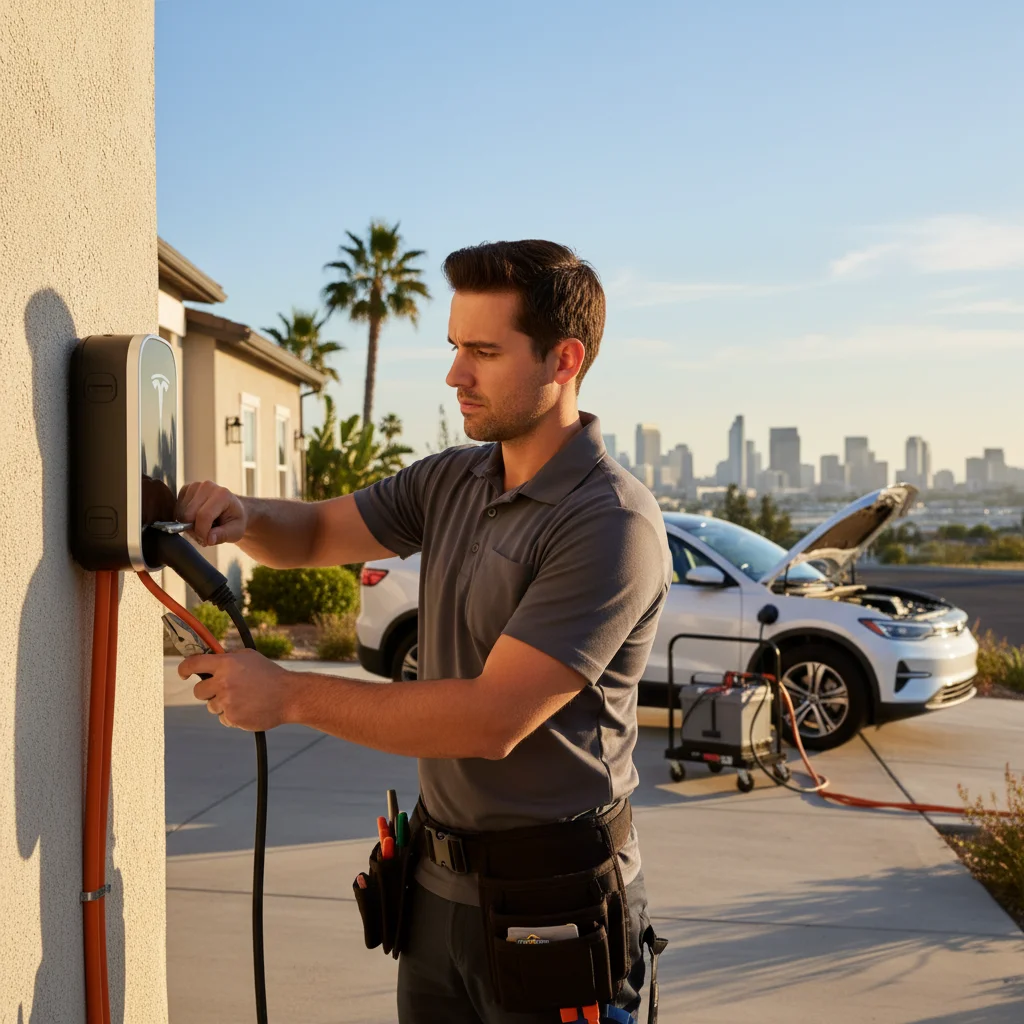
Dark dash, dead fob: treat it as the 12V first
A black cabin is easy to read as out of charge. On a Solterra those two failures don’t look the same.
Watch for this pattern:
- The power button does nothing. No chime. No screens.
- The key fob won’t unlock. The physical key is the way in.
- Hazard lights stay off.
- Locks don’t clunk as you walk up.
- Yesterday it drove. This morning it sits inert.
That last point is the tell. A weakening 12V often fails overnight after the car sits. Inland lots in Fontana, Ontario, and Chino take sun all day. Then they sit quiet until the commute home. The pack can still hold plenty of range. The small battery can’t boot the computers that wake the car.
If screens do come on, throw a high-voltage warning, and then die, stop. That belongs at a Subaru dealer. If screens come on, READY appears, and range is gone, that’s an empty pack. Jumping won’t help. The black-dash case is the 12V.
Why an inland overnight sit knocks a Solterra out
Warehouse rows and airport employee lots are where this looks like a dead car. A Solterra locked in a Fontana stall through a shift wasn’t driven empty. It sat. The same story shows up in Ontario airport lots and the warehouse grid around them. There’s a separate note on EV rescue around Ontario airport lots and warehouse rows. That one covers the empty-pack version of that stall. The 12V version looks worse, because nothing on the dash wakes.
Chino work lots repeat it. So do overnight parks in Riverside. Homes inside the city of Riverside sit on Riverside Public Utilities, not Southern California Edison. If you plugged in and still woke to a dark dash, don’t assume the utility failed first. Check the 12V before you blame the panel.
Moreno Valley splits power too. Southern California Edison serves much of the city. Moreno Valley Utility covers a pocket of newer development. Either way, a dark Solterra at dawn is still a 12V job. Wait for the dash to prove otherwise.
Newer driveways in Eastvale and Menifee see the same morning no-start. The houses are newer. The 12V is still a lead-acid unit that ages. High Desert mornings in Victorville and Hesperia can look identical after a parked night. Corona street parks along the 91 commute do it too. A hot parked day is enough.
The Solterra shares its bones with Toyota’s bZ4X. They ride Subaru and Toyota’s e-TNGA platform. The 12V layout matches. If you want the Toyota-framed walkthrough, use the Toyota bZ4X 12V checks.
The 12V is what actually wakes the pack
The Solterra has two batteries on purpose. The high-voltage pack moves the wheels. The 12V runs locks, lights, screens, and the computers that close the high-voltage contactors.
Until that 12V wakes those computers, the pack stays isolated. A healthy pack behind a dead 12V won’t move the car. Phone apps can still show last night’s range. The car in the stall won’t.
The auxiliary battery is a standard lead-acid unit, not a lithium 12V. It sulfates like the battery in a gas Subaru. A gas engine would recharge it at idle. The Solterra never idles. Heat, age, and a long sit drain it quietly. The wider version of this failure is in when the 12-volt dies, why the EV looks completely dead.
Jump posts on the Solterra, and the order that stays safe
The 12V sits under a plastic cover on the driver’s side of the front compartment. You can reach the battery there. Subaru also gives dedicated jump posts on that same side, so you don’t have to pull the whole cover.
Positive is the red post under a hinged red plastic cover. It sits on the driver’s side, toward the front of the bay, marked with a plus. Don’t clamp negative to the battery’s negative terminal. Use an unpainted metal bracket or bolt on the bay structure. Keep it away from the battery. That way a spark stays clear of venting.
Your year and trim can differ. Read the owner’s manual for your exact car before you clip a cable.
A careful sequence:
- Leave the donor car or jump pack off until the clamps are on.
- Clip positive to the Solterra’s red jump post, then positive to the donor.
- Clip negative to the donor’s negative. Put the last negative on bare metal on the Solterra, not the battery.
- Power the pack on, or start the donor, and wait a short time.
- Press the Solterra power button. Screens and a READY light should appear.
- Remove the clamps in reverse order once the car is awake.
Painted plastic isn’t a ground. The battery negative isn’t the ground you want. Those two mistakes cause most DIY trouble. A longer caution list is in how to jump start an electric car without frying the 12V.
If you’re unsure about the posts, stop. Independent operators we match handle Solterra 12V jumps and on-site replacements. They quote before they start.
Empty pack, CCS port, and a Level 2 visit
When the dash lights and READY is on but the car won’t drive, you’re out of charge. A 12V jump won’t add range.
The Solterra takes CCS. Operators in this network bring a 240V Level 2 source and a CCS adapter for non-Tesla EVs. They typically add 10 to 20 miles of range. That’s in 15 to 30 minutes of charging. That window is charging time at the car. It’s not how long someone takes to arrive. The goal is enough miles to reach a DC fast charger or to get home. It’s not a full pack in the stall.
That job is out-of-charge recovery. Keep it separate from a 12V jump. Black dash: 12V. Awake car with no range: a charge.
Non-Tesla EV rescue is how CCS and J1772 cars get help across the Inland Empire, including the Solterra.
Who actually shows up, and who sets the price
Charge Pro IE matches stranded EV drivers with independent local mobile rescue operators. We don’t perform the work. We don’t own trucks or equipment. We don’t employ technicians. We don’t set prices, and we don’t promise an arrival time.
The operator quotes you before starting and bills you directly. For a dead 12V they jump the correct posts and see if the battery will hold. They can replace it on site when it won’t. For an empty pack they charge through the CCS port.
Ask what plug they’re bringing. A Solterra needs CCS. Operators here carry a CCS or J1772 adapter for non-Tesla EVs.
If you’re sitting in a lot right now, call (909) 250-2881. Say it’s a Solterra. Say whether the dash is black or the car is awake with no miles. That’s how the operator quotes the right fix.
Frequently asked questions
Why won’t my Subaru Solterra start even though it has charge?
The 12V has to boot the computers before the traction pack can connect. If that battery is dead, the dash stays dark. Range from last night doesn’t matter yet. Jump the dedicated posts first. That’s the usual fix.
Is the Solterra 12V the same as the Toyota bZ4X?
Yes. They share the e-TNGA platform, including the 12V location and jump points. Badging and some tuning differ. None of that changes the jump. Use the same steps on either car.
Can I jump start my Solterra myself?
You can if you use the red positive jump post and a bare-metal ground. Don’t clip the last negative to the battery terminal. Check the manual for your year. If it still won’t wake, stop. A 12V that dies again after a jump likely needs replacement.