Your Tesla is sitting on the I-15 shoulder after the Cajon climb toward Victorville. The pack is low, or the car won’t wake. Tesla’s own roadside program is one channel. A local mobile operator is a different one. That operator quotes you before anyone rolls.
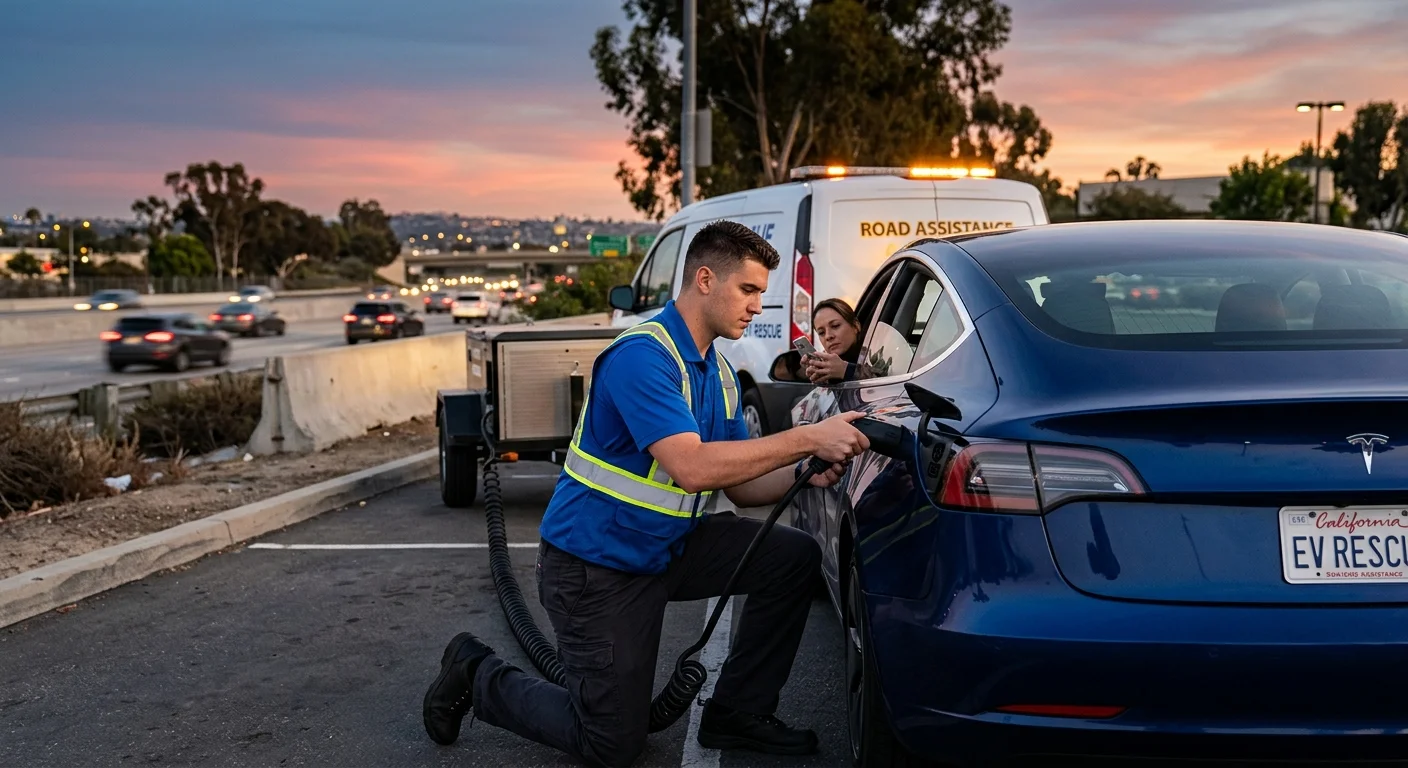
Tesla’s program isn’t the local rescue line
Tesla roadside assistance belongs to Tesla. Independent Inland Empire operators don’t work for Tesla. They’re separate businesses with their own terms. Charge Pro IE only matches you with one of those operators. We don’t dispatch Tesla. We don’t write Tesla’s rules.
If a search snippet claims Tesla help never sleeps, treat it as unproven. We couldn’t confirm Tesla’s current hours from the sources this site can cite. The Tesla app on the stranded car is where you check. Tesla’s own support pages are the backup. An old third-party article isn’t.
Hours and coverage aren’t the same question. A request button can show up while your problem still sits outside the terms. Read what’s on the screen for this VIN and this pin.
Verify in the app, not in an old listing
Open the Tesla app tied to the stranded car. Look for Roadside or support. If a request path appears, read every condition before you submit.
If that option isn’t there, stay with Tesla’s current materials. Don’t keep dialing a stale number from an unsourced directory. Read our note on the Tesla roadside phone number plus a local backup. It explains why the app still belongs in that check.
Menus change, and so do the problems Tesla will accept. We couldn’t confirm a full, current coverage list. What Tesla roadside actually covers is a companion read. It isn’t a substitute for the terms on your screen.
Name the place like a dispatcher would
“On the 15” isn’t a location. Say the direction of travel. Name the nearest signed exit. Note which shoulder you’re on. Add a mile marker if you can see one.
A Fontana warehouse row needs a gate, a dock, or a lot name. Ontario airport parking isn’t the same as a city curb. A Model 3 on a Riverside street is still yours to describe. Riverside Public Utilities doesn’t send a charger truck.
Downtown Riverside and a Glen Helen lot need different landmarks. A High Desert shoulder needs its own landmarks too. Write them down before you call anyone. I-10 through Colton and Redlands can look alike on a vague pin. So can I-215 through Moreno Valley and SR-60 in Jurupa Valley.
Safety comes before any coverage debate
If the Tesla is blocking a live lane, call 911. Coverage questions wait until you’re out of the lane. Follow what responders tell you.
Don’t push the car, pry panels, or charge from moving traffic. Hazard lights help if they work. Share travel direction, nearest exit, and which side of the road you occupy. A map pin helps. It doesn’t replace a written description.
The 91 through Corona moves fast. So does the Cajon grade. Don’t stand in a lane to inspect the pack. Once you’re out of immediate danger, figure out what the car actually needs.
An empty high-voltage pack isn’t a flat tire. A dark 12V isn’t the same as a depleted pack. Those jobs use different gear.
Empty pack, 12V, or something else
Describe what you see. Don’t diagnose the car for the dispatcher. Useful facts include dark screens or a car that won’t shift. Note a flat tire or a stuck charge port too. Repeat the exact warning on the display.
A Tesla that won’t roll can be low charge or a 12V failure. Tire damage is another common reason. Don’t say it just needs a jump unless that’s confirmed. The wrong story can send the wrong truck.
We couldn’t confirm Tesla covers every request or every location. Ask who bills you if the request sits outside the terms. Tesla’s program and a local operator aren’t the same invoice.
If the main pack is empty, try a Tesla roadside rescue. Charge Pro IE only makes the introduction. The operator looks at the car, explains the work, and bills you directly.
Operators who take these Inland Empire calls typically bring a 240V Level 2 source. Teslas take a native NACS plug. Other EVs may need a CCS or J1772 adapter. Time on the plug is typically 15 to 30 minutes. That usually adds about 10 to 20 miles of range. That’s charging time, not a promise of when someone arrives.
A local operator quotes before they roll
Tesla’s channel and a local mobile rescue aren’t interchangeable. You can try Tesla first. You can call a local operator instead. You can do both in sequence if Tesla’s path doesn’t fit.
An independent operator is worth considering when the app has no suitable option. It’s also worth considering when the on-screen terms exclude your problem. Some drivers simply want a different provider. Confirm the service and the quote before anyone starts.
Charge Pro IE is a referral line for the Inland Empire. We connect stranded EV drivers with independent local mobile rescue operators. The pros we connect you with are licensed. We don’t hold a trade license. We own no trucks. We employ no technicians. We set no prices. We publish no business hours. We promise no arrival.
Tell the operator the Tesla model and any warning text. Share pack status if the screen shows it, plus the exact pin. Say whether the car sits in a lot, a driveway, or next to traffic. The operator decides if the job matches the equipment.
Ask who performs the work. Ask what the quote covers. Ask whether the plan is a Level 2 charge or a 12V jump. Ask if a replacement or a tow is on the table instead. Keep the operator’s own agreement. Payment goes to that operator, not to Charge Pro IE.
Distance, time of day, and how much range you need all move the price. We don’t publish those figures because we don’t set them. The operator quotes you before starting.
See our comparison of who helps a stranded Tesla in the Inland Empire. For the Cajon climb, use the out of charge on I-15 toward Victorville checklist.
While you’re deciding who to use
Stay with the car if that’s safe. Stay out of the travel lanes. Don’t open high-voltage components.
Screenshot the Tesla app request and any confirmation. Save the provider name and the terms shown. If the request vanishes, go back to Tesla’s current support path. Our app versus phone guide covers what to have ready. It doesn’t say which path answers first.
Southern California Edison serves many inland cities, including Fontana, Ontario, and San Bernardino. Riverside Public Utilities serves Riverside. The City of Colton Electric Utility serves Colton. Moreno Valley Utility covers part of Moreno Valley. Bear Valley Electric Service covers Big Bear Lake and Big Bear City. None of those utilities is a roadside rescue. A home rate plan doesn’t roll a truck to I-15.
Apple Valley Choice Energy procures power in Apple Valley. San Jacinto Power supplies generation in San Jacinto. SCE still delivers in those two cities. That split still isn’t a rescue truck.
If you want a local operator instead
Call when your Tesla is stranded in the Inland Empire. Ask us to match you with an independent mobile rescue operator. We don’t promise that an operator is available. We don’t promise when someone will arrive. The operator confirms the service and the quote with you.
Call (909) 250-2881 and we’ll connect you with a local EV rescue operator.