Independent local rescuers are who actually help a stranded Tesla in the Inland Empire. They handle Tesla and every major EV brand across both counties. Tesla’s own roadside program is a separate call. An auto club like AAA is another. Those three options don’t send the same truck.
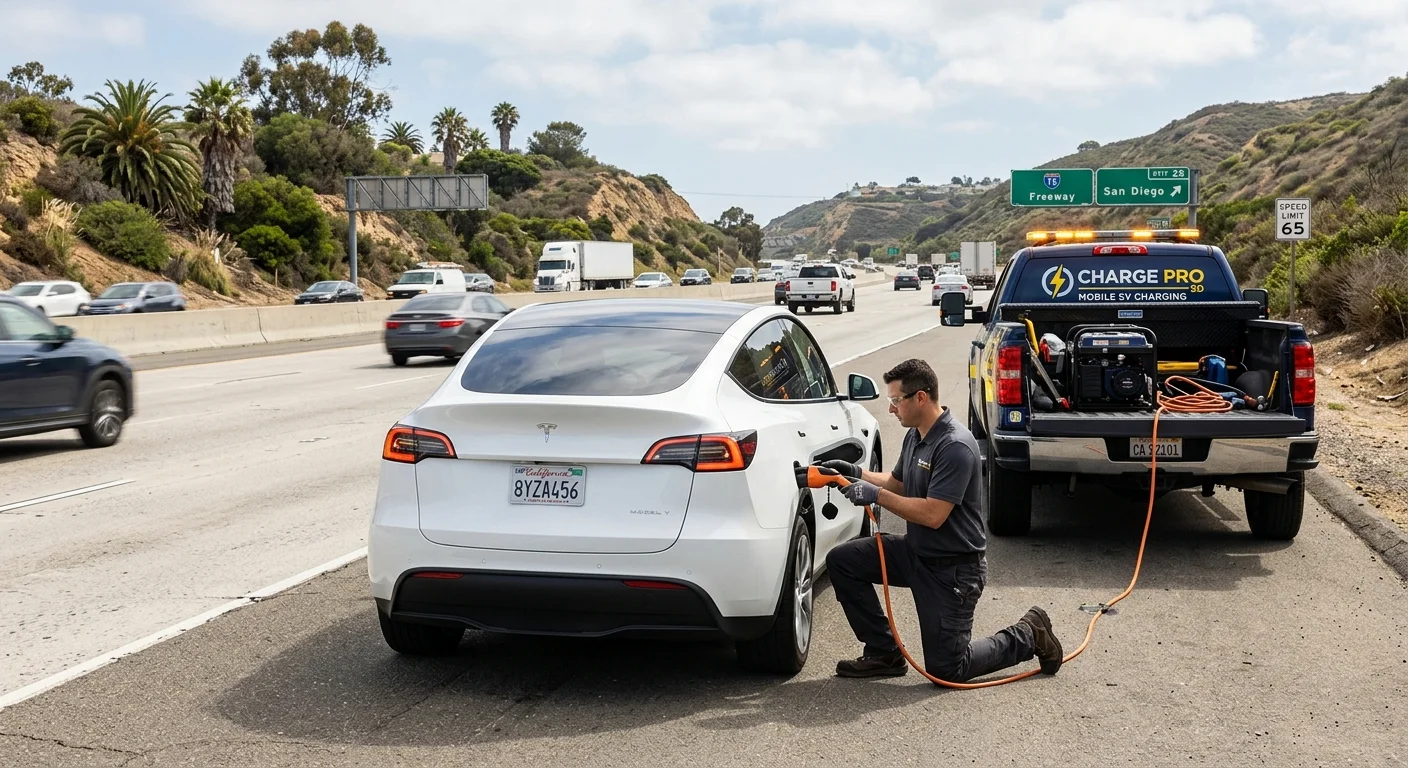
The Inland Empire is two counties, not one stall
Riverside County has about 2,478,600 residents. San Bernardino County has about 2,197,104. That split isn’t trivia. It’s the map your car stalled on.
A Model Y that died in a Fontana warehouse row is a work-lot problem. A Model 3 that stopped on the I-15 Cajon climb toward Victorville is a grade-and-heat problem. A Model X that won’t wake in Big Bear Lake is a mountain-lot problem.
Generic statewide copy doesn’t describe this place. The valley cities, the High Desert, and the mountain communities don’t share one housing stock. They don’t share one utility. They don’t share one climate. Tesla roadside assistance in the Inland Empire has to live on that real map.
Tesla roadside rescue from an independent operator is EV work on that map. Tesla’s own program is Tesla’s nationwide playbook. An auto club is a general contractor list. Learn which one you actually reached before you wait.
What usually strands a Tesla out here
Most inland Tesla stalls collapse into two failures. The low-voltage battery is dead, or the traction pack is empty. From the sidewalk they look alike. They’re not the same job.
Teslas still use a 12-volt battery to wake the computers. If that battery is down, screens stay dark. Handles may not present. The car looks fully dead even with miles still in the pack. That’s a jump or a replacement at the curb. It isn’t a hunt for a Supercharger. The operators Charge Pro IE connects you with jump a Tesla 12V when that’s the actual fault.
An empty traction pack is the other stop. Inland heat, long grades, and warehouse idling all chew range. I-15 over Cajon toward Victorville is a long climb. I-215 through Moreno Valley and Perris stacks heat with traffic. I-10 through Colton and Redlands is stop-and-go against a grade. SR-60 through Jurupa Valley does the same. So does the 91 through Corona. None of that claims a charger is missing. It means the car stopped where you’re standing.
A mobile Level 2 hookup is for that empty-pack case. The operator brings a 240-volt source to the car. Teslas take a native NACS plug. Other EVs use a CCS or J1772 adapter. Typical charging time is 15 to 30 minutes. That window is charging time. It isn’t an arrival time. In that window the car usually gains about 10 to 20 miles. That’s often enough to roll to a Supercharger, or to the charger you already meant to use. The operator quotes you before they start. Confirm that quote.
Warehouse districts around Ontario and Fontana add another flavor. Delivery vans and company Teslas sit on accessory load after a shift. The pack was fine at lunch. It isn’t fine at closing in a dark row. The same two jobs still apply. Wake the 12-volt, or add 240 volts.
Tesla’s own roadside line is Tesla’s program
Tesla publishes its own roadside assistance. You usually open it in the Tesla app. You can also call Tesla’s roadside number. What’s covered depends on the car, the warranty status, and whatever Tesla currently lists for that VIN. Charge Pro IE can’t see your Tesla coverage from here. Open the app. Read the current terms. Or call Tesla and ask what’s included today.
Tesla’s program is built around Tesla vehicles. It may send a Tesla-trained tech. It may send a contracted tow. For a depleted pack, Tesla often defaults to a tow toward Tesla service. For some tire issues, the published path is a tow, not a roadside plug. That’s Tesla’s policy. It isn’t a local operator’s menu. For a longer walk through what Tesla actually covers in this market, read Tesla roadside assistance coverage in the Inland Empire.
Tesla’s line isn’t there to rescue the Rivian, Hyundai, or Ford in the next stall. Independent operators are. That’s the part owners miss when they only save Tesla’s number. The same local rescuer who can NACS-plug a Model 3 can adapter-plug a CCS car. If your driveway holds more than Tesla, that difference is the whole decision.
An auto club sends a general truck unless you ask
AAA and similar clubs cover many vehicle types. That’s the product. The contractor who arrives may be a conventional tow. That truck may not carry a 240-volt EV source. The driver may not know Tesla’s 12-volt jump points. The truck may not be a flatbed if the car has to roll away.
Ask the club what they’re sending before you settle in. Ask if the truck can jump a Tesla 12-volt. Ask if it can add range on site. Ask if a tow would be a flatbed, because that’s how Tesla wants the car moved. If the answer is a general tow to a generic shop, that’s a different day than a mobile charge. The comparison is here: AAA or a local Tesla rescue: what actually shows up.
An auto club card can still be worth having. It isn’t a Level 2 charger on wheels. It isn’t a Tesla-specific 12-volt procedure unless the contractor says it is. Get that answer on the first call. Don’t wait until a gas-truck driver is already standing at the port.
Independent rescuers handle Tesla and every major EV brand
Charge Pro IE is a referral line. It matches stranded EV drivers with independent local mobile rescue operators. It performs no work. It owns no trucks. It employs no technicians. It sets no prices. It promises no arrival time. It publishes no business hours. It doesn’t hold a contractor license.
The operator quotes you before starting. The operator bills you directly.
What those operators do is specific. They bring a 240-volt Level 2 source to the car. They jump or replace a dead 12-volt battery on site. They handle Tesla and every major EV brand. If you’re not in a Tesla, use the non-Tesla EV rescue path. It’s the same kind of operator, with the adapter your port needs.
That mix matches how this region actually drives. Fontana and Ontario warehouse lots mix Tesla company cars with Lightning, Bolt, and Mach-E vans. Temecula and Murrieta mix Model Y family cars with other luxury EVs. Chino Hills and Eastvale add newer tract Teslas next to CCS crossovers. A Tesla-only tow to Tesla service doesn’t help the CCS car two stalls over. An independent rescuer with adapters does.
A visit isn’t a repair shop. It isn’t Tesla Service. It isn’t a home charger install. You can read the boundary here: what a mobile EV charging visit actually is.
The utility map is not one company
Most people assume the whole Inland Empire is Southern California Edison. It isn’t. That fact matters most when the failure is a dark garage, not a freeway shoulder. It still explains why “I’ll just drive home and plug in” collapses.
Riverside Public Utilities has served the city of Riverside since 1895. The City of Colton Electric Utility owns the electrical infrastructure inside Colton. Banning runs the City of Banning Electric Utility. Big Bear Lake and Big Bear City sit on Bear Valley Electric Service. Bear Valley also names Lake Williams, Erwin Lake, Sugarloaf, Moonridge, Fawnskin, and Boulder Bay on its service-area page.
Moreno Valley is split. SCE covers part of the city. Moreno Valley Utility covers newer development since 2004, with more than 6,500 customers. MVU publishes an address lookup. Rancho Cucamonga is split too. SCE covers most of the city. Rancho Cucamonga Municipal Utility covers a southeast pocket with more than 3,900 metered businesses and residents, including The Enclave, Day Creek Square, The Resort, and the Victoria Gardens area.
San Jacinto is a different kind of split. SCE delivers the power. San Jacinto Power, a community choice aggregator, supplies the generation. Apple Valley works the same pattern with Apple Valley Choice Energy procuring while SCE delivers. Victorville homes are on SCE. Victorville Municipal Utility Services serves only the Southern California Logistics Airport and Foxborough Industrial Park. It states it doesn’t provide utility service in residential areas at this time.
A dark garage charger in Riverside is an RPU problem, not an SCE one. A dark charger in Colton is Colton Electric. A mountain stall in Big Bear Lake sits on Bear Valley’s grid. None of that names who to call for a car already on the shoulder. It tells you why the house outlet isn’t a fallback until you confirm which utility actually feeds that panel.
Housing age splits the same way. Eastvale has about 2.2 percent of units built before 1980, ACS 2019-2023. Temecula is about 6.5 percent. San Bernardino is about 60.9 percent. Older garages and older panels fail differently than a 2010s tract. That’s a home-charging story. On the shoulder, the operator still brings 240 volts to the car.
For city-by-city charging and rescue context, use the Inland Empire EV charging hub.
When a tow is still the honest answer
Not every stall should be charged in place. If the car has collision damage, don’t charge it on the shoulder. If Tesla’s app is throwing a high-voltage fault, don’t guess with a plug. If a tire is destroyed and Tesla’s path is a tow, that’s a tow. Independent operators aren’t a body shop. They aren’t Tesla Service.
A tow still has a Tesla-specific method. Tesla publishes how to transport the car. The version owners need on the shoulder is simple. Use a flatbed. Follow Tesla’s published lift and tie-down points. A wheel-lift with drive wheels on the pavement is the wrong picture. Confirm the truck before it hooks. If Tesla’s contractor or an auto-club truck can’t confirm a flatbed, say so. Wait for a truck that can.
Mobile charging is for an empty pack on an otherwise healthy car. A 12-volt jump is for a low-voltage failure on an otherwise healthy car. Everything else is diagnosis or a tow. Don’t let a general shop take the car “to look at it” if you still have Tesla service in play. That’s how a simple 12-volt turns into a week in the wrong bay.
Mountain, desert, and valley aren’t interchangeable
Lake Arrowhead, Crestline, Running Springs, and Big Bear sit on grades that cost range on the way up. A car that arrived empty doesn’t magically refill in the lot. Regen on the way down only helps a car that can still move. High Desert miles around Victorville, Hesperia, Adelanto, Apple Valley, and Phelan are long and hot. Valley warehouse work in Fontana, Bloomington, and Ontario is idling and accessory load after a shift.
A Temecula or Murrieta wine-country loop isn’t an I-10 climb through Beaumont and Banning. Ortega Highway near Wildomar isn’t a surface street in Eastvale. The operator’s job is still the same two tasks. Add 240 volts, or wake the 12-volt. The road around the car isn’t the same, and the weather isn’t either.
Hemet, San Jacinto, Menifee, Perris, and Lake Elsinore sit in heat that sits on the pack all afternoon. Corona and Jurupa Valley sit in freeway traffic that does the same in stop-and-go. Name the place when you call. The operator needs the actual road, not “the Inland Empire.”
How to choose in the first two minutes
If the screens are dark and the pack still showed miles, start with the 12-volt. If the car is awake and the range reads zero, you need energy in the pack. If you want Tesla’s own contractor, use the Tesla app. If you have an auto club, ask what truck they’re sending. If you want an EV-specific operator who quotes on-site work, that’s the referral line.
Don’t stack three dispatches. You’ll get overlapping trucks and a mess on the shoulder. Pick one path. Change it only if that path says they can’t do the job.
Hazards first. If you’re in a live lane, get the car and people out of traffic if you can do it safely. Four-ways on. Passengers on the safe side. Then make the call. A coverage debate doesn’t help if the next problem is a passing truck.
Have the VIN, the model, the port type, and a pin you can describe. “Westbound I-10 through Colton, right shoulder” is useful. “Somewhere on the 10” isn’t. Mountain callers should add the community. Say Crestline, Running Springs, Big Bear City, or Lake Arrowhead. High Desert callers should add the town. Say Victorville, Hesperia, Adelanto, Apple Valley, or Phelan.
Who to call when you want a local operator
If you want an independent rescuer for a Tesla, or for another major EV brand, Charge Pro IE will match you with a local operator. The operator quotes before starting. They bill you directly.
Call (909) 250-2881. That’s the number. It isn’t a promise of when someone arrives. Ask the operator the same questions you’d ask Tesla or AAA. Can they jump the 12-volt. Can they add Level 2 range. Do they have the right plug for this car.