A VW ID.Buzz that won’t start is usually the 12V battery. The traction pack is often still holding range. After days unplugged in an inland lot, the 12V can fail to wake. It sits under the driver’s seat, not under the hood. Jump the remote posts in the front cover first.
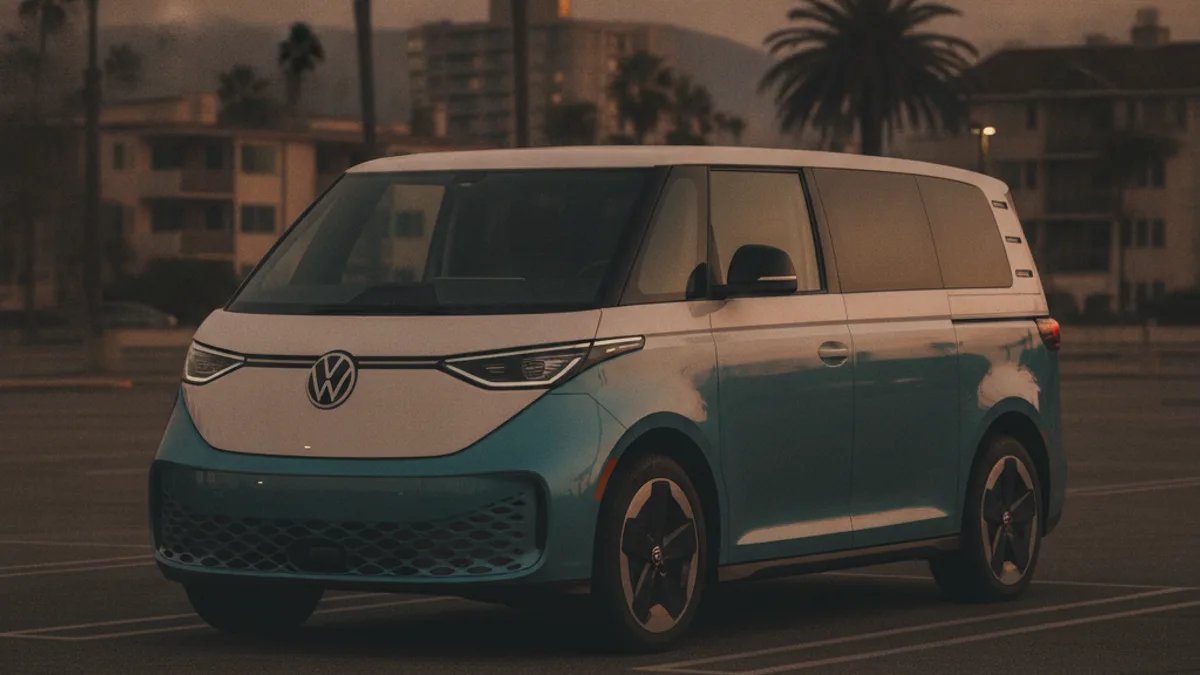
Dark dash after a long inland parked day
This van sits more than people think. It sits in Ontario airport rows during a trip. It sits in Fontana warehouse lots through a full shift. It sits on a Riverside street until the weekend. Background systems keep sipping the 12V while it waits. That battery mainly recharges when you drive. Leave it unplugged for a few days and Ready can refuse to come back.
Owners then chase the wrong problem. They look at range, if the screen even wakes. They assume the high-voltage pack is empty, and often it isn’t. The computers that unlock the drive never got 12V power. That’s why a VW ID.Buzz won’t start with range still on the pack.
The same stall hits when you leave a lot toward I-10. It was fine when you parked. It won’t go to Ready now. That gap of hours is the 12V story, not a pack failure.
Two batteries, two different failures
The ID.Buzz uses a high-voltage pack to move. A small 12V battery runs the low-voltage side. Locks, lights, screens, and the wake computers all live there. If the 12V is too low, those computers stay off. The traction pack stays locked out until the 12V comes back.
Treat it as a 12V stall when you see this:
- A 12 volt system error or electrical system fault on the cluster
- Ready and Drive never engage, even with range showing
- The key fob unlocks slowly, or it doesn’t unlock
- The screen flickers, or infotainment keeps rebooting
- The VW app can’t connect or wake the van
- You already needed a jump pack just to boot
An empty traction pack looks different. The van may still power on. It can show range, just not enough to drive. Jumping the 12V won’t add those miles. You need a charge for that job.
A genuine high-voltage warning that then kills the dash is different. Get a dealer scan for that one. The nothing-happens stall still starts at the 12V. The same lockout shows up across EV brands. When the 12-volt dies, why the EV looks completely dead explains that handoff.
What to try before you call
Work the simple checks first. Try the fob from a few feet away. Try the physical key if the fob is silent. Look at the cluster for a 12 volt system error. Open the hood cover and find the red cap on the positive post. A jump pack in the cargo area is the fastest 12V save.
Don’t keep cycling Ready if nothing wakes. You’re only deepening the drain. Don’t pull the seat trim on a freeway shoulder to reach the battery. Use the remote posts up front.
In an Ontario, Fontana, or Rancho Cucamonga lot, you can jump in place. On the shoulder of I-10, I-15, or I-215, stay out of traffic. Jump from the hood-cover posts. Don’t climb under the driver’s seat beside live lanes.
The 12V is under the seat
This is the check owners miss first. A gas Volkswagen put the battery up front. Some ID.4 drivers look under the hood too. On the ID.Buzz, the physical 12V is in the cabin. It’s under the driver’s seat, behind plastic trim. You slide the seat forward to reach the cover. That’s not a job you want next to traffic.
VW ran remote jump posts under the hood cover for this. You don’t have to pull the seat trim to jump. Find the positive post under a red plastic cap. Find the separate metal ground point for the negative clamp. Those posts wire back to the buried battery. Clamp there, not on the battery under the seat.
Layouts can shift a little by model year. Confirm the diagram in your owner’s manual before you start. One minute with the book beats guessing in a lot.
The Buzz and the ID.4 share VW’s MEB platform. A lot of the 12V drain pattern carries over. The battery location doesn’t. ID.4 owners should read ID.4 12V failures: what to do when the Volkswagen won’t wake.
Don’t jump another car with the Buzz
VW warns against using the ID.Buzz as a donor. That can damage the van’s own electrical system. Use a jump pack, or use another vehicle as the donor. Never reverse it.
Jump from the remote posts, not the seat
- Keep the donor or jump pack off until every clamp is set.
- Open the hood cover and find the red cap on the positive post.
- Put one red clamp on the ID.Buzz positive post. Put the other red clamp on the donor positive.
- Put one black clamp on the donor negative.
- Put the last black clamp on the ID.Buzz ground point. Never use the battery’s own negative terminal.
- Start the donor, or turn on the jump pack. Give it a couple of minutes.
- Foot on the brake, then try to power the van on. The dash should wake in a few seconds.
- Once it’s running, remove the cables in reverse order.
If it boots and then throws a 12V warning, the battery only sipped. Replacement comes next. A new 12V has to be coded and registered to this van. Skip that and warnings return. Sleep behavior gets odd. The battery can die again sooner than it should. Treat replacement as a shop visit, not a driveway swap. See EV 12V battery replacement: signs it’s going, and next steps.
Read How to jump start an electric car without frying the 12V for any EV.
Why a parked inland day drains this 12V
This isn’t random bad luck. It’s a known MEB pattern, the same platform under the ID.4. The 12V mainly charges while you drive. Parked, the van still runs low-level background systems. A family van that sits Friday through Monday is a classic no-start. So is a work van left in a lot all weekend.
Ontario is a common version of that story. Airport long-term rows and warehouse shifts both mean hours unplugged. EV rescue around Ontario airport lots and warehouse rows covers that stall. Fontana warehouse lots see the same end-of-shift surprise. Chino and San Bernardino work lots do too. Riverside office parks and downtown streets add another. Temecula day-trip parking can look the same when you return.
Home power doesn’t always save you here either. A Riverside home on Riverside Public Utilities can still leave you stranded. The van may have charged there last night. A Fontana shift on Southern California Edison territory is a long unplugged sit. The 12V doesn’t care which utility serves the house. It cares whether the van sat unplugged long enough to sag.
Moreno Valley is split between Southern California Edison and Moreno Valley Utility. Newer development is often on Moreno Valley Utility. That split doesn’t change this failure. If the Buzz sat all day, the 12V can still be the stall.
The van sat unplugged, and the 12V sagged. Ready never returned. You don’t need a mystery beyond that.
A 12V that’s already a few years old fails sooner in this cycle. Replacement still needs coding. An unregistered swap is how the warnings come back.
ID.Buzz vs ID.4: same platform, different 12V layout
Use this if you drive both vans. Or if a friend is talking you through a jump.
| VW ID.Buzz | VW ID.4 | |
|---|---|---|
| Platform | MEB | MEB |
| 12V battery location | Under the driver’s seat, in the cabin | Under the hood, passenger side |
| Jump-start terminals | Remote posts under the hood cover, positive under a red cap plus a separate ground point | Remote posts under the hood, near the washer fluid reservoir |
| Direct access to battery terminals | No, use the remote posts only | Limited, remote posts are the safer route |
| Common no-start trigger | Van sitting parked for several days | Van sitting parked for several days |
| Inland Empire pattern | Long unplugged days in airport, warehouse, and office lots | Long unplugged days in airport, warehouse, and office lots |
When a jump is the wrong tool
A dead 12V needs a jump. An empty traction pack needs a charge. Mixing those up wastes the afternoon.
If the dash is dark and the fob is dead, start with the 12V. If the van powers on with no range left, you need a charge. Charge Pro IE is a referral line. It matches stranded EV drivers with independent local mobile rescue operators. The brand doesn’t perform the work. It owns no trucks and employs no technicians. The operator quotes you before starting and bills you directly.
Operators can jump or replace a dead 12V on site. They also bring a 240V Level 2 source to the van. That’s a native NACS plug. A CCS or J1772 adapter covers non-Tesla EVs like the ID.Buzz. Typical charging time is 10 to 20 miles in 15 to 30 minutes. That’s charging time, never an arrival time.
For CCS and J1772 rescue around here, see non-Tesla EV rescue.
If your ID.Buzz is sitting dark in an Inland Empire lot, call Charge Pro IE. The number is (909) 250-2881. We’ll talk through what you’re seeing, then connect you with a local operator.
Frequently asked questions
Why won’t my VW ID.Buzz start if the pack still shows charge?
The traction pack and the 12V are separate systems. The 12V has to be alive before the van can power on. If it drops too low, the high-voltage side stays locked out. Jump the 12V first. Don’t assume the pack is the failure.
Where is the 12V battery on a VW ID.Buzz?
It’s under the driver’s seat, inside the cabin. It’s not under the hood. VW put remote jump posts under the hood cover instead. You’ll find a positive post under a red plastic cap. There’s a separate ground point for the negative clamp. Jump those posts. Don’t dig under the seat on the roadside.
Can I use my ID.Buzz to jump another car?
No. VW warns against using the ID.Buzz to jump another vehicle. It can damage the van’s electrical system. Use a jump pack or another vehicle as the donor.