A new Eastvale garage charger can’t reach I-15. It can’t reach the 15 Express Lanes either. EV roadside assistance in Eastvale is the call for that gap. The operator brings 240-volt power to the car. They can also jump a dead 12-volt battery on site. Your wall box stays in the garage. You’re not in the garage. When the pack dies on Hamner Avenue or Limonite, the home charger is still on the house. Charge Pro IE connects you with an independent local operator. That operator quotes before any work starts, then bills you directly.
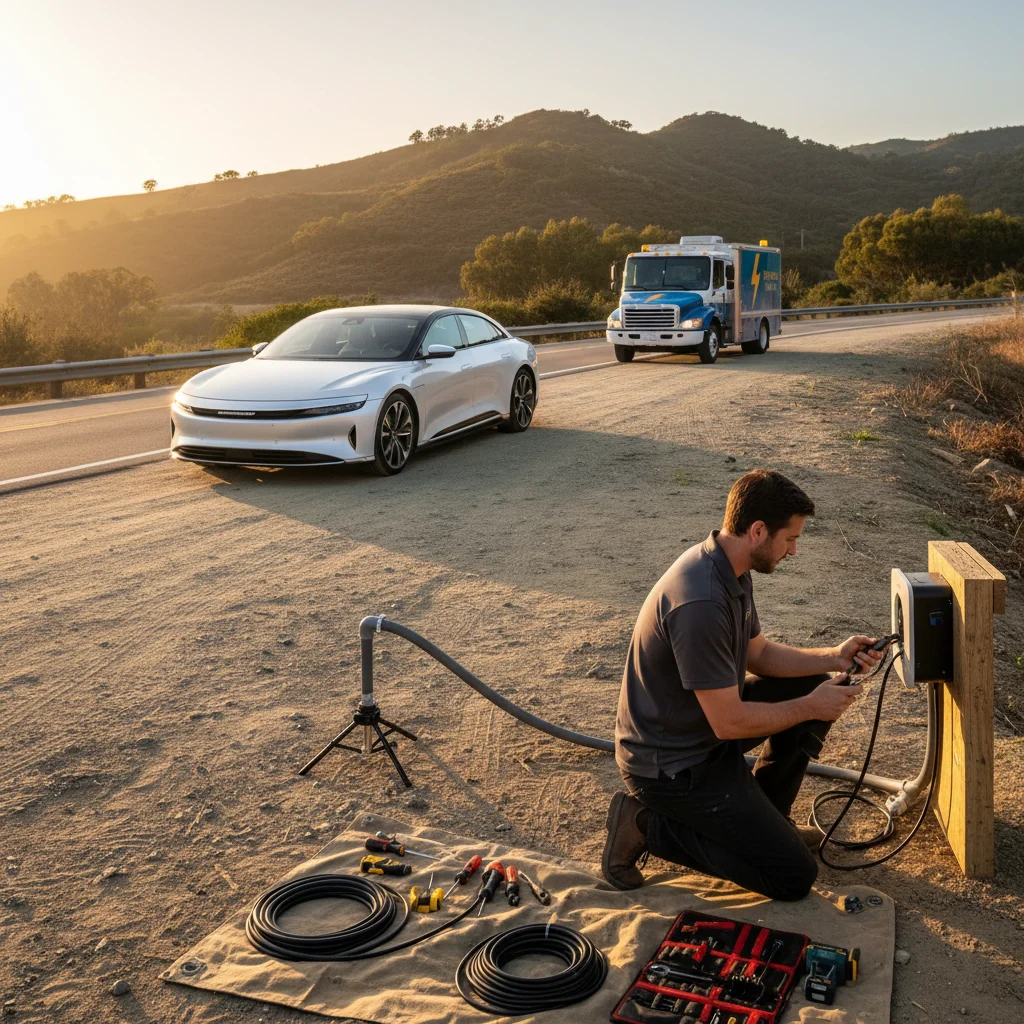
New streets, a modern panel, and a pack that still dies
Eastvale incorporated in 2010. It’s one of California’s newest cities. Almost the whole town sits on former dairy land. ACS 2019-2023 housing data puts pre-1980 stock at 2.2 percent. That’s the newest housing mix in this market, by a wide margin. Most homes have a garage and a panel that can take a Level 2 hookup.
That pattern is the inverse of older valley cities. Ontario’s older housing and warehouse lots create a different stall. Here, the call is rarely about a missing wall box. Families in Riverbend and along Hamner Avenue usually start the day with range. The stall happens later, on the way back from somewhere else.
Median household income here is the highest of any place in our Inland Empire research. That usually means a job outside the city. Many Eastvale drivers work in Orange County or Los Angeles County. They reach those jobs on the 15, the 91, or the 60. The garage charger never travels with them.
Southern California Edison serves Eastvale. An SCE time-of-use plan can shape overnight charging at the house. It still can’t add miles on a freeway shoulder. For a city-level map of local charging context, start with EV charging in Eastvale.
The city covers 12.68 square miles. 70,633 people live here, per ACS 2019-2023. ZIP codes that overlap the place include 91752, 92860, and 92880. They don’t describe a place where the house charger follows you onto the 15.
The 91752 trap, and why Riverside County still matters
Eastvale sits at the northwest corner of Riverside County. The main ZIP, 91752, uses a 917 prefix. That prefix sits in most people’s heads with Ontario and Chino. Neighbors in Chino and Ontario sit in San Bernardino County. Eastvale doesn’t.
If you give 91752 on the call, whoever hears it may picture the wrong county. You’re still in Riverside County. Name the city. Name the road. Hamner, Limonite, Archibald, and Schleisman all read as Eastvale. Cantu-Galleano Ranch Road does too. A local operator knows those names. The 917 prefix doesn’t.
Mira Loma is the older name some maps still show. City limits now cover that corner. Norco sits south. Jurupa Valley sits east. Corona sits farther south along the 15. A stall near the county line can confuse a GPS pin. Say Eastvale out loud.
The Santa Ana River and Prado Basin sit west of town. That edge is open, windy, and flat. It’s a landmark, not a climb. If you stalled on the west side, say Prado or the river. Don’t assume the operator knows which dairy-era grid you’re on.
I-15, the Express Lanes, and SR-60: heat, not hills
Eastvale is flat. There’s no terrain here to blame for range loss. Open former dairy land and Prado Basin winds leave summer heat unobstructed. Every mile you lose is heat, air conditioning, and freeway speed.
I-15 cuts through the city. The 15 Express Lanes run with it. This is the Corona-to-San Bernardino County commute spine. Stop-and-go on a hot afternoon burns a low pack. The dash at dawn often guessed high. A stall on the I-15 shoulder is a traffic problem first. It’s an energy problem second.
SR-60 sits to the north. Drivers heading toward the warehouse belt, or back from Los Angeles County, use it. Archibald and Hamner feed those ramps. Limonite Avenue is the east-west surface spine. None of these roads climb like a mountain grade. They still empty a pack that left Orange County with thin miles.
Stay in the car with hazards on. Don’t walk the freeway. Call for EV roadside assistance while you still have a safe place to sit. Tell the operator which direction you face. Tell them whether you’re in the Express Lanes or the general lanes. Those two aren’t the same stop.
A home charger can’t close that gap. The wall box is miles behind you. It’s on a new panel. That garage already did its job this morning.
Two EVs in one garage, and the 12V that sat for weeks
New Eastvale floor plans often hold two cars. One EV does the Orange County commute. The other sits. A 12-volt battery that sits for weeks can fail even when the traction pack is full. The dash stays dark. The doors may not wake. This looks like an empty pack. It often isn’t.
Operators who handle a Tesla 12V jump see this in big garages. The same pattern hits Rivian, Ford, Hyundai, Chevy, and other major EV brands. The 12V runs computers, contactors, and door latches. If that small battery is dead, the big pack can’t talk.
A home Level 2 charger can’t fix a dead 12V. The car won’t accept a charge until the low-voltage side wakes. If the car is silent in a Riverbend driveway, start with the 12V. Don’t hunt for a public stall first. Say “dark dash, won’t wake” on the call. That phrase changes the job from a pack fill to a 12V wake-up.
Weekend sitters fail too. A second car that waited through a heat wave can drop voltage overnight. You didn’t skip a plug-in. The small battery did the failing. The operator can jump or replace that 12V on site. Then you can use the house charger again, if the car is actually at home.
Eastvale Gateway, Roosevelt High, and the warehouse belt
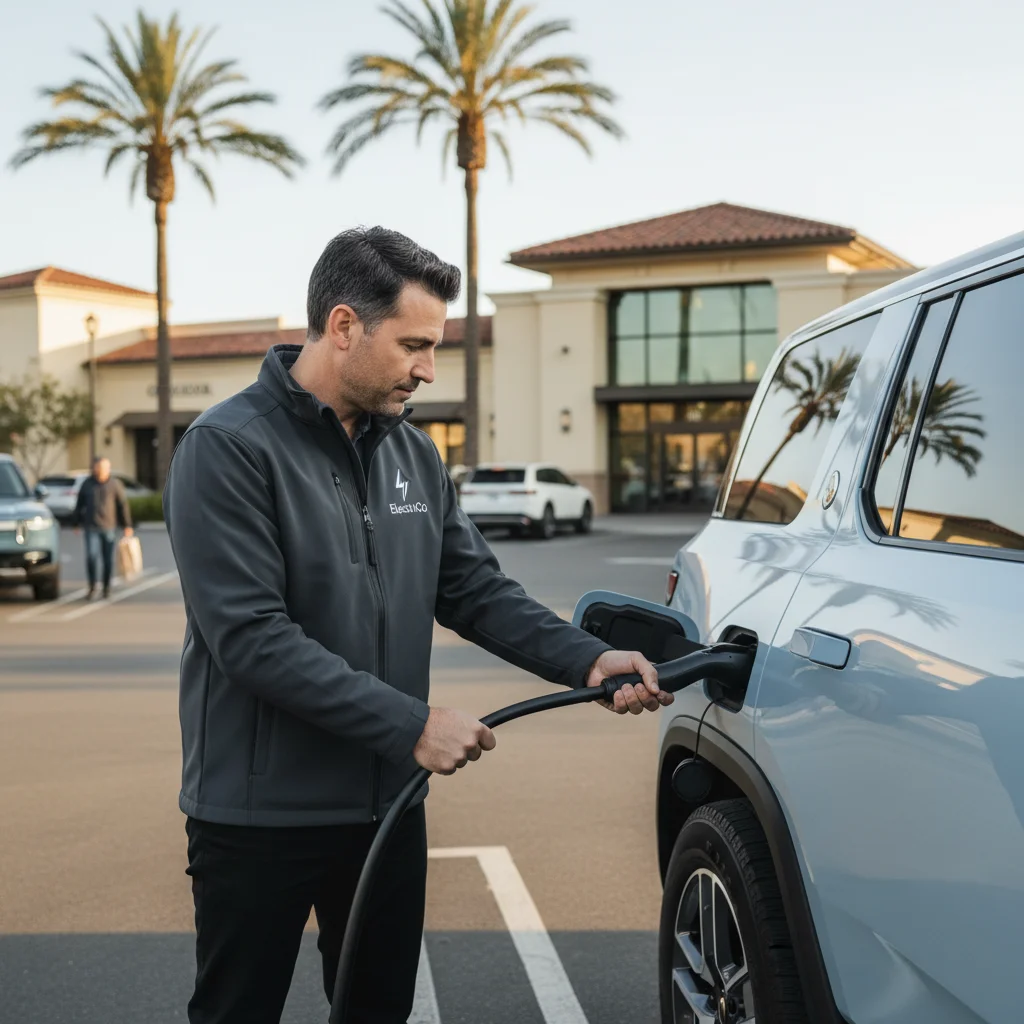
Eastvale Gateway is the shopping magnet off the 15. Weekend traffic stacks on Limonite and Hamner. A low pack in a busy lot is still a stranded car. The operator can charge it in the stall you already occupy. You don’t have to limp onto the freeway to keep moving.
The Roosevelt High area adds afternoon congestion on nearby streets. Climate control in a pickup line eats the last miles. Parents here aren’t climbing a grade. They’re sitting still in heat. These streets were built after 1990. The house charger can’t reach the curb.
Cantu-Galleano Ranch Road is the industrial belt. Warehouse shifts end with cars that sat all day in sun. A commuter EV can wake with less range than the driver remembered. That belt also sits close to Ontario’s logistics edge. If you stalled on a warehouse row, say Cantu-Galleano, not just “by the 15.”
Schleisman Road and Archibald Avenue cut the same new grid. They look residential. They still dump onto freeway ramps. A stall at those lights is a surface-street job, not a mountain rescue. For the new-build street version of this stall, mobile EV charging on Eastvale new streets covers who actually shows up.
What the operator brings to an Eastvale curb
Charge Pro IE is a referral line. It matches stranded drivers with independent local mobile rescue operators. It owns no trucks. It employs no technicians. It sets no prices. It publishes no arrival clock. The operator quotes you before work starts, then bills you directly.
What those operators do is specific. They bring a 240-volt Level 2 source to the car. Teslas use a native NACS plug. Other EVs use a CCS or J1772 adapter. A typical session adds about 10 to 20 miles of range in 15 to 30 minutes of charging. That’s charging time. It’s not an arrival time.
They also jump or replace a dead 12V on site. They handle Tesla and every major EV brand. For a plain description of the visit, read how a mobile EV charging rescue works.
If the traction pack is empty, mobile EV charging is the product you want. If the car is silent with a full or unknown pack, say so on the call. The operator will treat it as a 12V job first. Don’t assume the house charger can finish a car that won’t wake.
A mobile charge versus a tow on inland freeways
A dead EV on I-15 often gets a tow offer first. Many all-wheel-drive EVs can’t roll on a standard hook. A flatbed is the safe tow. Waiting for the right truck still leaves you on the shoulder.
A mobile charge leaves the car where it is. The operator adds enough range to get off the freeway. You can then finish the drive, or reach a charger you already planned to use. This page doesn’t guess a distance to any public stall. Those distances weren’t verified for Eastvale.
Tow versus charge depends on the failure. A dead 12V may only need a jump. A truly empty pack needs energy. A mechanical failure needs a shop. Towing a dead EV versus a mobile charge walks through that split.
Neighbors follow the same commute spine. Norco sits just south. Jurupa Valley sits east along the 60. Corona sits farther down the 15. An Eastvale stall is still an Eastvale stall. Give the city name even if the pin looks like Mira Loma.
When the house charger can’t help
Call if the pack is empty on I-15 or a surface street. Call if the car won’t wake in a Riverbend garage. Call if you’re on Limonite with single-digit miles and no safe way home. Charge Pro IE at (909) 250-2881 matches you with a local operator. The operator quotes before they start.