When your EV dies in Jurupa Valley, you need EV roadside assistance on site. You want a charge for the pack, or a jump for the 12V. Charge Pro IE is a referral line for that job. It matches stranded drivers with independent local mobile rescue operators. It doesn’t do the work, own a truck, or set a price. The operator quotes you before starting and bills you directly.
Warehouse miles and SR-60 traffic drain the pack
Jurupa Valley is the warehouse capital of Riverside County. The Mira Loma and Etiwanda Avenue corridor is packed with distribution centers. Truck traffic on Limonite Avenue and Etiwanda Avenue doesn’t really let up. Fleet EVs and personal cars both burn range in that grind.
A long yard shift is the usual story. You leave a dock or a trailer row with a thin buffer. Then you sit on SR-60 from the I-15 junction through Rubidoux. Cabin cooling stays on. The valley floor along the Santa Ana River runs hot. The miles you trusted at the gate often don’t survive that crawl home.
The Jurupa Mountains rise in the middle of the city. The drive isn’t one flat bowl. You climb, drop, then stack up again at Mission Boulevard or Van Buren Boulevard. That mix spends a pack faster than a quiet loop through Pedley.
This city is also a through-route. I-15 and SR-60 cross here. The northern end of the 15 Express Lanes sits at SR-60. Commuters headed to Glen Avon or Sunnyslope share those lanes with warehouse traffic. So do drivers on the Limonite Avenue corridor. A pack that looked fine in Ontario can be empty by Rubidoux Boulevard.
Shift change makes it worse. Gates stack. Yard tractors cut in. You idle in a line that wasn’t on the map app. Climate control keeps pulling. By the time you clear Etiwanda Avenue, the buffer is gone. SR-60 hasn’t even started.
Eastvale, Norco, and Riverside sit right beside this pattern. Bloomington, Fontana, and Ontario sit along the warehouse edge. Corona sits down the 15. Your pin might still say Mira Loma. The call is still a Jurupa Valley rescue.
Callers still say Rubidoux, not Jurupa Valley
The city incorporated in 2011. It’s one of the youngest cities in California. Before that it was unincorporated communities stitched into one map. Rubidoux, Mira Loma, Glen Avon, Pedley, Sunnyslope, and Belltown were the names people used.
They still are. Long-time residents say those names on the phone. Mail still uses them. If you only say Jurupa Valley, an operator has 42.94 square miles to guess at. Say you’re in Rubidoux. Say Pedley. Say Indian Hills or Crestmore Heights. Say the Limonite Avenue corridor if that’s where you are.
ZIPs that overlap the city include 91752, 92509, and 92860. Those codes also cross neighbors, so a ZIP is a clue, not a city limit. Pair it with a named road. Mission Boulevard, Van Buren Boulevard, Rubidoux Boulevard, Etiwanda Avenue, and Pedley Road are the ones locals actually give.
About 107,011 people lived here in the ACS 2019-2023 count. The 2024 estimate is 108,154. That’s a lot of drivers who still navigate by the old community names. The Jurupa Valley EV charging page is the local hub if you need the new city name on a map.
The Jurupa Valley Spectrum is another pin people use after errands. So are the Louis Robidoux Nature Center and the Jurupa Mountains Discovery Center. Mount Rubidoux sits nearby. The Santa Ana River corridor is a landmark too. Name the place if it helps someone find you.
What the operator brings, and what that visit isn’t
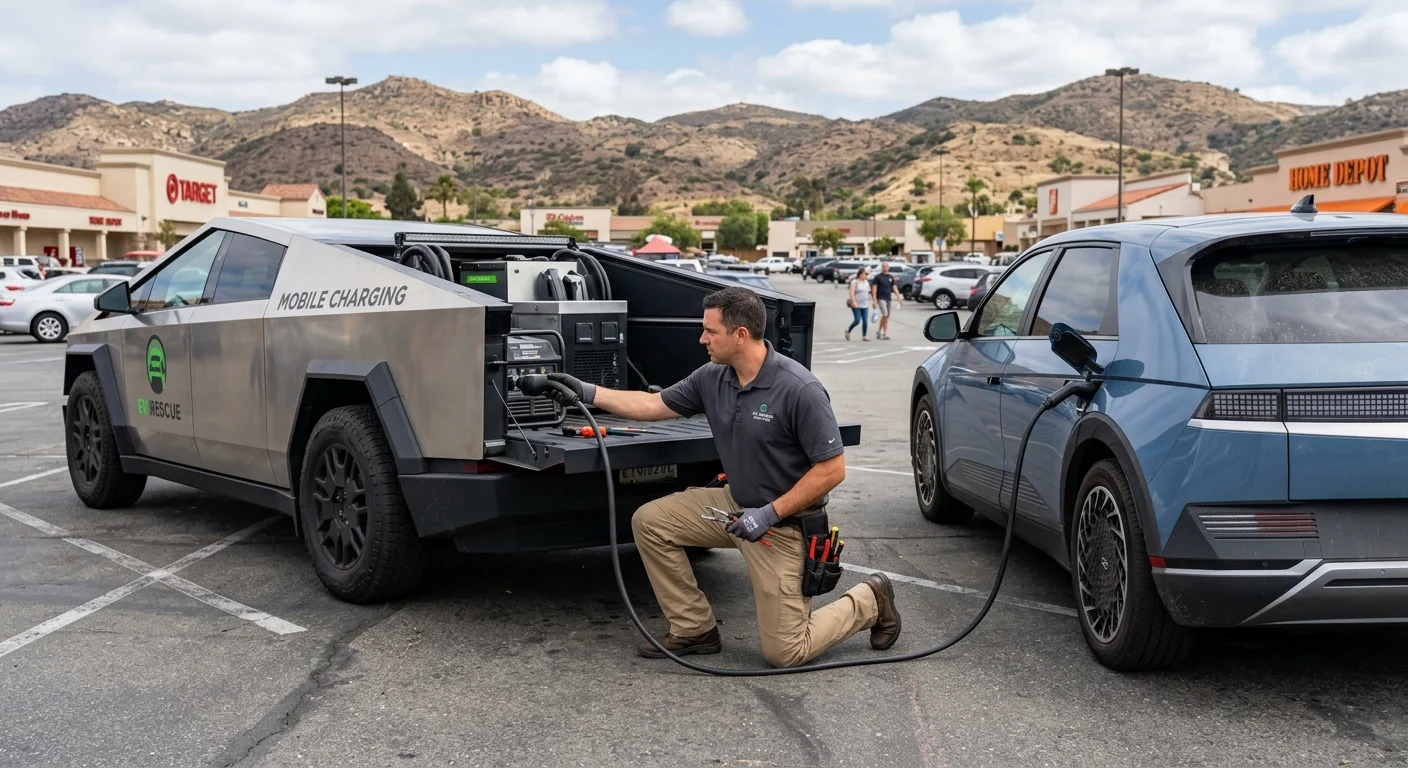
A mobile rescue for an empty pack is a 240-volt Level 2 hookup at the car. Tesla vehicles take a native NACS plug. Other EVs use a CCS or J1772 adapter. The operators in this network cover Tesla and every major EV brand.
They aren’t filling the battery to full. A typical stop adds about 10 to 20 miles of range in 15 to 30 minutes of charging. That’s charging time only. Charge Pro IE doesn’t promise an arrival window, publish hours, or send its own crew.
Have a few facts ready when you call. Tesla or not. The port you use if you know it. Whether the screens still work. Displayed percent or miles, if you have them. Whether you’re on pavement, dirt, or a private drive. The operator uses that to quote before anyone rolls.
The visit isn’t a repair shop. Crash damage is a tow. A failed pack is a dealer job. A car that won’t accept a cable may be too. The operator should tell you that on the quote call.
The sequence of the stop is in what a mobile EV charging visit actually is. The service page is mobile EV charging.
Dark dash versus a zero-mile display
An EV that won’t roll isn’t always out of charge. The high-voltage pack can still hold energy while the small 12-volt battery is dead. That 12-volt battery wakes the computers, closes contactors, and runs the locks. When it fails, the car can look completely dead.
Operators can jump or replace that 12-volt battery on site. That’s a common call on older streets where a car sat for days. ACS 2019-2023 puts 50.5 percent of Jurupa Valley housing as built before 1980. A lot of those homes never got a 240-volt circuit. Cars sit on a regular outlet, or they don’t plug in at all. Accessories drain the 12-volt. Monday morning is a silent dash.
If the screens still work and the car reports zero miles, you’ve got an empty traction pack. That’s out-of-charge recovery. If nothing wakes, describe a dead 12-volt first. A Level 2 cable can’t help a car that can’t close its contactors.
You can have both problems the same night. A 12-volt jump gets the car talking. Then the range number shows you were empty anyway. Tell the operator both symptoms. They’ll quote the work they can actually do.
Don’t keep turning the car on and off while you wait. Each wake cycle pulls from a weak 12-volt. Hazards are enough if you’re in a legal, visible spot. Save the remaining 12-volt for the operator.
Horse-property lanes, dirt shoulders, and pulling left on the 15
Warehouse aprons are the easy setup. Rural-residential and horse-property pockets aren’t. Unpaved shoulders and long driveways change where an operator can park and run cable. Say so up front if you’re on dirt, a private lane, or a narrow horse-property road. They’ll tell you if they can set up safely.
Freeway stalls have a different rule. The northern end of the 15 Express Lanes is here, at SR-60. If you’re in those median lanes, pull left. Don’t cut right across traffic for the outside shoulder. Hazards on. Stay with the car if that’s the safe choice. Give the operator your direction of travel and the nearest named exit or surface street.
SR-60 through Rubidoux and the river side is its own stranding corridor. More on that shoulder is in out of charge on SR-60 in Jurupa Valley.
I-15 through the west side has the same heat and grade mix as the 60. It also has the express-lane merge. If you can creep to Limonite Avenue or Mission Boulevard, do it. That’s a cleaner setup than a live lane. Only do that if you still have the miles and a legal path. Don’t enter an intersection on a dying pack.
Landmarks help when GPS is vague. Mount Rubidoux, the Jurupa Mountains, the Spectrum, and the river corridor are names anyone taking the call can work with. Pedley Road and Glen Avon still work too. The goal is a pin a local driver would recognize.
When a tow still makes more sense
If you’re only out of electrons, a mobile Level 2 stop is usually the simpler path. You don’t wait on a hook, a drop, and a second queue. You take a short charge and drive under your own power.
A tow is the better call when the car is damaged. It’s also better if the 12-volt won’t hold. Same if the operator can’t reach a legal, firm pad. Some horse-property drives won’t take a rescue rig. Some lots won’t let an outside vehicle set up. The operator should say that while they quote, not after they show.
Charge Pro IE doesn’t set prices for charges or tows. A published local price for either couldn’t be confirmed. Ask the operator for a quote, then compare it with a tow. Don’t assume one is cheaper.
Mobile EV charging or a tow walks that choice for Inland Empire roads.
SCE power at home, and why the commute still wins
Southern California Edison serves Jurupa Valley. If you charge at home, you’re on SCE. Cross the river into the City of Riverside and the utility changes. Riverside Public Utilities serves that city. Jurupa Valley stays on Edison.
SCE publishes a residential EV rate named TOU-D-PRIME. Look up the current figures on SCE’s own EV plan page. This page doesn’t reprint a rate that can change.
Older panels are common because so much of the housing predates 1980. A small service, a shared driveway, or a 120-volt outlet is a normal setup on those streets. That doesn’t strand you by itself. It does mean a warehouse day plus SR-60 can overtake whatever you added overnight.
Plan a buffer for heat and idle. Valley floor heat along the river is the daily tax. A loaded van that sat in a Mira Loma yard pays it twice. When the buffer is gone, call while the car can still creep to a legal curb. A live lane is a worse place to learn you’re empty.
Home charging is still the right daily habit. It just isn’t a rescue when you’re already stopped on Van Buren Boulevard. That’s when you want a Level 2 source brought to the car.
Who to call for EV roadside assistance in Jurupa Valley
Ask the first person you reach a plain question. Can they charge the pack on site, jump the 12-volt, or only tow. Automaker apps and national clubs sometimes send a gas-car truck. That truck can’t add range.
Charge Pro IE doesn’t hold a license and doesn’t perform licensed work. It’s a match. The independent operators it connects you with are licensed. They bring the Level 2 source, the adapters, and the 12-volt tools. They quote you first.
If you aren’t sure what you need, start at EV roadside assistance. Stay out of traffic if you can. Give the old community name, the nearest cross street, and whether the car is dark or just empty.
Charge Pro IE serves the Inland Empire, including every city in this county. Jurupa Valley is inside that area. So are the warehouse neighbors to the north and the river neighborhoods toward Riverside.
Call (909) 250-2881 when you’re ready. Charge Pro IE will connect you with a local operator. That operator quotes before starting and bills you directly.